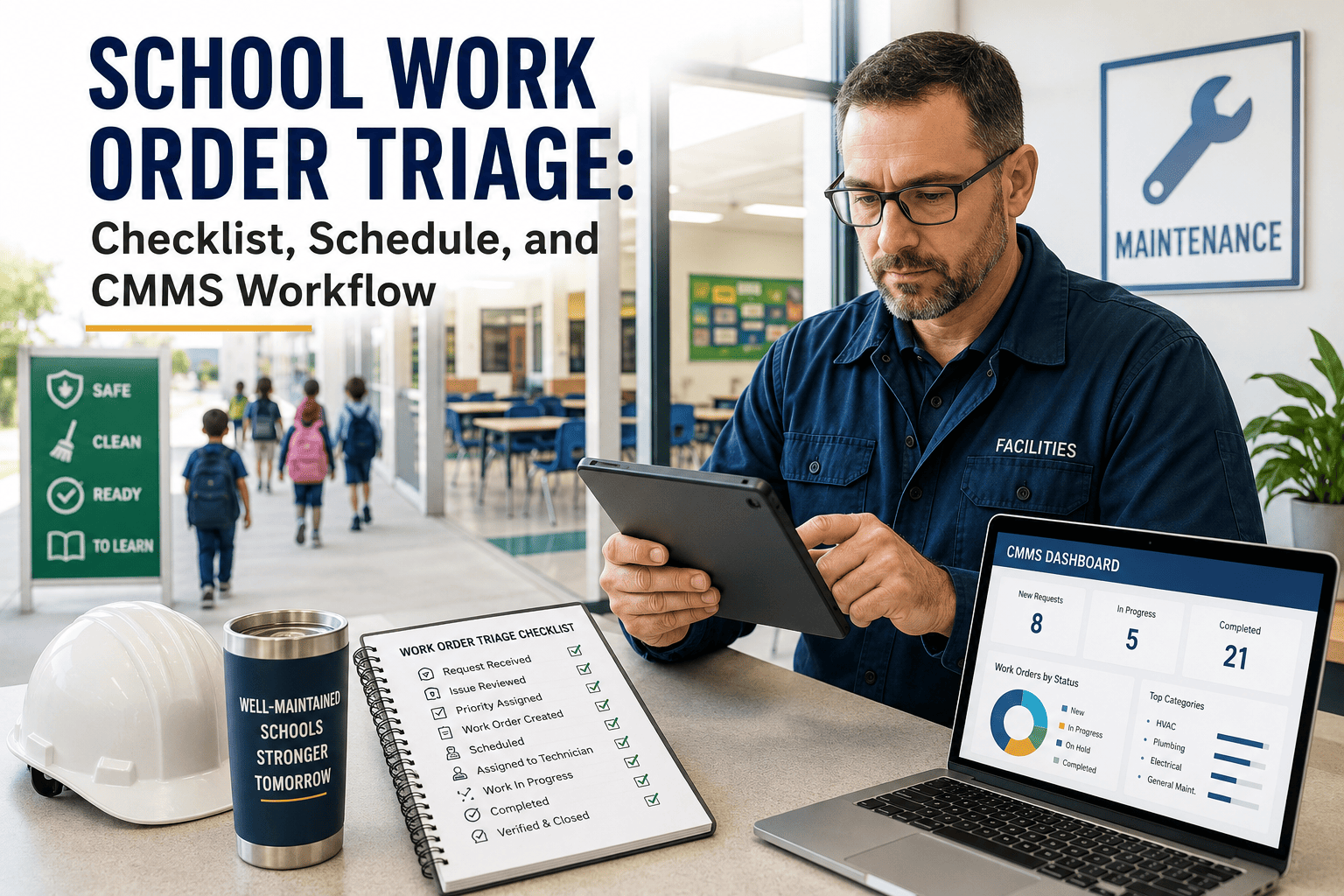
A school maintenance team that treats every work order as equally urgent will fail every category — emergency response will be slow, capital projects will starve, and the principal whose toilet is overflowing will be on the phone with the superintendent before the custodian even knows about it. Most districts run on email and paper request slips, where the broken AC in the library competes against the broken AC in the special-education classroom because no one has a documented priority scheme to separate them. Federal civil-rights law makes the priority obvious — ADA-affecting maintenance is a 4-hour SLA, full stop — but the rest of the queue needs a defensible classification too: a 4-tier priority system, SLA targets per tier, custodial-first dispatch for low-impact tasks, and geographic clustering that saves 12 to 18 hours of travel time per technician per week. This page gives you the triage matrix, the per-tier checklist, the escalation flow when SLAs slip, and the CMMS workflow that turns chaotic inboxes into a queue that runs itself. Set up your triage program in OxMaint or book a demo to see how districts route hundreds of requests per week without missing the ones that matter.
Inspection Management
School Work Order Triage: Checklist, Schedule, and CMMS Workflow
Four priority tiers, clear SLAs, AI-assisted classification, and a routing flow that puts the right technician at the right building — before the principal sends the second email.
4-Tier
priority classification
4hr
ADA accessibility SLA
12-18
hours/week saved by clustering
$120B
US deferred maintenance backlog
What This Guide Covers
Before You Begin
Title II of the ADA applies to all public school facilities — any maintenance issue affecting accessibility (ramps, lifts, accessible toilets, automatic doors, audible/visual alarms) carries a 4-hour response SLA regardless of other queue priorities. Items marked Trade require a licensed contractor. Items marked ADA bypass standard triage and route to emergency response, even if reported as low priority.
01
No Priority Classification on Intake
Requests arrive by email, phone, hallway conversation, and paper slip — none classified. The dispatcher reads each one and guesses urgency from tone. Polite requesters wait while loud ones jump the queue, regardless of actual impact.
02
Custodians Treated as Last Resort
A broken paper towel dispenser doesn't need an HVAC technician driving 40 minutes. Districts that route every request through skilled trades waste 60% of trade hours on tasks a building custodian could close in 5 minutes.
03
No Geographic Clustering
A technician driving from School A to School C to School B and back to School A burns half a day in travel. Routing without geographic clustering costs the typical district 12–18 hours of productive technician time per week.
04
No SLA Tracking or Escalation
When a request stalls, no one knows until the principal escalates. Without auto-escalation when SLAs are breached, work orders age silently and the deferred maintenance backlog grows in the dark.
EmergencyLife Safety, Security, and Operational Shutdown
UrgentSingle-Room Impact, Programmatic Disruption
AI-Assisted Triage From Every Request
OxMaint receives requests by mobile, QR code, web form, or email and auto-classifies into the right tier using equipment, location, and reported symptoms. ADA-affecting requests promote automatically. Geographic clustering bundles requests for the same building or zone before dispatch. The dispatcher reviews, not redoes — saving hours per day.
StandardCosmetic, Convenience, Custodial-First
ScheduledCapital Projects, PM, and Bond Items
1
Auto-Notification at 75% of SLA
When a work order reaches 75% of its tier SLA without resolution, the assigned technician and dispatcher receive an automatic alert. The system asks for a status update — work in progress, parts on order, or blocker identified.
2
Site Manager Notification at SLA Breach
If the SLA is crossed without resolution, the building site manager (principal or designee) is notified with current status, blocker, and updated target date. Site manager confirms communication to the original requester.
3
Facilities Director Escalation at 2× SLA
Work orders open beyond twice their tier SLA escalate to the facilities director with full history. Root cause is assigned: parts lead time, technician availability, scope creep, or budget. Resolution path is set with named owner.
4
Backlog Review and Pattern Analysis
Monthly backlog review by the facilities director with site managers. Repeat-issue rooms identified, recurring failure modes flagged for PM program update, and chronic backlog items moved into the next capital plan.
Mobile Intake
Requests submit by mobile app, QR code on the wall, web form, or email. The submitter selects building, room, equipment, and symptom; AI suggests the priority tier from the description; the dispatcher reviews and confirms.
Auto-Classification
The system classifies each request into one of four tiers using equipment type, reported symptoms, building zone, and ADA flags. Ambiguous requests flag for dispatcher review; no request stays unclassified for more than 15 minutes.
Custodial-First Routing
Low-impact tasks (dispensers, light bulbs, furniture tightening) route to the building custodian by default. Skilled trades are dispatched only when the task scope or safety profile exceeds custodial capability — saving 60% of trade hours.
Geographic Clustering
Open work orders are bundled by school, building, and zone before technician dispatch. The system optimises routes across the district; technicians complete 3–5 work orders per stop instead of one — reclaiming 12–18 hours per week per technician.
SLA Tracking
Every tier has its own SLA timer running from intake to resolution. Breaches trigger auto-escalation at 75%, 100%, and 200% thresholds. The facilities director dashboard shows real-time compliance by tier, building, and trade.
Backlog Visibility
The deferred maintenance backlog is no longer invisible. Open work orders, their age, and their tier are visible by building and across the district — feeding into bond planning, budget requests, and superintendent-level reporting.
Four tiers is the right balance — Emergency (0–4 hours), Urgent (24 hours), Standard (5 working days), and Scheduled (capital/PM). Three tiers collapse Emergency and Urgent together and lose the ADA 4-hour SLA. Five or more tiers create classification disputes without operational benefit. Run the 4-tier scheme in OxMaint with auto-classification.
Any maintenance issue affecting accessibility — ramps, lifts, accessible toilets, automatic doors, visual or audible alarms, accessible parking — must be treated as Emergency tier with a 4-hour response window, regardless of how the request was originally categorised. Title II of the ADA applies to all public school facilities; failure to maintain accessibility is a civil rights matter, not a maintenance preference.
For districts with more than 5 buildings, clustering open work orders by location before dispatch typically saves 12–18 hours of technician travel time per week per trade. That is the equivalent of adding a third of a full-time technician to the team without hiring — and the saved hours go directly to closing more requests.
Yes. Requests across every school flow into one queue, with auto-classification, custodial-first routing, geographic clustering, and tier-based SLA tracking. Principals see their own building's queue; the facilities director sees district-wide status; superintendents see backlog trend. Book a demo to see district-wide triage live.
Auto-classification from the system, not the requester, sets the tier. Submitters describe the issue; the system classifies based on equipment, symptoms, and ADA flags. This removes the requester from the priority decision and removes the principal from intermediating tier disputes. The data — not the loudest email — drives the queue.
OxMaint CMMS — Work Order Triage
Right Request, Right Tier, Right Technician — Every Time
Four-tier triage, AI-assisted classification, ADA auto-promotion, custodial-first routing, geographic clustering, and SLA-based escalation — built for school districts handling hundreds of requests across many buildings per week.
Mobile, QR, web, and email intake with AI tier classification
ADA accessibility auto-promotion to Emergency tier
Custodial-first routing saves 60% of skilled trade hours
Geographic clustering reclaims 12–18 hours per technician per week