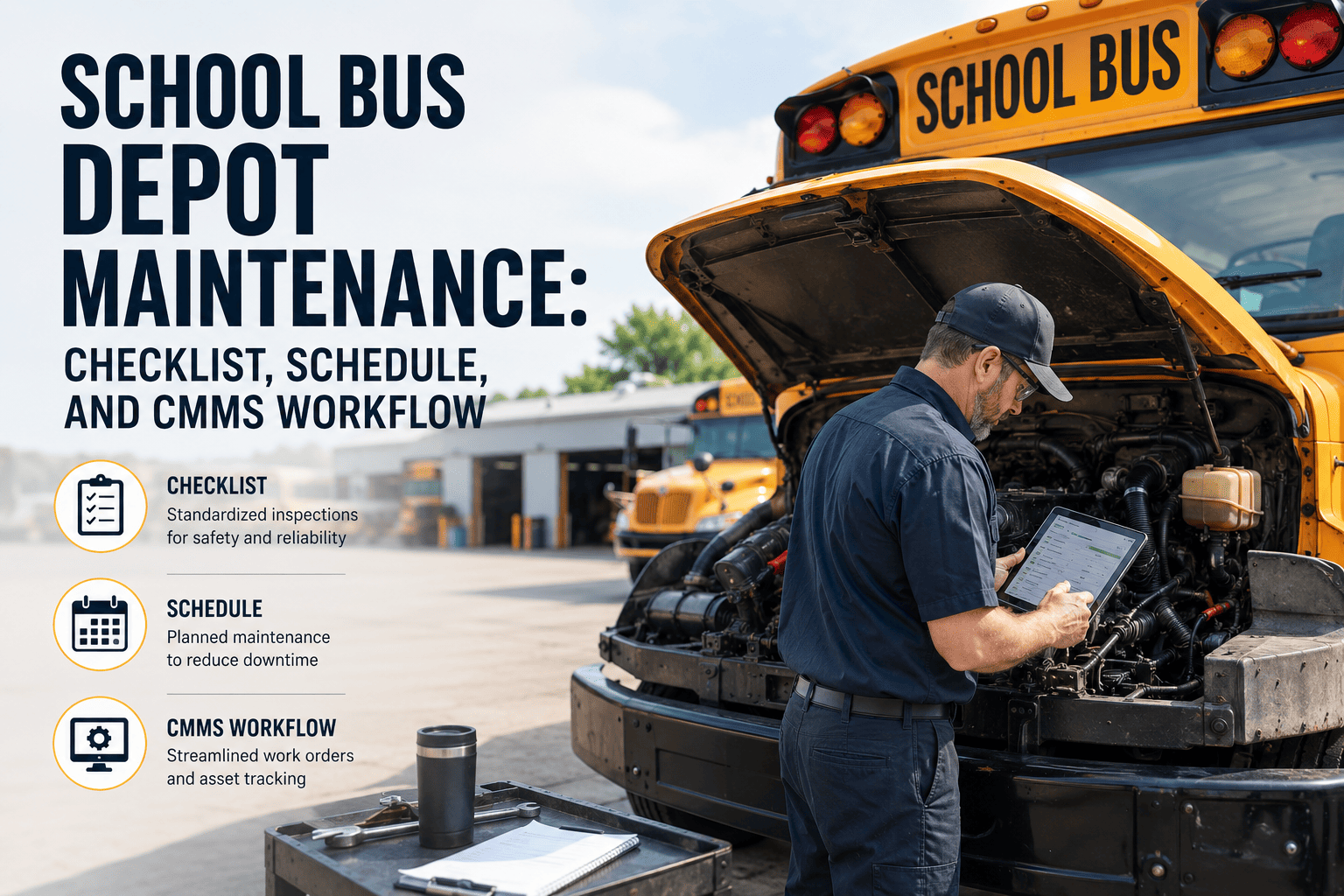
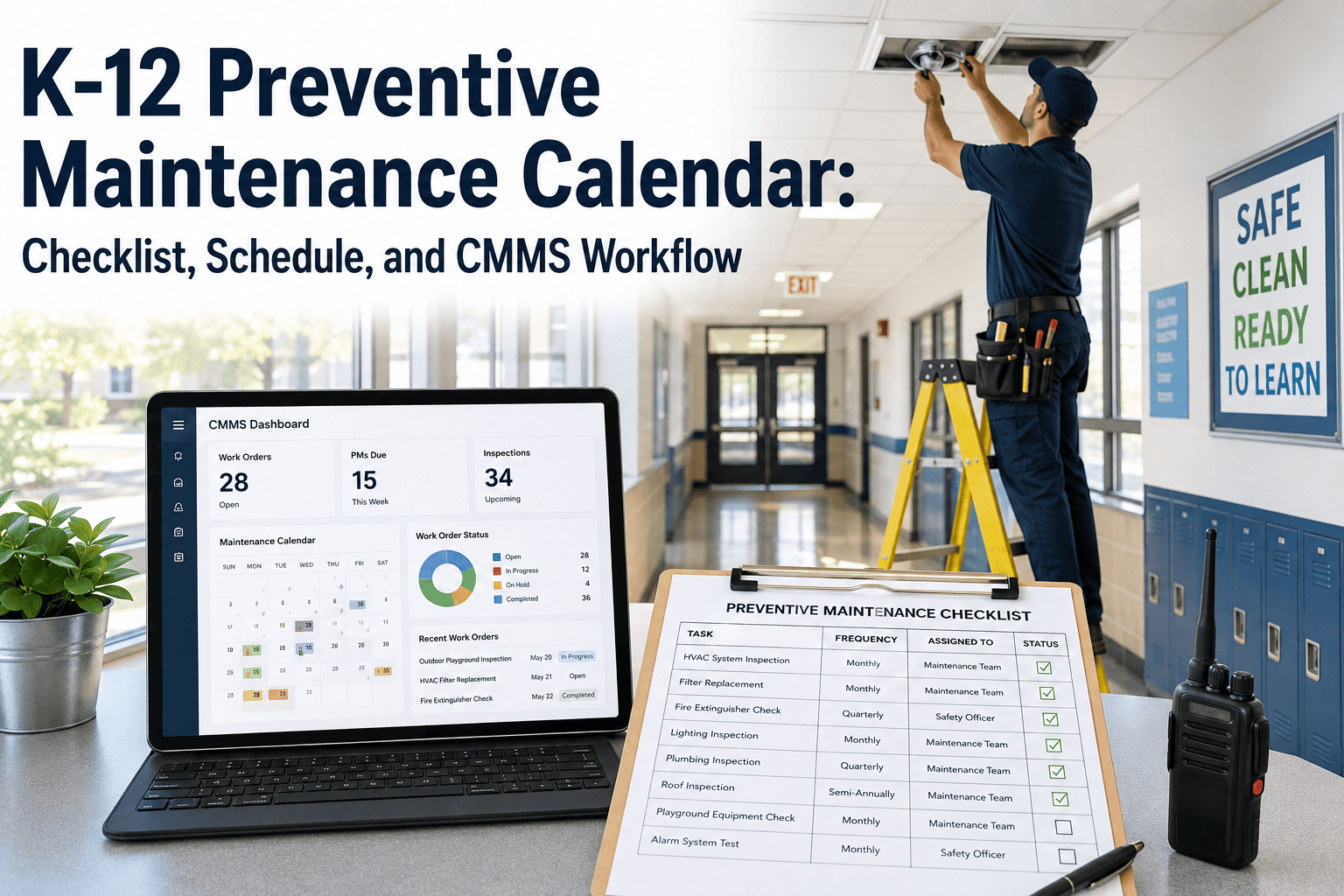
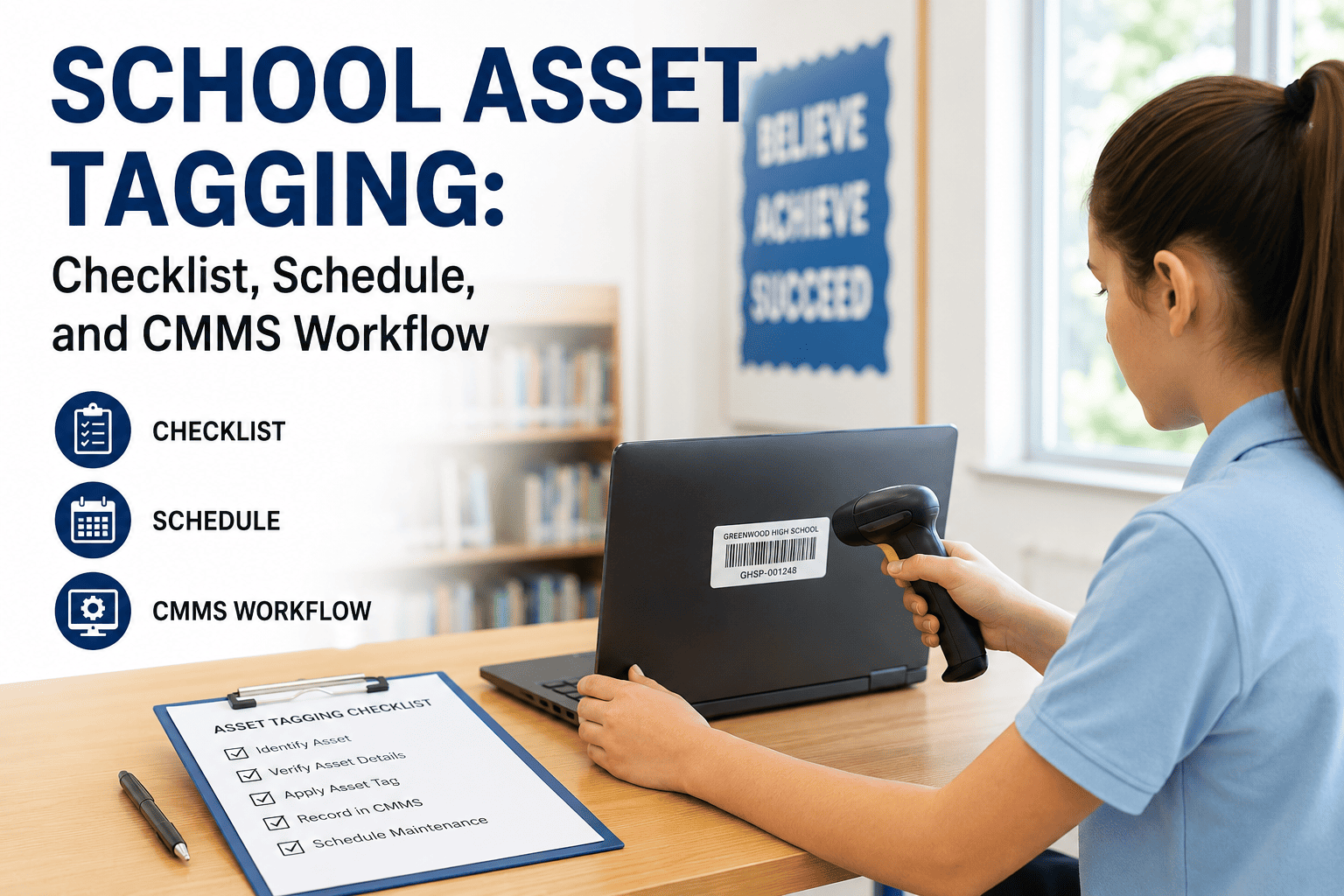
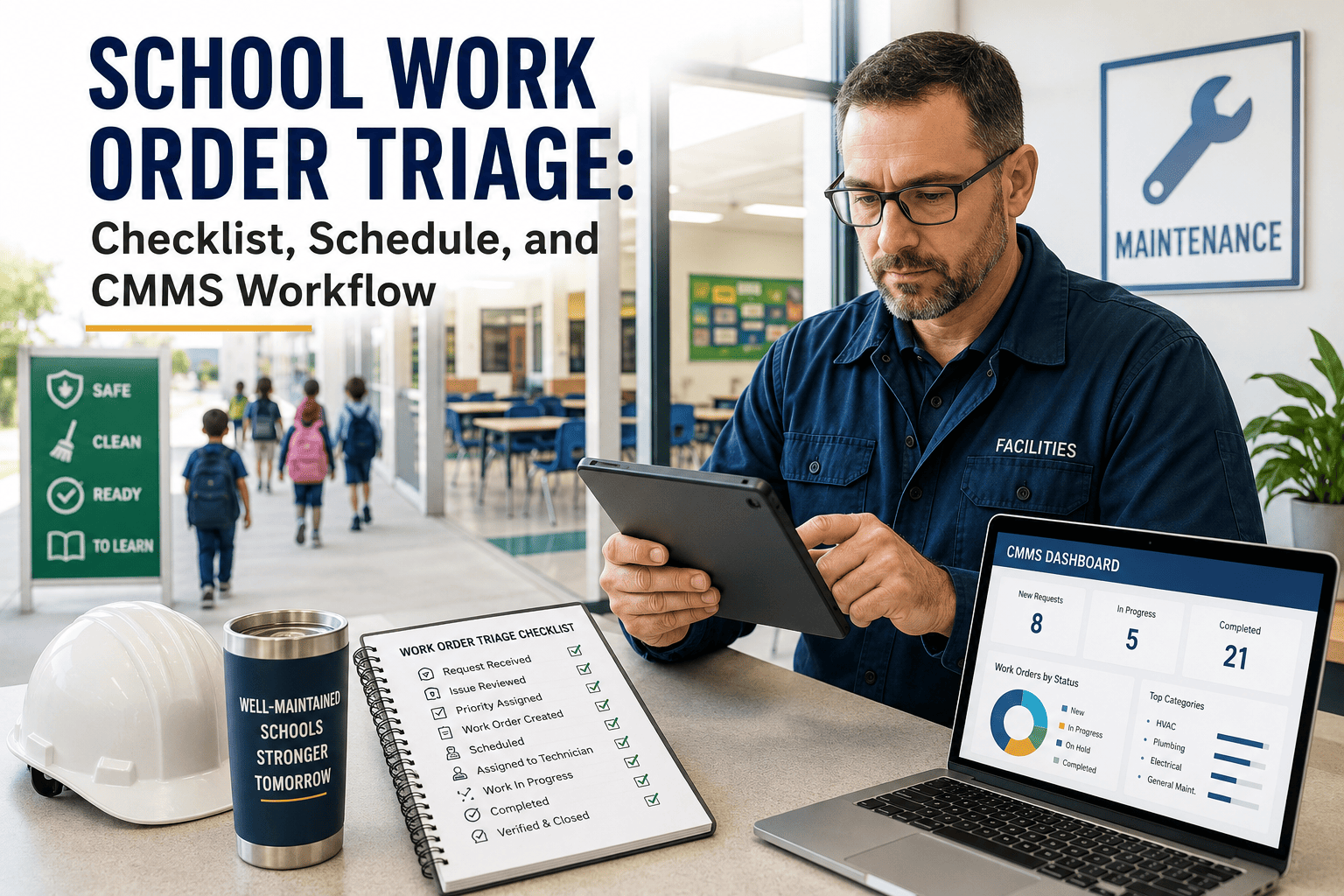
A school bus depot running without a structured preventive maintenance program is one missed brake inspection or one skipped coolant flush away from a roadside breakdown carrying 40 students. Transportation directors managing fleets of 20 to 200 buses — along with the fuel stations, wash bays, tire storage, and diesel emissions equipment inside the depot — need every maintenance task assigned, scheduled, and signed off before the next vehicle pulls out of the gate. State DOT auditors and school board insurance carriers treat unlogged vehicle inspections as uninspected vehicles, not paperwork gaps. This page gives your district transportation and fleet maintenance team a complete depot maintenance checklist, scheduling framework, and CMMS workflow covering vehicle PM, facility systems, fuel infrastructure, and safety compliance. Use OxMaint to manage every bus and every facility asset from one mobile platform with audit-ready records on demand.
Transportation Facilities · Fleet Maintenance · CMMS
School Bus Depot Maintenance: Checklist, Schedule & CMMS Workflow
A complete preventive maintenance framework for school district bus depots — covering vehicle PM, facility systems, fuel infrastructure, wash bays, and DOT compliance documentation with CMMS-tracked scheduling built for transportation directors and state auditors.
6
Maintenance Areas
45+
Checklist Items
DOT
Compliance Ready
CMMS
Workflow Ready
Risk Overview
What Breaks Down When Depot Maintenance Breaks Down
01
Student Safety Events
Brake fade, tire blowouts, and steering failures — the three leading causes of school bus safety incidents — are all preventable through scheduled inspections. A missed quarterly brake inspection is the most common finding in post-incident DOT investigations.
02
DOT Audit Failures
State DOT auditors arriving at a depot without complete vehicle PM records can place buses out of service immediately — a district that loses 20% of its fleet to a single audit faces route cancellations and parent escalations within hours.
03
Fuel System Liability
Underground storage tank leaks at depot fuel stations generate EPA Superfund liability that can exceed the entire district's annual capital budget. EPA requires documented monthly release detection and annual tank integrity testing with no gaps.
04
Unplanned Fleet Downtime
A single engine failure that sidelines a bus during the morning run costs the district a substitute vehicle, driver overtime, and parent complaints. Districts with PM completion rates above 95% experience 60% fewer unplanned breakdowns than reactive-only fleets.
Schedule Key
DDaily
MMonthly
QQuarterly
AAnnual
State DOT regulations require school buses to undergo pre-trip driver inspections daily and a comprehensive mechanical inspection by a certified mechanic at intervals defined by mileage or calendar — typically every 90 days or 5,000 miles, whichever comes first. A CMMS that tracks each bus by VIN, mileage, and last inspection date eliminates the manual calendar-watching that causes inspection due dates to slip during driver shortages and holiday schedule changes.
Pre-trip safety inspection completed by driver — brakes, tires, lights, horn, mirrors, emergency exits, and fire extinguisher checked before every revenue route; any defect identified on a pre-trip inspection must be logged as a work order before the bus is returned to service
DBus Driver · Pre-trip inspection form with bus number and driver signature
Brake system inspection by certified mechanic — brake pad thickness measured and recorded, brake drum or rotor condition documented, brake fluid level and condition checked; any bus with brake pad thickness below the state DOT minimum is placed out of service immediately pending repair
QASE-Certified Mechanic · Brake inspection record with measurements
Engine oil, coolant, transmission fluid, and power steering fluid levels checked and topped off — oil analysis performed annually to detect internal engine wear before catastrophic failure; coolant pH tested and glycol concentration verified for freeze protection at the region's minimum design temperature
MFleet Mechanic · Fluid level and condition log with bus VIN
Tire condition and inflation pressure inspected on all axles — tread depth measured with gauge, sidewall condition checked for cracking or bulging, inflation pressure compared to manufacturer specification; a tire operating 20% below specification has 4x the blowout risk of a properly inflated tire at highway speed
MFleet Mechanic · Tire inspection log with axle position and measurements
Emergency exit doors, roof hatches, and window emergency releases tested for proper operation — each exit opened and closed from both interior and exterior; any emergency exit that requires more than 60 pounds of force to open is a deficiency requiring immediate adjustment before the bus returns to student service
QASE-Certified Mechanic · Emergency exit function test log
School district fuel stations with underground storage tanks are regulated under EPA 40 CFR Part 280 and equivalent state UST regulations. A single documentation gap in monthly release detection records can trigger an EPA compliance order and six-figure corrective action costs. The UST compliance program is typically the highest-consequence maintenance documentation area in any school district and cannot be managed on paper without significant risk of record loss.
Automatic tank gauge (ATG) system tested and inventory reconciliation completed — daily ATG readings compared against fuel dispensed; any unexplained inventory loss exceeding 130 gallons in a 30-day period triggers a suspected release investigation under EPA regulations regardless of system alarm status
MUST Compliance Coordinator · ATG inventory reconciliation log
Spill buckets and overfill prevention devices inspected — spill bucket water and debris removed, bucket integrity confirmed with no cracks or failed seals; overfill valve function verified; a fuel spill at the fill port that reaches the storm drain system can trigger a state environmental agency notification requirement within 24 hours
QUST Operator · Spill prevention inspection log
Dispenser hose, nozzle, and breakaway coupling condition inspected — hoses checked for cracking, swelling, or abrasion damage; nozzle auto-shutoff function tested; breakaway coupling confirmed to meet flow specification; a failed breakaway coupling on a drive-off event can pull a dispenser head and release 50+ gallons of diesel before the emergency shut-off is reached
QFuel System Technician · Dispenser equipment log
DOT Audit Ready — Every Day
Transportation directors using OxMaint never scramble to reconstruct vehicle PM records before a state audit. Every inspection is timestamped, mechanic-signed, and searchable by bus VIN, inspection type, or date range — available in 30 seconds, not 3 hours.
A bus wash bay that discharges untreated wastewater containing diesel fuel, antifreeze, and road salt into the municipal storm sewer system is an NPDES permit violation. Most school districts operating depot wash facilities are required to maintain an oil-water separator with documented cleaning intervals and discharge monitoring. A neglected separator can cause a permit exceedance that results in a consent order and system upgrade costs that dwarf the cost of a proper PM program.
Oil-water separator inspected and pumped out — separator inlet and outlet conditions documented, accumulated oil layer thickness measured; separator must be pumped out when oil accumulation exceeds 25% of water capacity or per the manufacturer's inspection interval, whichever is sooner
QEnvironmental Contractor · OWS service record with manifest
Wash bay drain and trench condition inspected — trench covers checked for integrity and proper seating, floor drain strainers cleared of debris, drain slope confirmed to direct all wash water to the separator; a clogged floor drain that causes wash water to bypass the separator is a permit violation event
MFacilities Technician · Wash bay drain inspection log
Wash equipment pump, brush drive, and chemical dispensing system inspected — pump pressure output measured against specification; brush wear documented; chemical concentration at the nozzle verified; a wash system operating below design pressure produces inadequate cleaning results and increases per-bus wash time and water consumption
QWash Equipment Technician · Equipment performance log
A two-post or four-post vehicle lift that has not had its safety locking mechanism and hydraulic system inspected annually is a catastrophic liability in a school district mechanic shop. OSHA 1910 Subpart J governs vehicle lift safety in general industry, and most states have parallel requirements for public employer shops. A lift failure while a mechanic is working under a fully loaded school bus is the highest-severity injury scenario in any transportation facility maintenance program.
Vehicle lift hydraulic system and safety lock mechanism inspected by certified lift inspector — hydraulic cylinder seals checked for weeping, safety latch engagement tested at multiple height positions, load capacity placard verified legible; any lift with a failed safety latch is placed out of service until repaired by the manufacturer's authorized service technician
AALI-Certified Lift Inspector · Lift inspection certificate
Torque wrenches and brake measurement tools calibrated against NIST-traceable standards — calibration stickers current on all measurement tools used for safety-critical fastener torque; any torque wrench used to tighten wheel lug nuts must have a current calibration record or it cannot be used for wheel installation on student transport vehicles
ACalibration Technician · Tool calibration log with serial numbers
Shop exhaust extraction system inspected and flow tested — flexible exhaust hose connectors checked for cracks and secure attachment, blower motor current draw measured, carbon monoxide detector in shop verified functional; CO buildup in an enclosed bus repair shop from a running diesel engine without extraction can reach dangerous levels within 8 minutes
QFacilities Technician · Exhaust system flow log
The depot building itself — office areas, driver lounge, parts storage, and the maintenance shop — requires the same structured facility maintenance attention as any other school district building. Facility failures in the depot affect mechanic productivity, parts inventory integrity, and winter bus readiness. An unheated parts room during a cold snap can freeze antifreeze concentrate and render a significant portion of fleet inventory unusable.
Shop and parts room heating system inspected before winter season — unit heater gas valves and burner condition checked, thermostat setpoint verified, combustion air supply unobstructed; a failed unit heater in a parts room during a cold weather event can cause fluid product damage exceeding the cost of a full heating system replacement
AHVAC Technician · Pre-winter heating inspection record
Emergency lighting and exit signs in shop, parts room, and office areas tested monthly — each unit activated and confirmed for 90-second minimum illumination; emergency lighting in a shop area where mechanics work around raised vehicles is a critical life safety system that must be functional at all times
MFacilities Staff · Emergency light test log
Compressed air system drains, filters, and pressure relief valve inspected — air receiver drain valve opened to purge condensate, filter element condition checked, PRV test-lifted and confirmed to discharge; water accumulation in a compressed air system contaminates pneumatic tool lubricant and causes brake air line corrosion on buses being serviced
MFacilities Technician · Compressed air system log
A bus fleet that cannot complete a brake job because the parts room is out of the correct pad set experiences unnecessary down time that disrupts routes and triggers parent complaints. A minimum viable spare parts inventory — sized to the fleet composition and tracked in the CMMS — ensures that scheduled PM tasks are never delayed by parts availability. NHTSA recall compliance tracking is a separate but equally important documentation requirement for any fleet operating school buses manufactured after 2000.
Critical spare parts inventory audited against minimum stock levels — brake pads, belts, filters, fuses, and bulbs for each bus make and model in the fleet counted and compared against the fleet-specific minimum inventory list; any item below minimum stock level generates a purchase requisition before the parts room count is closed
MParts Manager · Inventory count log by part number
NHTSA safety recall status checked for all vehicles in fleet — each bus VIN verified against the NHTSA recall database quarterly; any open recall affecting brakes, fuel systems, or emergency exits is treated as an out-of-service condition until the recall remedy is applied and documented with the remedy completion date and technician ID
QFleet Manager · Recall compliance log with VIN and remedy date
Vehicle maintenance history files reviewed for completeness — each bus VIN record confirmed to include current registration, insurance certificate, last DOT inspection date, and open work orders; any bus with an expired registration or inspection is pulled from service before the next morning run regardless of operational impact
QFleet Manager · Vehicle compliance file audit log
CMMS Workflow
How OxMaint Manages Your Entire Depot — Fleet and Facility Together
1
Register Every Asset by VIN or Asset ID
Each bus, lift, UST, wash system, and facility asset gets its own record with make, model, install date, and maintenance history. OxMaint links every work order to a specific asset — so you always know each bus's complete service history.
2
Schedule PM by Mileage or Calendar
Set up recurring tasks triggered by odometer reading or calendar interval. OxMaint alerts mechanics when a bus approaches its next PM mileage — no more relying on a spreadsheet or whiteboard to track 80 individual vehicles simultaneously.
3
Mobile Inspections with Photo Evidence
Mechanics complete inspection checklists on their phone, attach photos of brake measurements and tire tread gauges, and submit with a digital signature. Every record is timestamped and tamper-proof for DOT audit purposes.
4
Auto-Generate Corrective Work Orders
A deficiency flagged during a pre-trip or quarterly inspection automatically creates a corrective work order assigned to the right mechanic with the correct priority level. Nothing falls through the cracks between a driver's report and a mechanic's action.
5
Pull DOT-Ready Reports in Seconds
Generate a complete service history for any bus by VIN, sorted by date and inspection type, formatted for state DOT audit review. No more pulling paper folders the night before an audit visit.
6
Track Fleet Health on a Live Dashboard
See PM completion rate, buses overdue for service, open safety deficiencies, and parts consumption trends on one screen. Transportation directors use OxMaint dashboards to brief school boards on fleet condition with data, not anecdotes.
Fleet KPIs
Six Metrics That Prove Your Depot Maintenance Program Is Working
| Metric |
How to Measure |
Target |
Frequency |
| PM Completion Rate |
PM tasks completed on schedule / Total scheduled PM tasks |
95%+ |
Monthly |
| Roadside Breakdown Rate |
Roadside incidents / Total route days operated |
Below 0.5% |
Monthly |
| Fleet Availability Rate |
Buses available for service / Total fleet size |
92%+ |
Daily |
| DOT Inspection Pass Rate |
Buses passing DOT inspection / Total buses inspected |
100% |
Per Inspection |
| Open Safety Deficiency Age |
Average days from deficiency discovery to closure |
Below 3 days |
Weekly |
| Recall Compliance Rate |
VINs with no open safety recalls / Total fleet VINs |
100% |
Quarterly |
FAQs
Frequently Asked Questions
How often must school buses be inspected under state DOT regulations?
Most states require a comprehensive mechanical inspection by a certified mechanic every 90 days or 5,000 miles, whichever comes first, in addition to a daily pre-trip inspection by the driver before each revenue route. Some states — including New York, California, and Texas — have additional inspection interval requirements for buses over a certain age or mileage threshold. Your state DOT website publishes the exact current requirements for your jurisdiction.
OxMaint tracks inspection due dates by mileage and calendar so nothing slips.
What records does a state DOT auditor expect to see at a school bus depot?
State DOT auditors typically request the last 12 months of vehicle PM records for a random sample of buses, all pre-trip inspection forms for the current quarter, brake inspection records with measured pad thickness, and documentation of any out-of-service events and their resolution. Records must identify the inspecting mechanic, the date, the bus VIN, findings, and corrective actions.
Book a demo to see how OxMaint formats these records for immediate audit presentation.
Can a school district use a CMMS to manage both fleet vehicles and depot facility assets?
Yes — and this is the strongest argument for a CMMS over separate vehicle management and facility management systems. A single platform that manages bus PM schedules, lift inspection records, UST compliance logs, and wash bay equipment maintenance eliminates the documentation gaps that appear when fleet and facility records are kept in separate systems by separate teams. OxMaint supports both asset types on the same platform with the same mobile workflow.
What is the EPA requirement for underground storage tank inspection at a school bus depot?
EPA 40 CFR Part 280 requires monthly release detection (typically through ATG inventory reconciliation), annual line tightness testing, and periodic tank integrity testing on a schedule determined by the tank's age and construction type. All records must be retained for at least three years and made available to the implementing state agency on request. Many states have stricter requirements than the federal baseline.
How do you reduce unplanned bus breakdowns without adding mechanics?
The most effective strategy is shifting from reactive to scheduled maintenance using a CMMS — studies consistently show that districts completing 90%+ of scheduled PM tasks experience 50–65% fewer unplanned breakdowns than comparable fleets on reactive programs. The key is ensuring no PM task slips through the cracks due to scheduling confusion, which is exactly what a mobile CMMS with automatic due-date alerts solves.
Start a free trial to see how OxMaint reduces your emergency work order volume within the first 60 days.
Built for School District Transportation Teams
Every Bus Inspected. Every Record Signed. Every DOT Audit Ready.
OxMaint gives your transportation department a live, mobile-first maintenance program for every bus in the fleet and every asset in the depot — with automatic PM scheduling, deficiency escalation, and audit-ready reports that satisfy state DOT reviewers without pulling your mechanics off the floor.