School districts managing multi-site facility portfolios face a challenge that most CMMS vendors never address directly: implementation requires board authorization, federal funding alignment (ESSER, IDEA, Title funds), union-aware role definitions, and cross-departmental sign-off before a single work order is created. A project charter designed for a commercial property manager will not satisfy a district facilities director presenting to a school board. The Sign Up Free template below gives K-12 districts a structured, board-ready implementation framework — scope boundaries, RACI matrix, success metrics, and compliance checkpoints built specifically for public school facility operations. Districts ready to move from reactive maintenance to a structured CMMS can Book a Demo to see how Oxmaint maps to K-12 operational requirements before committing to implementation.
Why a Standard CMMS Project Charter Fails in a School District Context
Most CMMS implementation charters assume a single decision-maker, a procurement cycle measured in weeks, and an IT team with full administrative control. School districts operate on board approval cycles, multi-year budget appropriations, collective bargaining agreements that define maintenance technician roles, and federal grant compliance timelines that do not flex for software rollouts. A Sign Up Free project charter designed for K-12 addresses these constraints from the first page — not as an afterthought.
CMMS procurement above district threshold requires board resolution, public agenda listing, and vote record. The charter must define the approval pathway and timeline before any vendor contract is signed.
Districts using ESSER III, IDEA facilities funds, or Title I maintenance allocations must document how CMMS implementation connects to allowable use categories — healthy schools, deferred maintenance remediation, and safe facility standards.
Assigning work orders, inspection tasks, and PM responsibilities requires alignment with classified employee bargaining agreements. The charter RACI must reflect existing job classifications, not generic software roles.
A district with 20 schools, a transportation facility, and a central office requires a phased asset onboarding plan — not a single-site go-live. Scope definition prevents implementation sprawl and missed facility coverage.
Successful K-12 CMMS rollouts require active participation from facilities directors, district IT, business services (for procurement integration), and building principals who originate work requests.
The charter must define measurable outcomes the board can track — deferred maintenance reduction, PM completion rate, work order response time — not just software deployment milestones.
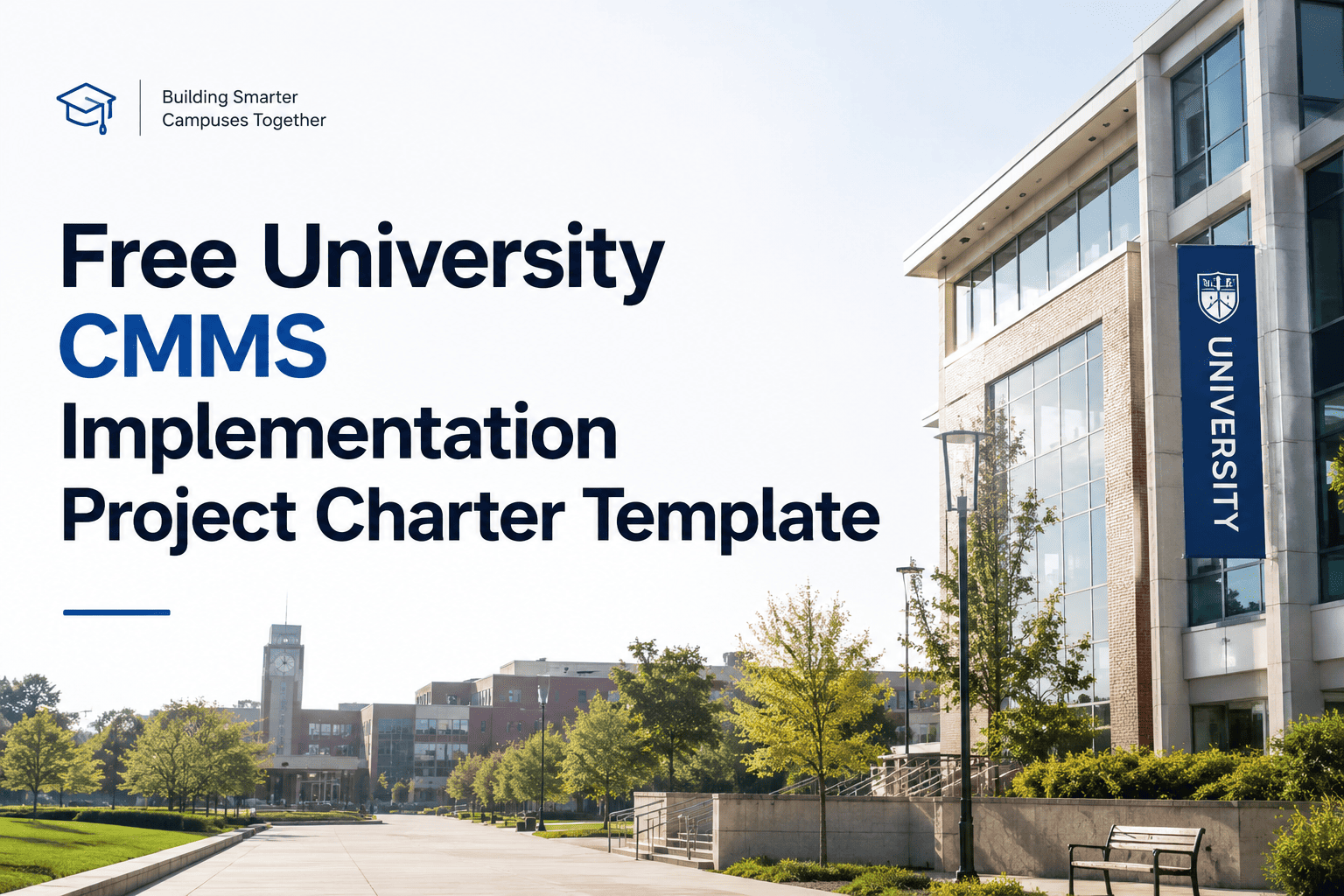
School District CMMS Implementation Project Charter — Section by Section
This template structure reflects the components required for board submission, federal funding documentation, and operational accountability in a K-12 district context. Each section maps to a specific district governance requirement. Book a Demo to see how Oxmaint's onboarding process maps to each charter phase.
District name, fiscal year, superintendent authorization signature, board resolution number and date, and project sponsor designation. This section creates the formal record linking the CMMS implementation to board-approved action.
Explicit list of facilities in scope (school buildings, administrative offices, transportation, athletics), asset categories to be onboarded (HVAC, plumbing, electrical, grounds, custodial), and out-of-scope exclusions. Prevents implementation scope creep and defines the asset inventory baseline.
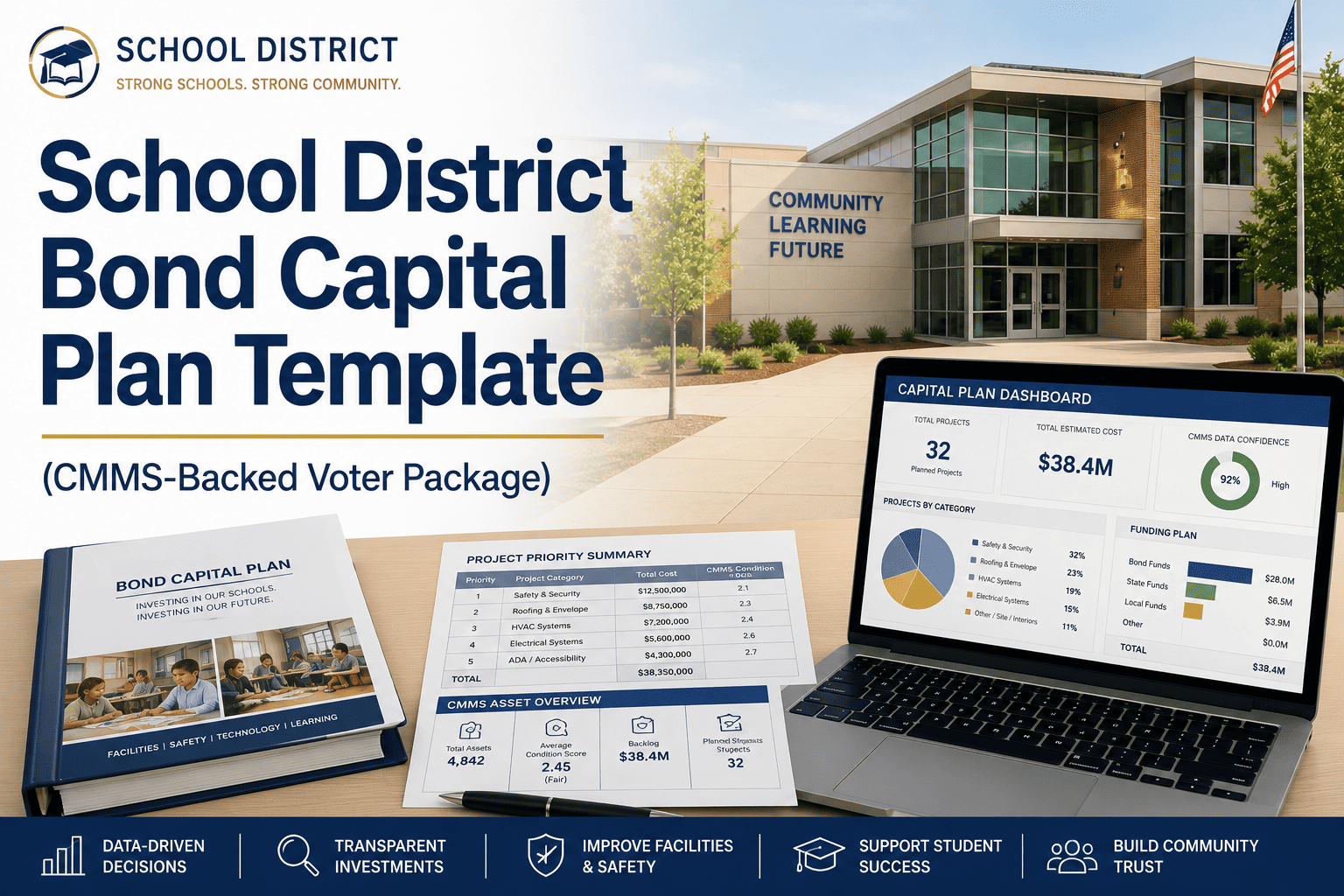
Documentation mapping CMMS implementation costs to allowable use categories under ESSER III (healthy schools, safe facilities, deferred maintenance), IDEA, or applicable Title allocations. Includes fund source, allowable use citation, and amount allocated per funding stream.
Responsible, Accountable, Consulted, and Informed designations for every implementation task — mapped to actual district job titles and CBA classifications. Covers facilities director, maintenance supervisor, district IT director, business services, building principals, and CMMS vendor project manager.
Phase-gated timeline from board approval through full go-live: vendor selection, contract execution, data migration and asset tagging, staff training, pilot building launch, district-wide rollout. Milestone dates tied to district academic calendar to avoid implementation conflicts with school-year operational peaks.
Total project cost by line item (software licensing, implementation services, training, data migration, hardware), funding source allocation, and procurement pathway (sole source justification, competitive bid, cooperative purchasing agreement such as TIPS or NJPA/Sourcewell).
Quantifiable outcomes reported to the board at 90 days, 6 months, and 12 months post-launch: PM completion rate (target: 85%+), reactive-to-planned work order ratio, average work order response time, deferred maintenance backlog reduction, and asset warranty compliance rate.
Identified implementation risks specific to K-12 context: staff resistance tied to CBA concerns, summer construction calendar conflicts, legacy data quality issues, principal buy-in for work request submission, and federal audit documentation requirements.
K-12 CMMS Implementation RACI Matrix — Key Roles
This RACI reflects district job classifications typical in K-12 operations. Adapt role titles to match your district's organizational chart and CBA classifications. Sign Up Free to access Oxmaint's K-12 role configuration that maps directly to these stakeholder categories.
| Implementation Task | Facilities Director | District IT | Business Services | Principals | CMMS Vendor PM |
|---|---|---|---|---|---|
| Board Presentation Preparation | A | C | C | I | R |
| Asset Inventory and Data Migration | A | C | I | I | R |
| System Configuration and User Setup | C | A/R | I | I | R |
| Staff Training — Maintenance Technicians | A | C | I | I | R |
| Principal / Requestor Training | A | C | I | R | R |
| Federal Funding Documentation | C | I | A/R | I | C |
| Go-Live Authorization | A | R | I | I | R |
| 30/60/90-Day Board KPI Reporting | A/R | C | C | I | C |
Board-Reportable KPIs for K-12 CMMS Implementation
Percentage of scheduled preventive maintenance tasks completed on time across all district facilities — the primary indicator that reactive maintenance is being displaced.
Time from principal or staff work request submission to technician assignment — measured and reported at board level as a service delivery accountability metric.
Target reduction in documented deferred maintenance items within 12 months of CMMS go-live — a direct measure of capital planning improvement enabled by structured asset tracking.
Percentage of under-warranty assets with active PM records — ensuring district is not voiding equipment warranties through missed maintenance that CMMS now documents.
How Oxmaint Supports School District CMMS Implementation
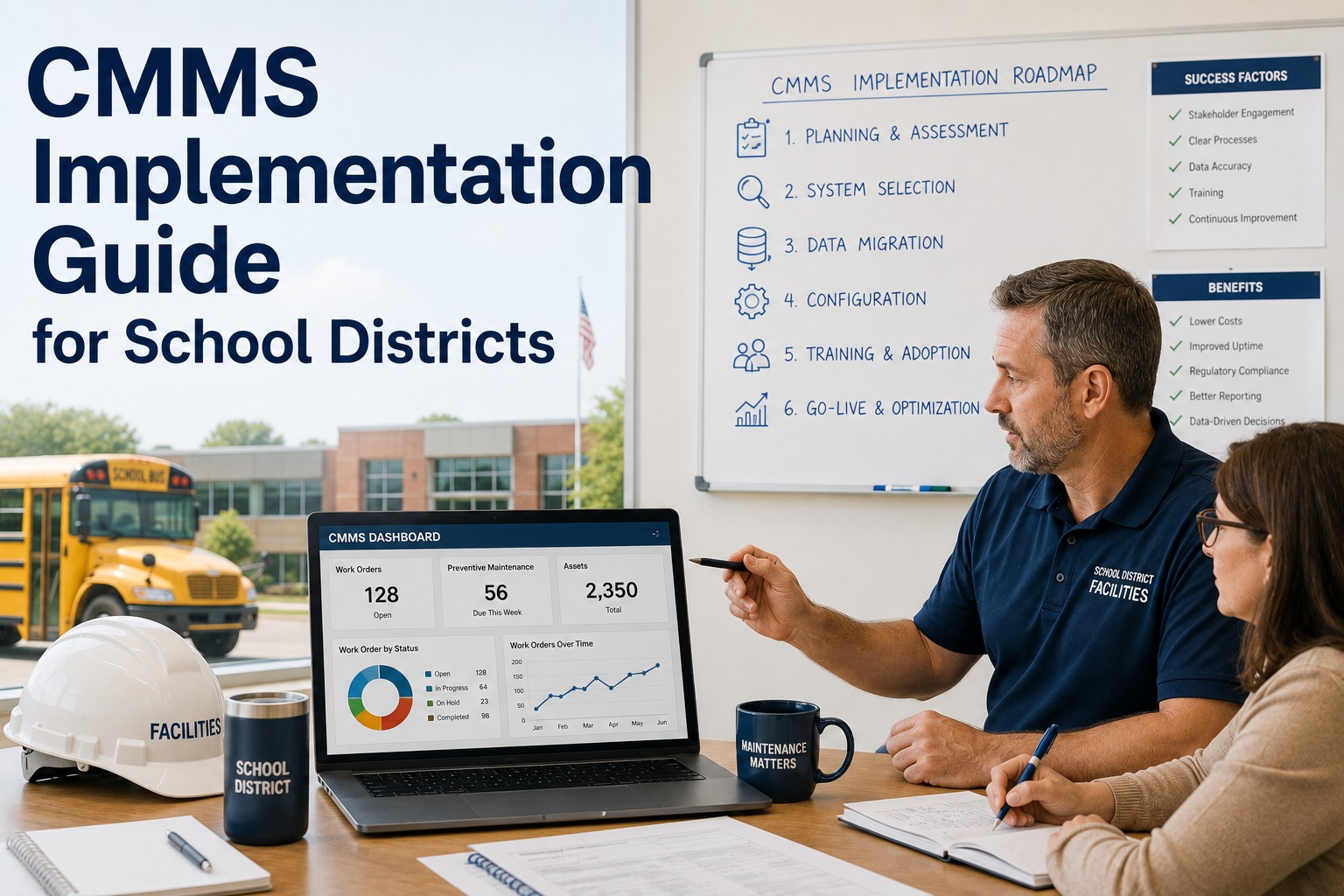
Oxmaint is configured for multi-site K-12 operations — each building as a separate asset location, role-based access aligned to district job classifications, work order workflows that accommodate principal-initiated requests, and reporting structured for board presentation. Book a Demo to walk through a K-12 configuration specific to your district size and facility inventory.
Each school configured as a separate site with its own asset inventory — HVAC, plumbing, electrical, grounds equipment, and custodial assets — with building-level PM schedules and cross-district reporting.
Building principals and staff submit facility requests through a simplified portal — no CMMS training required. Requests route to the correct technician by building assignment and trade classification.
Preventive maintenance schedules built around the school year — summer construction windows for major equipment service, minimized disruption during instructional time, and inspection tasks aligned to state facility compliance cycles.
Exportable PM completion rate, work order response time, deferred maintenance backlog, and cost-per-work-order reports formatted for board presentation and ESSER grant audit documentation.
Fire suppression, elevator, boiler, and health-inspection compliance tasks scheduled and documented within Oxmaint — creating the audit trail required for state facility compliance reviews and federal grant audits.
Oxmaint's implementation team configures the system to your district's site structure, imports existing asset data, and delivers role-specific training for maintenance staff, supervisors, and principals — aligned to your charter timeline.