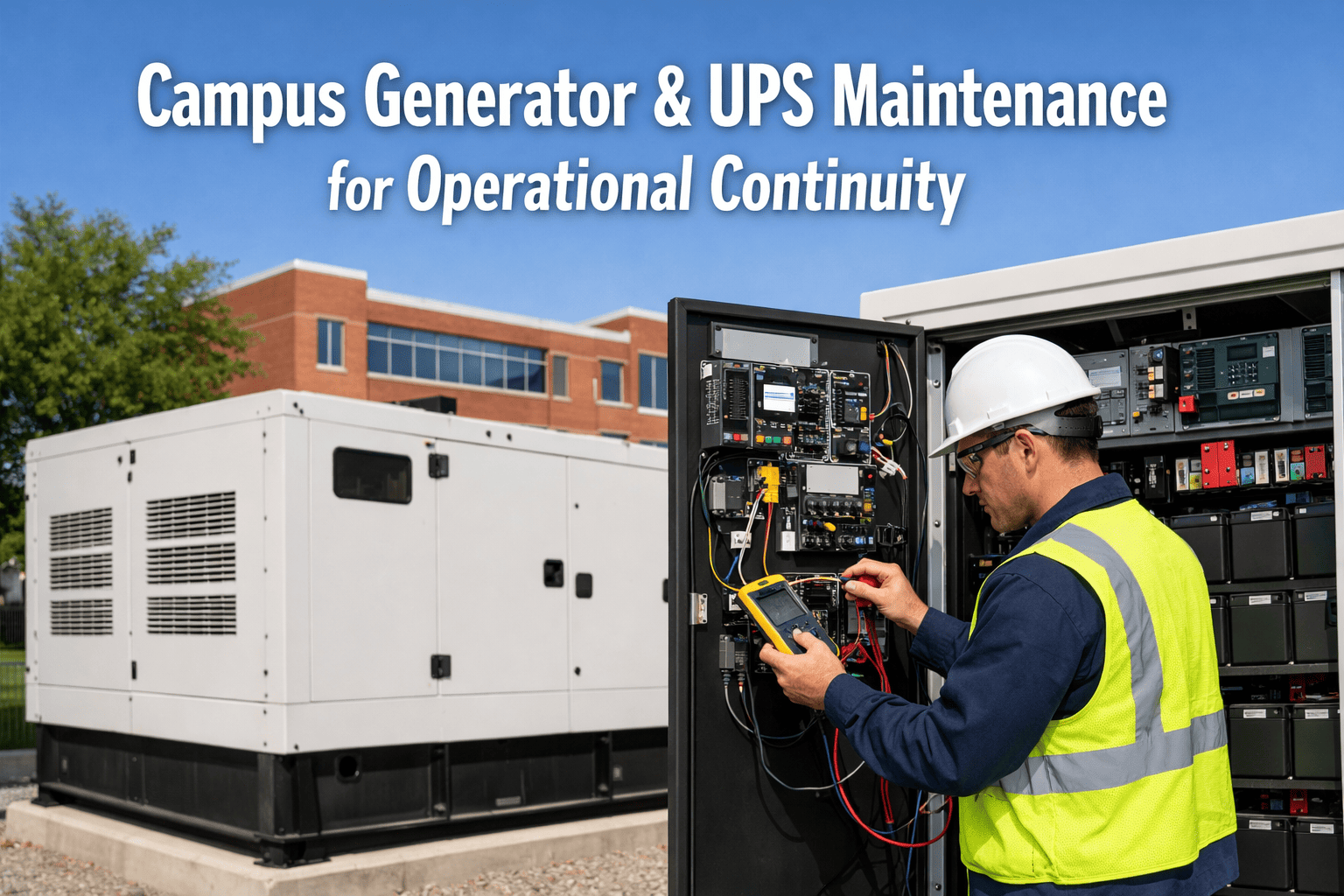
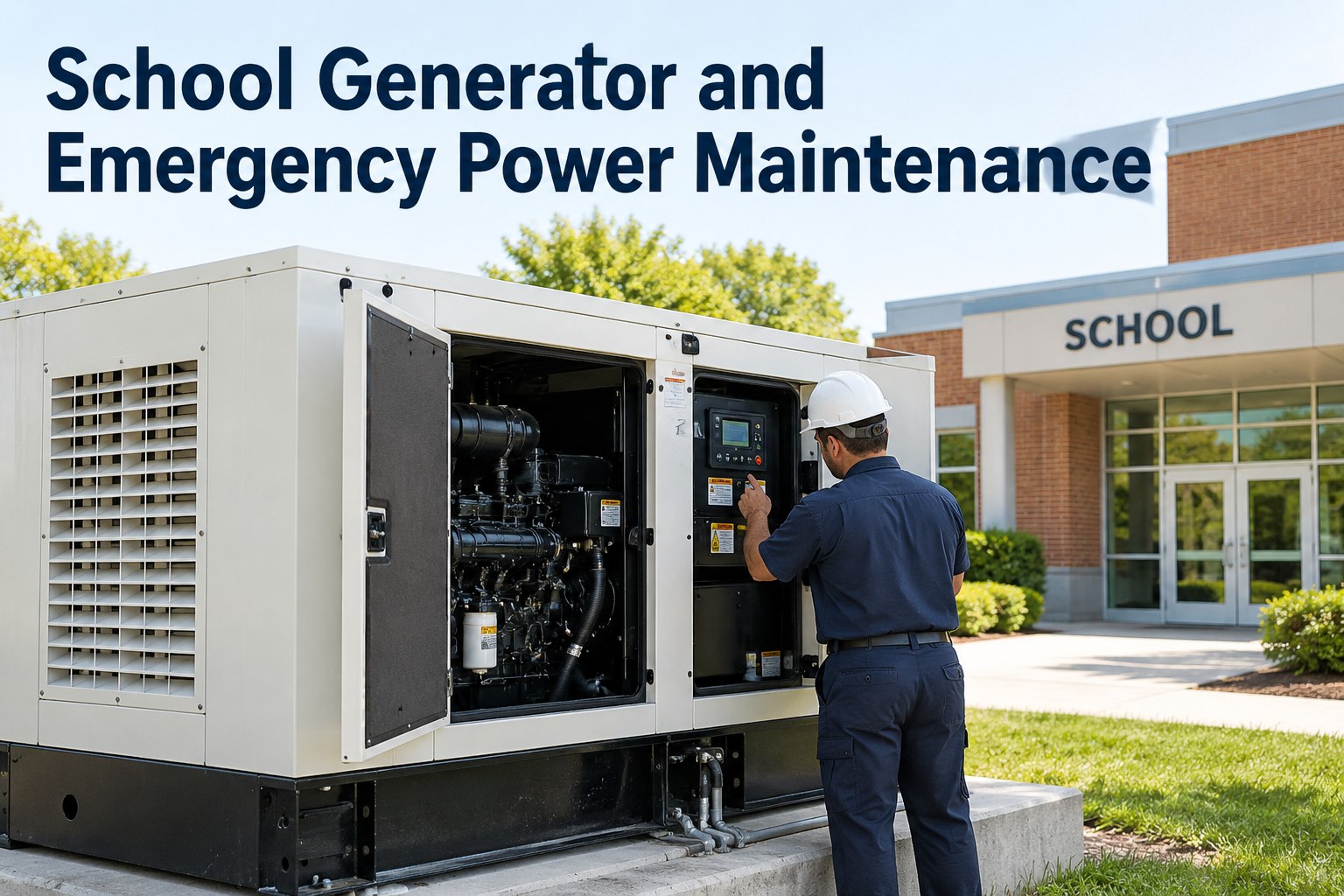
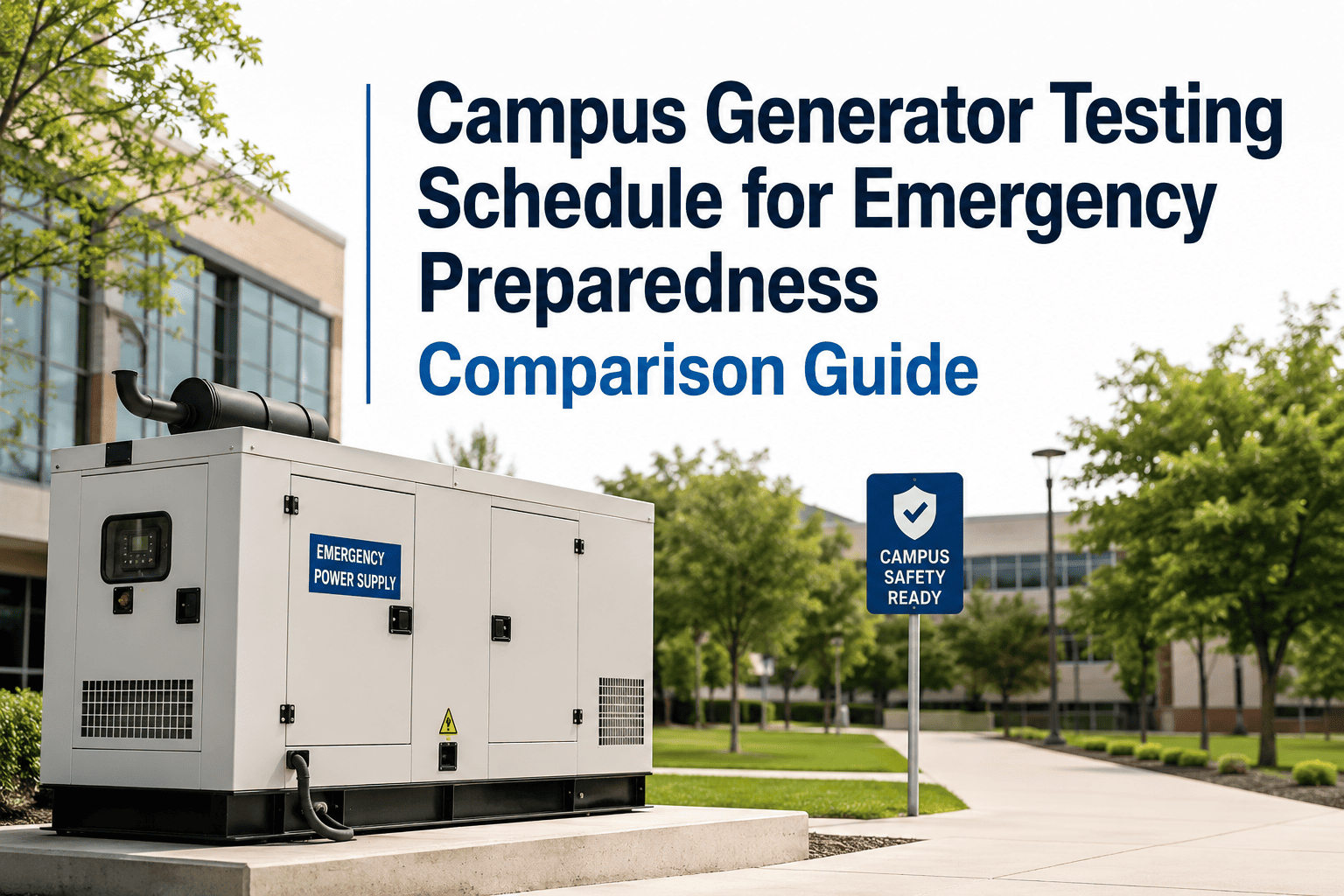
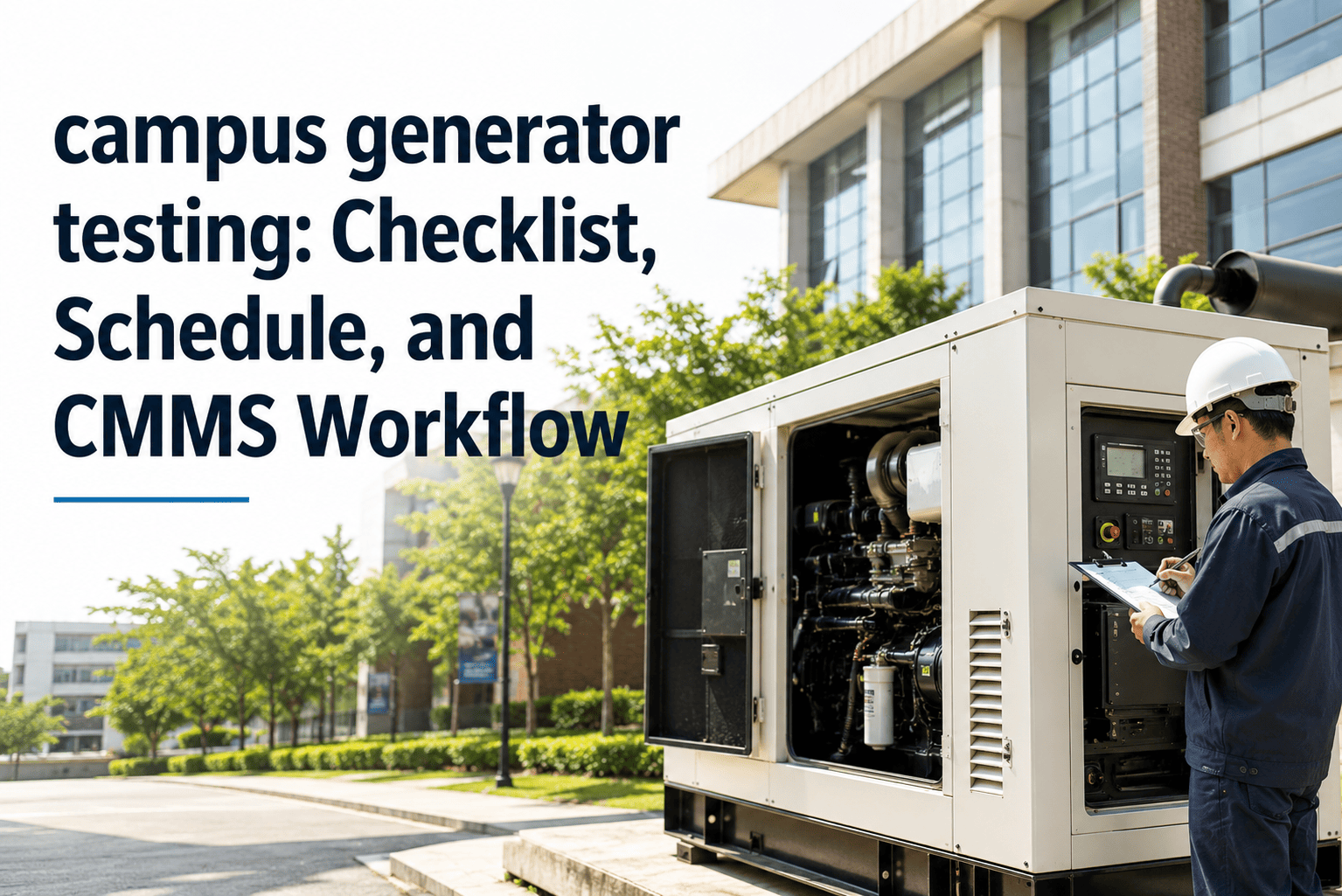
A university in Texas lost power to its data center, hospital simulation wing, and research freezers during a late-summer storm — not because the campus had no backup power, but because the generator serving those critical loads had missed two consecutive load bank tests, the weekly exercise run had been logged on paper for three months without anyone verifying the engine actually started, and the UPS batteries feeding the server room had not been replaced on schedule. The generator was physically present. It was not operationally ready. Campus generator and UPS systems are the most consequential backup infrastructure on any university or school campus — and they are also among the most commonly under-maintained, because their failure is invisible until the moment the utility supply fails and nothing happens. Sign in to OxMaint to configure generator and UPS maintenance schedules for your campus, or book a demo to see how OxMaint manages load bank test scheduling, battery replacement intervals, fuel log tracking, and transfer switch testing across every critical load on your campus.
Campus Generator Maintenance · UPS Management · Backup Power Continuity · OxMaint CMMS
Generator Load Bank Tests. UPS Battery Replacement. Transfer Switch Testing. Fuel Level Management. One CMMS That Keeps Every Campus Backup Power System Ready Before the Grid Fails.
Campus backup power failures happen when maintenance programmes drift — missed exercise runs, untested transfer switches, expired UPS batteries, and fuel tanks that are full on paper but contaminated in practice. OxMaint eliminates every one of these drift points with automated scheduling, mobile completion logging, and compliance records that prove readiness before the emergency arrives.
67%
of campus generator failures during actual power outages involve a missed PM — load bank test, transfer switch check, or battery replacement that was overdue
$2.8M
average cost of a 24-hour campus power outage affecting research operations, residence halls, and food service simultaneously
82%
of UPS battery failures in campus environments occur within the manufacturer's replacement interval — meaning scheduled replacement prevents virtually all failures
67%
of campus generator failures during actual utility outages involve a maintenance gap that predates the failure by 30 to 180 days. The generator started on the last exercise run. It passed the last visual inspection. But the load bank test that would have revealed the cooling system degradation was postponed during exam week and never rescheduled. The transfer switch that had been sticking in manual mode was noted in a logbook that nobody reviewed. OxMaint closes these gaps by making every backup power PM a scheduled, tracked, and completed event — with alerts that escalate when completion is overdue.
Four Backup Power Asset Domains OxMaint Manages at Campus Facilities
GEN — Emergency Generators
Generator PM Scheduling & Load Bank Test Management
Campus emergency generators serve the most critical loads on the property — data centers, research labs, hospitals and clinics, emergency lighting, and HVAC for occupied buildings. A generator that has not been tested under load cannot be confirmed ready for service. Weekly exercise runs confirm the engine starts but do not reveal cooling system degradation, voltage regulator drift, or fuel system problems that only manifest under sustained load. Load bank testing at 75–100% nameplate rating is the only reliable way to confirm generator readiness — and it must be scheduled, completed, and recorded in the CMMS to mean anything.
Sign in to OxMaint to configure generator PM schedules and load bank test intervals for every campus generator asset.
Key Parameters Tracked in OxMaint
Load bank test result — kW output, voltage, frequency at rated load
Engine exercise run — start time, run duration, oil pressure, coolant temp
Fuel level and quality — water contamination, microbial growth test results
Battery voltage — cranking battery health per cell, charger output
Coolant system — antifreeze concentration, block heater operation
Primary Failure Modes OxMaint Tracks
Cooling overtemperature under load — detected only by load bank test
Fuel starvation — detected by fuel quality monitoring and level trending
Cranking failure — detected by battery voltage trend decline
UPS — Uninterruptible Power Supplies
UPS Battery Replacement & Runtime Capacity Management
UPS systems protecting campus data centers, network equipment, and research instruments fail in two modes: battery failure at the moment of need, and capacity failure where the runtime is insufficient to carry the load through the generator start sequence. Both failure modes are preventable with a structured replacement schedule and regular runtime capacity testing. VRLA battery manufacturers specify 3–5 year replacement intervals, but campus UPS batteries are frequently run to failure because no system tracks the installation date and generates a replacement alert before degradation reaches the point of risk.
Book a demo to see UPS battery lifecycle management in OxMaint for campus facilities.
Key Parameters Tracked in OxMaint
Battery installation date — per string, per cabinet, per UPS asset
Runtime capacity test result — actual runtime at 50% and 100% load
Battery internal resistance — trend per cell for early degradation detection
Float voltage and charging current — charger health per UPS module
Primary Failure Modes OxMaint Tracks
Battery sulphation — detected by internal resistance trend increase
Capacity degradation — detected by runtime capacity test results
Charger failure — detected by float voltage deviation trending
ATS — Automatic Transfer Switches
Transfer Switch Testing & Operation Record Management
The automatic transfer switch is the device that connects the generator to the critical load when utility power fails — and it is also the single point of failure that, if it does not operate correctly, means the generator can run perfectly and still deliver no power to the building. ATS testing is the most frequently deferred maintenance activity in campus backup power programmes because it requires a controlled utility interruption or a bypass arrangement that disrupts operations. OxMaint tracks every ATS test result, bypass operation record, and contact condition inspection against the specific switch asset — ensuring the transfer sequence has been validated on schedule.
Sign in to OxMaint to configure ATS test schedules and transfer time logging for your campus backup power systems.
Key Parameters Tracked in OxMaint
Transfer operation time — utility to generator transition in seconds
Retransfer time — generator to utility when supply is restored
Contact condition — thermal scan of ATS contact surfaces
Control voltage — ATS control circuit power supply health
Primary Failure Modes OxMaint Tracks
Contact welding — detected by thermal survey of ATS contact surfaces
Control circuit failure — detected by control voltage monitoring
Slow transfer — detected by operation time exceeding specification
FUL — Fuel Systems
Fuel Storage, Quality, and Consumption Management
Diesel fuel stored in generator day tanks and main storage tanks degrades over time — water accumulates through condensation, microbial growth occurs in fuel-water interfaces, and long-chain hydrocarbons precipitate as sediment that blocks fuel filters and injectors under load. A campus generator with a full fuel tank that has not been tested for water and microbial contamination in 18 months is not a reliable backup power asset — it is a tank of degraded fuel that will fail the generator the moment sustained load demands are placed on the injection system.
Book a demo to see fuel quality and consumption management in OxMaint.
Key Parameters Tracked in OxMaint
Fuel level — daily or weekly reading per tank asset
Water content — Karl Fischer test result per annual fuel sample
Microbial contamination — ATP test or culture result per sample
Fuel consumption rate — actual vs. expected during load bank tests
Primary Failure Modes OxMaint Tracks
Filter blockage under load — detected by fuel quality test trend
Injector fouling — detected by consumption rate deviation
Tank water accumulation — detected by Karl Fischer test result
OxMaint Campus CMMS · Backup Power Continuity Management
Every Generator Test, UPS Battery Check, Transfer Switch Operation, and Fuel Sample Your Team Conducts Needs to Connect Into One Verified Readiness Record
Paper logs and calendar reminders don't prove readiness. OxMaint does — with timestamped completion records that protect your campus and satisfy every accreditation and insurance audit.
Technology That Makes Campus Backup Power Management Proactive
How OxMaint Connects Backup Power Data Into Campus Continuity Intelligence
Technology · IoT Monitoring
Real-Time Generator & UPS Sensor Integration
IoT sensors on generator fuel tanks, coolant systems, and UPS battery strings transmit status data continuously to OxMaint. Fuel level drops, coolant temperature anomalies, and battery voltage deviations generate automatic work orders before the scheduled PM date — catching developing problems between inspection cycles.
Alert: Any parameter outside baseline triggers OxMaint work order automatically
Technology · AI Analytics
AI Digital Twin — Generator Health Prediction
Digital twin models of each generator combine load bank test history, engine hours, fuel consumption trends, and exercise run data to predict which generators are developing cooling or fuel system issues before they produce a failure under real emergency load conditions. Maintenance is scheduled at the optimum intervention point.
Alert: Health score declining 20% from baseline — schedule load bank test
Technology · Computer Vision
AI Camera Vision — Generator Room Condition Monitoring
AI cameras in generator rooms detect coolant leaks, oil accumulation, exhaust anomalies, and physical damage between scheduled inspections. Visual findings trigger OxMaint work orders with photo evidence attached — building a documented condition record between formal PM visits.
Alert: Visual anomaly detected — inspection WO generated with photo evidence
Campus Backup Power Risk Register — Critical and Elevated Load Priorities
Critical Risk
Data Center & Network Infrastructure Generators
Server room power failures destroy active processes and corrupt storage. Load bank test every 6 months, UPS runtime capacity test quarterly, and ATS transfer test biannually — all records logged in OxMaint per asset.
Critical Risk
Research Laboratory & Freezer Bank Power
Irreplaceable specimens, cultures, and reagents require uninterrupted power. UPS batteries must be on a documented replacement schedule — not run until capacity testing reveals failure risk after years of degradation.
Critical Risk
Student Health & Campus Emergency Systems
Health center generators and emergency lighting systems carry life-safety designation in NFPA 110. Monthly exercise, annual load bank test, and every ATS test must be documented with full compliance evidence accessible in OxMaint.
Elevated Risk
Residence Hall Backup Power
Power failures in occupied residence halls during storms or extreme temperatures create immediate welfare concerns. Generator and ATS readiness for residential buildings must be tested before weather season — not confirmed after an event.
Elevated Risk
Administrative & Examination Building Power
Power failures during examination periods create immediate operational and reputational impact. Building backup power systems supporting examination rooms require scheduled readiness verification before each major examination session.
Elevated Risk
Campus IT Relay & Telecommunications Systems
Communication system failures during emergencies impair campus-wide response capability. UPS systems on telecommunications closets require battery replacement schedules and runtime verification on a documented OxMaint PM cycle.
Campus Generator and UPS Maintenance Schedule — OxMaint Coverage by Interval
Documented Outcomes — Campus Facilities Using OxMaint Backup Power Management
94%
of campuses using OxMaint backup power PM scheduling report zero generator failures during actual utility outages in the 12 months post-deployment
$210K
average annual savings from prevented research sample loss, data recovery costs, and emergency contractor response at campuses with structured UPS PM programmes
100%
compliance documentation availability for NFPA 110 and insurance audits at campuses storing generator and UPS records in OxMaint — retrievable in under 2 minutes
3–5 yr
VRLA battery replacement interval — the most commonly missed campus UPS maintenance deadline
10 sec
maximum allowable ATS transfer time for NFPA 110 Type 10 emergency systems — verified only by annual transfer test
18 mo
typical diesel fuel degradation timeline in storage — fuel quality testing must precede this window to prevent contamination failures
6×
higher failure rate for generators that have not completed a load bank test in the prior 12 months vs those on scheduled load test programmes
Your campus generators are either on a verified maintenance schedule with documented load test results — or they are backup power systems that have not been confirmed ready since the last time the grid stayed up.
OxMaint makes every generator, UPS, transfer switch, and fuel tank a managed asset with a maintenance history that proves readiness before the emergency tests it.
We had a generator fail its load bank test six weeks before a major storm hit our region. Because OxMaint had flagged the cooling system trend two months earlier and the load test confirmed the problem, we had the repair done and documented before the event. That generator carried our data center and research labs through 19 hours without utility power without a single issue.
— Director of Facilities Management, Research University · North Carolina · 34 generators tracked in OxMaint · user since 2022
Frequently Asked Questions — Campus Generator and UPS Maintenance CMMS
How does OxMaint schedule and track generator load bank tests across a large campus?
Every generator is registered as a discrete asset with its own PM schedule, including configurable load bank test intervals. OxMaint sends alerts 30 and 14 days before each test is due and escalates to the facilities director if completion is not logged within the deadline window.
Sign in to OxMaint to configure your generator PM templates.
Can OxMaint track UPS battery replacement dates across multiple buildings?
Yes. Each UPS battery string is registered with installation date, rated replacement interval, and internal resistance trend data. OxMaint generates a battery replacement work order when the date approaches and tracks completion with the replacement date and battery specification recorded against the asset.
Does OxMaint produce NFPA 110 compliance documentation for campus emergency power systems?
Yes. OxMaint stores every generator exercise log, load bank test result, ATS transfer test record, and fuel sample result with timestamps and technician records. NFPA 110 compliance exports are available by asset or by campus — retrievable in under 2 minutes for any inspection or audit request.
How does OxMaint handle generator exercise runs that are completed but not properly documented?
OxMaint requires technician sign-off with recorded readings — start time, run duration, oil pressure, coolant temperature — before an exercise run is marked complete. Runs logged without readings are flagged as incomplete. This prevents the paper-based drift where runs are marked done without verification data.
Can OxMaint integrate with building management systems to monitor generator and UPS status in real time?
Yes. OxMaint integrates with BMS platforms via API and Modbus — receiving generator status, UPS alarm signals, and fuel level data automatically. When any monitored parameter breaches its threshold, OxMaint generates a maintenance work order without waiting for the next scheduled inspection.
Book a demo to see BMS integration in action for a campus facility.
The Next Power Outage Will Test Every Generator and UPS on Your Campus. OxMaint Makes Sure They Are Ready Before It Arrives.
Documented load test results. Verified battery replacement dates. Confirmed ATS transfer times. Clean fuel quality records. OxMaint provides the maintenance evidence that proves readiness — so the emergency tests the grid, not your maintenance programme.