
Your residence hall access system has been running without incident for 14 months. Then, over a single weekend in October, 23 smart locks across three floors of a 600-bed dormitory go offline simultaneously. Students are locked out of their rooms at 11 PM on a Friday. Campus police respond to 23 individual calls. A locksmith is dispatched at emergency weekend rates. The root cause: lithium batteries in those 23 locks all hit end-of-life within the same 72-hour window — because they were all installed on the same day during summer renovation, and nobody tracked their battery health after deployment. The emergency locksmith bill: $4,600. The reputational damage with students and parents: incalculable. The Clery Act incident reports generated by 23 simultaneous access failures at a residence hall: a compliance headache that persists for years in annual security reporting.
A CMMS with IoT battery monitoring would have flagged those 23 locks four weeks earlier — when voltage readings dropped below the replacement threshold — and generated work orders to swap batteries during a Tuesday morning maintenance window at $0.87 per battery. This is what separates reactive campus security infrastructure from operationally resilient access management. Schedule a walkthrough to see how predictive lock monitoring works.
This guide covers every maintenance task, monitoring metric, and operational workflow campus facilities teams need to keep smart lock systems reliable, secure, and compliant across residence halls, academic buildings, labs, and administrative spaces. Start tracking your lock fleet digitally.
What if you could see lock failures coming weeks before students get locked out? IoT-connected CMMS makes it possible.
Campuses using predictive lock monitoring report a 92% reduction in battery-related lockouts — dropping emergency events from 40–80 per 1,000 locks annually to under 5. That translates to $9K–$22K in avoided emergency costs per residence hall per year, with most programs paying for themselves in under 6 weeks.
Why Smart Lock Maintenance Is Now a Campus Safety Issue
Campus smart lock deployments have scaled from a handful of server rooms to thousands of doors across residence halls, classrooms, laboratories, and administrative buildings. A mid-size university now manages 1,500–4,000 networked lock endpoints — each one a potential security gap, compliance liability, or student service failure when maintenance lapses. Unlike commercial office buildings where a lock failure inconveniences an employee for 10 minutes, a campus lock failure at a residence hall at midnight creates a personal safety incident, a Clery Act reporting event, and a call to campus police.
| Campus Challenge | Reactive Approach | Predictive Approach |
|---|---|---|
| Student Safety | Discover lock failure when student reports being locked out — often late at night | Battery and connectivity alerts trigger replacement weeks before failure |
| Clery Act Compliance | Document access failures after they become security incidents | Proactive monitoring prevents access failures that generate reportable incidents |
| Credential Management | Discover expired or orphaned credentials during security audits | Automated credential lifecycle tracking with CMMS-triggered reviews |
| Budget Control | Emergency locksmith calls, weekend police overtime, expedited parts | Planned battery replacements and firmware updates during maintenance windows |
| Fleet Lifespan | Replace locks on fixed 5-year cycles regardless of condition | Condition-based replacement optimized by actual wear and failure data |
How IoT-Connected Smart Lock Monitoring Works
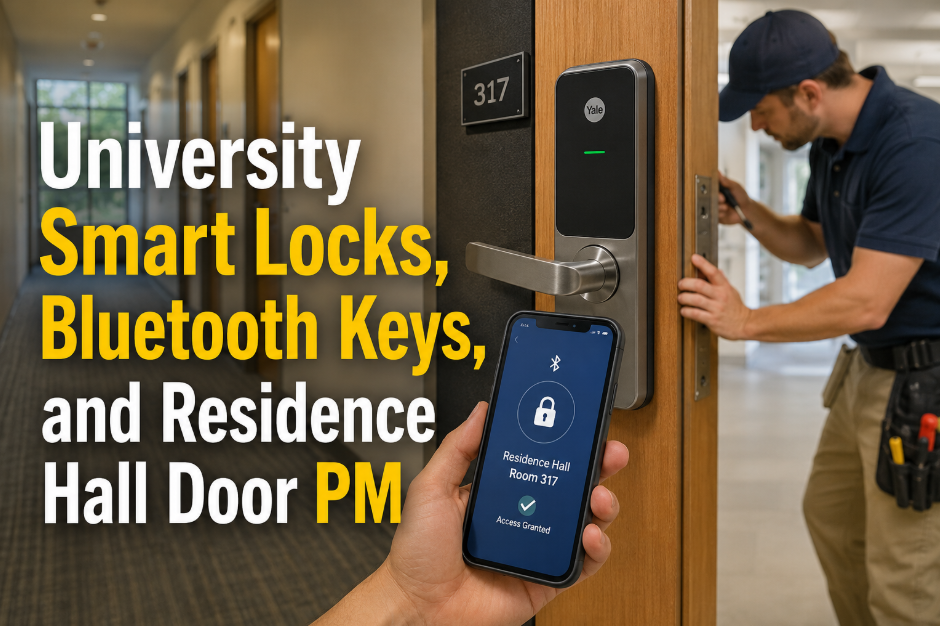
Modern campus smart locks communicate wirelessly via BLE, Zigbee, Z-Wave, or Wi-Fi to a centralized access control platform. When that platform feeds data into a CMMS, every lock becomes a monitored asset with predictive maintenance capabilities — not just a door that works until it doesn't. See how this workflow runs live in a demo.
Each lock reports battery voltage, signal strength, access events, tamper alerts, and firmware version to the access platform
CMMS receives telemetry and flags locks approaching battery depletion, losing connectivity, or showing mechanical anomalies
Automated work orders route to the correct technician with lock location, door number, building, and required parts
Technician completes service, CMMS logs battery replacement or repair with before/after readings and photo documentation
What Makes CMMS Monitoring Different from Access Control Dashboards
Your access control platform tells you which doors are locked and who swiped where. It was not designed to manage maintenance workflows, track battery replacement cycles, schedule firmware updates across 2,400 endpoints, or generate compliance documentation for auditors. A CMMS adds the maintenance intelligence layer that access control software lacks — turning door status data into preventive maintenance actions.
| Capability | Access Control Platform Only | Access Control + CMMS Integration |
|---|---|---|
| Battery Visibility | Low battery icon when already critical | Voltage trending with 4–6 week advance warning |
| Maintenance Scheduling | None — IT or facilities manage separately | Auto-generated work orders routed by building and technician |
| Firmware Management | Shows current version — no update workflow | Tracks versions across fleet, schedules phased rollouts |
| Failure Documentation | Event log — no root cause tracking | Full repair history with cause codes, parts used, and resolution |
| Compliance Reporting | Access logs only | Maintenance records, inspection logs, and audit-ready reports |
| Fleet Lifecycle Data | None | Total cost of ownership, failure rates by model, replacement planning |
| Multi-Trade Coordination | None | Integrates lock work with door hardware, closer, and frame maintenance |
Smart Lock Subsystem Monitoring Applications
Every smart lock is a multi-component system — battery, motor, circuit board, antenna, credential reader, and mechanical latch — each with distinct failure modes that IoT monitoring can detect before they cause lockouts. Start building your lock monitoring program.
| Lock Subsystem | What Sensors Track | Failure Signatures Detected | Warning Lead Time | Prevented Cost |
|---|---|---|---|---|
| Battery Pack | Cell voltage, discharge rate, temperature, cycle count | Voltage drop curve, accelerated drain, cold-weather capacity loss | 4–8 weeks | $180–450/event |
| Motor & Actuator | Lock/unlock cycle time, motor current draw, stall detection | Increasing cycle time, rising current indicating mechanical binding | 2–6 weeks | $350–900/lock |
| Wireless Module | RSSI signal strength, packet loss rate, connection frequency | Signal degradation, increasing retransmissions, intermittent drops | 1–4 weeks | $200–600/event |
| Credential Reader | Read success rate, read time, error frequency by card type | Declining read rate, increased retry frequency, reader contamination | 2–4 weeks | $150–400/reader |
| Door Position Sensor | Open/close state, forced entry alerts, held-open duration | False alerts from misaligned sensors, increasing held-open events | 1–3 weeks | Security risk |
| Firmware & Logic | Current version, boot errors, watchdog resets, config integrity | Increasing reboot frequency, version drift from fleet standard | Immediate | $100–300/lock |
| Physical Hardware | Tamper switch, handle torque (where equipped), latch engagement | Tamper alerts, incomplete latch engagement, handle looseness | 1–2 weeks | $250–700/door |
See which lock subsystems across your campus would benefit most from predictive monitoring.
Oxmaint integrates with Allegion, ASSA ABLOY, Salto, Dormakaba, and HID platforms via API — no hardware changes required. Integration typically takes 2–4 hours per building, and you can start with a single residence hall pilot before expanding campus-wide.
Battery Health Monitoring Deep Dive
Battery failure accounts for 78% of campus smart lock outages — yet every battery failure provides weeks of measurable warning through voltage decline patterns that a CMMS tracks automatically. A single residence hall with 200 smart locks will experience 40–60 battery replacements per year. Without monitoring, each one is a potential midnight lockout. With monitoring, each one is a scheduled Tuesday morning maintenance task.
| Metric | What It Measures | Normal Range | Warning Pattern | Indicates |
|---|---|---|---|---|
| Pack Voltage | Total battery pack voltage under load | Above 5.4V (4x AA lithium) | Decline below 5.0V | 4–6 weeks to failure — schedule replacement |
| Discharge Rate | Voltage drop per week over rolling 30 days | 0.02–0.04V per week | Rate exceeds 0.08V per week | Accelerated drain — possible motor issue or excessive traffic |
| Cold Snap Response | Voltage sag during temperature drops below 32°F | Recovers within 2 hours of warming | Fails to recover — persistent low voltage | Battery capacity loss — exterior locks most vulnerable |
| Cycle Count | Total lock/unlock actuations since battery install | 8,000–15,000 cycles per battery set | Approaching rated cycle limit | Usage-based replacement trigger for high-traffic doors |
| Motor Current Draw | Current spike during lock/unlock actuation | Per manufacturer baseline | Rising current >20% above baseline | Mechanical binding draining batteries faster — inspect door alignment |
| Last Replacement Date | Days since last battery change | 12–18 months typical life | Approaching 12-month mark without voltage decline | Proactive scheduling window — replace before winter stress |
Reactive vs. Predictive Smart Lock Maintenance
The shift from reactive to predictive lock maintenance is the difference between campus police responding to lockouts at midnight and a technician swapping batteries at 10 AM on a Tuesday. Build your predictive lock program.
| Metric | Reactive Maintenance | Predictive with CMMS |
|---|---|---|
| Response Time | 30–90 minutes after student reports lockout | Scheduled days or weeks in advance during business hours |
| Cost Per Battery Event | $180–450 including emergency labor and police response | $0.87–3.50 per battery set during planned rounds |
| Student Impact | Locked out of room — safety risk at night, missed classes during day | Zero — battery replaced before depletion during vacant hours |
| Clery Act Exposure | Every lockout at a residence hall is a potential reportable event | Failures prevented — no incidents to report |
| Battery Waste | Calendar-based bulk replacement wastes 20–30% of remaining life | Condition-based replacement uses 90–95% of battery capacity |
| Firmware Currency | Unknown — checked only during annual audits | Fleet-wide version tracking with phased update scheduling |
| Annual Emergency Events | 40–80 per 1,000 locks | 2–5 per 1,000 locks |
| Compliance Posture | Incident documentation after failures | Proactive monitoring records demonstrate due diligence |
Implementation Roadmap
Most campuses can deploy a CMMS-integrated smart lock monitoring program starting with a single residence hall within 4–6 weeks, expanding to campus-wide coverage in phases aligned to budget cycles and building priority. Schedule a walkthrough to plan your implementation.
- Inventory all smart locks by building, door number, lock model, firmware version, and last battery change date
- Classify doors by criticality: residence hall exterior (critical), lab/server room (high), classroom (standard), storage (low)
- Document current access control platform, communication protocol (BLE, Zigbee, Wi-Fi), and available telemetry data
- Identify top-priority buildings based on complaint history, emergency call logs, and student population
- Calculate current emergency lockout costs from police, locksmith, and facilities response records
- Connect access control platform API to CMMS for automated telemetry ingestion (battery voltage, signal strength, events)
- Configure battery voltage thresholds: warning at 5.2V, critical at 4.8V, emergency at 4.5V (adjust per manufacturer)
- Set up connectivity monitoring: flag locks with signal loss exceeding 30 minutes during occupied hours
- Build PM schedules: quarterly physical inspection, annual hardware audit, firmware update cycles
- Configure work order routing rules by building, floor, and technician assignment
- Run the integrated monitoring and maintenance workflow across your pilot residence hall for one full cycle
- Train maintenance technicians on mobile CMMS work order completion, battery replacement documentation, and photo verification
- Train campus police dispatch on the new escalation workflow — CMMS-generated tickets replace phone calls
- Validate that every low-battery alert generates a work order, and every work order is completed before failure
- Refine thresholds based on pilot data — adjust for exterior vs. interior locks, high-traffic vs. low-traffic doors
- Expand to remaining residence halls, then academic buildings, labs, and administrative spaces in priority order
- Build executive dashboard showing fleet health, battery replacement forecast, emergency event trends, and compliance status
- Use failure data to evaluate lock models — identify which manufacturers and models have lowest total cost of ownership
- Integrate with procurement for automated battery and parts ordering at minimum stock thresholds
- Generate annual security infrastructure report for campus safety committee and board presentations
Monitoring Technology Options for Campus Smart Locks
Smart lock monitoring leverages your existing access control infrastructure supplemented by CMMS integration. Most implementations require zero additional hardware — just software configuration and API connections.
| Monitoring Method | Implementation | Data Provided | Typical Cost | Best For |
|---|---|---|---|---|
| Access Control API | Connect existing platform to CMMS via REST API | Battery level, events, firmware, online/offline status | Software only | Primary data source — covers 80% of monitoring needs |
| BLE Gateway Mesh | Install BLE gateways on each floor for real-time polling | Continuous battery voltage, signal strength, lock state | $80–200 per gateway | Real-time monitoring where access platform polling is infrequent |
| Door Position Sensors | Magnetic reed switches on door frames | Open/close state, held-open alerts, forced entry detection | $25–60 per door | High-security doors — labs, server rooms, pharmacy |
| Environmental Sensors | Temperature and humidity monitoring in lock areas | Conditions affecting battery life and electronics | $40–100 per sensor | Exterior locks, unconditioned spaces, mechanical rooms |
| Network Monitoring | Wi-Fi/Zigbee/Z-Wave network health tracking | Signal quality, interference, hub connectivity | Software only | Diagnosing connectivity-related lock failures |
| CMMS Analytics Platform | Software subscription with trending and alerting engine | Aggregated fleet health, failure prediction, compliance dashboards | Included in CMMS | Central management of all monitoring data and maintenance workflows |
Get a customized monitoring recommendation for your campus lock infrastructure.
Tell us your access control platform, building count, and lock fleet size — we'll map the fastest path from reactive lockout response to predictive maintenance with a free 15-minute assessment tailored to your campus. Most setups require zero new hardware and go live within weeks.
Integration with Campus CMMS
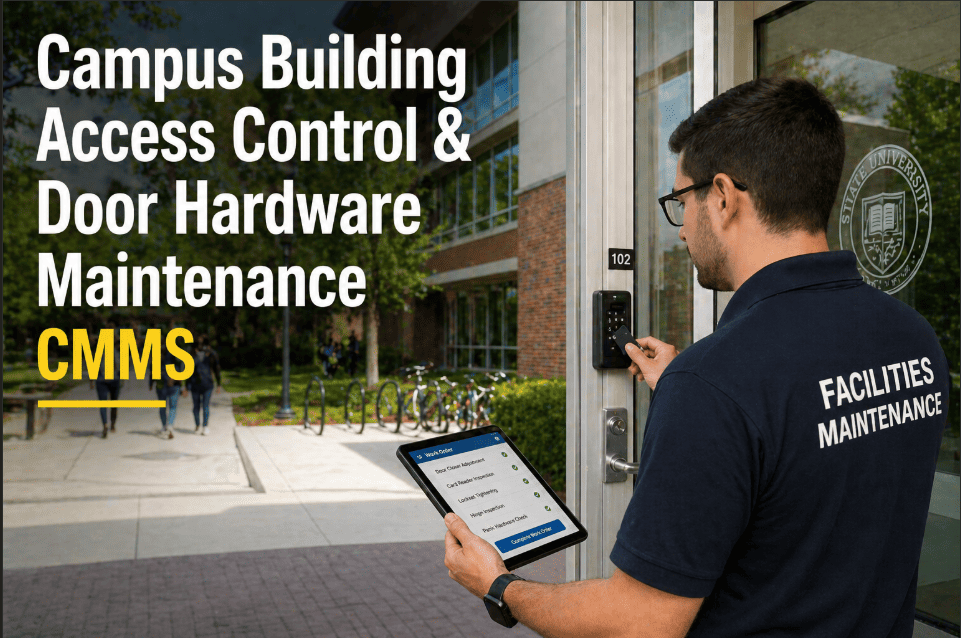
Smart lock monitoring delivers maximum value when telemetry data flows directly into your maintenance management system — automatically generating work orders, updating asset records, and providing the compliance documentation that campus safety auditors require. Activate CMMS-connected lock monitoring.
| Integration Feature | What It Does | Value Delivered |
|---|---|---|
| Automated Work Orders | Low-battery and connectivity alerts trigger work orders with door number, building, lock model, and parts needed | No manual monitoring — technicians arrive with the right battery before failure |
| Asset History Timeline | Every battery change, firmware update, hardware repair, and inspection logged per lock | Complete lock lifecycle history for replacement decisions and warranty claims |
| Credential Audit Integration | CMMS schedules periodic credential reviews aligned with enrollment changes and staff turnover | No orphaned credentials — terminated employees and graduated students removed on schedule |
| Fleet Health Dashboard | Real-time view of battery status, connectivity, firmware currency, and upcoming maintenance across every lock | Campus-wide lock fleet visibility for IT and facilities leadership |
| Clery Act Documentation | Maintenance records and proactive monitoring logs archived for compliance reporting | Audit-ready evidence of due diligence in maintaining access control infrastructure |
| Parts Inventory Management | Battery stock levels tracked with auto-reorder at minimum threshold | Batteries always in stock — no procurement delays when replacements are needed |
| Door Hardware Coordination | Lock maintenance integrated with door closer, hinge, frame, and weather seal work orders | One visit addresses all door hardware issues — not just the electronic lock |
Measuring Smart Lock Maintenance ROI
Track these metrics to quantify the value of your predictive lock maintenance program and justify expansion across your campus portfolio.
Track after-hours lockout events per 1,000 locks before and after implementation. Target: 90% reduction from reactive baseline of 40–80 events annually.
Calculate total maintenance cost divided by number of managed locks. Target: reduce from $45–120 per door (reactive) to $8–15 per door (predictive) including battery and labor.
Measure percentage of battery capacity consumed before replacement. Calendar-based replacement wastes 20–30% of life. Condition-based target: 90–95% utilization before swap.
Track percentage of locks in operational status at any given time. Target: 99.9% fleet availability — no more than 2–3 locks offline campus-wide at any moment.
Percentage of locks running current approved firmware version. Target: 95%+ within 30 days of each security patch release — critical for vulnerability management.
Track access-system-related security incidents that require Clery Act reporting. Target: zero preventable incidents from lock maintenance failures.



.png)

