A 19,000-student university in North Carolina lost access control across 34 residence hall entry doors at 1:18 AM on a Saturday — peak move-in weekend for fall semester. The smart lock system had been deployed 26 months earlier. No one had replaced a single battery. The IoT monitoring dashboard showed green status indicators because the platform only checked connectivity, not battery voltage. When temperatures dropped to 38°F that night, the voltage sag in 34 lithium packs crossed the cutoff threshold within the same 90-minute window. Residence advisors propped doors open with textbooks. Campus police dispatched every available officer to stand at entries until facilities could replace batteries — a process that took 11 hours because no one had stocked CR2 cells for the specific lock model. The locksmith vendor charged emergency weekend rates: $14,200 for labor alone. A CMMS tracking battery voltage trends, predicting replacement windows, and auto-generating stocked work orders would have flagged those 34 locks six weeks earlier — total cost of planned replacement: $1,400 in batteries and 8 hours of scheduled tech time. Book a Demo to see how Oxmaint monitors smart lock health across campus. Sign Up to start tracking your lock fleet today.
34
residence hall doors lost access control simultaneously — because no one tracked battery voltage
Composite data from campus smart lock deployments 2024–2026
82%of campus lock failures are battery-related and fully preventable
68%of campuses lack a formal smart lock maintenance program
$8K–$25Kaverage cost per emergency lock-system-wide failure event
90%+lock uptime achievable with CMMS-integrated IoT battery monitoring
Your smart locks are IoT devices. Maintain them like IoT devices. Oxmaint tracks every battery voltage, firmware version, connectivity heartbeat, and credential sync — auto-generating work orders before a dead lock becomes a security breach.
Smart locks have replaced mechanical cores across higher education at extraordinary speed — most campuses deployed 500–3,000 units within 2–3 years. But nearly every institution treated deployment as a capital project and forgot the operational reality: each lock is a battery-powered IoT device with firmware, wireless connectivity, mechanical components, and a credential database that requires continuous maintenance. The locks that failed silently last semester are not defective — they are unmaintained.
Smart Lock Technologies Across Campus Buildings
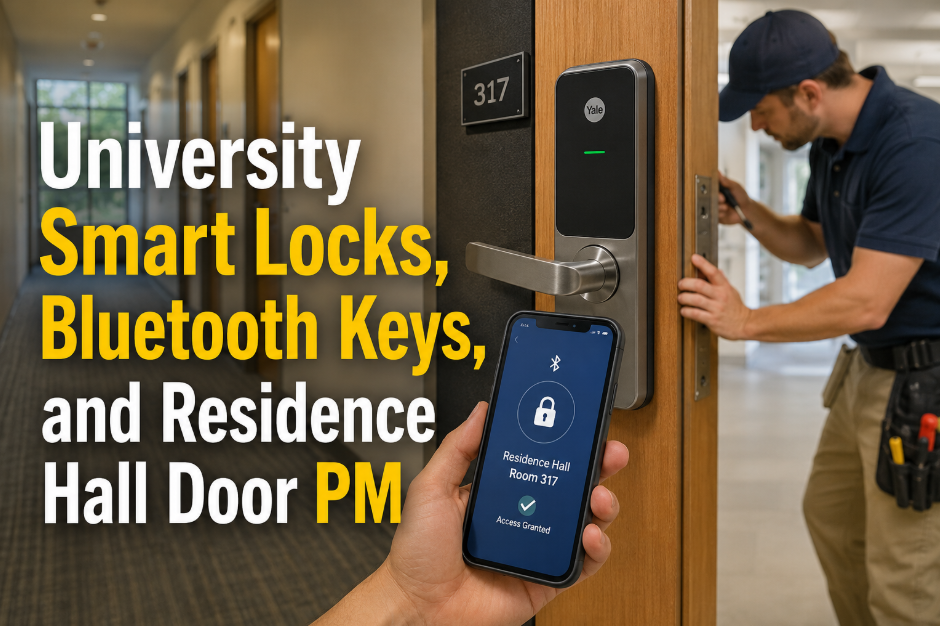
Different building types demand different lock technologies — and each creates distinct maintenance requirements that a CMMS must track independently. A residence hall deadbolt and a classroom lever set share almost no service profile despite both being called "smart locks." Book a Demo to review lock types across your campus portfolio.
Smart Lock Types & Campus Applications
Wireless Deadbolt
Residence Hall & Apartment Entry
Battery-powered (12–24 month life)BLE / Z-Wave / ZigbeeCard + mobile credentialAudit trail per door
High-Density
Networked Lever Set
Classrooms & Office Suites
PoE or battery with Wi-FiSchedule-based auto-lockClassroom lockdown capableHigh cycle count (200+/day)
High-Cycle
Electrified Panic Hardware
Building Main Entry & Emergency Exits
Hardwired with battery backupFire alarm integrationFree egress complianceMotor-driven latch retraction
Life Safety
Cabinet & Server Room
Labs, IT Closets & Restricted Spaces
RFID + PIN dual-factorTamper detection sensorCompliance audit loggingLow cycle, high security
Restricted
Critical Subsystems and Maintenance Priorities
A smart lock is not a single device — it is six subsystems in one enclosure, each degrading on a different timeline. Campuses that track only "lock status: online/offline" miss every failure mode except complete death. The ones holding 99%+ uptime track each subsystem against actual operating data. Sign Up — start tracking your lock fleet's subsystem health.
Smart Lock Subsystem Maintenance Map
Subsystem
Degradation Signals
Service Interval
Failure Cost
Battery Pack
Voltage drop below 80%, cold-weather sag, uneven cell drain
12–24 months or voltage threshold
$150–$500 per emergency call
Motor / Actuator
Slow retraction, grinding, incomplete throw, current draw spike
100,000–250,000 cycles
$300–$1,200 per lock
Wireless Module
Missed heartbeats, credential sync failures, range degradation
Campuses achieving 99%+ smart lock uptime track all six subsystems in their CMMS — not just connectivity status.
How CMMS Integrates with Smart Lock IoT Monitoring
The smart lock vendor dashboard tells you a lock is online. A CMMS tells you that lock's battery will fail in 6 weeks, its motor has exceeded 80% of cycle life, its firmware is two versions behind, and a work order with the correct battery SKU is already scheduled for next Tuesday. That is the difference between monitoring and maintenance.
Oxmaint Smart Lock & Access Control Integration
Predictive Battery Replacement
IoT voltage telemetry feeds CMMS trend analysis. Work orders auto-generate 4–6 weeks before predicted depletion — with correct battery SKU, building location, and tech assignment.
Building-Wide Lock Asset Registry
Every lock tagged with QR code linked to its digital profile: model, install date, firmware version, battery type, cycle count, and full maintenance history. Techs scan the door to see everything.
Firmware Compliance Dashboard
Tracks every lock's firmware version against vendor's current release. Flags outdated devices, schedules update campaigns by building zone, and documents completion for cybersecurity audits.
Lock Health Analytics & Reporting
Correlate lock failures with building type, lock model, weather events, and usage patterns to optimize maintenance intervals and inform capital replacement planning.
Every Lock. Every Battery. Every Firmware Version. Tracked.
Oxmaint gives campus operations a single platform to manage every smart lock, electrified door, and access point — with predictive battery alerts, firmware compliance tracking, and cycle-based maintenance that prevents the midnight lockout no one saw coming.
The decision to formalize smart lock maintenance is not about technology preference — it is about whether your campus discovers lock failures from student complaints at 2 AM or from a scheduled work order six weeks before the battery dies.
Smart Lock Operations Comparison
Reactive / No CMMS
CMMS + IoT Monitoring
Battery failures discovered when students can't enter buildings
Voltage trending predicts replacement 4–6 weeks before failure
Every lock's firmware tracked, update campaigns scheduled by zone
Emergency locksmith calls at weekend rates: $400–$800 per visit
Planned work orders during business hours with stocked parts
No maintenance history — replacement decisions based on guesswork
Full lifecycle data drives capital replacement timing per lock model
Clery Act exposure: undocumented security system gaps
Every lock event, repair, and inspection logged for audit compliance
12–18%annual lock failure rate without formal maintenance
<1%unplanned lock failures with CMMS-managed IoT monitoring
Impact: What CMMS-Managed Smart Locks Deliver
82%
Fewer emergency lock calls
Predictive battery replacement eliminates the #1 cause of campus smart lock failures
70%
Lower lock maintenance cost
Planned replacements during business hours vs. emergency locksmith weekend rates
99%+
Lock fleet uptime
IoT-monitored voltage, connectivity, and cycle tracking prevents simultaneous failures
100%
Audit-ready documentation
Every battery swap, firmware update, and inspection logged with timestamps for Clery Act compliance
Implementation Roadmap
Most campuses achieve full smart lock fleet management within 8–12 weeks when maintenance infrastructure is built in parallel with IoT monitoring integration. Book a Demo to plan your rollout.
Smart Lock Fleet CMMS Integration
1
Weeks 1-3
Lock Fleet Audit & Asset Tagging
Survey every smart lock on campus: model, battery type, firmware version, install date. Tag each with QR code linked to its CMMS profile. Map building zones for maintenance routing.
2
Weeks 3-5
IoT Telemetry Connection
Connect lock vendor API or LoRaWAN gateway data to Oxmaint. Configure battery voltage thresholds, heartbeat monitoring intervals, and connectivity alert rules per lock model.
3
Weeks 5-8
PM Programs & Parts Stocking
Configure cycle-based and calendar PMs in Oxmaint: battery replacement, firmware updates, reader cleaning, alignment checks. Stock correct battery SKUs by building zone.
4
Weeks 8-12
Optimization & Reporting
Review first-cycle PM data. Adjust battery replacement thresholds by model and environment. Build dashboards for facilities leadership showing fleet health, cost-per-door, and compliance status.
Never lose a building to dead batteries again. Oxmaint monitors every lock's voltage in real time and auto-schedules replacements with the right parts stocked in the right building — weeks before failure.
How does CMMS know when a smart lock battery needs replacement?
Most enterprise smart lock platforms expose battery voltage via API or LoRaWAN telemetry. Oxmaint ingests this data and tracks voltage trends over time — not just current level. When voltage decline rate predicts the lock will reach cutoff within 4–6 weeks, a work order auto-generates with the correct battery model, building location, and assigned technician. This prevents the simultaneous-failure scenario where dozens of locks installed at the same time all die in the same week. Sign Up to connect your lock vendor's API.
What smart lock brands does Oxmaint integrate with?
Oxmaint integrates via API with major campus access control platforms including Allegion (Schlage), ASSA ABLOY (Yale, August), Salto, and Dormakaba. For locks communicating via LoRaWAN or BLE gateways, Oxmaint ingests telemetry through standard IoT platform connectors. The integration is additive — Oxmaint handles maintenance, parts, and compliance while the lock vendor's platform handles credential management and access policies. Book a Demo to verify integration with your specific lock models.
What does a smart lock maintenance program cost per door?
CMMS-managed smart lock maintenance typically costs $8–$15 per door per year in software, plus $20–$60 per door annually in battery and hardware consumables. Compare this to reactive maintenance costs of $150–$800 per emergency lock call — a single prevented emergency event pays for an entire building's annual maintenance. Campuses with 1,000+ locks see the strongest ROI because the CMMS eliminates the staffing overhead of manual tracking spreadsheets.
How does smart lock maintenance relate to Clery Act compliance?
The Clery Act requires institutions to maintain campus security infrastructure and report on security policies in the Annual Security Report. Documented smart lock maintenance — battery replacements, firmware updates, mechanical inspections — demonstrates the institution's commitment to maintaining access control systems. When a lock fails and a security incident follows, the first question in litigation is whether maintenance was documented. A CMMS provides the timestamped maintenance trail that satisfies both Clery auditors and premises liability defense. Sign Up to start building your compliance record.
Your Locks Run 24/7. Your Maintenance System Should Too.
Oxmaint manages every smart lock battery, firmware version, and mechanical component across your entire campus — with predictive IoT alerts, cycle-based work orders, and audit-ready documentation that proves your access control systems are maintained, not just installed. Request a campus lock fleet assessment and we will map your maintenance gaps and the security risk you are carrying.





.png)