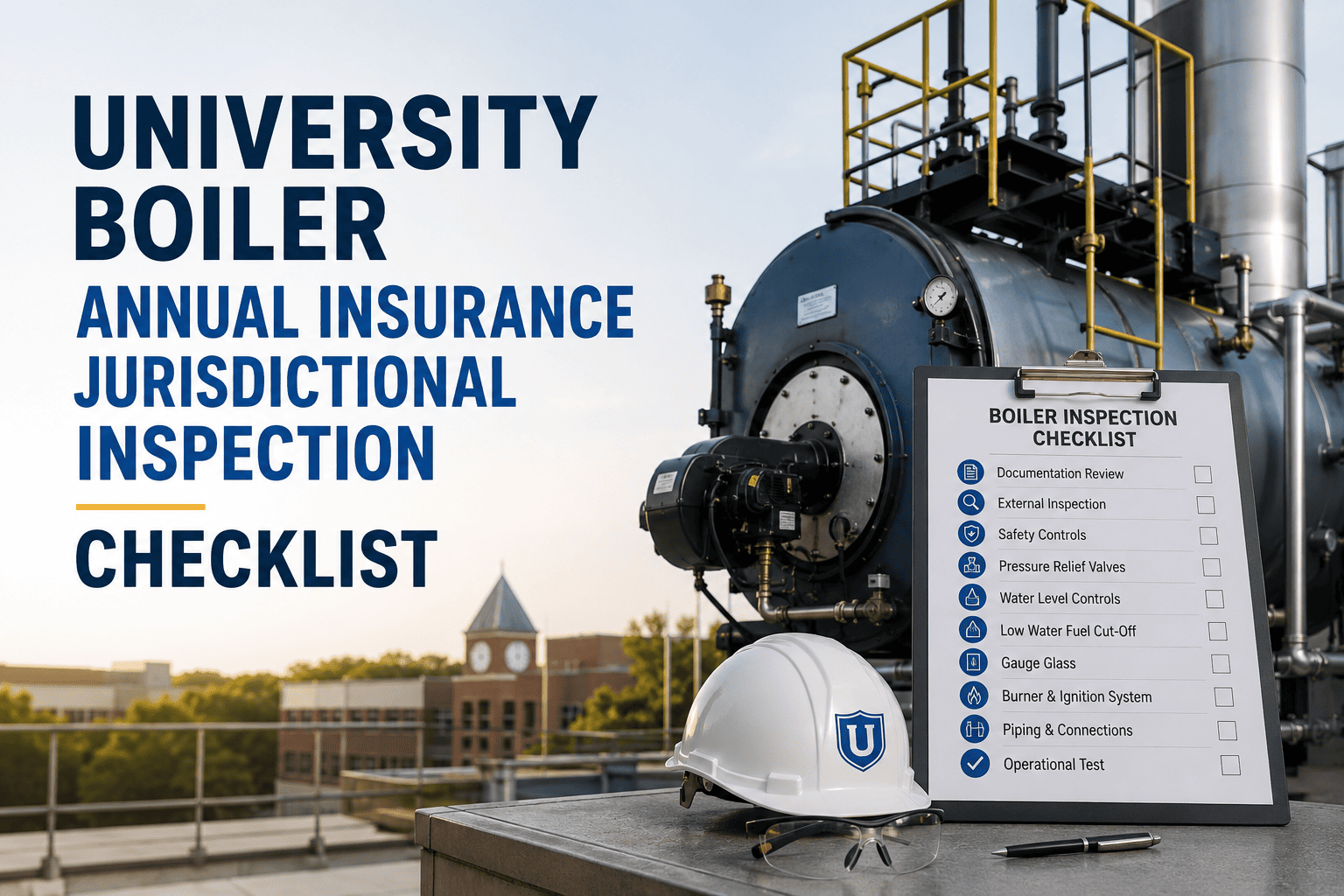
A boiler that has not been walked down by a licensed operator at the start of every shift is not a heating asset — it is a pressure vessel waiting for an unwitnessed failure. On university campuses, central plant boilers serving residence halls, laboratories, and administrative buildings operate year-round under ASME Section I or Section IV requirements, with insurance carriers and state boiler inspectors expecting a documented operator round every single day. This checklist gives your facilities, operations, and environmental health and safety teams a complete daily inspection framework covering pressure, water level, blowdown, combustion, low water cutoff, and burner management — structured so every check is traceable in your OxMaint compliance tracking platform with timestamped records that prove your boiler room is actively managed, not just periodically visited.
University Boiler Daily Operator Round Checklist (ASME / Insurance Aligned)
A system-by-system daily boiler operator round framework covering steam pressure, water level, blowdown, combustion, low water cutoff, and burner management — built for campus central plants where a missed check becomes an ASME violation or an insurance coverage gap.
Steam Pressure & Water Level
Steam pressure above the maximum allowable working pressure and water level outside the visible gauge glass range are the two conditions that precede every catastrophic boiler failure. Neither can be assumed normal between operator rounds — both must be read, recorded, and compared against operating limits at every shift start.
Blowdown Operations
Bottom blowdown removes sludge and concentrated dissolved solids from the mud drum; surface blowdown controls total dissolved solids. Neither is optional. A boiler operating without regular blowdown accumulates scale that reduces heat transfer efficiency and, in severe cases, causes overheating of the pressure-containing shell.
Low Water Cutoff (LWCO)
The low water cutoff is the last line of defense before a boiler fires dry. State boiler codes and ASME CSD-1 require float-type and probe-type LWCO devices to be tested at intervals defined in the operating permit. A LWCO that has never been function-tested may have a seized float or a fouled probe that will not trip the burner when water level drops below the danger point.
Combustion & Burner Management
A burner producing incomplete combustion generates CO at levels that can migrate from the boiler room into occupied campus buildings through shared HVAC pathways. Flame scanner fouling, air register sticking, and fuel pressure drift are all conditions that change combustion quality silently between tune-up visits.
State boiler inspectors arrive unannounced. OxMaint timestamps every operator round, captures gauge readings as structured data, and flags missed blowdowns before the next shift handover — giving your facilities team audit-ready boiler records on demand.
Feedwater System & Chemical Treatment
Feedwater pump failure on a high-pressure steam boiler with no backup pump and a low water alarm that was never tested is a scenario that ends with an emergency shutdown, a state investigation, and a very expensive insurance claim. Pump redundancy verification and chemical feed continuity are daily operator responsibilities, not annual contractor activities.
Safety Relief Valve & Compliance Documentation
A safety relief valve that has not been tested in more than two years may have a corroded seat that will not open at the set pressure — meaning the only overpressure protection on the boiler is non-functional. Insurance carriers and state inspectors treat an overdue SRV test as a compliance failure equivalent to operating the boiler without a valid certificate.
Six Metrics That Prove Your Campus Boiler Is Safely Operated
| Metric | How to Measure | Target | Frequency |
|---|---|---|---|
| LWCO Trip Reliability | Successful trips / Total blowdown tests | 100% | Daily |
| Steam Pressure Within Band | Shift readings within operating band | 100% of readings | Daily |
| Blowdown Completion Rate | Completed blowdowns / Scheduled blowdowns | 100% | Daily |
| Flue Gas CO Level | Analyzer reading at stack corrected to 3% O₂ | < 400 ppm | Daily |
| Boiler Certificate Validity | Days remaining to inspection due date | Minimum 60 days buffer | Monthly |
| Operator Log Completion Rate | Signed logs / Scheduled shifts | 100% | Weekly |
Frequently Asked Questions
What ASME standards govern university boiler operations?
University boilers are governed by ASME Section I (power boilers above 15 psig steam) or Section IV (heating boilers at or below 15 psig steam), and ASME CSD-1 for controls and safety devices. State boiler codes — which adopt ASME standards by reference — set inspection frequency, operator licensing requirements, and certificate of inspection conditions. OxMaint tracks inspection due dates and operator log compliance automatically.
How often must the low water cutoff be tested on a campus boiler?
ASME CSD-1 and most state boiler codes require float-type LWCO devices to be tested by slow drain or blowdown at least daily on steam boilers. Probe-type electronic LWCO devices may have different test intervals specified by the manufacturer, typically weekly. Failure to perform and document the LWCO test is one of the most common deficiencies cited during state boiler inspections. See how OxMaint tracks LWCO test completion by boiler and shift.
Does a licensed boiler operator need to be present at all times on a university campus?
Operator attendance requirements depend on state jurisdiction, boiler horsepower, and operating pressure. Most states require a licensed operator to be on site whenever an unattended boiler exceeds defined pressure thresholds, or to conduct rounds at intervals not exceeding those specified in the boiler's certificate of inspection. Automated plants with remote monitoring must still have an operator available to respond within a defined time.
What does an insurance carrier review during a university boiler inspection?
Insurance boiler inspectors (typically Hartford Steam Boiler, FM Global, or similar) review the state certificate of inspection validity, operator shift logs for completeness, LWCO and safety valve test records, water treatment logs, and blowdown frequency. Gaps in any of these records may result in an insurance premium surcharge, a coverage restriction, or a requirement for corrective action before the policy renews.
How is blowdown frequency determined for a university steam boiler?
Bottom blowdown frequency is set by the water treatment program target TDS level and the makeup water quality. A boiler operating on softened city water with good condensate return may require only one bottom blowdown per shift, while a boiler with high makeup water hardness or poor condensate return may need two to three blowdowns per shift to maintain water quality. The water treatment contractor should specify the blowdown frequency as part of the written treatment program.
Every Blowdown Logged. Every LWCO Test Documented. Every Shift Record Ready.
OxMaint converts your boiler operator round into a mobile inspection workflow with structured data entry, automatic shift handover summaries, and one-click compliance reports — so the next state boiler inspection is a formality, not a risk.