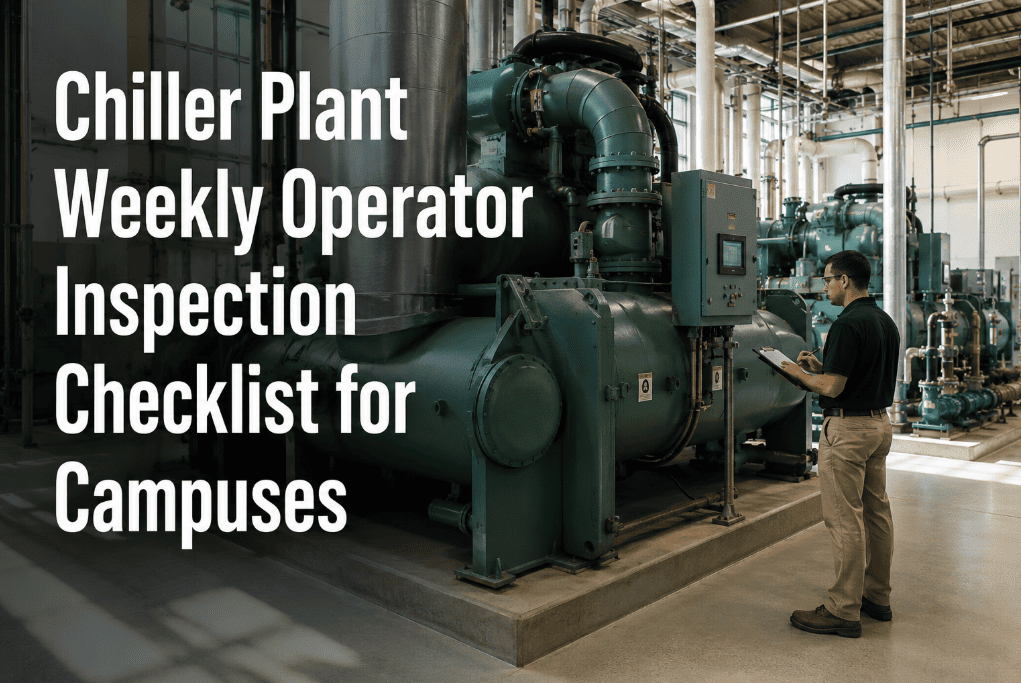
A chiller plant that is walked down once a week by a qualified operator and logged only on paper that no one reviews is not a managed asset — it is a cooling system waiting for an undetected refrigerant loss, a condenser tube foul, or a compressor oil failure to force an emergency shutdown during peak academic load. On university and college campuses, central chiller plants serving laboratories, data centers, and occupied buildings require systematic weekly inspections that capture compressor performance, condenser and evaporator conditions, refrigerant circuit integrity, electrical data, and pump operation — structured so every reading is traceable in your OxMaint compliance tracking platform with timestamped records that support ATC handoffs, insurance reviews, and energy efficiency reporting.
Chiller Plant Weekly Operator Inspection Checklist for Campuses
A system-by-system weekly chiller plant operator inspection framework covering compressor, condenser, evaporator, refrigerant circuit, electrical data, and pump logs — built for campus central plants where a missed inspection becomes a refrigerant incident, a chiller failure, or an ATC handoff dispute.
Compressor Performance & Oil System
Compressor oil pressure below the minimum differential, oil temperature outside the normal band, and excessive vibration are the three pre-failure indicators that a weekly operator inspection must capture before a compressor trip forces an unplanned shutdown during peak cooling demand. Trend logging is more valuable than any single reading.
Refrigerant Circuit & EPA Compliance
EPA Section 608 requires that refrigerant leaks exceeding the applicable trigger rate be repaired within 30 days, and that leak inspections be documented. An operator who smells refrigerant or observes oil staining around fittings but does not log and report the observation is creating an environmental compliance exposure that the university's environmental officer may not discover until an EPA inspector arrives.
EPA refrigerant inspectors and insurance surveyors review chiller logs as the primary evidence of active plant management. OxMaint captures every kW/ton reading, refrigerant circuit check, and pump data point with timestamps and operator attribution — audit-ready on demand.
Condenser Performance
A condenser with 1 mm of scale on the waterside tubes operates at significantly reduced heat transfer efficiency — raising condensing pressure, increasing compressor work, and driving kW/ton upward in a trend that appears gradual until it isn't. Weekly approach temperature logging is the earliest indicator of condenser fouling that does not require a tube pull.
Evaporator & Chilled Water System
An evaporator with leaving chilled water temperature 2°F above setpoint at full load is not delivering the cooling capacity the campus is paying for. Low chilled water flow, approaching the freeze protection setpoint, and rising evaporator approach temperature are the three conditions that escalate from performance issue to equipment damage if not caught in the weekly round.
Pumps & Electrical Systems
A chilled water pump with a mechanical seal leak that has been dripping for three weeks and never reported is not a maintenance item — it is an uncontrolled water release that will eventually cause motor insulation failure, bearing corrosion, and an unplanned pump changeout during peak cooling season.
ATC Handoff Records & Compliance Documentation
An ATC (Automatic Temperature Controls) handoff that does not include a complete chiller plant data log gives the incoming operator no baseline to detect performance degradation. A plant where weekly logs exist in paper binders that no one reviews is a plant where trending is impossible and every failure appears sudden.
Six Metrics That Prove Your Campus Chiller Plant Is Performing
| Metric | How to Measure | Target | Frequency |
|---|---|---|---|
| Chiller kW/ton Efficiency | kW input / Tons cooling output | Within 5% of design | Weekly |
| Condenser Approach Temperature | Condensing saturation temp − LCWT | Within 1°F of design | Weekly |
| Refrigerant Leak Rate | Annual charge loss / Total charge | < EPA trigger rate | Monthly |
| LCHWT at Setpoint | Leaving chilled water temp vs. setpoint | ±1°F | Weekly |
| Pump Seal Integrity | Seals with zero reported leakage | 100% | Weekly |
| Weekly Inspection Completion | Completed inspections / Scheduled weeks | 100% | Weekly |
Frequently Asked Questions
What EPA requirements apply to campus chiller plants?
Campus chillers using refrigerants with a GWP greater than zero are subject to EPA Section 608 of the Clean Air Act. Requirements include: maintaining appliance records (refrigerant additions and removals), leak inspection at the applicable trigger rate (for commercial equipment, currently 20% annual leak rate triggers a mandatory repair), and using EPA Section 608-certified technicians for refrigerant handling. OxMaint tracks refrigerant additions, calculates annual leak rates, and alerts you before the EPA trigger threshold is reached.
How is kW/ton calculated for a campus chiller?
kW/ton is calculated by dividing the total electrical power input to the chiller (in kilowatts, including compressor motor and auxiliaries) by the cooling output in tons of refrigeration. Cooling output in tons equals (GPM × ΔT °F × 500) / 12,000. A centrifugal chiller in good condition typically operates between 0.5 and 0.7 kW/ton at design load, with higher values indicating degradation or off-design conditions. See how OxMaint trends kW/ton automatically from operator-entered data.
How often should campus chiller tubes be cleaned?
ASHRAE recommends condenser tube cleaning when the approach temperature exceeds the design value by more than 1°F. For most campus applications with treated condenser water, this typically means annual tube brushing during the off-season maintenance window. Evaporator tubes in a well-maintained closed chilled water loop rarely require cleaning more than every three to five years, but should be inspected annually via borescope.
What is an ATC handoff and why does it require chiller plant documentation?
An ATC (Automatic Temperature Controls) handoff refers to the formal transfer of plant operating data and status between the campus facilities team and an ATC contractor, or between operators at shift change. A complete handoff includes current set points, recent alarm history, any equipment in manual or bypassed, and the most recent weekly inspection data. Without documented weekly inspection records, the incoming operator has no basis to evaluate whether the plant is performing normally or degrading.
What is the risk of operating a campus chiller with low refrigerant charge?
Operating a centrifugal chiller with low refrigerant charge causes the suction pressure to drop below the design value, which reduces the density of refrigerant vapor entering the compressor, reduces cooling capacity, and may cause the chiller to surge — a violent reverse-flow condition that causes compressor impeller damage. In addition, low charge may be accompanied by elevated discharge superheat that degrades motor windings in hermetic compressors cooled by refrigerant gas. EPA Section 608 also prohibits knowingly venting refrigerant and requires repair of leaks above the trigger rate.
Every kW/ton Trended. Every Refrigerant Addition Logged. Every ATC Handoff Documented.
OxMaint converts your chiller plant weekly round into a mobile inspection workflow with automatic efficiency trending, EPA refrigerant log integration, and one-click compliance reports — so the next insurance survey or EPA inspection is a formality, not an exposure.