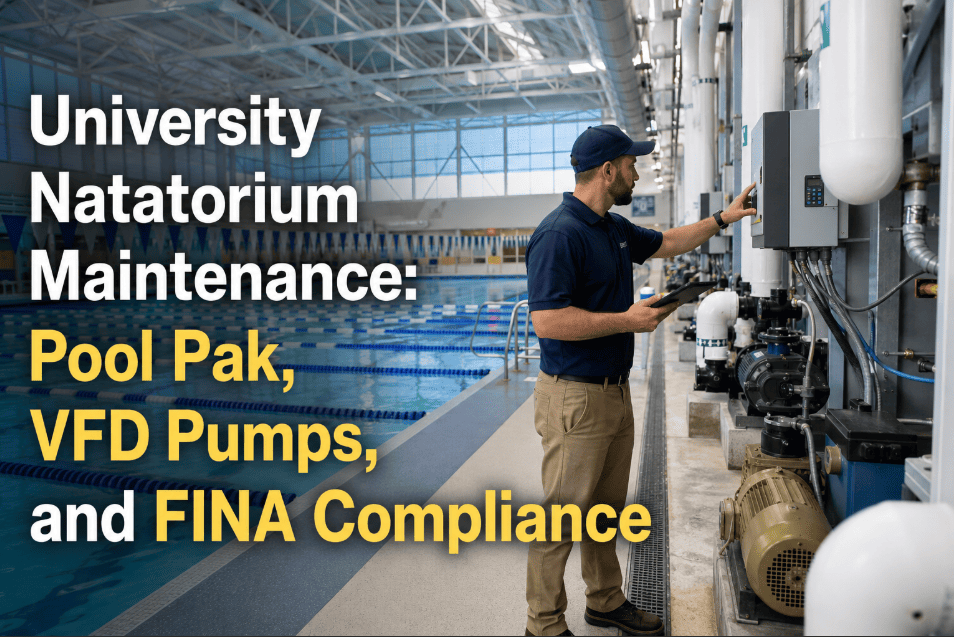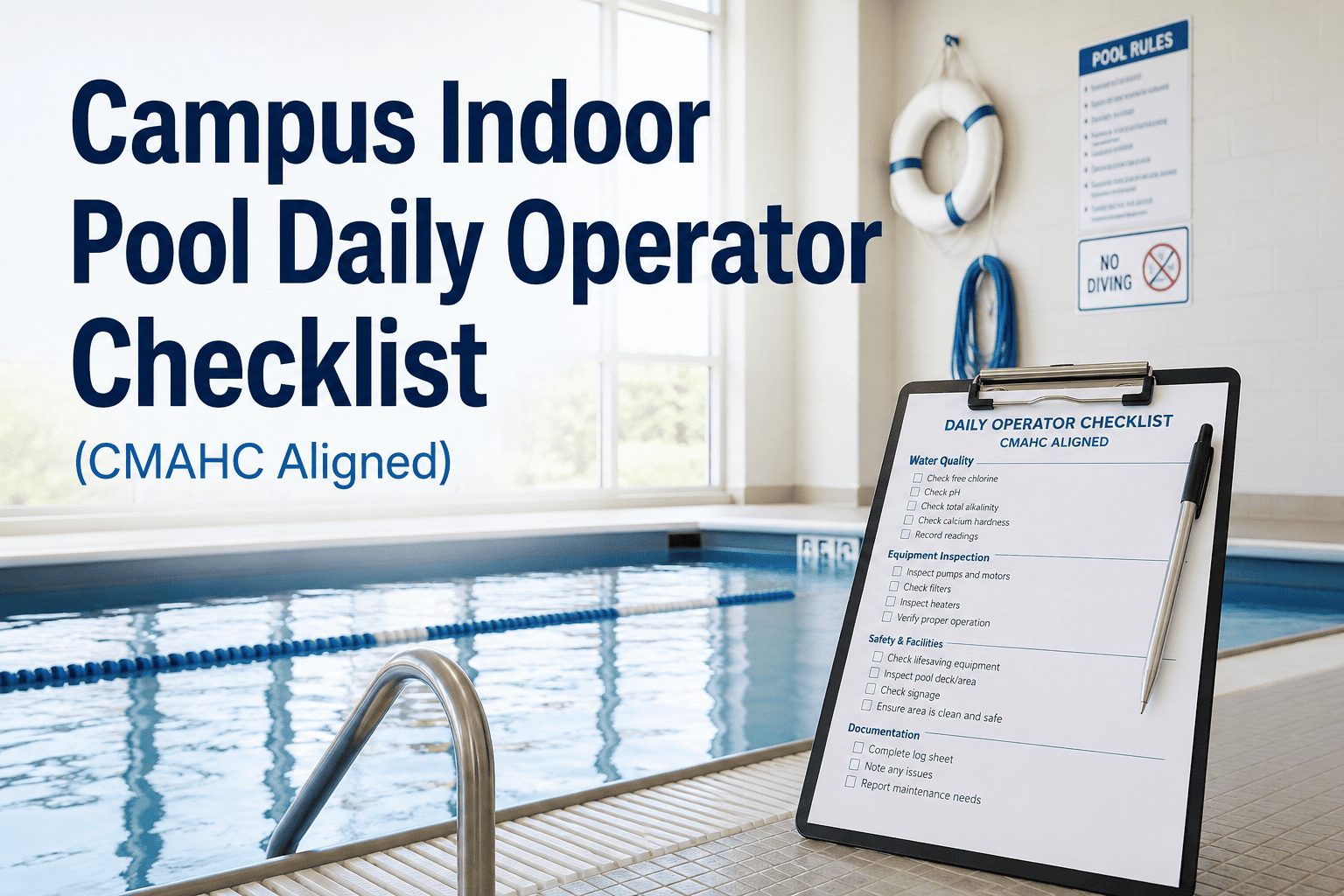
Campus indoor pool daily operations demand rigorous chemical testing, filtration monitoring, life safety verification, and documentation — every single day. For university aquatic center operators, a missed chemistry log or skipped deck inspection isn't just a compliance gap; it's a potential health emergency, a liability event, or a regulatory citation under CMAHC/MAHC guidelines. Sign Up Free to run your campus pool daily checklist in Oxmaint and capture every chemistry reading, filter check, and safety inspection with a timestamped digital record. From opening chemistry to closing sign-off, every operator action is logged per pool, per shift, and per responsible staff member — so nothing is assumed and nothing is missed. Book a Demo to see how university aquatic facilities use Oxmaint to stay CMAHC-aligned, reduce chemical incidents, and cut paperwork hours each week.
Digitize Your Campus Pool Daily Operator Checklist in Oxmaint
Oxmaint gives university aquatic facility teams a guided daily operator workflow covering water chemistry, filtration, deck safety, life safety equipment, signage compliance, and shift sign-off — fully aligned with CMAHC daily documentation requirements.
Campus Indoor Pool Daily Operator — Shift Sequence Overview
The CMAHC-aligned daily operator routine follows a structured opening-to-closing sequence. Each phase must be completed and recorded before the pool opens to users — and again at mid-shift and closing. Skipping a phase or recording results after the fact undermines the audit trail that protects the institution during health department inspections.
1. Pre-Open Equipment and Filtration Checklist
Filtration and chemical feed systems must be verified operational before any chemistry testing begins. An undetected pump failure or chemical feeder fault will corrupt all subsequent water quality readings — and allow chemistry to drift to unsafe levels during peak occupancy. Sign Up Free to assign pre-open equipment checks in Oxmaint with automated escalation if a critical system failure is logged before pool opening.
Circulation pump confirmed running — flow rate at design specification
Verify pump operation and confirm flow rate meets the facility's minimum turnover rate. CMAHC requires a minimum 6-hour turnover for pools — a failed or throttled pump reduces disinfectant distribution and creates dead zones. Required — verify before opening
Filter pressure gauge read and logged — backwash initiated if 8–10 PSI above clean baseline
Record filter influent and effluent pressure at each opening. High differential pressure indicates filter loading that reduces circulation efficiency and increases chemical demand. Document backwash events with time and operator initials. Action required — high differential pressure
Chemical feed system — chlorinator and CO₂/acid feed operational and supply levels confirmed
Verify chlorine feeder output, CO₂ or acid pH control system function, and chemical supply levels. An empty feeder discovered mid-shift can result in an hours-long chemistry exceedance that requires pool closure. Required — supply check before opening
Heater and temperature control setpoint verified — pool water temperature within posted range
Record water temperature and confirm it matches posted facility temperature. Temperature affects chlorine demand significantly — pools above 84°F consume free chlorine faster and require more frequent retesting. Note — elevated temp increases retest frequency
Automated chemical controller (ORP/pH probe) calibrated and reading within expected range
Where automated controllers are installed, verify probe calibration against a manual test at opening. Fouled ORP probes can under-report actual disinfectant levels, masking dangerous under-chlorination to the automation system. Required — manual verification of automated reading
2. Opening Water Chemistry Checklist (CMAHC Parameters)
Water chemistry is the most regulated component of the CMAHC-aligned daily log. Every parameter must fall within the acceptable range before the pool opens to bathers — and must be retested at minimum every two hours during operation. Book a Demo to see how Oxmaint captures chemistry readings with out-of-range alerts that escalate to the CPO before opening is permitted.
Free chlorine tested and logged — CMAHC acceptable range 1.0–10.0 ppm (pool), 3.0–10.0 ppm (spa)
Use a DPD test kit or electronic colorimeter — OTO test kits do not differentiate free from combined chlorine and are not acceptable for regulatory log documentation. Record test method, result, and time. Required — DPD test method only
Combined chlorine (chloramines) tested — action threshold above 0.4 ppm requires superchlorination
Combined chlorine above 0.4 ppm is the primary cause of eye and respiratory irritation in indoor pool facilities. Elevated combined chlorine in campus natatoriums frequently indicates inadequate bather hygiene compliance or insufficient breakpoint chlorination history. Action — superchlorinate if combined >0.4 ppm
pH tested and logged — CMAHC acceptable range 7.2–7.8, target 7.4–7.6
pH is the most critical chemistry parameter affecting disinfectant efficacy. Free chlorine effectiveness drops by 80% as pH rises from 7.2 to 8.0 — a pool with 2.0 ppm free chlorine at pH 8.0 has the effective disinfection capacity of 0.4 ppm at pH 7.2. Required — pool closed if outside 7.2–7.8
Total alkalinity tested — acceptable range 60–180 ppm, target 80–120 ppm
Total alkalinity functions as the pH buffer. Low alkalinity causes unstable pH swings that are difficult to control chemically; high alkalinity causes pH drift toward 8.0 and scale formation on tiles, equipment, and heat exchanger surfaces. Note — outside range requires chemical adjustment
Cyanuric acid (stabilizer) tested — CMAHC maximum 100 ppm; indoor pools typically 0 ppm
Cyanuric acid is not recommended for indoor chlorinated pools — it reduces chlorine efficacy without providing the UV-protection benefit it offers outdoors. Document if cyanuric acid is detected in an indoor facility and investigate stabilized chlorine product use. Flag — investigate source if detected indoors
Water clarity verified — main drain visible from pool deck at deepest point
Visual clarity is a mandatory opening check under CMAHC — the main drain or bottom must be clearly visible from the pool deck. A pool that fails the clarity check must be closed until filtration restores visibility. Required — closure if main drain not visible
3. Deck Safety and Life Safety Equipment Checklist
Deck safety and life safety equipment checks are legally required before bathers are admitted. Missing or damaged rescue equipment at a campus aquatic facility creates direct institutional liability. Sign Up Free to track rescue equipment inspections in Oxmaint, with automatic work order generation when a deficiency is logged and escalation to the aquatic director before pool opening proceeds.
Rescue tubes and throwing rope inspected — count verified against required station inventory
Each lifeguard station must have its required rescue tube in serviceable condition before opening. Missing, damaged, or incorrect rescue equipment is an immediate pool closure trigger during health department inspection. Document count and condition per station. Required — station inventory before opening
AED inspected — indicator light green, pads within expiration date, battery status confirmed
AED readiness is a non-negotiable pre-open check for campus aquatic facilities. A failed AED indicator requires the unit to be pulled from service and a backup deployed — pool does not open with an AED deficiency unresolved. Required — pool closed if AED inoperable
Backboard and cervical collar present and accessible at poolside — straps intact
Spinal rescue backboard must be present and fully rigged with straps at the pool deck before opening — not in a storage room. Verify strap condition and head immobilizer attachment. Record location and condition. Defect — inaccessible or damaged backboard
Pool deck slip hazard inspection — wet areas, lane line hardware, gutter grates checked
Walk the full perimeter before opening. Document any trip hazards, missing gutter grates, cracked deck tiles, or standing water beyond normal wet-deck conditions. Rope off hazardous areas and submit a facilities work order before allowing bather access. Action — rope off and submit work order
Required signage posted and legible — bather rules, depth markers, no diving, occupant load
CMAHC requires maximum bather load, depth markers at transition points, no-diving signage, and facility rules to be posted and legible. Faded, missing, or incorrect signage is a health department citation item — document signage condition at each opening check. Required — all signage before opening
4. Mid-Shift Retest and Incident Log Checklist
Chemistry retesting every two hours during operation is an explicit CMAHC requirement — not a recommendation. Bather load, temperature, sunlight (in hybrid indoor/outdoor facilities), and chemical feed interruptions all affect disinfectant levels between tests. Book a Demo to see how Oxmaint sends scheduled retest reminders to on-duty operators and flags missed test windows for CPO review before the shift closes.
Free chlorine and pH retested at minimum every 2 hours — results logged with time and operator ID
Every retest entry must include the exact test time, reading, and the operator who performed the test. CMAHC-aligned logs require this data for compliance — entries that show rounded times or missing operator IDs are red flags during health department audits. Required — timestamped and initialed
Chemical adjustment documented — product name, amount added, time, and post-adjustment retest result
Every chemical addition must be recorded: product name, quantity, time added, and the follow-up test result confirming the adjustment achieved the desired correction. Undocumented chemical additions are a compliance deficiency and a safety concern if overdosing occurred. Required — document all additions
Fecal or vomit incident response procedure followed — pool closure, hyperchlorination, 30-minute contact time
Any fecal release or vomit incident requires immediate pool closure, removal of visible material, and a CMAHC-prescribed hyperchlorination treatment. Document incident time, action taken, contact time achieved, post-treatment chemistry, and time of reopening. Required — do not reopen without 30-min contact time
Bather count tracked against posted maximum occupant load
Exceeding the posted occupant load increases chemical demand, reduces lifeguard surveillance effectiveness, and is a code violation. Log peak hourly bather count for trend analysis — consistent near-capacity operation signals need for operational schedule adjustment. Note — log peak count per shift
Technology Streamlining Campus Aquatic Facility Daily Operations
Campus aquatic facilities require daily chemistry documentation, life safety equipment logs, incident records, and shift sign-offs that span multiple operators, supervisors, and regulatory frameworks simultaneously. Manual paper logs create gaps — illegible entries, missing retests, undocumented incidents — that surface as compliance violations during health department inspections or in post-incident litigation. Sign Up Free to replace paper pool logs with Oxmaint's guided digital checklist that captures every required data point in a legally defensible audit trail.
Replace Paper Pool Logs With a CMAHC-Aligned Digital Checklist
Oxmaint gives campus aquatic operators a complete daily workflow — chemistry logging, life safety checks, incident documentation, and CPO sign-off — with every entry timestamped and auditable for health department compliance.
Frequently Asked Questions
Common questions from campus aquatic facility managers, CPOs, and university recreation directors about CMAHC daily requirements, pool log documentation, and operational compliance.
CMAHC requires free chlorine and pH to be tested at minimum every two hours during operation, plus at opening and closing. High-bather-load periods or elevated water temperature may require increased frequency as dictated by the CPO's professional judgment.
CMAHC specifies a minimum of 1.0 ppm free chlorine for pools, with a maximum of 10.0 ppm. The operational target for most campus indoor pools is 2.0–4.0 ppm to balance disinfection efficacy with bather comfort in enclosed natatorium environments.
Yes. CMAHC requires the main drain to be visible from the pool deck as a mandatory clarity standard. Failure to meet visual clarity requires immediate pool closure until filtration and chemistry are corrected and clarity is restored.
CMAHC requires immediate pool closure, removal of visible fecal material, and hyperchlorination to achieve the prescribed free chlorine level for a minimum 30-minute contact time before the pool can reopen. All steps must be documented with times and post-treatment chemistry readings.
Retention requirements vary by state health authority, but most jurisdictions require a minimum of one to three years. Oxmaint stores all daily logs with timestamps, operator IDs, and chemistry readings in a searchable digital archive accessible for health department inspections on demand.
Oxmaint provides guided daily checklists covering opening chemistry, mid-shift retests, life safety equipment inspections, incident documentation, and CPO sign-off — with out-of-range alerts, scheduled reminders, and a fully auditable digital log per pool per shift.
Every Chemistry Reading. Every Safety Check. Fully Documented.
Oxmaint gives campus aquatic teams a single platform for CMAHC-aligned daily logs, life safety equipment records, incident documentation, and CPO sign-off — so every shift is compliant, every log is auditable, and no inspection catch you unprepared.