An elevator that has passed its annual state inspection certificate but has never had its door reversal force tested, its leveling accuracy measured, or its emergency communication system verified by a monthly operator round is not a safe vertical transport system — it is a certificate on a wall and an unverified machine. In university campuses, elevators serve students with mobility impairments, transport heavy laboratory equipment, and operate in dormitories where late-night entrapments without functioning communication systems become emergency response events. ASME A17.1 establishes the performance requirements; the monthly operator inspection is what verifies those requirements are still being met between annual inspections. This checklist gives your facilities, safety, and compliance teams a complete monthly operator inspection framework covering door operation, leveling, cab condition, emergency lighting, communication, and statutory certificate documentation — structured so every inspection is traceable in your OxMaint compliance tracking platform with timestamped records that prove your elevators are maintained, not just certified, when a state elevator inspector, ADA auditor, or insurance surveyor arrives.
University Facilities · Safety & Compliance · Vertical Transport
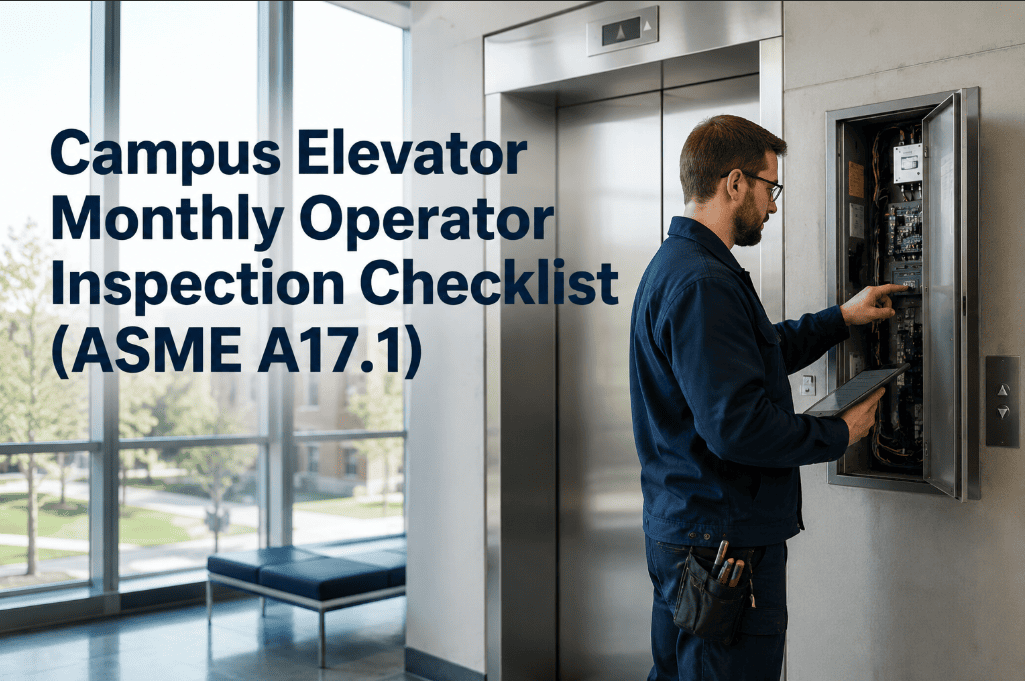
Campus Elevator Monthly Operator Inspection Checklist (ASME A17.1)
A system-by-system elevator operator inspection framework covering door operation, cab leveling, emergency lighting, communication systems, machine room condition, and statutory certificate documentation — built for university campuses where an entrapment without a functioning phone or an out-of-level landing becomes an ADA violation and a liability event.
7
Inspection Categories
50+
Check Points
100%
Compliance Target
P1
Safety Priority
High-Risk Elevator Failure Scenarios on a University Campus
Door Reversal Failure
Doors that do not reverse on contact trap passengers and cause injury
Emergency Phone Failure
Non-functioning communication during entrapment delays rescue and violates ASME A17.1
Out-of-Level Landing
Mis-leveling above 13 mm creates a trip hazard and ADA non-compliance
Emergency Lighting Failure
Loss of cab lighting during power outage leaves trapped passengers in darkness
Overloaded Machine Room
Stored materials in machine rooms obstruct maintenance access and create fire load
Expired Operating Certificate
Operating without a current state certificate is a statutory violation and voids insurance
DDaily
WWeekly
MMonthly
QQuarterly
AAnnual
Category 01
Door Operation & Safety Edge Verification
The elevator door is the most frequent point of passenger injury and the most frequently cited ASME A17.1 deficiency in campus elevator inspections. A door that closes faster than permitted, fails to reverse on obstruction, or has a safety edge that activates only after 75 mm of contact rather than at first touch is not a compliant door — it is an injury mechanism that the annual inspection date has not yet caught up with. Monthly door operation verification is the check that keeps passenger contact with a closing door from becoming a regulatory finding.
Door opening and closing cycle timed — doors must open fully within ASME A17.1 specified time and close at a closing speed that does not exceed the maximum permitted kinetic energy; doors that slam or close with visible speed increase require immediate elevator contractor inspection
MFacilities Inspector · Door cycle time log
Safety edge or light curtain reversal function tested — obstruction introduced at door edge during closing cycle; doors must reverse immediately upon contact or detection without applying force exceeding ASME A17.1 limits; delayed or absent reversal requires elevator removal from service
MFacilities Inspector · Safety edge test log
Door open button function verified at each floor — door open button tested from inside cab; doors must remain open for the full hold-open period when button is pressed; a button that does not extend the open time has a failed switch requiring work order generation
MFacilities Inspector · Door hold-open function log
Door sills and tracks inspected for debris accumulation — loose screws, grit, food debris, or fallen objects in the door track can cause door hunting, premature reversal, or door-sill trip hazards; tracks cleaned and any obstruction removed during inspection
MFacilities Inspector · Door track condition log
Hoistway door interlock function confirmed — cab must not move when any hoistway door is open; interlock test performed by attempting to move cab with hoistway door held slightly ajar; cab movement with open hoistway door is an immediate out-of-service condition
MFacilities Inspector · Interlock test log
Category 02
Leveling Accuracy & Ride Quality
An elevator that consistently stops 25–50 mm above or below floor level is not a minor inconvenience — it is a trip hazard for all passengers and an ADA violation that prevents wheelchair users from independently entering and exiting the cab. ASME A17.1 permits a maximum leveling tolerance of ±13 mm under normal load conditions. A campus elevator serving multiple buildings or an older hydraulic elevator with worn pump seals will creep out of level between annual inspections — and only monthly measurement catches the drift before it becomes an injury.
Landing accuracy measured at each floor in both directions of travel — cab floor position measured relative to landing floor level using a straight-edge or laser level; any floor stop exceeding ±13 mm (½ inch) from level requires immediate elevator contractor callout before the next operating day
MFacilities Inspector · Leveling accuracy log — all floors
Re-leveling function verified under load — passenger enters cab to simulate load; hydraulic elevators must re-level to within ±6 mm if settling occurs after loading; a hydraulic elevator that settles more than 25 mm under load has a cylinder seal or pump check valve fault
MFacilities Inspector · Re-leveling function log
Ride quality assessed for unusual vibration, jerking, or noise — smooth acceleration and deceleration confirmed on each floor stop; significant vibration or jerking on traction elevators indicates worn guide shoes, uneven rope tension, or controller fault requiring elevator contractor investigation
MFacilities Inspector · Ride quality observation log
Floor indicator accuracy confirmed — cab position display and hall indicator displays confirmed to correctly show current floor at all landings; incorrect floor indication misleads passengers during evacuation and is a separately cited deficiency under ASME A17.1
MFacilities Inspector · Floor indicator accuracy log
State elevator inspectors check the certificate. Monthly operator rounds check the elevator. OxMaint assigns inspection routes to named technicians, captures leveling measurements and door test results, and generates the documentation trail that proves your campus elevators are maintained between annual inspections — not just certified.
Category 03
Emergency Communication System
ASME A17.1 Rule 2.27.1 requires that every elevator cab be equipped with a means of two-way communication with a location staffed by a person capable of initiating emergency rescue procedures. On a university campus, this means the cab phone must reach campus security or facilities dispatch — not voicemail, not an automated attendant, and not a disconnected line. A cab phone that rings but is not answered within the time required by ASME A17.1, or that does not function at all, turns every elevator entrapment into an extended emergency without communication.
Emergency telephone tested from within cab — phone activated and confirmed to connect to a staffed location within 60 seconds; operator at the receiving end confirms cab number and location; phone that reaches voicemail, an unmonitored line, or does not connect fails the ASME A17.1 test and requires immediate repair
MFacilities Inspector · Emergency phone test log with call answer confirmation
Alarm button audibility verified — alarm button activated and audible alarm confirmed to be heard from outside the hoistway at the nearest occupied space; alarm that cannot be heard from outside the cab does not meet the ASME A17.1 signaling requirement
MFacilities Inspector · Alarm audibility log
Emergency lighting battery backup tested — main cab lighting switched off to simulate power failure; emergency lighting must activate within 5 seconds and provide minimum 1 foot-candle at floor level; battery that fails to sustain lighting for minimum 4 hours requires immediate replacement
MFacilities Inspector · Emergency lighting backup test log
ADA-compliant signage and Braille confirmed legible — all cab buttons confirmed to have current Braille labels; floor number signage at each landing confirmed present and legible; damaged or missing Braille labels are an ADA Title II violation for public university elevators
MFacilities Inspector · ADA signage condition log
Category 04
Cab Interior & Load Capacity Compliance
Elevator cab interior condition is the most visible indicator of an elevator maintenance programme to every campus user — and to every state inspector who enters the cab. A cracked cab panel does not fail an ASME A17.1 safety test, but it indicates a maintenance programme where cosmetic deterioration is accepted, and inspectors who find cosmetic deterioration look harder for mechanical deficiencies. Capacity plate compliance, handrail integrity, and floor covering condition are the interior checks that prevent the cab from becoming the leading indicator of a poorly maintained machine room.
Rated capacity plate confirmed present, legible, and current — capacity plate must show rated load in pounds or kilograms and maximum occupancy; removed, defaced, or outdated capacity plates are a statutory deficiency in every US state elevator code
MFacilities Inspector · Capacity plate condition log
Cab interior panels, ceiling, and floor covering inspected — cracked panels, loose ceiling tiles, damaged floor covering, or exposed electrical conduit logged and work orders generated; priority assigned based on whether deficiency creates a physical hazard or is purely cosmetic
MFacilities Inspector · Cab interior condition log
Handrail integrity and mounting security verified — handrail confirmed firmly mounted with no movement under 50 kg lateral force; missing handrail sections replaced before elevator is returned to passenger service; handrail is required equipment under ADA accessibility standards
MFacilities Inspector · Handrail condition log
Certificate of inspection confirmed posted in cab and current — operating certificate must be currently dated and displayed in the cab or machine room as required by state elevator code; expired certificate triggers immediate notification to elevator contractor and state authority for renewal
MFacilities Inspector · Certificate validity log
Category 05
Machine Room & Hydraulic Unit Inspection
The elevator machine room is a restricted space that most campus facilities departments treat as a secondary storage location — a tendency that creates fire hazards, maintenance access obstructions, and ASME A17.1 deficiencies that are cited every time a state inspector accompanies a maintenance technician to the machine room. Machine room compliance is not a mechanical issue; it is a facilities management discipline issue that monthly inspection reinforces and documents.
Machine room confirmed free of non-elevator storage — no boxes, cleaning supplies, spare parts for other systems, or personal items stored in machine room; ASME A17.1 prohibits use of machine rooms for storage of any materials not related to elevator operation
MFacilities Inspector · Machine room access log
Machine room temperature confirmed within acceptable range — machine room must be maintained between 10°C and 40°C for hydraulic fluid viscosity and electronic controller operation; temperature outside this range logged and HVAC fault reported to facilities engineering
MFacilities Inspector · Machine room temperature log
Hydraulic fluid level checked and confirmed within normal operating range — hydraulic unit sight glass or dipstick level confirmed full; low fluid level indicates cylinder or pipe leakage requiring immediate investigation; hydraulic fluid on floor is an environmental spill requiring reporting under campus spill response plan
MFacilities Inspector · Hydraulic fluid level log
Machine room lighting and dedicated electrical supply confirmed — machine room illumination minimum 200 lux at floor level; dedicated circuit breaker panel for elevator confirmed labelled; fire extinguisher in machine room confirmed in date and accessible
MFacilities Inspector · Machine room utility condition log
Category 06
Pit Condition & Safety Device Verification
The elevator pit is inspected during annual state inspections and virtually never between them. A pit that accumulates water, debris, or vermin between inspections creates a working environment hazard for every technician who enters the pit for maintenance and provides corrosion conditions that degrade the buffer springs, limit switches, and safety devices that the annual inspection verified as functional. Monthly pit observation from the lowest landing door is the minimum check that confirms the pit condition has not deteriorated.
Pit water level observed through pit access door — any water accumulation in pit logged and reported to facilities; water in pit indicates sump pump failure or groundwater infiltration requiring investigation; pit flooding can disable limit switches and buffers, creating an unsafe travel condition
MFacilities Inspector · Pit water observation log
Pit stop switch accessibility confirmed — pit stop switch must be accessible from pit access door without entering the pit; switch tested to confirm it stops elevator travel when activated; a seized or non-functional pit stop switch is a worker safety violation independent of passenger safety compliance
MFacilities Inspector · Pit stop switch test log
Pit lighting confirmed functional — pit lighting switch tested from access door; minimum illumination required for safe entry by maintenance personnel; failed pit lighting generates work order with 5-working-day closure target before next scheduled maintenance entry
MFacilities Inspector · Pit lighting condition log
Category 07
Statutory Compliance & Maintenance Records
State elevator codes require that the operating certificate be posted, that maintenance records be maintained, and in many states that a written maintenance control programme (MCP) be in place and followed. A university that can produce the annual inspection certificate but cannot produce the monthly operator inspection logs has satisfied one statutory requirement while failing another — and the monthly log gap is the finding that creates the most audit exposure during a state enforcement visit.
Monthly operator inspection log completed and filed in CMMS — log entry includes elevator unit ID, inspection date, inspector name, findings for each category, and work order numbers for any deficiencies raised; incomplete logs treated as missed inspections for compliance reporting purposes
MFacilities Manager · CMMS monthly inspection log
State operating certificate expiry date tracked in CMMS — certificate renewal application submitted minimum 60 days before expiry; many state elevator authorities require the elevator to be re-inspected and out of service until renewal is confirmed; 60-day buffer prevents operational disruption
MFacilities Manager · Certificate expiry tracker
Elevator contractor maintenance visit log reviewed — contractor maintenance visit records reviewed monthly to confirm scheduled visits were completed; any missed contractor visit triggers a follow-up call and rescheduling before the next 30-day period; contractor visit records retained for 5 years
MFacilities Manager · Contractor visit verification log
Entrapment and callback log reviewed — any entrapment events, emergency callbacks, or passenger-reported deficiencies logged and reviewed monthly; repeat callbacks on the same unit within 30 days trigger an elevator contractor performance review and possible contract escalation
MFacilities Manager · Entrapment and callback review log
Compliance KPIs
Six Metrics That Prove Your Campus Elevator Programme Is ASME A17.1 Compliant
| Metric |
How to Measure |
Target |
Frequency |
| Monthly Inspection Completion Rate |
Elevators inspected on schedule / Total campus elevators |
100% per month |
Monthly |
| Door Safety Edge Pass Rate |
Elevators passing reversal test / Total elevators tested |
100% |
Monthly |
| Leveling Accuracy Compliance |
Floor stops within ±13 mm / Total floor stops measured |
100% |
Monthly |
| Emergency Phone Connectivity |
Phones connecting to staffed location / Total cabs tested |
100% |
Monthly |
| Certificate Validity Buffer |
Days remaining on shortest-expiry operating certificate |
Minimum 60 days |
Monthly |
| Deficiency Closure Rate |
Closed deficiency work orders / Total raised |
100% within 5 working days |
Monthly |
FAQs
Frequently Asked Questions
What does ASME A17.1 require for university elevator maintenance between annual state inspections?+
ASME A17.1 requires that a maintenance control programme (MCP) be developed and followed, that all maintenance tasks be documented, and that periodic tests including door safety device verification, leveling checks, and emergency communication tests be performed at intervals specified in the MCP. Monthly operator rounds that systematically verify door operation, leveling, emergency phone function, and machine room condition are the documented evidence that the MCP is being followed. OxMaint structures monthly elevator operator rounds as traceable digital inspections with timestamped evidence —
start a free trial or
book a demo to see the workflow.
What is the maximum permitted leveling tolerance under ASME A17.1?+
ASME A17.1 requires that elevators level to within ±13 mm (½ inch) of the landing floor under normal load conditions, and re-level to within ±6 mm (¼ inch) for hydraulic elevators experiencing settling under load. Any landing that consistently stops outside the ±13 mm tolerance creates a trip hazard and an ADA Title II accessibility violation for public university elevators. Hydraulic elevators with worn cylinder seals or a failing pump check valve will exceed the settling tolerance; both conditions require elevator contractor investigation before the next operating day.
What are the ASME A17.1 requirements for the elevator emergency communication system?+
ASME A17.1 Rule 2.27.1 requires that each elevator cab be equipped with a means of two-way communication between the cab and a location that is continuously staffed by a person capable of initiating emergency procedures — such as campus security dispatch or a facilities control room. The communication device must operate on a dedicated circuit or on a cellular system that does not require the passenger to dial a number. The phone must connect within a specified time (generally 60 seconds or less in most state codes), and the answering party must be able to identify the specific elevator cab and location. Monthly testing with a logged confirmation from the receiving party is the standard of evidence required by most state elevator authorities.
Can a university continue operating an elevator after its state operating certificate has expired?+
No. Operating an elevator without a current state operating certificate is a violation of state elevator safety law in every US jurisdiction that has adopted ASME A17.1 as the regulatory basis. Consequences include civil penalties per day of operation, direction to cease operation immediately, and voidance of the university's insurance coverage for any injury or entrapment event during the period of lapsed certification. Certificate renewal must be initiated no later than 60 days before expiry. OxMaint tracks operating certificate expiry dates for every elevator unit and generates renewal reminders automatically —
start a free trial to configure your campus elevator compliance tracking.
What items are prohibited from being stored in an elevator machine room under ASME A17.1?+
ASME A17.1 prohibits the storage of any materials in the elevator machine room that are not directly related to elevator operation and maintenance. This includes janitorial supplies, spare parts for other building systems, network equipment, HVAC components, and personal items left by maintenance personnel. The prohibition exists because non-elevator materials create fire load in a room that contains electrical equipment and hydraulic fluid, obstruct emergency access to the controller and disconnect switch, and indicate that the machine room is not being maintained to code standards. State elevator inspectors treat unauthorized machine room storage as a separately cited deficiency from any mechanical findings.
Digitize Elevator Compliance · Oxmaint CMMS
Every Door Tested. Every Floor Level Verified. Every Certificate Tracked.
OxMaint converts your campus elevator operator rounds into mobile monthly inspections with leveling measurements, door test records, emergency phone confirmation logs, and certificate expiry tracking — so the next state elevator inspection is a formality, not a citation. No implementation project. First automated inspection work orders in week one.