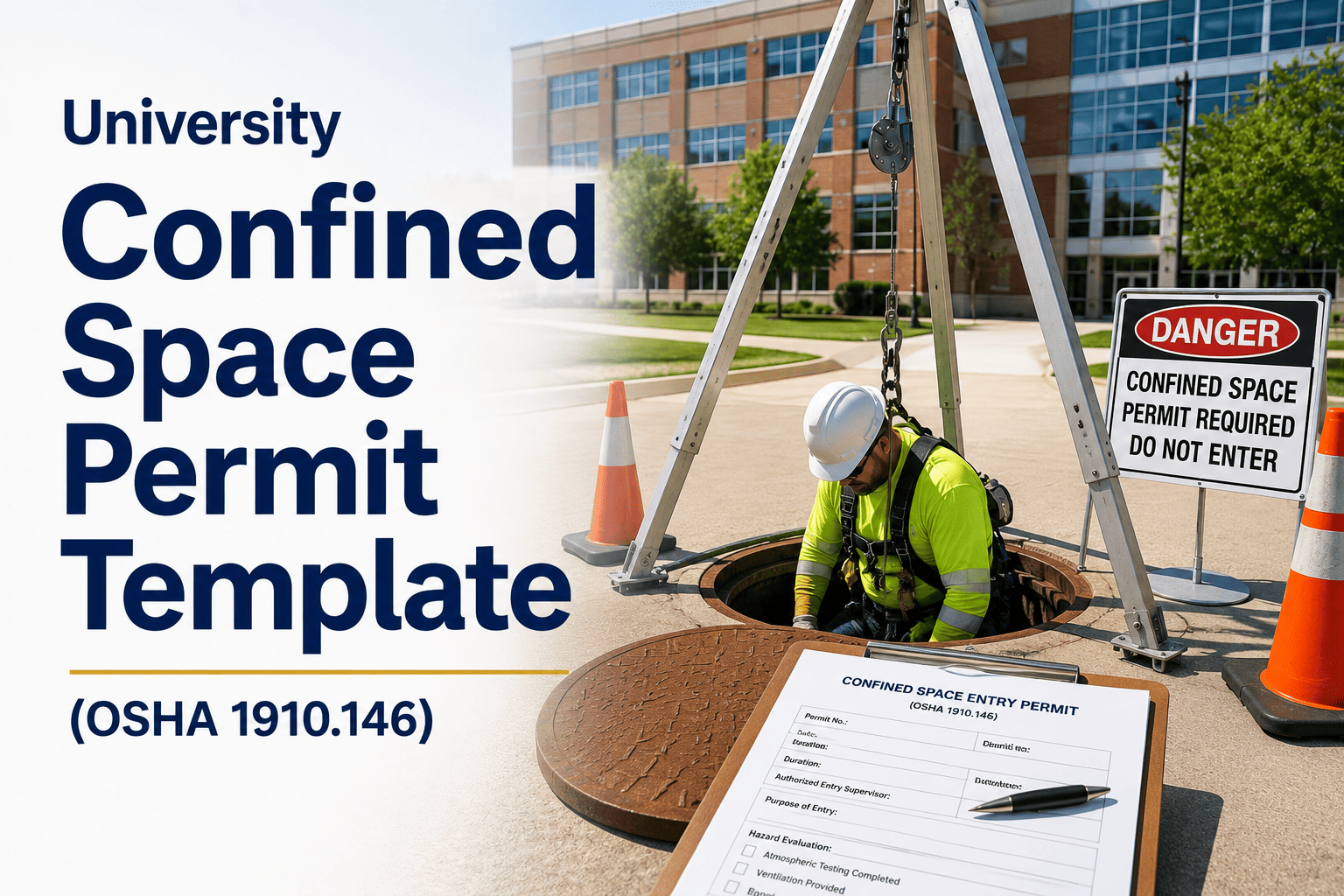
University Confined Space Permit Template (OSHA 1910.146)

By Corin Hale on June 12, 2026

university-confined-space-permit-template-osha-1910-146

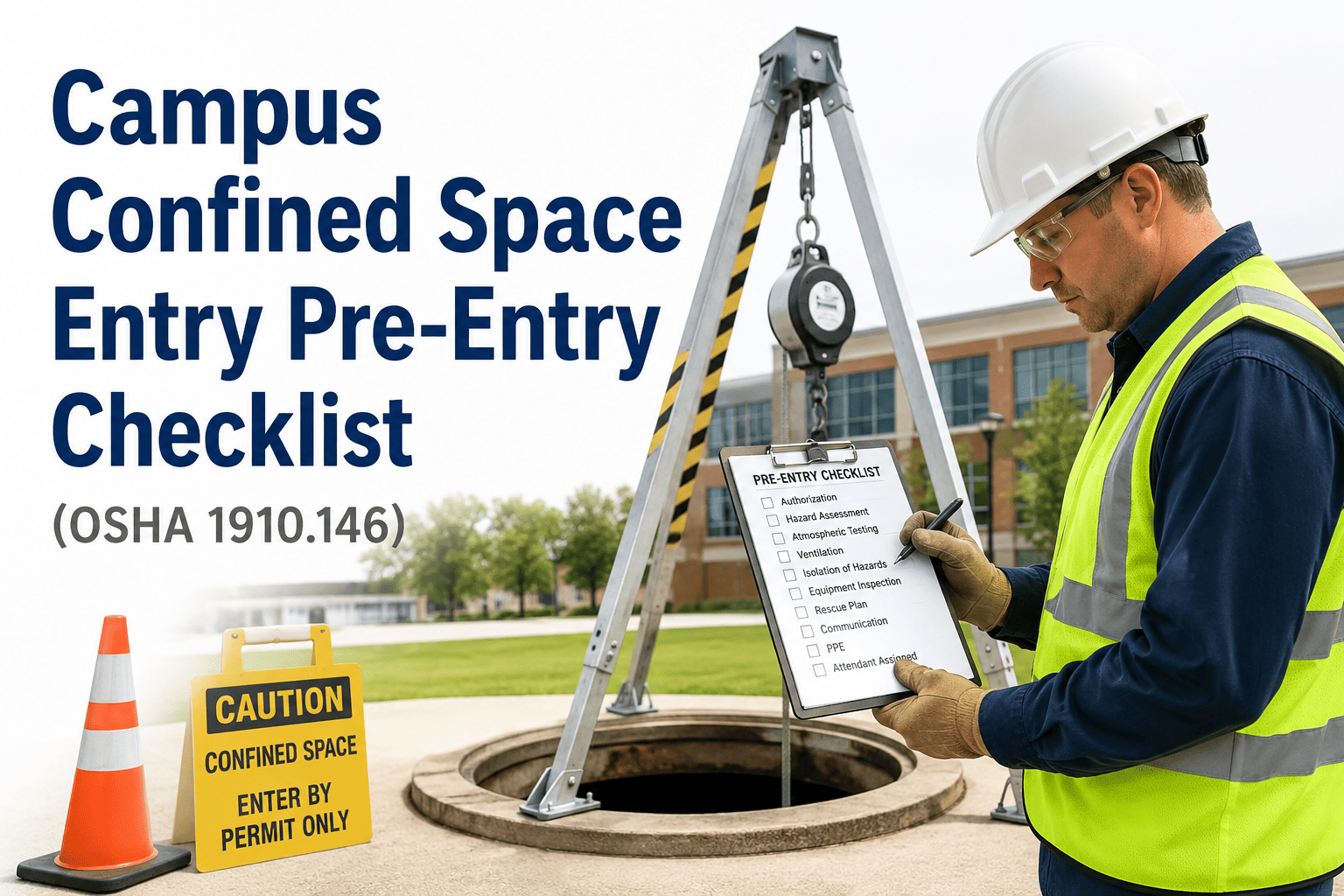
University campuses are densely packed with confined spaces that most building occupants never think about — utility tunnels connecting steam and chilled water distribution lines, electrical vaults beneath parking structures, below-grade mechanical equipment rooms, manholes in campus grounds, and storage tanks associated with research facilities. OSHA 1910.146 requires a written permit-required confined space program, and every entry into a permit-required space must be documented with a completed confined space entry permit before work begins. The documentation burden across a large research university is significant — maintenance teams entering dozens of permit spaces annually, each requiring atmospheric testing records, attendant assignment, authorized entrant sign-off, rescue plan notation, and PPE specification before the first worker descends. Without a structured permit template tied to a real-time work order system, that documentation often exists as paper forms stored in department files — inaccessible during an OSHA inspection and invisible to the facilities director responsible for the program. Sign Up Free and start connecting confined space permits to the asset work orders that generate them. The template structure below covers all required fields under OSHA 1910.146 Appendix D, adapted for the multi-building, multi-department operational reality of university facilities management. Teams that standardize on a digital permit template — with each permit linked to a specific campus asset — eliminate the paper trail problem and create an auditable record that survives personnel transitions. Book a Demo to see how Oxmaint manages confined space assets, entry permits, and rescue plan documentation across an entire campus utility network. The permit is only as useful as the system that keeps it retrievable — and that system needs to be in place before the next OSHA compliance audit or near-miss incident.

Link every confined space entry permit to the campus asset it covers. Oxmaint tracks permit history, atmospheric test results, and authorized entrant records across all university buildings and utility systems.

OSHA 1910.146 Confined Space Permit — Required Fields Overview

OSHA 1910.146(f) specifies the minimum content a confined space entry permit must contain. A university template must cover all statutory fields while being practical enough for maintenance technicians to complete accurately in the field, before entry.

Space Identity and Location
Space name or number, building, campus zone, GPS reference for below-grade vaults. Must match the confined space inventory map and the Oxmaint asset ID.
Date / Time of Entry
Entry date, authorized start time, and permit expiration time. OSHA requires permits to be cancelled when entry is complete or conditions change materially.
Purpose of Entry
Specific work scope — inspection, valve maintenance, pump service, electrical work, cleaning. Scope drives the hazard assessment and PPE selection.
Atmospheric Testing
O₂ percentage, LEL percentage, CO ppm, H₂S ppm. Pre-entry readings required. Continuous monitoring notation if required by space classification. Instrument ID and calibration date.
Hazard Identification
All serious hazards present — atmospheric, mechanical, electrical, engulfment, entrapment. Isolation and lockout/tagout procedures referenced by LOTO procedure number.
Rescue Plan Reference
Non-entry rescue method described or attached rescue plan referenced. University emergency services contact, campus EMS, or local fire department notification protocol.

University Confined Space Types and OSHA Classification

Not every confined space on a university campus is permit-required, but many are — and misclassifying a permit-required space as non-permit is the most common OSHA 1910.146 violation in institutional settings. The table below maps common university confined space types to their typical OSHA classification.

Space Type Location Examples Typical Classification Primary Hazard
Utility Tunnel Steam, chilled water, electrical duct bank tunnels Permit-Required O₂ deficiency, steam, electrical exposure
Electrical Vault / Manhole Below-grade switchgear rooms, cable vaults, manholes Permit-Required Electrical hazard, O₂ deficiency, engulfment
Below-Grade Mechanical Room Basement plant rooms, pump rooms, chiller pits Permit-Required (typically) Atmospheric, mechanical, engulfment
Storage Tank Research lab chemical tanks, fuel oil tanks, water tanks Permit-Required Toxic atmosphere, O₂ deficiency, engulfment
Elevator Pit All campus buildings with elevators Non-Permit (typically) Mechanical — verify atmospheric if enclosed
Crawl Space Below-floor mechanical, historic buildings Non-Permit or Permit (site-specific) Atmospheric if enclosed, biological
Roof Penthouse / HVAC Housing Rooftop mechanical equipment enclosures Non-Permit (typically) Atmospheric if forced ventilation limited

Confined Space Permit Template — Section-by-Section Field Reference

The following field groups form a complete OSHA 1910.146 compliant confined space entry permit for university use. Sign Up Free to configure digital confined space permit checklists in Oxmaint, attached to each permit-required space asset in your campus inventory.

Section 1 — Space and Entry Information

Space Name / IDUnique identifier matching the campus confined space inventory and Oxmaint asset record
Building / LocationBuilding name, address, floor level, and specific location within building
Entry DateCalendar date of authorized entry — permit is not reusable across dates
Valid Entry PeriodStart time and cancellation time — permit expires when work is complete or conditions change
Purpose of EntrySpecific maintenance or inspection task — must match work order scope
Work Order ReferenceOxmaint work order number linking the permit to the maintenance task and asset history

Section 2 — Personnel Assignments

Authorized EntrantsName and signature of each worker authorized to enter — entries and exits logged against this list
Attendant (Outside)Name, signature, and radio/phone contact of the attendant stationed outside the space throughout entry
Entry SupervisorName and signature of supervisor who authorizes entry after verifying all permit conditions are met
Rescue Team ContactUniversity emergency services, campus EMS, or fire department contact — number verified before entry

Section 3 — Atmospheric Testing

Testing Instrument IDMake, model, and serial number of gas detector used — calibration date and bump test date required
Oxygen (O₂) %Acceptable range: 19.5%–23.5%. Record pre-entry and at intervals per program requirements
Flammable Gas (LEL %)Entry prohibited above 10% LEL. Record reading and gas being monitored
Carbon Monoxide (CO ppm)PEL 50 ppm TWA; action level site-specific. Required in utility tunnels and areas with combustion equipment
Hydrogen Sulfide (H₂S ppm)Required for sewer manholes, wastewater spaces, and laboratory waste lines. Ceiling 10 ppm.
Continuous Monitoring RequiredYes / No — specified for spaces where atmospheric conditions can change during entry

Section 4 — Hazard Control and Isolation

Hazards IdentifiedChecklist: atmospheric / mechanical / electrical / thermal / engulfment / noise / other
LOTO Procedure ReferenceLOTO procedure number(s) applied before entry — energy sources isolated and verified
Ventilation MethodForced air ventilation type, CFM rating, and duration of pre-entry ventilation
Engulfment / Entrapment ControlsBlanking, blinding, double block and bleed, or line breaking procedures applied

Section 5 — PPE and Equipment

Required PPEHard hat, safety glasses, gloves, foot protection, chemical-resistant clothing as applicable to space hazards
Respiratory ProtectionType — supplied air, SCBA, air-purifying respirator. Required when atmospheric controls are insufficient
Retrieval / Rescue EquipmentTripod and winch, full-body harness, retrieval line — required for vertical entry spaces
Communication EquipmentRadio channel or phone number for entrant-to-attendant communication throughout entry

Section 6 — Rescue Plan

Rescue MethodNon-entry retrieval using retrieval system (preferred) or entry rescue by trained team — method specified per space
Emergency Contact NumbersCampus emergency, university EMS, local fire department — numbers verified and posted before entry
Rescue Team NotificationConfirmation that the rescue service has been notified of the entry prior to work start
Space Access for RescueEntry point dimensions, obstructions, and approach route documented for rescuer reference

Section 7 — Permit Cancellation and Record Retention

Permit Cancelled ByEntry supervisor signature confirming all entrants have exited and space is secure
Time CancelledActual time entry was terminated — required for OSHA record retention audit trail
Unusual Events NotedAny atmospheric alarms, near-misses, condition changes, or early evacuations recorded
CMMS Asset LinkOxmaint asset ID — permit attached to the specific confined space asset record for 1-year minimum retention

How Oxmaint Manages Confined Space Permits Across a University Campus

University facilities teams managing dozens of permit-required spaces across multiple buildings need more than a paper permit binder. Oxmaint links each confined space to a campus asset record, attaches permits to the work orders that generate entry, and keeps the full permit history retrievable for OSHA review. Book a Demo to see the confined space module in a live university environment.

Confined Space Asset Inventory
Every permit-required space registered as an asset under its building in the campus hierarchy. Space classification, last entry date, and permit history visible at the facilities director level.
Digital Permit Checklists on Mobile
Entry supervisors complete the permit on mobile before authorizing entry — atmospheric readings logged, personnel assigned, hazards checked. No paper, no missing fields, no illegible handwriting.
Work Order — Permit Linkage
Each confined space entry permit is attached to the work order that required the entry. When a regulator asks for permit records associated with a specific maintenance task, the link is already there.
Rescue Plan Document Attachment
Rescue plans, space maps, and emergency contact sheets attached directly to each confined space asset record — accessible on mobile by the attendant standing outside the space.
Permit History and Retention
All cancelled permits retained against the asset record with timestamps, attendant signatures, and atmospheric readings. OSHA requires 1-year retention — Oxmaint retains indefinitely with export on demand.
Annual Program Audit Support
OSHA 1910.146(e) requires an annual review of the confined space program using cancelled permits. Oxmaint generates the permit history export needed for that review in minutes across all campus spaces.

University confined space compliance requires more than paper permits filed in a binder. Oxmaint connects each permit to the asset and the work order — giving your facilities program an auditable record that holds up under OSHA scrutiny.

Frequently Asked Questions — University OSHA 1910.146 Confined Space Permits

Does every entry into a university confined space require a permit?
Only permit-required confined spaces (PRCS) require an entry permit. OSHA 1910.146 defines a PRCS as a space with a known or potential serious hazard — atmospheric, engulfment, or configuration. Non-permit confined spaces require hazard awareness but no formal entry permit.
How long must a university retain cancelled confined space entry permits?
OSHA 1910.146(e)(6) requires cancelled permits to be retained for at least one year to support the annual program review. Many universities retain permits longer for liability documentation purposes.
Can a single permit cover multiple entries on the same day?
Yes, if conditions have not changed and the permit is still valid. OSHA requires the permit to be cancelled if conditions change materially or when the work is complete. A new permit is required if atmospheric conditions change or the entry team changes significantly.
Who is qualified to serve as an attendant under OSHA 1910.146?
OSHA requires the attendant to be trained on the hazards, know the behavioral effects of exposure, maintain communication with entrants, and be capable of initiating rescue — without entering the space. University facilities training programs must document this training per 1910.146(g).
What happens during an OSHA inspection if a university cannot produce entry permit records?
Failure to maintain required permit records is a citable violation under 1910.146(e)(6). Combined with other program deficiencies, OSHA can issue willful violation citations carrying penalties up to $156,259 per violation under current penalty schedules.
How does Oxmaint support the OSHA-required annual confined space program review?
OSHA requires universities to review cancelled permits annually to identify recurring problems and improve program procedures. Oxmaint exports the full permit history for any date range, enabling the review without a manual records search across multiple building files.

Build a university confined space program where every permit is linked to an asset, every entry is documented, and every cancelled permit is retrievable for OSHA review. Start with Oxmaint today.


Share This Story, Choose Your Platform!