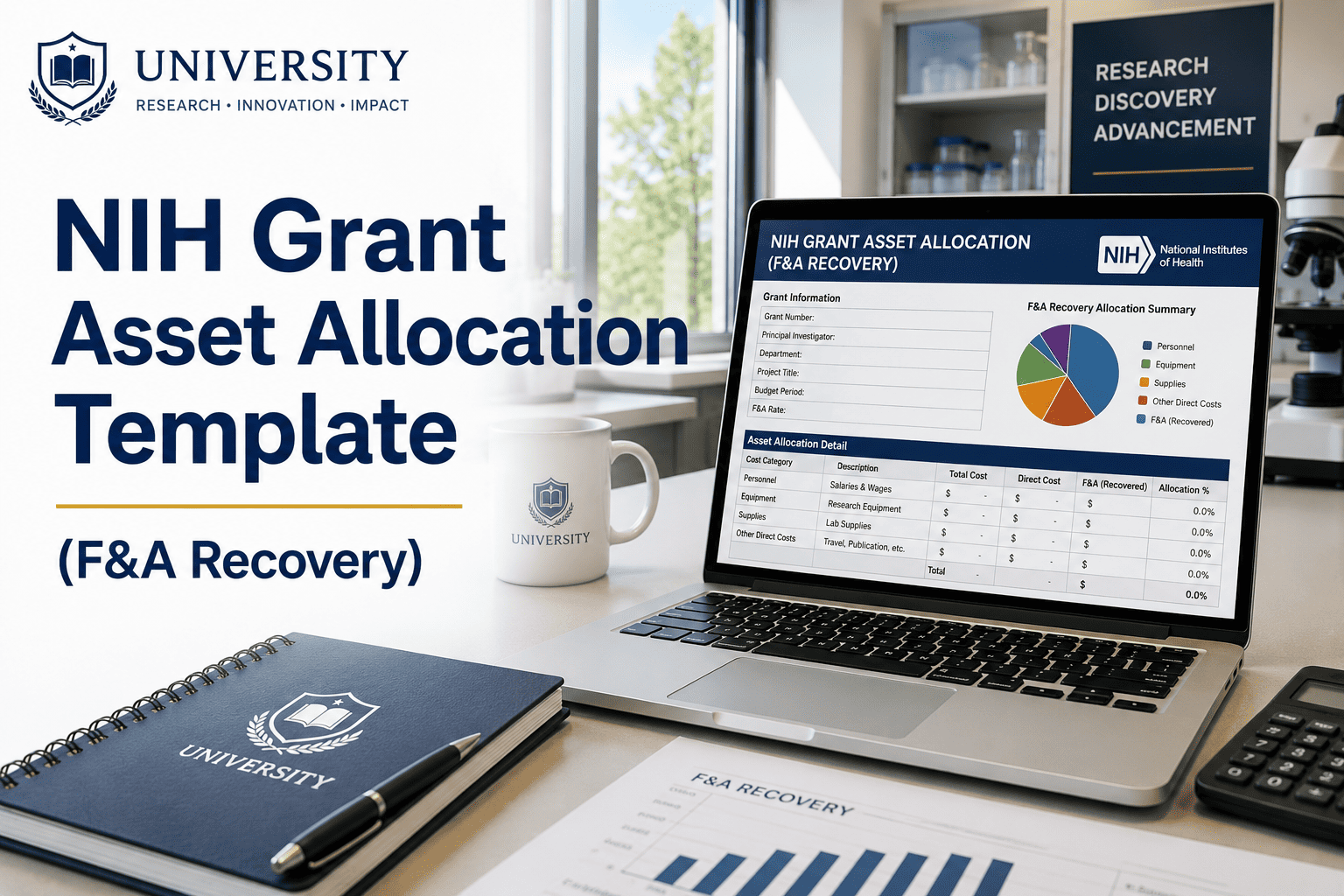
University NIH Grant Asset Allocation Template (F&A Recovery)

By Corin Hale on June 12, 2026

university-nih-grant-asset-allocation-template-fa-recovery

University research operations run on federal grant funding, and NIH grants come with asset management obligations that most facilities and research administration teams underestimate until an audit arrives. The NIH Grants Policy Statement and 2 CFR 200 (Uniform Guidance) require institutions to maintain records of equipment acquired with federal funds — by grant number, instrument identification, acquisition cost, location, custodian, and depreciation status. The F&A (Facilities and Administrative) cost recovery calculation depends on the same equipment data. When research equipment records are scattered across department spreadsheets, PI filing systems, and disconnected procurement databases, the institution cannot accurately calculate its F&A rate, cannot respond to NIH property audits with confidence, and cannot demonstrate stewardship of federally funded assets. The practical gap is not awareness of the requirement — it is having a structured NIH grant asset allocation template that captures instrument ID, lab assignment, F&A recovery classification, depreciation schedule, and CMMS-aligned asset identifiers in a single auditable record. Sign Up Free and start connecting your NIH-funded equipment records to a live research asset registry that supports both compliance and F&A rate substantiation. Universities that standardize on a structured grant asset template — where each instrument is tracked from acquisition through disposal — eliminate the retroactive record reconstruction that makes federal audits expensive and damaging. Book a Demo to see how Oxmaint manages equipment records across a multi-department research campus, with grant number tracking, F&A classification, and depreciation linked to the same asset profile that maintenance work orders reference. The template below gives research administration and facilities teams the shared data structure needed to satisfy NIH property requirements while supporting the institution's F&A recovery position.

Track NIH-funded equipment from acquisition to disposal in a single asset registry. Oxmaint links instrument records, grant numbers, F&A classification, and maintenance history — ready for NIH property audits and F&A rate documentation.

What NIH Grant Asset Allocation Records Must Capture

Under 2 CFR 200.313 (Equipment) and the NIH Grants Policy Statement Section 8.4, research institutions must maintain property records for federally funded equipment throughout its useful life. The template fields below reflect the minimum required data set for NIH compliance and F&A rate substantiation.

Instrument Identification
Unique asset tag or serial number, equipment description, manufacturer, model number. Must match physical tag on instrument and procurement records.
Grant and Award Data
NIH grant number (format: R01-GM000000), project period, PI name, department. Required to attribute acquisition cost to the correct federal award.
Acquisition Cost and Date
Total acquisition cost including delivery and installation. Acquisition date for depreciation start. Equipment over $5,000 (or institutional threshold) requires NIH prior approval for initial acquisition.
Lab Assignment and Custodian
Building, room number, PI custodian. Required for physical inventory verification — 2 CFR 200.313(d) requires physical inventory at least every two years.
F&A Recovery Classification
Capitalized equipment in research function contributes to the institution's F&A rate calculation. Classification — research / instruction / other sponsored — determines how depreciation is allocated across cost pools.
Depreciation Schedule
Useful life category, depreciation method (straight-line), annual depreciation amount, accumulated depreciation, and book value. Required for F&A rate proposal submission to DHHS.

NIH Equipment Thresholds and Approval Requirements

Understanding the federal thresholds that trigger specific documentation and approval requirements is the starting point for building a compliant grant asset template. The table below maps NIH and 2 CFR 200 requirements to the dollar values and conditions that apply to most research universities.

Threshold / Condition Regulatory Requirement Template Field Implication
Equipment ≥ $5,000 acquisition cost 2 CFR 200.313 — property records required; physical inventory every 2 years Acquisition cost, tag number, inventory date fields required
Equipment ≥ $25,000 (single item) NIH prior approval may be required under specific award terms Prior approval status field — Y/N with approval document reference
Equipment transferred between grants NIH approval required; must document prior grant number and transfer date Prior grant number, transfer date, and approval reference fields
Equipment at project end 2 CFR 200.313(e) — disposition instructions required; items over $5,000 require NIH approval to retain or transfer Disposition status field — retain / transfer / cannibalize / dispose
Shared use equipment 2 CFR 200.313(c)(3) — use must be for authorized purposes; shared use must not interfere with grant project Shared use flag, authorized projects list, usage log reference
Fabricated equipment Separately capitalized if total cost exceeds institutional threshold — components tracked under fabrication project Fabrication flag, component list, total capitalized cost, completion date

NIH Grant Asset Allocation Template — Field-by-Field Reference

The following sections map to a complete NIH grant asset allocation template structured for F&A recovery documentation and NIH property audit readiness. Sign Up Free to attach completed asset records to grant-funded equipment in Oxmaint and generate F&A-aligned asset reports on demand.

Section 1 — Instrument and Equipment Identification

Asset Tag NumberUnique institutional property tag affixed to the instrument — matches physical label and CMMS asset ID
Serial NumberManufacturer serial number — required for instrument verification during physical inventory
Equipment DescriptionInstrument type and name — e.g., "High-Performance Liquid Chromatography System"
Manufacturer / ModelManufacturer name and model number — required for warranty, maintenance contract, and calibration tracking
Acquisition Cost (USD)Total cost including purchase price, shipping, installation, and initial accessories charged to the grant
Acquisition DateDate of receipt or in-service date — depreciation clock starts here

Section 2 — NIH Grant and Award Attribution

NIH Grant NumberFull NIH award number in format: R01-GM000000-01A1 — activity code, institute, serial, year, suffix
Project PeriodAward start and end dates — determines the period of performance during which equipment was acquired
Principal InvestigatorPI name and department — custodial responsibility and contact for physical inventory verification
Administering DepartmentDepartment responsible for the award — used for F&A cost pool assignment and departmental reporting
Budget Period ChargedSpecific budget period within the project when the equipment was purchased — for cost allocation accuracy
Prior NIH Approval ObtainedYes / No — if Yes, approval document reference number and date attached to this record

Section 3 — Lab Assignment and Physical Location

Building / RoomBuilding name, room number — physical location for biennial inventory verification
Lab Name / NumberLab designation per institutional room numbering system — links to facilities floor plan
Equipment CustodianPerson responsible for equipment condition and availability — typically the PI or designated lab manager
Last Physical Inventory DateDate and verifier name for the most recent physical inventory — 2 CFR 200.313(d) biennial requirement
Shared Use FlagYes / No — if shared, list authorized grants and departments; attach usage log reference if applicable

Section 4 — F&A Recovery Classification

Functional ClassificationResearch / Instruction / Other Sponsored Activity / Departmental Administration — per OMB Circular A-21 successor classifications
F&A Cost PoolEquipment pool assignment for F&A rate calculation — research equipment depreciation allocated to research function
Space Assignment CodeFICM space use code for the room where equipment is located — ties equipment to the space survey used in F&A calculation
Usage Percentage (if shared)Percentage of use attributable to each function if equipment serves multiple purposes — documented for audit substantiation

Section 5 — Depreciation Schedule

Asset CategoryInstitutional equipment category — scientific instruments, computers, general lab equipment — determines useful life
Useful Life (years)Assigned useful life per institutional capitalization policy — typically 5–15 years for lab instrumentation
Depreciation MethodStraight-line depreciation — required for F&A rate proposals submitted to DHHS under 2 CFR 200 Appendix III
Annual Depreciation AmountAcquisition cost divided by useful life — the annual charge included in the F&A rate calculation
Accumulated DepreciationTotal depreciation recorded to date — annual amount multiplied by years in service
Net Book ValueAcquisition cost minus accumulated depreciation — reported in F&A rate proposal equipment schedule

Section 6 — CMMS Integration and Maintenance Record

Oxmaint Asset IDCMMS asset identifier — links grant asset record to full maintenance work order history in Oxmaint
Maintenance ContractVendor, contract number, and expiration date — maintenance costs tracked against the asset for total cost of ownership
Calibration StatusLast calibration date and next due date — for instruments requiring periodic calibration per research protocols
Condition RatingCurrent condition assessment — Excellent / Good / Fair / Poor — used for remaining useful life estimation

Section 7 — Disposition Record

Disposition StatusActive / Transferred / Cannibalized / Disposed — updated when equipment leaves the grant project
Disposition DateDate equipment was transferred, surplused, or disposed — closes the asset record for NIH property purposes
NIH Disposition ApprovalNIH approval reference for items over $5,000 — required before transfer or disposal under 2 CFR 200.313(e)
Proceeds (if sold)Sale proceeds for disposed equipment — NIH may require pro-rated federal share to be returned

How Oxmaint Supports NIH Grant Asset Management Across a Research University

Research universities managing hundreds of NIH-funded instruments across multiple departments need an asset management platform that serves both research compliance and facilities maintenance without requiring parallel data entry. Oxmaint gives research administration and facilities teams a single asset record per instrument — carrying grant attribution, F&A classification, depreciation data, and maintenance history in one retrievable profile. Book a Demo to see how a multi-department research campus manages grant-funded equipment in Oxmaint.

Grant-Attributed Asset Registry
Each instrument registered with its NIH grant number, PI, department, and F&A classification. Equipment inventory visible across all buildings and labs — ready for biennial physical inventory verification.
Depreciation and F&A Reporting
Equipment acquisition cost, useful life, and depreciation schedule captured per asset. F&A rate proposal equipment schedule generated from Oxmaint asset data — eliminating manual spreadsheet consolidation across departments.
Document Attachment per Instrument
Purchase orders, NIH approval letters, calibration certificates, and maintenance contracts attached directly to the asset record. NIH property auditors can verify any instrument's full documentation in under 60 seconds.
Physical Inventory Workflow
Biennial physical inventory conducted using Oxmaint mobile — verifier scans asset tag, confirms location, and updates inventory date. Discrepancies between recorded and physical location flagged automatically.
Maintenance History Integration
All maintenance work orders — preventive maintenance, repairs, calibration, service contracts — linked to the same asset profile as the grant record. Total cost of ownership tracks against acquisition cost and depreciation schedule.
Disposition Workflow
When a grant period ends or equipment reaches end of useful life, Oxmaint generates a disposition work order with the NIH approval requirement flagged. Proceeds and transfer documentation attached to close out the asset record.

NIH grant audits ask for equipment records that most universities cannot produce quickly. Oxmaint gives research administration and facilities teams a single platform where every NIH-funded instrument carries its grant data, F&A classification, and maintenance history — retrievable on demand.

Frequently Asked Questions — University NIH Grant Asset Allocation and F&A Recovery

What is the NIH equipment threshold that requires a formal property record?
Under 2 CFR 200.313, equipment with an acquisition cost of $5,000 or more requires a formal property record. Many universities set a lower capitalization threshold — as low as $1,000 — which applies to their NIH-funded equipment records as well.
How does NIH-funded equipment affect a university's F&A rate?
Equipment depreciation is a direct cost input to the equipment use allowance in the F&A rate calculation. Research-classified equipment depreciation is allocated to the research function cost pool, which drives the research F&A rate negotiated with DHHS. Accurate equipment records directly support a higher defensible F&A rate.
How often must universities conduct physical inventory of NIH-funded equipment?
2 CFR 200.313(d)(2) requires a physical inventory of federally funded equipment at least every two years, with reconciliation of results against property records. Universities must also have a procedure to control loss, damage, or theft.
Can NIH-funded equipment be used for non-grant research?
2 CFR 200.313(c)(3) allows equipment to be used for other projects or programs when not needed for the original grant, provided the use does not interfere with the grant project and is otherwise authorized. Shared use must be documented and, if used commercially, may require compensation to the federal government.
What happens to NIH-funded equipment when a grant ends?
At grant closeout, equipment with an acquisition cost over $5,000 requires disposition instructions from NIH. The institution may retain the equipment for other federally sponsored activities, transfer it to another grant, or request disposition approval to surplus or transfer it — with the federal share of net proceeds potentially returned to NIH.
How does Oxmaint help when a PI leaves and takes institutional knowledge of equipment with them?
All grant attribution, inventory records, maintenance history, and document attachments reside in Oxmaint — not in a departing PI's files. The incoming PI or research administrator sees the full equipment record on day one, with no retroactive reconstruction needed for the next NIH property audit.

Build a research equipment asset registry where every NIH-funded instrument is tracked from acquisition to disposition — with F&A classification, depreciation, and maintenance history in one auditable record. Start with Oxmaint today.



Share This Story, Choose Your Platform!