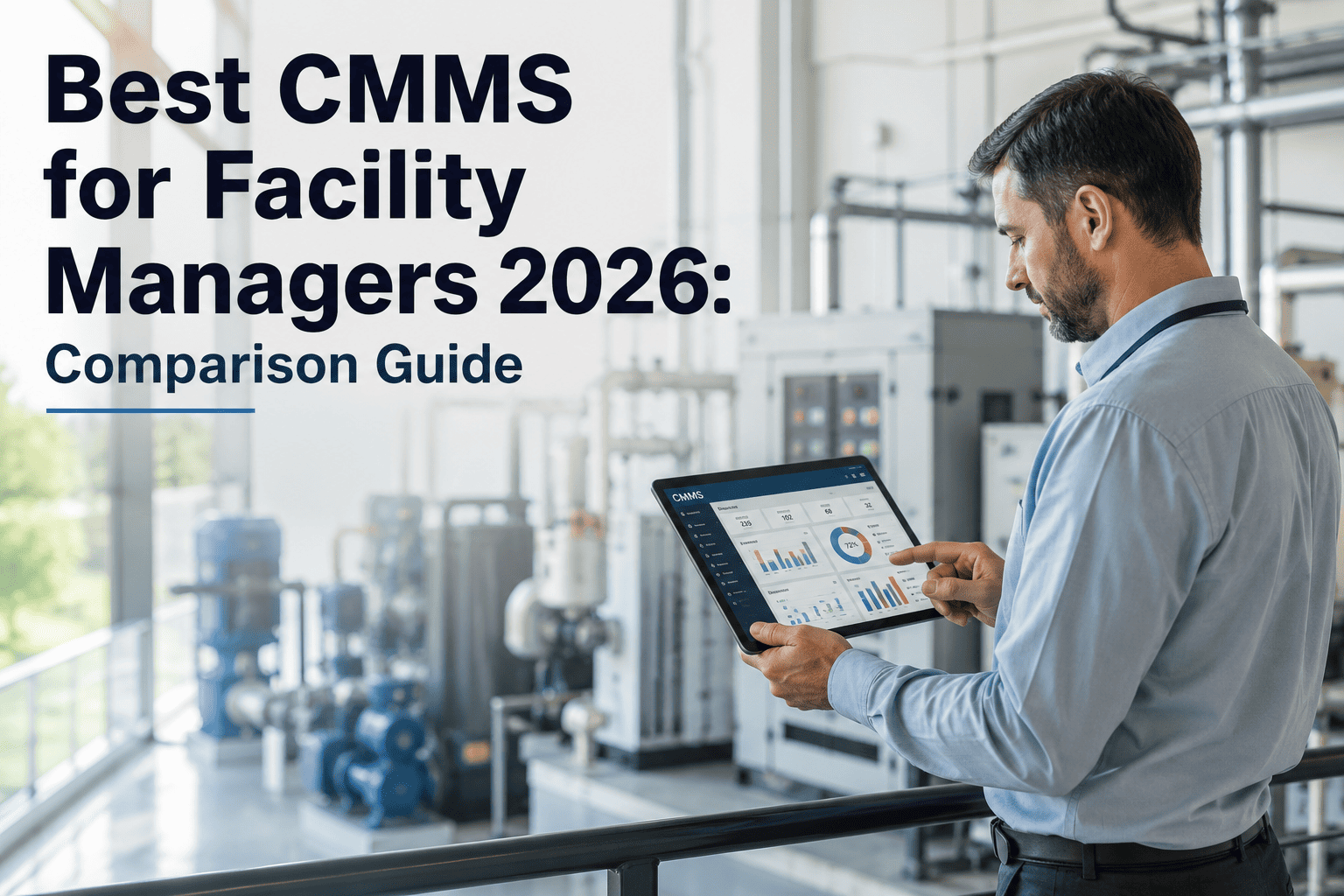
Facility management in 2026 is operating under conditions that have no historical parallel: 81% of FM leaders identify cost efficiency as their top priority, yet 75% faced budget constraints in 2025 — with 40% reporting outright budget cuts. Meanwhile, work orders are increasing year-over-year for 55.7% of facility managers, and the gap between what teams are expected to deliver and the resources available to deliver it has never been wider. The organizations navigating this environment successfully share one distinguishing characteristic: they have moved from reactive, paper-based maintenance to data-driven, proactive facility management underpinned by a modern CMMS. A 12-location coworking network applying these strategies achieved a 31% operational cost reduction and 287% ROI in 11 months. The FM teams still running on spreadsheets and manual work orders are not just behind on technology — they are losing competitive ground every quarter. This guide covers the proven facility management best practices for 2026 that are delivering measurable results across commercial, industrial, and multi-site portfolios right now. Ready to see Oxmaint running against your facility's specific asset structure? Book a free demo and we will walk through your operations directly.
81%
Of FM leaders cite cost efficiency as top 2026 priority — yet 75% faced budget constraints in 2025 (SFG20)
4–6x
ROI on every $1 invested in safety and proactive maintenance programmes — U.S. Department of Energy
287%
ROI achieved in 11 months by a 12-location portfolio that adopted data-driven FM best practices (Spacebring)
4.8x
More expensive — the cost ratio of emergency reactive repairs versus planned preventive maintenance interventions
Oxmaint Gives Facility Managers the Platform to Execute Every Best Practice on This Page
Preventive maintenance scheduling, asset lifecycle tracking, work order management, CapEx forecasting, and multi-site portfolio reporting — unified in one CMMS. Free to start. No implementation fees. Deployed in days.
Why 2026 Is Different
The 4 Structural Shifts Making Facility Management Best Practices Non-Negotiable in 2026
Facility management has always required discipline. What has changed in 2026 is the cost of not having it. Four structural shifts are making the gap between facilities running on best practices and those running reactively measurably wider every quarter.
01
Budget Pressure Has Become Permanent
40% of FM teams saw budgets cut between 2024 and 2025. This is not a cycle — it is a structural reallocation of organizational resources that requires FM teams to demonstrate value through data, not just service delivery. Facilities that cannot quantify cost avoidance, asset uptime, and maintenance ROI in hard numbers are the first to face further cuts.
02
Regulatory Complexity Is Accelerating
The UK Building Safety Act, OSHA enforcement intensification, UAE OSHAD-SF compliance requirements, and Germany's BetrSichV updates have moved from implementation to active enforcement. Facilities without automated compliance documentation and audit-ready inspection records are not behind on admin — they are exposed to enforcement actions that dwarf any CMMS cost.
03
C-Suite Reporting Expectations Have Risen
Finance and operations leadership now expect facility managers to report on maintenance cost per asset, asset availability rates, CapEx forecast accuracy, and PM completion rates — not just work order volumes. Teams that cannot produce these metrics from structured digital data are losing credibility in capital allocation conversations.
04
AI Requires Data Readiness — Not Just Adoption
JLL's global research shows a clear divide: organizations with clean CMMS data and modern asset records are making measurable progress with AI. Those without this foundation cannot move beyond pilot projects. In 2026, data readiness — complete asset registries, consistent work order history, structured PM records — determines which facilities benefit from AI and which do not.
The 8 Core Practices
8 Facility Management Best Practices That Deliver Measurable Results in 2026
These are not aspirational principles. They are the specific operational practices that distinguish high-performing FM programmes from reactive ones — and each is executable with a modern CMMS from day one of deployment.
01 — Formalize Preventive Maintenance Schedules for Every Critical Asset
The single highest-ROI shift available to any FM team is formalizing preventive maintenance — moving from reacting to failures to scheduling interventions before they occur. PM schedules should be set by asset criticality, manufacturer specification, and operating environment, then automated in a CMMS so intervals are enforced without manual coordination. Best-in-class facilities target PM completion rates above 85%. Below 70% signals resource or scheduling gaps that compound into emergency costs. Oxmaint automates PM triggers by calendar interval, runtime hours, or production cycles — generating work orders automatically before due dates are missed.
02 — Build a Complete, Accurate Asset Registry With Condition Scoring
You cannot manage what you cannot see. A complete asset registry — covering every maintained system with manufacturer details, installation date, service history, current condition score, and remaining useful life estimate — is the data foundation that all other best practices depend on. Asset registries are not one-time projects; they are living documents that update automatically as work orders close and sensor data feeds in. Facilities without structured asset registries make maintenance decisions on memory and intuition — and pay the price in capital decisions made without data when replacement cycles arrive.
03 — Implement Digital Work Order Management Across All Maintenance Types
Paper work orders and email-based task management create documentation gaps, accountability voids, and reporting blindspots that make every other FM best practice harder to execute. Digital work order management — with technician attribution, parts used, labour hours, and photo documentation captured at the point of work — generates the maintenance history that asset condition scoring, CapEx forecasting, and regulatory compliance all require. A CMMS that captures this data from mobile devices ensures completeness even when technicians are working in plant rooms, plant floors, or multi-building campuses away from a desk.
04 — Track FM KPIs That Finance and Operations Leadership Actually Use
Facility managers who report on work order volumes are reporting on activity. Facility managers who report on PM completion rate, mean time to repair, reactive-to-planned maintenance ratio, maintenance cost per asset, and corrective action closure rate are reporting on outcomes. This distinction determines whether FM is perceived as a cost centre or a strategic operational asset. Oxmaint calculates all of these KPIs automatically from live work order data — producing dashboards that finance and operations directors can use directly for budget justification and capital planning decisions without manual report preparation.
05 — Use Rolling CapEx Forecasting to Replace Guesswork With Data
Capital expenditure decisions made on asset age and gut feel consistently result in either premature replacement (wasted capital) or deferred replacement (catastrophic failure). Rolling 5–10 year CapEx forecasting built on actual maintenance cost trends per asset — rising cost-per-unit curves, remaining useful life calculations, and refurbish-versus-replace analysis — transforms capital planning from an annual negotiation into a data-supported strategic function. Organizations with structured CapEx forecasting models reduce surprise capital expenditure events by 35–50% and improve budget accuracy to within 10–15% annually.
06 — Automate Compliance Documentation From Daily Operations
Compliance documentation prepared manually from paper records for OSHA, Building Safety Act, OSHAD-SF, or BetrSichV audits typically requires 4–8 hours per audit event across multiple staff. Documentation assembled under pressure from fragmented sources is incomplete — creating audit exposure that a structured CMMS eliminates entirely. Audit-ready records generated automatically from daily work order and inspection data are retrievable in under 60 seconds. The FM team shifts from defensive audit preparation to proactive compliance demonstration — with timestamped, person-attributed records that hold up under regulatory scrutiny.
07 — Standardize Maintenance Practices Across Multi-Site Portfolios
Multi-site facility portfolios managed through siloed records, site-specific spreadsheets, and inconsistent inspection standards create a portfolio-wide risk picture that no single team member can see. Standardized PM schedules, inspection checklists, and KPI benchmarks across all sites — accessible in a portfolio-level dashboard — give operations directors the visibility to identify which facilities are under-maintaining before a failure event forces the issue. Portfolio-level benchmarking also enables best-practice identification: the site achieving the lowest reactive maintenance ratio becomes the model that data-supported process improvement replicates across the portfolio.
08 — Prioritize Maintenance Investment by Asset Criticality, Not Uniform Schedule
Applying equal maintenance intensity to all assets regardless of criticality wastes resources on low-value equipment while under-protecting high-value systems where failure creates disproportionate cost and downtime. Asset criticality scoring — classifying assets as critical, major, or minor based on replacement cost, failure impact, and regulatory exposure — enables FM teams to direct limited maintenance budgets toward the equipment where investment delivers the highest return. The 2026 FM market shift identified by SFG20 is exactly this: from uniform maintenance regimes to optimized asset-risk-proportionate approaches that balance statutory compliance with operational resilience.
FM Performance Benchmarks 2026
The 8 FM KPIs That Separate High-Performing Facilities from the Rest — and What Best-in-Class Looks Like
85%+
PM Completion Rate
Percentage of scheduled PM tasks completed on time. Below 70% signals serious resource or scheduling gaps. Best-in-class facilities maintain above 85% consistently — achievable only with automated scheduling and mobile work order completion.
<20%
Reactive Maintenance Ratio
Proportion of emergency and unplanned repairs versus total maintenance work. Best-in-class target: below 20% reactive. Most facilities starting a structured PM programme discover their reactive ratio is above 60% — and drop it within 12 months of structured CMMS adoption.
MTTR
Mean Time to Repair
Average time from failure detection to equipment restoration. Reducing MTTR requires structured parts inventory, clear escalation paths, and mobile work order access for technicians. Tracking MTTR per asset class identifies where response processes need improvement before the next failure event.
95%+
Asset Availability Rate
Percentage of time critical assets are operational and available. Calculated from total available hours minus planned and unplanned downtime. Rising reactive maintenance ratios directly correlate with declining asset availability — the two metrics should be tracked together to identify root causes.
Cost/Asset
Maintenance Cost Per Asset
Total labour, parts, and contractor spend per maintained asset per year. Rising cost-per-asset on specific equipment is the earliest financial signal of impending failure and replacement. Without per-asset cost tracking, the highest-cost assets in a portfolio are invisible until they force a crisis decision.
90%+
Corrective Action Closure Rate
Percentage of identified deficiencies resolved within target timeframes. Items open more than 30 days need escalation paths or documented deferral justification. Low closure rates compound — open deficiencies become your next emergency repair event and your next regulatory liability simultaneously.
±10%
CapEx Forecast Accuracy
Variance between capital expenditure forecast and actual spend. Facilities with structured asset registries and rolling CapEx models achieve within 10–15% accuracy annually. Those relying on age-based depreciation tables are typically 40–60% off — generating surprise capital events that undermine organizational budget credibility.
OEE
Overall Equipment Effectiveness
For industrial and production facilities, OEE tracks availability, performance, and quality rate at the individual line level. Real-time OEE dashboards connect maintenance events directly to production output — quantifying in financial terms exactly how maintenance investment translates to revenue and throughput capacity.
Before vs. After Best Practices
Reactive FM Operations vs. Best-Practice CMMS-Driven Facility Management — What Changes and What It Costs
FM Function
Reactive Paper Operations — No Best Practice Framework
Oxmaint CMMS — Best Practice Execution
Maintenance Scheduling
Manual calendar reminders or no schedule at all. Intervals drift past due dates. PM completion rate typically 50–65% on paper systems.
Automated PM triggers by calendar, runtime hours, or production cycles. Work orders auto-generated. PM completion rate above 85% enforced.
Asset Records
Scattered across spreadsheets, binders, and individual technician knowledge. No condition scoring. Asset age the only replacement signal.
Complete digital asset registry with condition scoring, service history, and remaining useful life estimate per asset. Updates automatically as work orders close.
Maintenance Cost Visibility
Total maintenance spend known. Per-asset cost unknown. Highest-cost assets invisible until they force a capital decision. Budget justification based on estimates.
Maintenance cost per asset tracked automatically from work order data. Cost-trend alerts identify deteriorating assets before they reach crisis. Data-backed budget defence.
Compliance Documentation
4–8 hours manual assembly per audit event. Paper records incomplete or missing. Regulatory exposure from documentation gaps discovered under enforcement.
Audit-ready records auto-generated from daily operations. Retrievable in under 60 seconds. Zero documentation preparation time for routine regulatory audits.
CapEx Planning
Age-based replacement decisions. CapEx variance 40–60% from actuals. Surprise capital events that undermine organizational budget credibility annually.
Rolling 5–10 year CapEx model from actual maintenance cost trends. Forecast accuracy within 10–15%. Refurbish vs replace analysis per asset built in.
Multi-Site Visibility
Each site manages independently. Portfolio-wide risk picture invisible. Under-maintained sites discovered only when failure event forces escalation to leadership.
Portfolio dashboard aggregates PM completion, condition scores, open work orders, and CapEx forecast across all sites. Under-maintained facilities visible before crisis.
Reactive Maintenance Ratio
Typically 50–70% reactive on paper-based programmes. Emergency repairs cost 4.8x more than planned maintenance. Ratio unknown without structured tracking.
Best-in-class target below 20% reactive. Ratio tracked automatically. Most facilities reach target within 12 months of structured CMMS adoption.
Reporting to Leadership
Work order volumes reported. No KPI data. FM perceived as cost centre. Capital requests unsupported by data. Budget cuts applied first to FM.
PM completion rate, MTTR, cost per asset, and asset availability reported automatically. FM positioned as data-driven strategic function. Budget defended with hard numbers.
How Oxmaint Enables Best Practices
How Oxmaint's Integrated Platform Puts Every FM Best Practice Into Operational Execution
Knowing the best practices is not the same as executing them. Oxmaint is the operational platform that makes each practice executable — from the first PM schedule configured to the first portfolio-level CapEx report generated.
Automated PM Scheduling
Set preventive maintenance triggers by calendar interval, runtime hours, production cycles, or mileage per asset class. Work orders auto-generate before due dates. PM completion rates above 85% become the default, not the aspiration — because enforcement is built into the workflow, not dependent on individual discipline.
Full Asset Registry with Condition Scoring
Every asset maintains a complete digital record: service history, parts consumed, downtime events, current condition score, and remaining useful life estimate. The condition score updates automatically as work orders close and IoT sensor data feeds in — giving facility managers a live fleet health picture across every site without manual data entry.
Work Order Management with Full History
Create, assign, track, and close work orders digitally from mobile devices. Technician attribution, parts used, labour hours, photo documentation, and cost — all captured at point of work. The resulting maintenance history per asset powers condition scoring, CapEx forecasting, and compliance documentation without any additional reporting step.
Rolling 5–10 Year CapEx Forecasting
Oxmaint's CapEx forecasting models use actual maintenance cost trends per asset to predict replacement cycles — telling operations directors when specific assets will exceed their economic repair threshold with data-backed confidence rather than depreciation table guesswork. Finance presentations built on Oxmaint data carry a credibility that manual estimates cannot match.
Portfolio-Level Reporting for Multi-Site Operations
For organisations managing multiple facilities, Oxmaint aggregates PM completion rates, condition scores, open work orders, and CapEx forecasts across all sites in a single dashboard. Operations directors see which facilities are under-maintaining before a failure event forces the issue — and which sites' best practices are worth replicating across the portfolio.
Audit-Ready Compliance Documentation
Every inspection, service event, and corrective action is auto-documented with timestamp and person attribution from daily operations. OSHA, Building Safety Act, OSHAD-SF, and BetrSichV compliance records are retrievable in under 60 seconds — not assembled manually over days before an audit visit. The documentation gap that most FM programmes carry as latent risk is eliminated from day one.
Stop Knowing Best Practices. Start Executing Them — With a Platform Built to Make Every One Operational.
Oxmaint gives facility managers automated PM scheduling, complete asset registries, digital work orders, rolling CapEx forecasting, and portfolio-level reporting in one unified CMMS. Free to start. No heavy implementation fees. Deployed in days across any number of sites.
Frequently Asked Questions
Facility Management Best Practices 2026 — What Facility and Operations Managers Ask First
What is the single most impactful facility management best practice for reducing costs in 2026?
The data is consistent across every FM research dataset in 2025–2026: formalizing preventive maintenance with automated scheduling generates the highest cost reduction per pound or dollar invested of any single FM practice. The reason is straightforward — reactive emergency repairs cost 4.8 times more than the same repair completed as a planned service event. For a facility spending $500,000 annually on maintenance with a reactive ratio of 60%, shifting to a PM-led programme with a reactive ratio below 20% typically recovers $150,000–$200,000 in annual maintenance spend without reducing maintenance activity. The secondary benefit is compounding: structured PM data builds the asset condition history that CapEx forecasting requires, which reduces surprise capital events that are even more expensive than reactive repair cycles. For facilities starting from a reactive baseline, the recommended first step is deploying a CMMS, importing your asset registry, and configuring PM schedules for your critical systems — HVAC, electrical distribution, water systems, and any production-linked equipment. Oxmaint can complete this foundation in 7–14 days for most facility portfolios.
Sign up free to begin your PM programme setup today, or
book a demo to see how Oxmaint configures PM schedules for your specific asset classes.
How do you measure whether a facility management programme is actually improving — which KPIs matter most?
The KPIs that matter most are the ones that connect maintenance activity to financial and operational outcomes — not just the ones that measure activity volume. The five most important FM performance indicators, in order of strategic value, are: first, the reactive-to-planned maintenance ratio (target below 20% reactive — this single metric captures the health of your entire PM programme); second, PM completion rate (target above 85% — below 70% signals scheduling or resource gaps that compound into emergency costs); third, maintenance cost per asset per year (rising cost on specific assets is the earliest financial signal of impending failure or replacement need); fourth, mean time to repair (tracks responsiveness and parts availability — improving MTTR directly improves asset availability); and fifth, CapEx forecast accuracy (measures whether your asset data is good enough to support budget decisions — best-in-class facilities achieve within 10–15% annually). Facilities that track all five and review them monthly at operations leadership level consistently outperform those that only track total maintenance spend. Oxmaint calculates all five automatically from work order data — no manual report preparation required.
Book a demo to see the KPI dashboard configured for your facility type, or
sign up free to start tracking your programme performance immediately.
How do facility management best practices differ for multi-site portfolios versus single-facility operations?
The core best practices are the same — preventive maintenance scheduling, asset registry, work order management, CapEx forecasting, compliance documentation. What changes in a multi-site context is the governance layer required to execute them consistently and the visibility tools required to identify where they are not being executed. For single facilities, the CMMS is primarily an operational tool: it enforces PM schedules, tracks work orders, and generates compliance records. For multi-site portfolios, the CMMS becomes a portfolio management platform: it standardises maintenance practices across all sites, enables portfolio-level KPI benchmarking, and makes the facilities under-maintaining visible to operations leadership before a failure event forces the issue. The critical differentiator for multi-site FM in 2026 is the move from siloed site records to a unified portfolio dashboard. Site-specific spreadsheets and disconnected CMMS instances mean the organization's aggregate maintenance risk picture is invisible to anyone except the individual site managers. A portfolio-level CMMS like Oxmaint gives operations directors the visibility to see PM completion rates, condition scores, open work orders, and CapEx forecasts across every facility simultaneously — enabling proactive intervention rather than reactive crisis response.
Sign up free to configure your multi-site portfolio structure, or
book a demo to see the portfolio-level dashboard running across multiple facility types.
What compliance requirements are facility managers most at risk of missing in 2026 — and how does a CMMS help?
The compliance areas generating the most enforcement activity in 2026 vary by region but share a common gap: documentation failures. Regulators rarely cite facilities for failing to perform inspections — they cite them for failing to document that inspections occurred, that deficiencies were identified, that corrective actions were assigned, and that those actions were completed within required timeframes. In the USA, OSHA 29 CFR 1910 equipment inspection records and NFPA compliance documentation are the most frequently cited gaps at commercial and industrial facilities. In the UK, the Building Safety Act and PSSR 2000 pressure systems inspection records have moved from implementation to active enforcement. In the UAE, OSHAD-SF compliance inspections require continuous monitoring records. In Germany, BetrSichV equipment safety records must be timestamped, person-attributed, and retrievable on demand. The CMMS solves the documentation problem by auto-generating compliance records from daily work order and inspection activity — eliminating the manual assembly that creates gaps. When an auditor requests records, they are retrieved in under 60 seconds from the CMMS dashboard rather than assembled over days from paper files. Oxmaint's compliance documentation framework is pre-configured for USA, UK, UAE, Germany, Canada, and Australia from go-live — without additional regional configuration spend.
Book a demo to see compliance record generation for your jurisdiction, or
sign up free to start building your audit-ready documentation trail today.
How quickly can a facility team deploy a CMMS and start seeing results from FM best practices?
For a cloud-based, mobile-first CMMS like Oxmaint, the deployment timeline for a standard facility management programme is 7–14 days from sign-up to first operational work orders. The deployment process runs in three phases. Days 1–3: data onboarding — asset registry import, user account setup, and initial PM schedule configuration for critical systems. Days 4–7: workflow configuration — inspection checklists, work order templates, escalation paths, and compliance record categories configured to your facility type. Days 7–14: go-live and verification — live operations with Oxmaint support monitoring data quality and completing any workflow gaps. The first measurable results typically appear within 30 days: PM completion rates become visible and trackable, work order history begins building, and the first compliance records are auto-generated. By Month 3, the reactive-to-planned maintenance ratio is measurable — and most facilities discover it is higher than they estimated, which focuses improvement investment on the highest-return PM expansions. By Month 6, asset condition trends are visible and CapEx forecasting has data depth sufficient for the first evidence-based capital planning conversations with finance leadership. Because Oxmaint is cloud-based and mobile-first, there is no server installation, no IT department project, and no hardware procurement required for the core deployment.
Sign up free and complete your asset import today, or
book a demo to see a deployment timeline specific to your facility type and portfolio size.
81% of FM Leaders Say Cost Efficiency Is Their Top Priority in 2026. The Facilities That Execute Best Practices First Will Win the Budget Conversations.
Oxmaint gives facility and operations managers the unified CMMS platform to execute every best practice covered on this page — automated PM scheduling, complete asset registries, digital work orders, rolling CapEx forecasting, portfolio-level reporting, and audit-ready compliance documentation. Free to start. No implementation fees. Deployed in days.