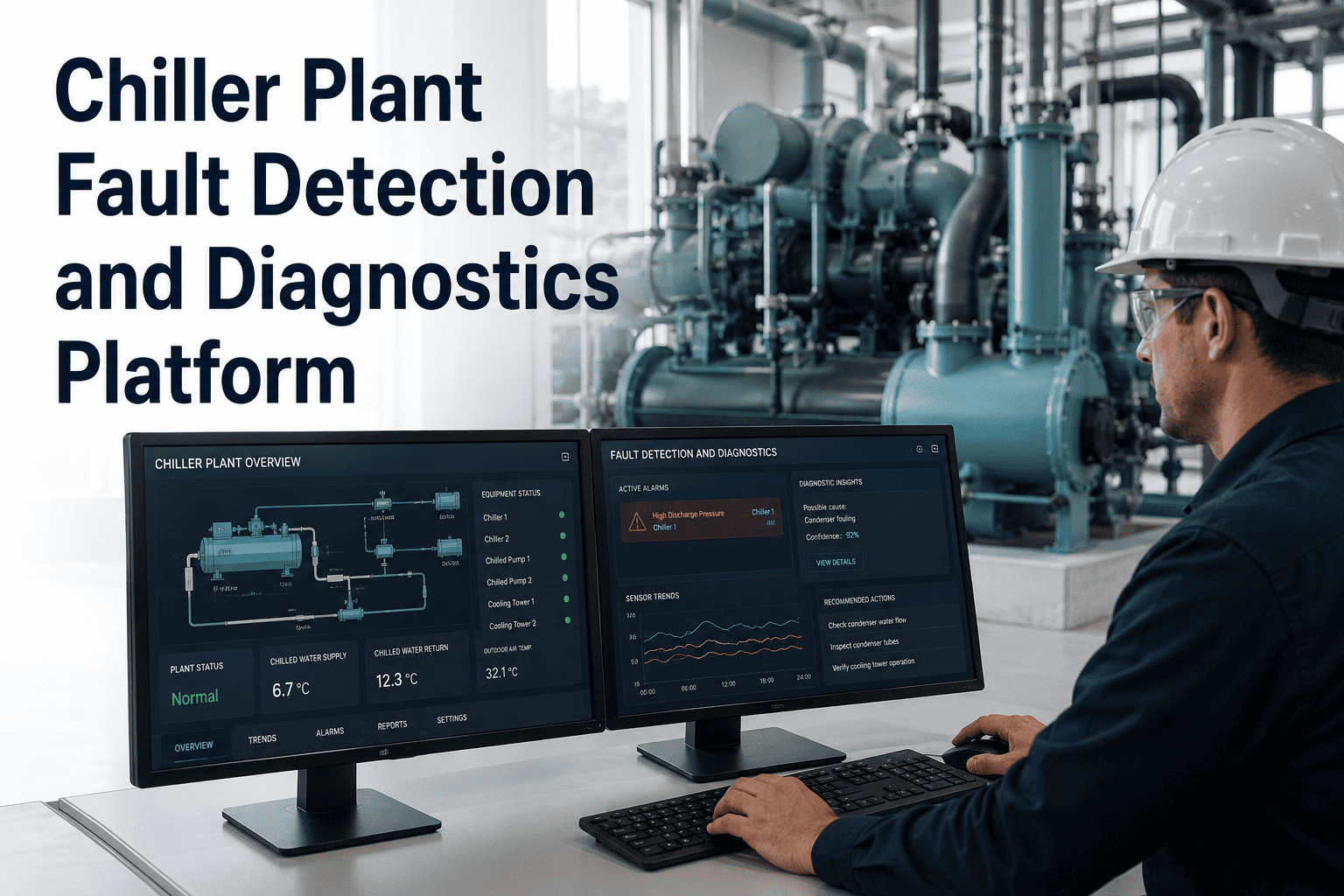
Chiller systems are the backbone of commercial cooling, yet most facilities only discover faults after a breakdown has already cost thousands in emergency repairs and downtime. AI-powered fault detection changes that equation entirely — identifying short cycling, low delta T conditions, and efficiency losses days before they escalate into failures. This platform guide explains how Oxmaint's predictive maintenance AI gives facility teams a decisive advantage in chiller plant operations. Book a demo to see live chiller diagnostics in action.
AI Fault Detection Platform
Chiller Plant Fault Detection & Diagnostics
Stop chiller failures before they happen. Oxmaint's AI identifies short cycling, low delta T, and energy inefficiency — giving your team time to act, not react.
73%
of chiller failures are preceded by detectable anomalies weeks in advance
$180K
average cost of a single unplanned chiller failure including downtime
-41%
reduction in chiller energy waste after AI diagnostics deployment
9 days
average advance warning before critical chiller fault events
The Three Faults That Drain Your Chiller Budget
Most chiller inefficiency comes from three recurring fault categories. Understanding them is the first step — detecting them automatically is what Oxmaint delivers for every connected chiller plant.
01
Chiller Short Cycling
Impact Severity: Critical
Short cycling occurs when chillers start and stop too frequently, preventing proper refrigerant pressure stabilization. Each unnecessary cycle adds wear equivalent to hours of normal operation. AI monitoring detects abnormal cycle frequency patterns and alerts teams before compressor damage occurs.
02
Low Delta T Syndrome
Impact Severity: High
Low delta T occurs when chilled water supply and return temperatures converge, forcing chillers to run at full load while delivering minimal cooling capacity. Oxmaint's AI continuously monitors supply-return differentials and flags conditions that signal fouled coils, control valve issues, or flow imbalances.
03
Energy Inefficiency Drift
Impact Severity: High
Gradual efficiency degradation is invisible to manual inspection. Condenser fouling, refrigerant charge loss, and compressor wear all reduce kW/ton performance over weeks. AI baseline modeling detects performance drift and generates corrective work orders before energy bills reflect the loss.
How Oxmaint AI Diagnoses Chiller Faults
1
Sensor Data Collection
Continuous streams from temperature, pressure, flow, and power sensors build a real-time picture of chiller plant health across all connected units.
2
AI Baseline Modeling
Machine learning models establish healthy operating baselines for each chiller, accounting for load variation, ambient conditions, and seasonal demand shifts.
3
Anomaly Detection & Alert
Deviations from baseline trigger prioritized alerts with fault classification — short cycling, low delta T, efficiency loss — so teams act on the right problem first.
4
Automated Work Order
Confirmed faults generate work orders with diagnostic evidence attached. Technicians arrive with context — not guesswork — reducing repair time by up to 44%.
See It Working on Real Chillers
Your Chiller Plant Deserves Smarter Diagnostics
Oxmaint connects to your chiller sensors and begins building health baselines within days. No rip-and-replace. No months-long implementation. Book a demo and we'll walk through your specific chiller configuration.
Fault Detection Results: Before vs After
| Metric |
Without AI Diagnostics |
With Oxmaint AI |
Change |
| Fault detection lead time |
0 days (reactive) |
7–14 days advance |
+14 days warning |
| Short cycling incidents per year |
18–24 events |
3–5 events |
-78% |
| Chiller energy efficiency (kW/ton) |
Baseline degraded |
Maintained at design |
-41% waste |
| Emergency repair calls |
6–9 per year |
1–2 per year |
-80% |
| Maintenance cost per cooling ton |
$38–$52 |
$21–$29 |
-45% |
Expert Review
Low delta T syndrome is the most underdiagnosed chiller problem in commercial buildings. Most operators see it on energy bills months after it starts — by then, corrective maintenance costs triple what early detection would have. AI monitoring closes that gap entirely. The ability to catch delta T deviation within hours rather than billing cycles is genuinely transformative for facility operating budgets.
Short cycling diagnosis has always been a manual, time-intensive process. Technicians would need to observe a chiller through multiple cycles to confirm a problem. AI-driven fault detection eliminates that entirely — the system flags abnormal cycling patterns automatically and provides the frequency data technicians need to diagnose root cause on first visit, not the third.
Frequently Asked Questions
How quickly can Oxmaint detect a new chiller fault after deployment?
After an initial 4–6 week baseline learning period, Oxmaint's AI detects anomalies in real time as sensor data streams in. For common fault signatures like short cycling, the system can flag deviations within the first operating cycle. For drift-based faults like low delta T, detection typically occurs 7–14 days before the condition would be identified through manual inspection.
Book a demo to review detection timelines for your chiller configuration.
Does the platform work with all major chiller manufacturers?
Oxmaint integrates with chillers from Carrier, Trane, York, Daikin, McQuay, and other major manufacturers through both direct sensor integration and BAS/BMS connection. The AI diagnostic models are adapted to each unit's design operating parameters rather than applying generic thresholds. This means fault detection accuracy is specific to your equipment, not a one-size-fits-all algorithm.
Start a free trial to connect your first chiller.
What sensors are required for full chiller fault detection capability?
Full fault detection capability requires supply and return water temperature sensors, refrigerant pressure sensors (suction and discharge), compressor current monitoring, and condenser water flow data. Oxmaint can operate with partial sensor sets and will indicate which fault categories are covered given the available data inputs. Many facilities already have most required sensors connected to their BAS — Oxmaint reads those directly without additional hardware installation in most cases.
Can Oxmaint help with chiller plant energy optimization, not just fault detection?
Yes. Beyond fault detection, Oxmaint's analytics layer continuously monitors chiller plant efficiency metrics including kW/ton ratios, condenser approach temperatures, and chilled water system delta T. When performance drifts from design targets, the platform generates optimization recommendations — not just fault alerts. Facilities using Oxmaint's optimization recommendations alongside fault detection report 18–25% reductions in chiller plant energy spend within the first operating year.
Book a demo to see the optimization analytics dashboard.
Stop Chiller Failures Before They Start
Every unplanned chiller failure represents a problem that AI diagnostics could have flagged weeks earlier. Oxmaint gives your facility team that lead time — converting reactive emergencies into planned, cost-controlled maintenance. The math is straightforward: one prevented failure pays for the platform. Everything after that is savings.