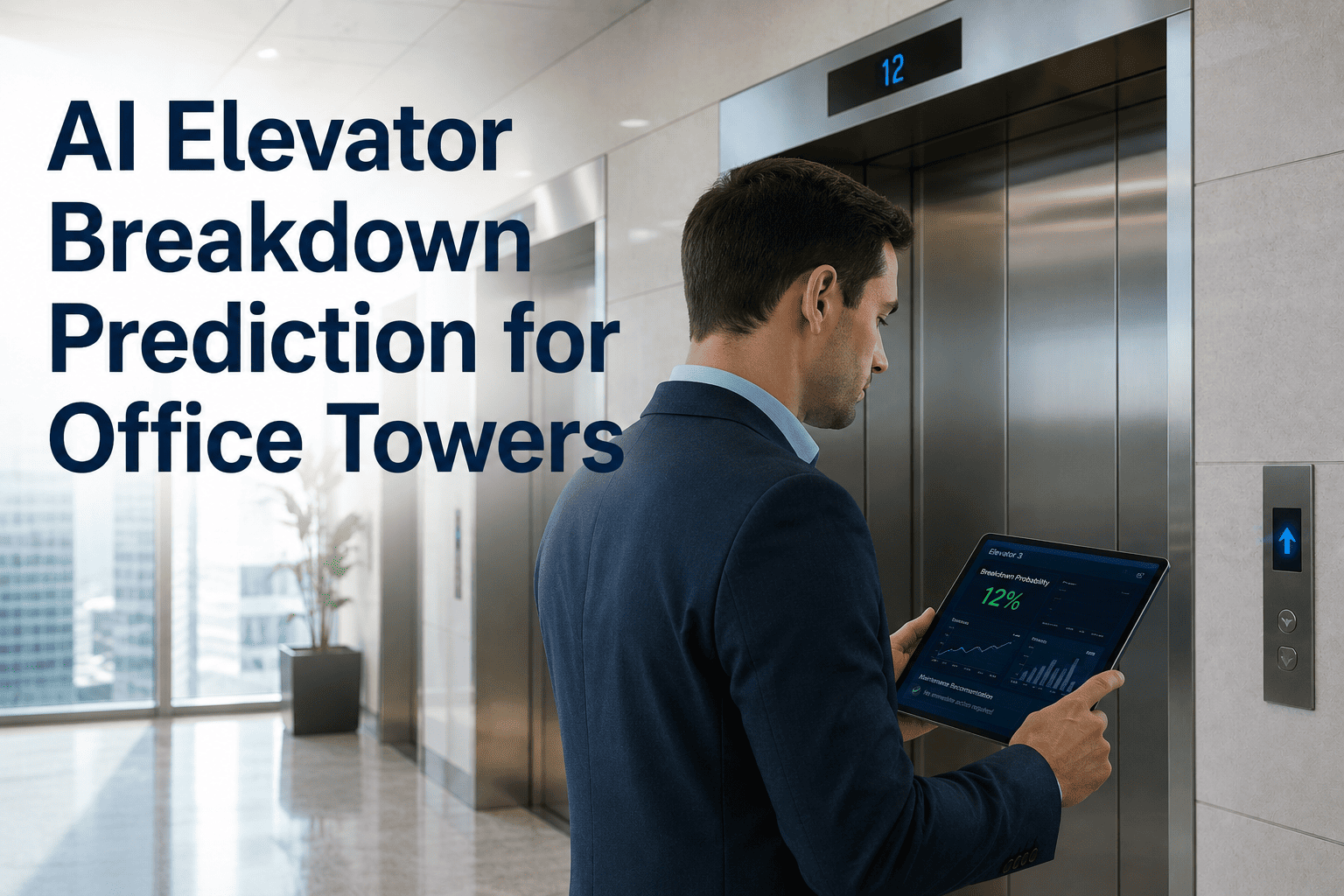
An elevator outage in an occupied office tower is not a maintenance inconvenience — it is a business disruption that affects thousands of daily building users, triggers tenant complaints, and generates liability exposure that persists long after the elevator is back in service. Traditional elevator maintenance programs wait for faults to surface during inspections or service calls. AI-powered breakdown prediction flips that model, identifying degrading components from usage patterns and maintenance history before they reach failure threshold. This article explains exactly how that works and what it means for office tower operations teams. Book a demo to review AI elevator prediction capabilities for your building portfolio.
Predictive Maintenance AI
AI Elevator Breakdown Prediction
For Office Towers and High-Rise Buildings
Predict elevator downtime before it happens. Prioritize inspections using real maintenance history, usage data, and AI fault analytics — not reactive service calls.
Floor 32
Floor 28
Floor 24 ⚠
Floor 18
Floor 12
Floor 6
Lobby
Active — Healthy
Alert — Inspect Soon
$24K
Average cost per unplanned elevator outage in a Class A office building
-69%
Reduction in unplanned elevator downtime events after AI monitoring
18 days
Average advance warning before a predicted elevator component failure
-82%
Drop in emergency service call costs within 12 months of deployment
What AI Monitors in Elevator Systems
Motor Current & Temperature
Hoist motor load profiles, winding temperature trends, and current draw anomalies that predict bearing or winding failure weeks in advance
Door Operation Timing
Door open/close cycle timing deviations identify operator wear, safety edge failures, and guide rail misalignment before entrapment or injury incidents
Leveling Accuracy
Floor-leveling precision degradation signals rope stretch, brake wear, or drive control system drift — all predictable failure modes with 2–4 week warning windows
Usage Cycle Counting
Total cycle counts against component remaining useful life models determine optimal inspection timing — not fixed calendar intervals that ignore actual usage intensity
Safety Circuit Status
Continuous monitoring of governor, buffer, pit switch, and overspeed protection circuits ensures safety systems are functional between mandated inspection intervals
Vibration Signatures
Guide rail and sheave vibration analysis identifies wear patterns that correlate with future breakdown events in AI models trained on elevator fault databases
Breakdown Prediction vs Traditional Maintenance
Calendar-based inspections regardless of usage intensity
Faults discovered during breakdown or tenant complaint
Emergency service calls at premium contractor rates
Component replacement on schedule — not condition
Manual log review for compliance documentation
No advance warning of deteriorating performance
Usage-based inspection scheduling from cycle data
Faults flagged 10–25 days before performance impact
Planned repairs during off-peak hours, standard rates
Condition-based replacement using RUL modeling
Digital audit trail generated automatically
Quantified health score with trend visualization
Measured Outcomes: Office Tower Deployments
| Performance Metric |
Before AI Monitoring |
After 12 Months |
Result |
| Unplanned downtime events/elevator/year |
4.2 average |
1.3 average |
-69% |
| Emergency service call cost / year |
$18,000 – $26,000 |
$3,200 – $5,800 |
-82% |
| Mean time between failures |
94 days |
310 days |
+230% |
| Tenant complaint rate (transport related) |
22 per quarter |
4 per quarter |
-82% |
| Inspection compliance rate |
78% |
97% |
+24% |
Predict. Prevent. Protect.
Your Tenants Expect Reliable Vertical Transportation
Elevator reliability is a core building quality metric that directly affects tenant satisfaction, lease renewals, and building reputation. Oxmaint's AI prediction platform gives operations teams the tools to deliver on that expectation consistently. Book a demo to review how it applies to your specific elevator inventory.
Expert Review
AI-based elevator prediction represents one of the clearest return-on-investment cases in building technology. The cost structure is simple: emergency service calls run three to five times the rate of planned maintenance visits. If AI monitoring shifts even two emergency calls per elevator per year into planned visits, the platform pays for itself on labor cost differential alone — before factoring in the avoided outage cost, tenant impact, or component damage from delayed intervention. For a 40-story building with eight elevators, this is a meaningful annual financial impact.
AS
Aaron Singh
Vertical Transportation Consultant, 19 years advising commercial real estate portfolios on elevator operations
Door operation failures are the most underrated elevator reliability problem in commercial buildings. They account for more than 40% of unplanned outage events in high-rise office towers, yet they are almost entirely predictable from timing data. When door cycle timing drifts outside normal parameters, it is a clear signal that operator components are wearing. AI systems that track door timing trends generate alerts weeks before the door fails to close and traps the car mid-floor. Preventing that single event — and the regulatory notification it triggers — is worth more than a year of monitoring cost.
NR
Nicole Ross
Licensed Elevator Inspector, Building Systems Engineer, NAESA International member
Frequently Asked Questions
Does Oxmaint's elevator prediction work with all major elevator brands and controllers?
Oxmaint integrates with Otis, KONE, Schindler, ThyssenKrupp, Mitsubishi, and Fujitec elevator controllers through both direct API connections and universal IoT sensor overlays for legacy systems without native connectivity. The AI models are trained on fault patterns specific to each controller type, so prediction accuracy reflects the known failure modes of your specific equipment rather than generalized models. For buildings with mixed elevator fleets, the platform manages all units in a single dashboard.
Book a demo to confirm compatibility with your elevator inventory.
How does usage-based inspection scheduling work in practice?
Oxmaint tracks elevator cycle counts continuously and compares them against component remaining useful life models. When a component approaches its usage-based inspection threshold — say, a door operator with 150,000 cycles — the platform generates an inspection work order for that specific component rather than scheduling a full elevator inspection on a fixed calendar date. This means high-usage elevators in lobby banks receive more frequent attention than low-usage freight elevators on the same property. The result is maintenance resources concentrated on the assets that need them most, not distributed evenly by calendar.
Start a free trial to activate cycle-based inspection for your elevators.
What is the implementation timeline to get AI prediction active on a building's elevator fleet?
For elevators with modern controller connectivity, Oxmaint integration is typically complete within 5–10 business days per building. For older elevators requiring sensor installation, hardware setup adds 1–3 days per unit. The AI models begin building usage baseline profiles immediately upon data connection. Anomaly detection becomes active after approximately 4–6 weeks of baseline establishment. Full predictive capability — with failure probability scores and lead-time alerts — is typically operational within 60 days of deployment for most elevator configurations.
Elevator Reliability Is a Tenant Experience Issue
In a competitive commercial real estate market, building systems reliability is a lease negotiation factor. Tenants who experience repeated elevator outages do not renew at asking rates — or renew at all. Oxmaint gives operations teams the predictive intelligence to keep vertical transportation running reliably, not reactively. Book a demo to see how it works for your building.