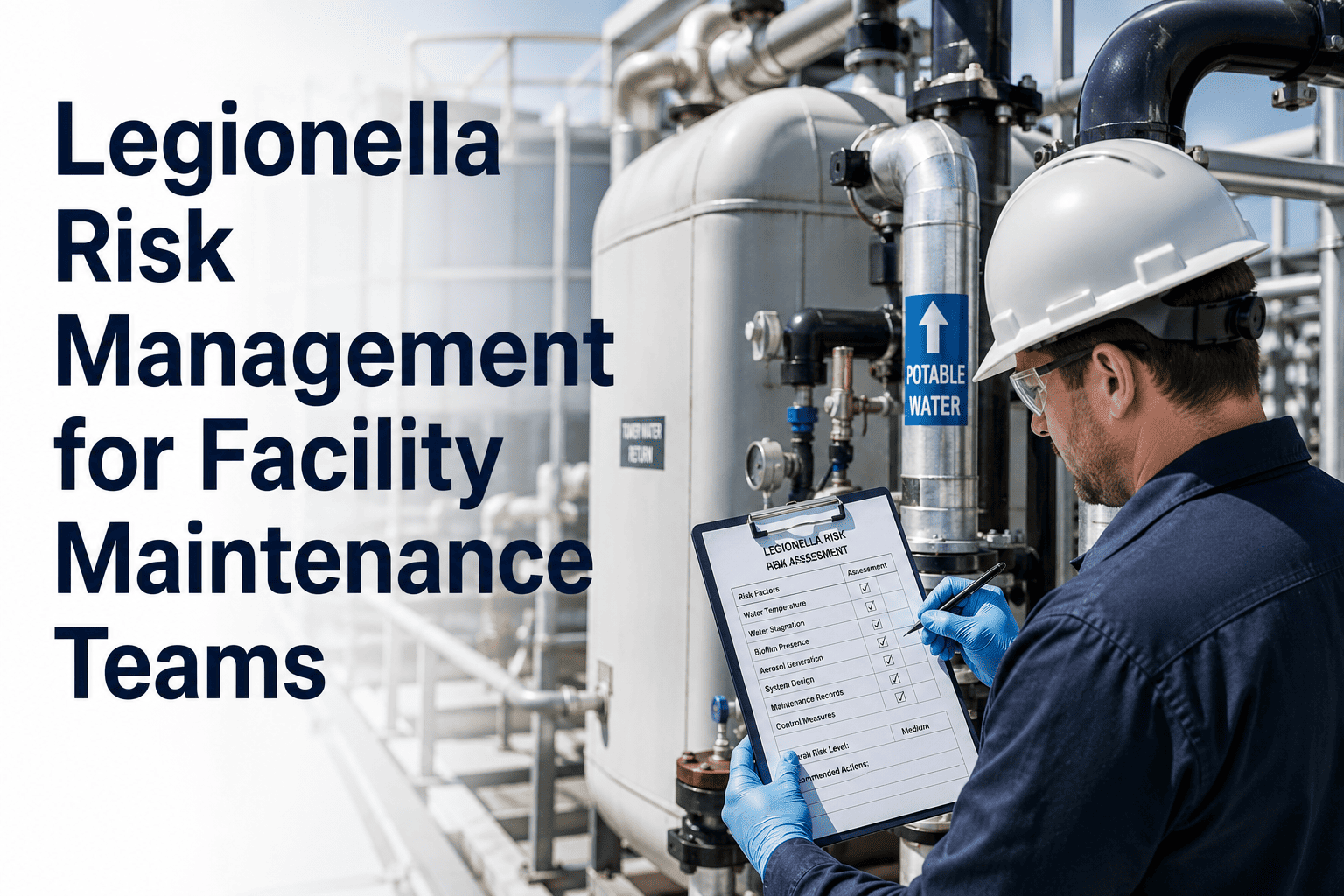
Legionella bacteria thrive in facility water systems where temperature, stagnation, and nutrient conditions are left uncontrolled — and the consequences of an outbreak extend far beyond the building itself. Regulatory penalties, civil liability, and reputational damage from a Legionnaires' disease investigation follow facility managers for years. This checklist gives maintenance teams a structured, actionable framework for Legionella risk reduction — and explains how Oxmaint's digital compliance platform ensures every task is completed, documented, and audit-ready. Book a demo to see how Oxmaint tracks Legionella prevention programs across your entire facility portfolio.
P1 Critical Compliance
Legionella Risk Management
For Facility Maintenance Teams
Digital water temperature logs, flushing schedules, and corrective action records — all in one platform. Protect your facility, your tenants, and your compliance record.
10,000+
Legionnaires' disease hospitalizations in the US annually
$4.8M
Average civil settlement from a facility-linked Legionella outbreak
85%
Of outbreaks occur in buildings with documented program gaps
-91%
Reduction in compliance gaps with digital tracking vs paper programs
The Complete Legionella Prevention Checklist
This checklist covers the critical control points defined in ASHRAE 188, CDC guidelines, and local health department Legionella prevention program requirements. Each item should be digitally logged with technician sign-off and result capture.
Verify hot water storage temperature at heater outlet ≥ 60°C (140°F)
Risk: Legionella multiplies rapidly between 25–50°C. Storage below 60°C creates active growth conditions within hours.
Critical
Check hot water delivery temperature at distal fixtures ≥ 55°C (131°F)
Risk: Recirculation system failures or heat losses in long distribution runs create cold zones that host bacteria.
Critical
Log cold water system temperatures — all points must remain below 20°C (68°F)
Risk: Cold water warmed by proximity to hot pipes or mechanical rooms creates Legionella-conducive temperatures in domestic cold systems.
High
Verify thermostatic mixing valve set points and function at all TMV-equipped outlets
Risk: Failed TMVs allow full hot water temperatures to reach fixtures, or fail in the opposite direction creating Legionella growth zones in blended water.
High
Flush all low-use hot and cold water outlets for minimum 2 minutes each
Risk: Stagnant water in infrequently used outlets is the most common Legionella colonization point in commercial buildings. Weekly flushing prevents biofilm establishment.
Critical
Document all flushed outlets with location, flush duration, and technician sign-off
Risk: Undocumented flushing provides no legal or regulatory protection — regulators require evidence of completion, not assertion.
High
Identify and report any outlets with persistent flow discoloration or odor
Risk: Discoloration or biofilm odor indicates advanced Legionella-conducive conditions requiring immediate remediation, not routine flushing.
Critical
Verify biocide dosing levels — chlorine residual, bromine, or alternative biocide per WMP
Risk: Inadequate biocide concentration allows rapid bacterial growth. Cooling towers with aerosol generation are the highest-risk Legionella transmission vector in commercial facilities.
Critical
Test and log conductivity, pH, and Legionella culture results per WMP schedule
Risk: pH outside 7.5–8.5 reduces biocide efficacy significantly. Conductivity exceedances indicate blowdown failure and concentrated nutrient conditions.
Critical
Inspect drift eliminators, basin, and fill media for visual contamination and scale
Risk: Fouled drift eliminators and scale-covered fill media harbor biofilm communities that are resistant to biocide treatment without physical cleaning.
High
Digital Legionella Compliance
Never Miss a Flushing Schedule or Temperature Check Again
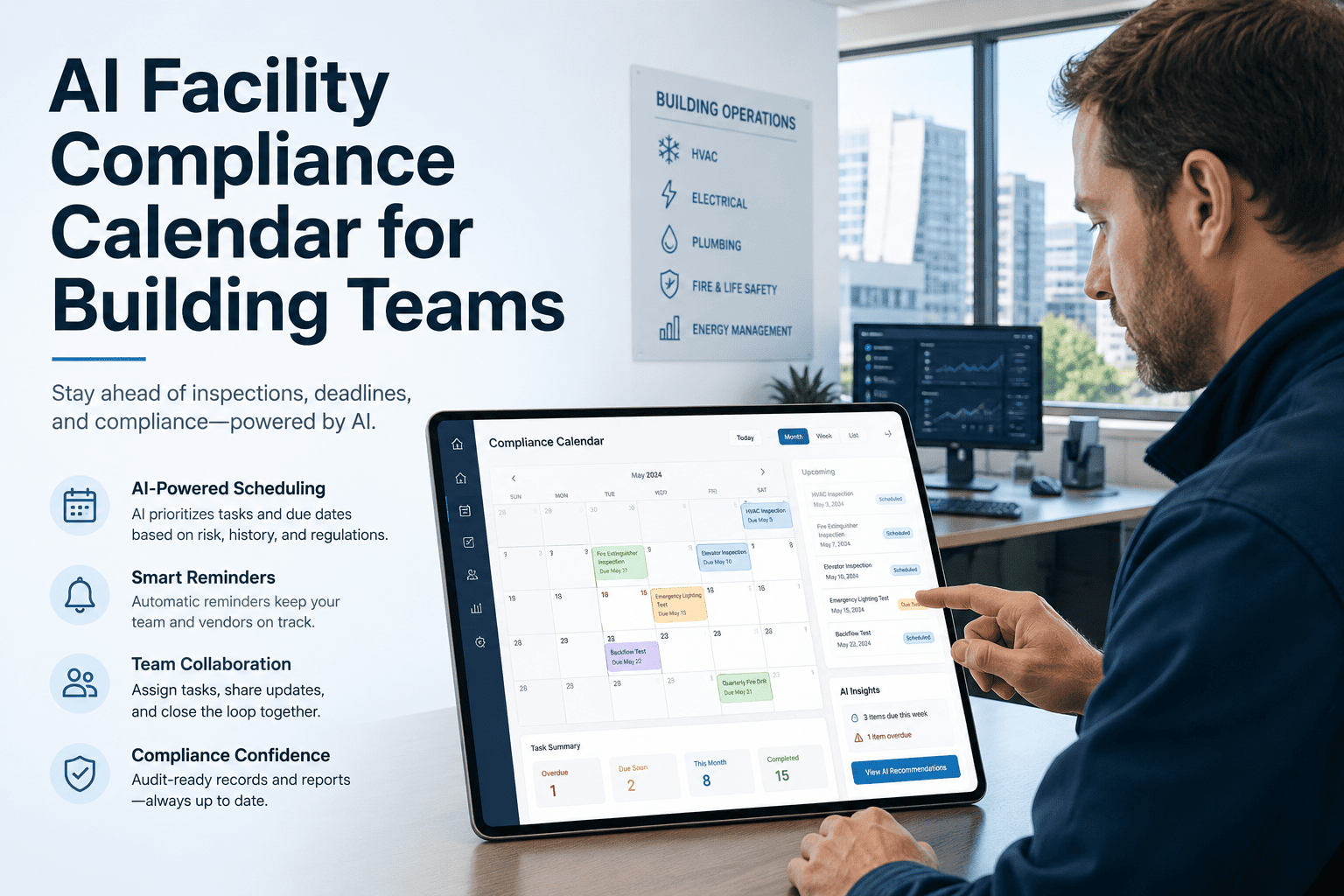
Oxmaint's compliance platform automates Legionella prevention scheduling, captures results digitally, and generates audit-ready records on demand. Every item on this checklist becomes a tracked, timestamped, verified task — not a paper entry that can be questioned.
Corrective Action Response Times
| Trigger Condition |
Required Response Time |
Corrective Action |
Documentation Required |
| Hot water below 55°C at distal outlet |
Within 4 hours |
Investigate recirculation failure; superheating if biofilm suspected |
Temperature logs, work order, retest results |
| Positive Legionella culture (>1 CFU/mL) |
Within 24 hours |
Remediation per WMP; notify health authority; restrict affected systems |
Culture results, remediation log, authority notification |
| Cooling tower biocide below minimum |
Within 8 hours |
Emergency biocide dosing; verify dosing system function |
Biocide levels before/after, dosing records |
| Cold water above 20°C |
Within 8 hours |
Identify heat source; insulation or routing modification |
Temperature survey, corrective action report |
| Flushing schedule missed (>14 days) |
Within 48 hours |
Complete flush; assess outlet for visible contamination |
Flush completion record, visual inspection note |
Expert Review
The facilities that end up in a Legionella investigation are almost never the ones that tried to prevent it and failed — they are the ones that had no systematic program in place. The difference between a facility that passes a public health investigation and one that faces enforcement action is documented evidence of a functioning Water Management Plan. Digital platforms that create timestamped records of every temperature check and flushing event provide that evidence automatically. Paper programs create liability; digital programs create defensibility.
HC
Helen Crane
Public Health Consultant, former state health department Legionella investigator, 20 years experience
Flushing schedule adherence is the single most preventable failure point in commercial Legionella programs. We see buildings with well-designed water management plans that fail on execution — a low-use restroom on a vacant floor that hasn't been flushed in six weeks becomes a colonization point that undermines the entire program. Digital scheduling that pushes notifications to a technician's phone and won't mark a task complete without a documented result eliminates that gap entirely. The technology exists to make Legionella prevention program failures a thing of the past.
BN
Brian Nolan
Certified Water Treatment Professional, ASHRAE 188 implementation specialist
Frequently Asked Questions
Which building types are required to have a formal Legionella Water Management Plan?
ASHRAE 188 and CDC guidelines strongly recommend formal Water Management Plans for all buildings with complex water systems, including hotels, hospitals, nursing homes, multi-family residential buildings over six stories, and commercial office buildings with cooling towers. Some states including New York, Maryland, and California have enacted mandatory WMP requirements for buildings above specified occupancy thresholds. Regardless of regulatory mandate, any building with a cooling tower, hot water storage systems, or decorative water features carries significant Legionella risk without a documented prevention program.
Book a demo to review WMP requirements applicable to your facilities.
How does Oxmaint handle Legionella culture testing records and out-of-range results?
Lab culture results can be logged directly in Oxmaint with the specific CFU count, sampling location, and test date. When results exceed program action thresholds, the platform automatically escalates alerts to designated managers, generates a corrective action work order, and initiates the documentation trail required for regulatory notification purposes. The platform tracks the full remediation cycle from detection through corrective action completion and verification resampling — creating a complete chain of evidence.
Start a free trial to see the Legionella testing workflow.
Can Oxmaint generate the documentation required for a health department investigation?
Yes. In the event of a Legionella investigation, Oxmaint exports a complete documentation package including all water temperature logs, flushing records, biocide treatment logs, culture results, corrective action records, and technician certification records. These packages are formatted to satisfy the documentation requirements of state health departments, the CDC's Environmental Investigation Protocol, and legal discovery requirements. Facilities that can produce complete digital records during an investigation demonstrate program diligence and significantly reduce enforcement exposure. Speak with Oxmaint's compliance team during a demo for investigation-readiness guidance specific to your jurisdiction.
Legionella Prevention Starts with the Next Task Completed
Every temperature check logged, every flushing record captured, and every corrective action documented builds the compliance evidence that protects your facility in a regulatory investigation. Oxmaint turns this checklist into a managed, automated, audit-ready program — not a paper form that gets filed and forgotten.