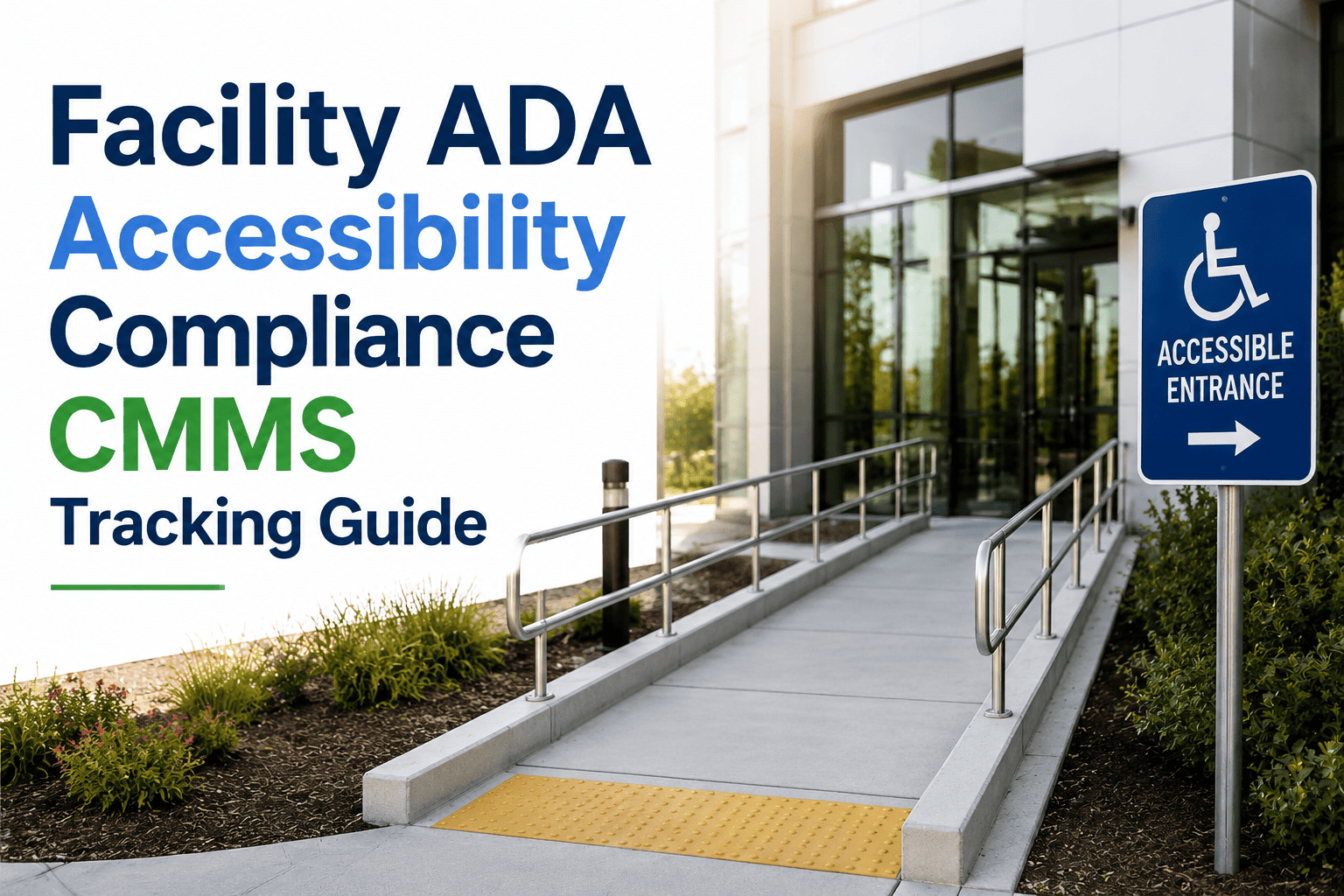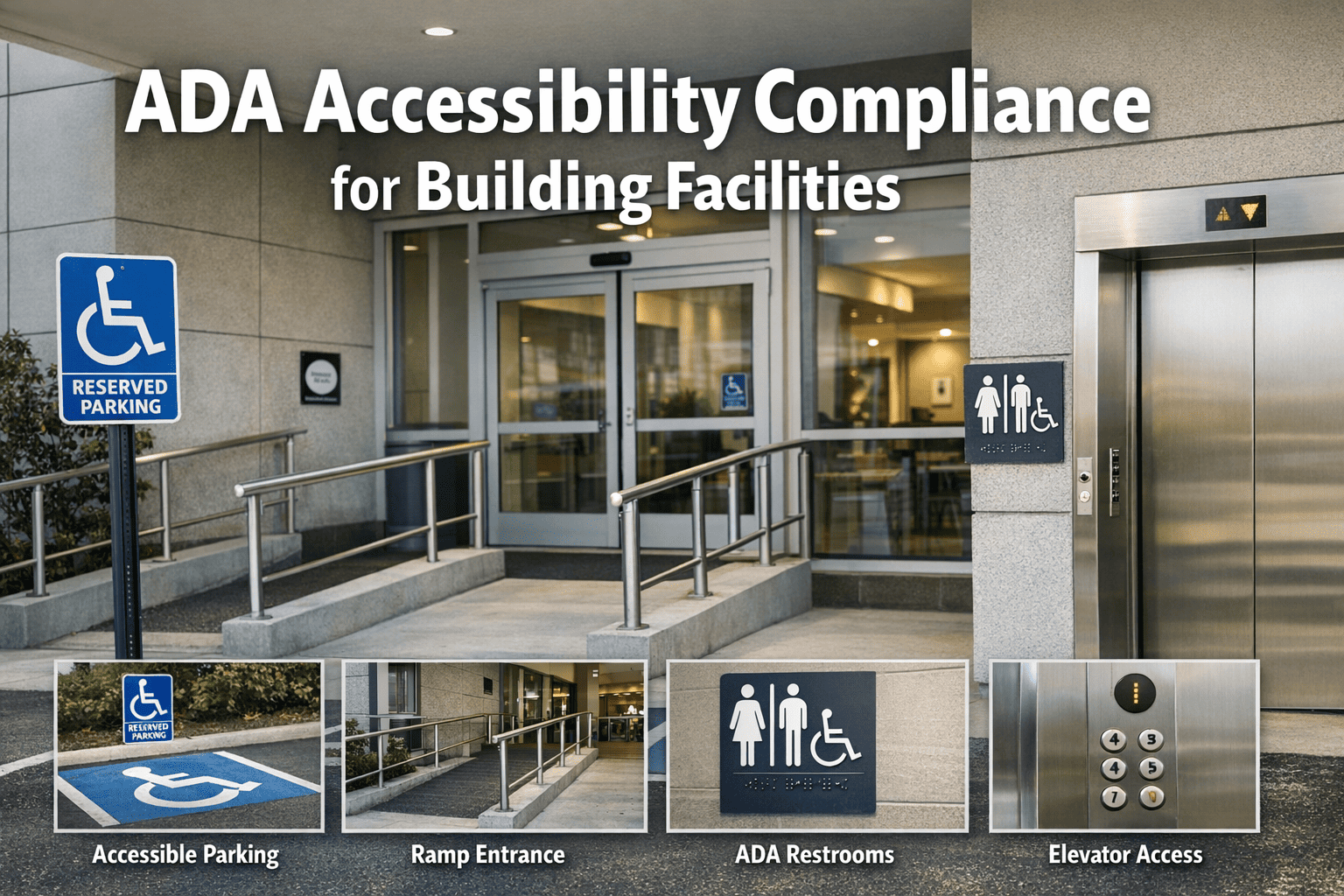
The Americans with Disabilities Act is not a building code with a compliance date that passes — it is a civil rights law that applies to your facility today, regardless of when it was built. Public accommodations under Title III must remove architectural barriers where it is readily achievable to do so, and state and local government facilities under Title II must ensure program accessibility across all services. ADA violations expose building owners to DOJ enforcement, private lawsuits, and remediation costs that consistently exceed the original barrier removal expense by several multiples. This Inspection covers the six areas most commonly cited in ADA compliance audits — parking, entrances, corridors, restrooms, signage, and elevators — with the specific dimensional requirements from the 2010 ADA Standards for Accessible Design. Use it as the foundation for your facility inspection, and track every finding and corrective action through OxMaint's compliance tracking system so your documentation is audit-ready at all times.
Walk your facility with floor plans in hand, bring a tape measure, and assign a pass/fail status to each item. Items marked as failing become corrective actions. Prioritize by the ADA's own four-priority sequence: exterior accessibility first, then access to goods and services, then restrooms, then any remaining elements. Document every finding and every corrective action with date, responsible party, and target completion — this documentation constitutes evidence of good faith compliance under DOJ guidelines.
Accessible parking is the first barrier most people with disabilities encounter. The 2010 Standards specify both the number of accessible spaces required and the exact dimensions for space width, access aisle width, and signage height. Van-accessible spaces have additional dimensional requirements that standard accessible spaces do not meet.
| Inspection Item | ADA Requirement | Pass / Fail |
|---|---|---|
| Accessible space quantity | 1 per 25 spaces (minimum 1); 1 van-accessible per 6 accessible spaces | PF |
| Standard accessible space width | 96 inches (8 feet) minimum width per space | PF |
| Van-accessible space width | 132 inches (11 feet) minimum — OR 96" space with 96" adjacent access aisle | PF |
| Access aisle width | 60 inches minimum for standard; 96 inches for van-accessible | PF |
| Accessible signage — ISA symbol | Mounted at 60 inches minimum above ground to bottom of sign | PF |
| Accessible route from parking to entrance | Continuous, unobstructed — no curbs without curb ramps; slope max 1:20 | PF |
| Surface condition | Stable, firm, and slip-resistant; no level changes exceeding ½ inch without ramp | PF |
At least 60% of public entrances must be accessible in new construction. For existing facilities under barrier removal requirements, at least one entrance must be accessible and connect to the accessible route. Door clear width is measured with the door open 90 degrees — the door slab thickness reduces the clear opening and must be accounted for in measurements.
| Inspection Item | ADA Requirement | Pass / Fail |
|---|---|---|
| Door clear width | 32 inches minimum clear (measured at door open 90°) | PF |
| Maneuvering clearance — pull side | 18 inches latch side clearance minimum on pull side of door | PF |
| Door opening force — interior | 5 lbs maximum for interior non-fire-rated doors | PF |
| Threshold height | ½ inch maximum new construction; ¾ inch maximum existing with beveled edge | PF |
| Door hardware type | Lever, loop, or push type — no round knobs requiring tight grasping or twisting | PF |
| Ramp running slope | 1:12 maximum (8.33%) — any slope steeper than 1:20 is treated as a ramp | PF |
| Ramp handrails | Required on both sides if ramp rise exceeds 6 inches; graspable, 34–38 inches high | PF |
| Landing at top and bottom of ramp | 60 inches minimum length; width at least as wide as the widest ramp run | PF |
The accessible route must connect all accessible spaces within and outside the facility without interruption. Width, head clearance, surface condition, and protruding objects are all regulated. Passing spaces are required where corridors narrow below 60 inches — a T-intersection qualifies as an acceptable passing place.
| Inspection Item | ADA Requirement | Pass / Fail |
|---|---|---|
| Minimum corridor clear width | 36 inches minimum; 44 inches minimum where required by occupancy | PF |
| Passing space — corridors under 60" | 60" × 60" passing space at max 200-foot intervals; T-intersection acceptable | PF |
| Head clearance along route | 80 inches minimum clear overhead height throughout accessible route | PF |
| Protruding objects — wall-mounted | Objects between 27–80 inches high cannot protrude more than 4 inches into the route | PF |
| Floor surface condition | Stable, firm, slip-resistant — carpet must be secured and have firm cushion | PF |
| Cross slope of accessible route | Maximum 1:50 (2%) cross slope anywhere along the accessible route | PF |
Restroom compliance involves the most precise dimensional requirements in ADA inspection. Every measurement matters — a toilet centerline 1 inch outside the 16–18 inch range, a grab bar at 32 inches instead of 33 inches, or a stall door that swings inward into the required clearance all constitute violations. At least one accessible stall is required in every multi-stall restroom; restrooms with 6 or more stalls must also include an ambulatory-accessible stall (35–37 inches wide with parallel grab bars).
| Inspection Item | ADA Requirement | Pass / Fail |
|---|---|---|
| Accessible stall width | 60 inches minimum clear width inside the stall | PF |
| Stall depth — wall-mounted toilet | 56 inches minimum from side wall; 59 inches for floor-mounted toilet | PF |
| Toilet seat height | 17–19 inches above finish floor | PF |
| Toilet centerline from side wall | 16–18 inches from the side wall | PF |
| Side grab bar — length | 42 inches minimum; located no more than 12 inches from rear wall; mounted 33–36" above floor | PF |
| Rear grab bar — length | 36 inches minimum; extends 12" toward side wall and 24" in other direction; 33–36" above floor | PF |
| Grab bar structural strength | Must withstand 250 lbs of force — verify mounting substrate, not just fixture | PF |
| Lavatory knee and toe clearance | 27 inches high × 30 inches wide × 19 inches deep minimum; insulated pipes | PF |
| Faucet controls | Operable without tight grasping, pinching, or wrist twisting — lever or sensor type | PF |
| Restroom door — interior opening force | 5 lbs maximum force to open; closer must allow 5 seconds from open to 12° from latch | PF |
ADA signage requirements apply to permanent room and space identification signs — not to temporary or informational signage. Permanent signs must have raised characters and Grade 2 Braille for tactile reading by people with visual impairments. Signs must be mounted at a specific height and located on the latch side of the door — where a tactile reader can stand without being struck by an opening door.
| Inspection Item | ADA Requirement | Pass / Fail |
|---|---|---|
| Sign mounting height | Centerline of sign at 60 inches above finished floor | PF |
| Sign location — permanent rooms | Latch side of door; 18 inches minimum from any door corner to edge of sign | PF |
| Raised characters | 5/8" to 2" high; 1/32" minimum raised; sans-serif typeface; no italic | PF |
| Braille — Grade 2 required | Contracted Grade 2 Braille directly below corresponding raised characters | PF |
| Pictogram field height | 6 inches minimum pictogram field on permanent room signs | PF |
| Visual contrast | Light characters on dark background or dark on light — high contrast required | PF |
| Accessible alarms — visual | Visible alarm coverage required in restrooms and common use areas with audio alarms | PF |
Elevators are not required in facilities under three stories or with fewer than 3,000 square feet per floor — unless the building is a shopping center, health care provider office, transit station, or airport terminal, where elevators are required regardless of size. Where elevators are provided, they must meet specific cab size, control height, door timing, and communication requirements.
| Inspection Item | ADA Requirement | Pass / Fail |
|---|---|---|
| Elevator cab — minimum clear floor area | 51 × 80 inches minimum for center-opening doors; 54 × 80 for side-opening | PF |
| Door clear width | 36 inches minimum clear width at elevator doors | PF |
| Control button height | Highest operable button: 48 inches maximum above floor (forward reach) or 54 inches (side reach) | PF |
| Floor designation — Braille and raised | Raised floor designations on door jambs at 60" centerline; Braille below | PF |
| Door hold-open time | Reopening device required; 20-second minimum hold-open time when triggered | PF |
| Two-way emergency communication | Two-way communication system inside cab — usable without voice (visual/TTY capable) | PF |
| Lobby call button height | Centered at 42 inches above finished floor; visual indicator on each call button | PF |