Facility managers lose an average of $17,000 per hour during unexpected equipment failures — yet most faults leave detectable signals weeks before breakdown. OxMaint's AI anomaly detection reads those signals so you never get caught off guard. Book a free demo and see live fault detection on your building data.
Blog | AI & Smart Technology
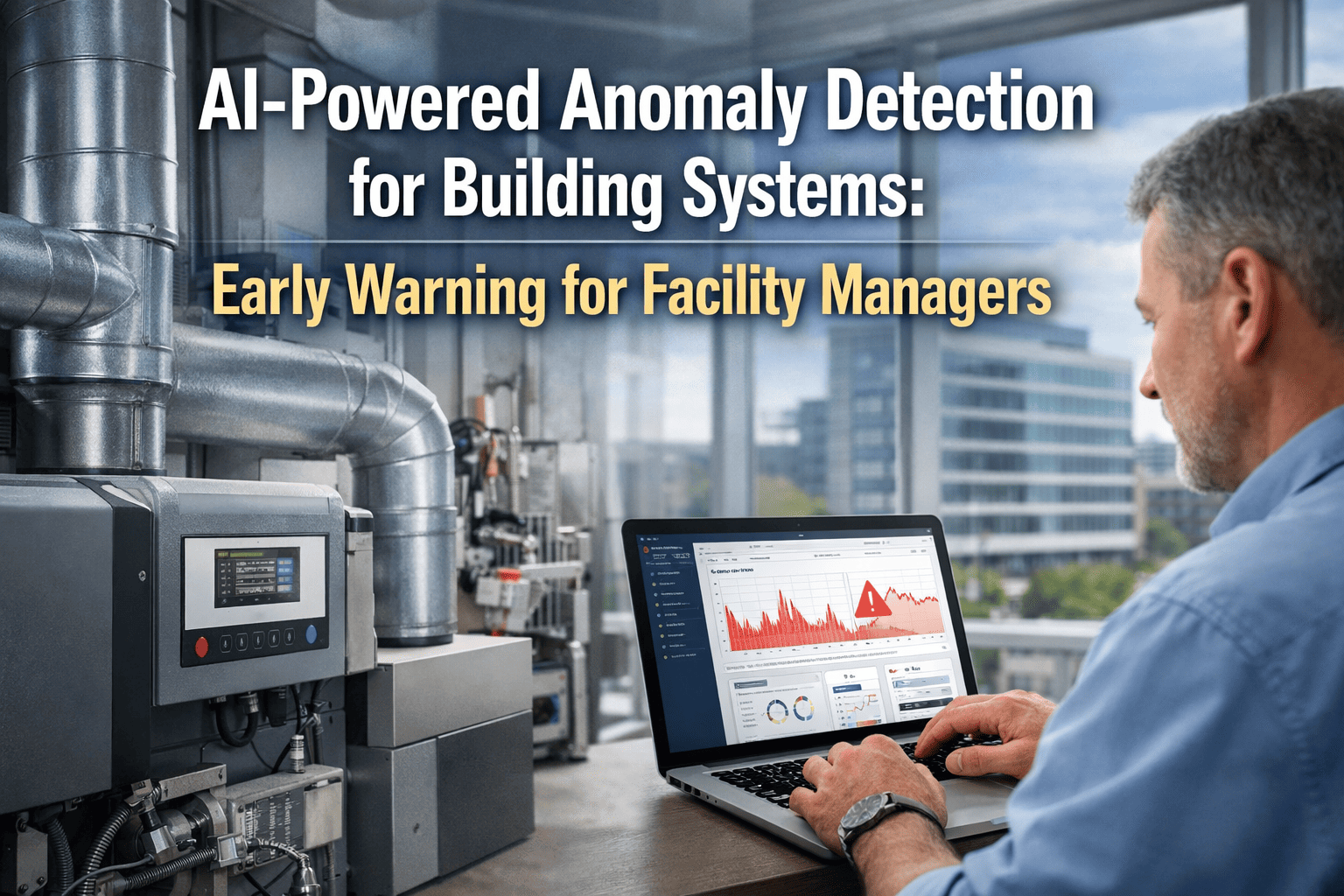
AI-Powered Anomaly Detection for Building Systems: Early Warning for Facility Managers
73%
Failures Are Detectable in Advance
5×
ROI on Predictive vs Reactive
The Problem
Why Traditional Monitoring Keeps Failing Facility Teams
Standard BMS dashboards show you what is happening right now — not what is about to happen. By the time an alert fires, the equipment has already entered failure mode. AI anomaly detection works differently: it learns the normal behavior signature of every asset and flags deviations days or weeks before the physical threshold is crossed.
01
Threshold Alerts Fire Too Late
Static temperature or vibration thresholds only trigger when damage is already occurring. AI detects subtle drift from baseline 2–8 weeks earlier.
02
False Alarms Cause Alert Fatigue
Rule-based systems generate 40–60% false positives. Machine learning filters noise, sending alerts only when patterns genuinely signal risk.
03
No Cross-System Correlation
An HVAC fault often shows up first in energy draw, not temperature. AI links signals across systems to identify root causes humans miss.
How It Works
From Raw Sensor Data to Actionable Early Warnings
1
Sensor Ingestion
OxMaint pulls live data from HVAC, chillers, pumps, elevators, and electrical panels — any BACnet, Modbus, or IoT source.
→
2
Baseline Learning
ML models build a normal behavior fingerprint for every asset, accounting for time-of-day, occupancy, and seasonal patterns.
→
3
Anomaly Scoring
Every reading receives a deviation score. Scores trending upward trigger staged alerts — low risk, medium risk, urgent — before failure.
→
4
Auto Work Order
When risk crosses a threshold, OxMaint auto-creates a prioritized work order with asset history, recommended action, and parts list attached.
Stop Waiting for Alarms That Arrive Too Late
See OxMaint catch a live equipment anomaly on your building data — before it becomes a breakdown.
Detection Performance
What the Data Shows: AI vs Traditional Monitoring
| Metric |
Rule-Based BMS |
OxMaint AI Detection |
Improvement |
| Average Detection Lead Time |
0–2 hours |
2–8 weeks |
14–56× earlier |
| False Positive Rate |
40–60% |
Under 8% |
85% reduction |
| Faults Caught Before Failure |
27% |
73% |
+46 percentage points |
| Avg. Repair Cost per Incident |
$18,400 |
$3,200 |
83% lower |
| Unplanned Downtime per Year |
Baseline |
Down 40% |
40% reduction |
Asset Coverage
Building Systems OxMaint AI Monitors
H
HVAC & Chillers
Detects: refrigerant drift, coil fouling, compressor wear
P
Pumps & Motors
Detects: bearing degradation, cavitation, overheating
E
Electrical Systems
Detects: harmonic distortion, load imbalance, insulation failure
L
Elevators & Lifts
Detects: motor torque anomalies, door cycle drift, brake wear
B
Boilers & Cooling Towers
Detects: combustion efficiency drop, scaling, water quality shifts
A
Access & Security
Detects: door sensor faults, access controller anomalies
Expert Review
What Industry Analysts Say
"Facilities that deploy machine learning anomaly detection report 30–50% reductions in unplanned downtime within the first year. The technology's ability to distinguish normal operational variation from genuine fault signatures is what separates it from legacy threshold alerting — and it is now accessible to mid-market facility operations, not just enterprise campuses."
— Verdantix Smart Building Research, 2024 Facility Intelligence Report
"AI-driven fault detection and diagnostics represent the single highest-ROI investment a facility manager can make in 2024–2025. Every dollar spent on predictive AI yields five to seven dollars in avoided repair and downtime costs. The evidence across commercial real estate, healthcare, and manufacturing is now conclusive."
— IFMA Foundation, Intelligent Buildings Benchmark Study 2024
FAQs
Frequently Asked Questions
How long does it take for the AI to learn our building's normal behavior?
Most facilities see accurate baseline models within 2–4 weeks of sensor connection. OxMaint accelerates this by pre-loading manufacturer-recommended operating ranges for common equipment classes. By day 30, the system is detecting real anomalies with under 8% false positive rates. You can
start free today and connect your first assets immediately to begin the learning cycle.
Does OxMaint AI work with our existing BMS and sensor infrastructure?
Yes. OxMaint integrates with all major building management protocols including BACnet, Modbus, LonWorks, and leading IoT sensor platforms. If your facility already has sensors feeding a BMS, OxMaint can connect without new hardware in most cases. Our integration team maps your asset registry in the first week.
Book a demo to review your specific infrastructure with our engineers.
What types of faults can AI anomaly detection actually predict?
OxMaint has been validated across HVAC compressor failures, pump bearing degradation, electrical insulation breakdown, chiller refrigerant leaks, boiler combustion efficiency loss, and elevator motor wear — among others. The AI detects any measurable deviation from established baseline behavior, meaning it can identify novel fault types even those not in its initial training set, because it monitors patterns rather than specific failure modes.
How does OxMaint reduce alert fatigue from AI anomaly systems?
The platform uses a three-stage alert system: informational anomalies are logged silently, medium-risk patterns generate a daily digest, and urgent fault signatures trigger immediate work order creation and notification. Facility managers set their own alert thresholds per asset class. In practice, clients report receiving 85% fewer false alarms compared to their previous threshold-based systems while catching more real issues.
Early Warning Saves Assets
Give Your Building Systems an AI Watchdog
OxMaint monitors every sensor, learns every asset, and alerts your team weeks before failures strike — turning reactive firefighting into planned, cost-effective maintenance.