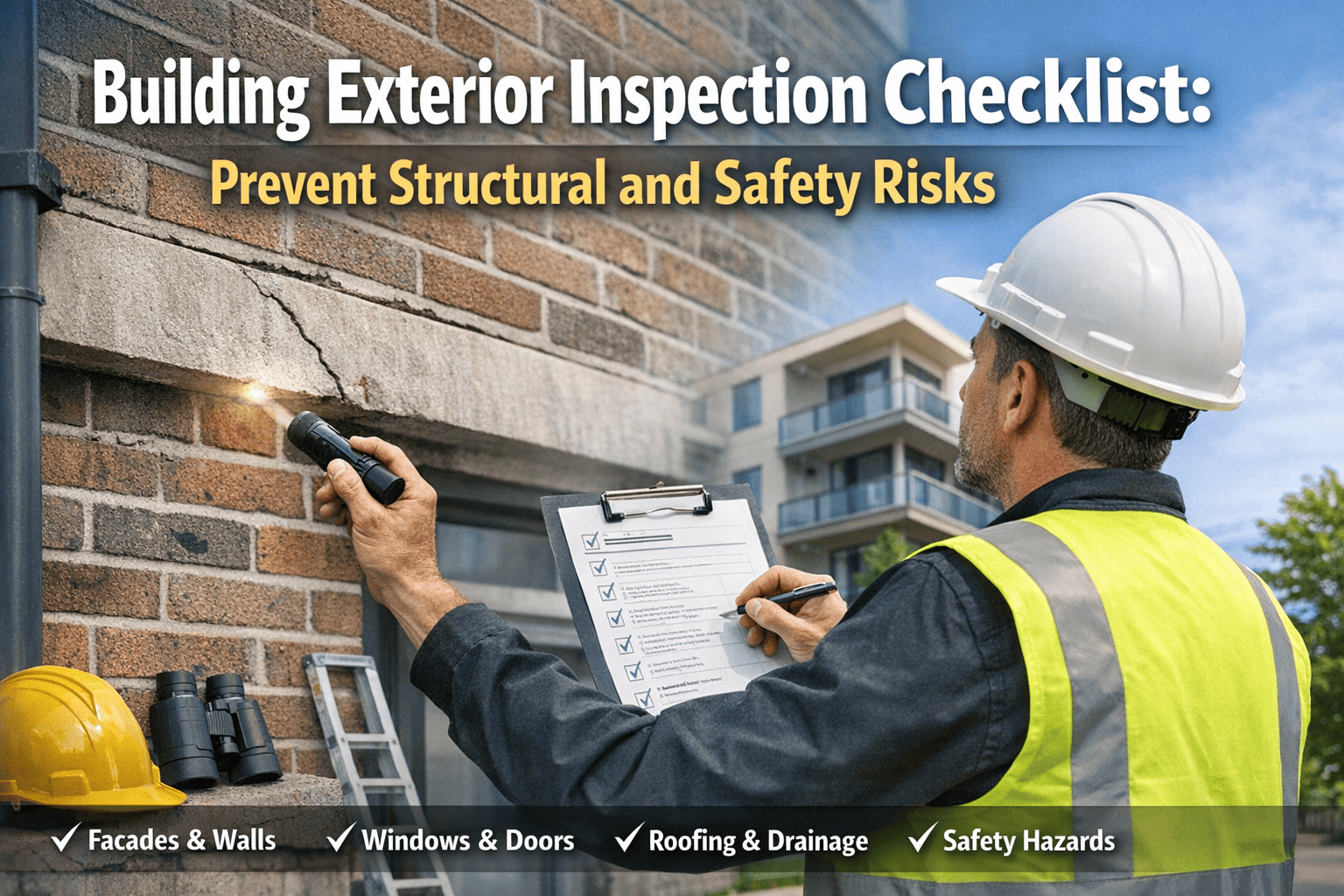
A piece of masonry falling from a building facade killed Barnard College student Grace Gold in 1979 — and that single tragedy prompted New York City to enact Local Law 10, the first mandatory facade inspection requirement in the United States. Today, building exterior inspection is not optional. It is a legal, safety, and financial obligation for every commercial property owner, and the consequences of missed inspections range from $1,000-per-month late filing penalties to catastrophic liability when a structural failure harms a passerby. Oxmaint's Asset Lifecycle Management module digitizes your entire exterior inspection program — scheduling inspections by component and frequency, tracking defect severity ratings, and converting every failed item into a documented corrective work order before conditions escalate from SWARMP to Unsafe classification. Book a demo to see how Oxmaint transforms exterior inspection compliance.
CHECKLIST · ASSET LIFECYCLE MANAGEMENT
Building Exterior Inspection Checklist
A structured, compliance-aligned inspection framework covering facades, windows, roofing, drainage, structural elements, and site safety — with severity classifications, regulatory references, and corrective action triggers.
$1,000
Per month penalty for late FISP facade report filing (NYC)
90 days
Repair deadline once unsafe facade condition is classified
5 years
Maximum inspection cycle for buildings over 6 stories
Condition Classification Reference
SAFE
No repair required — structural integrity maintained for next inspection cycle.
SWARMP
Safe With a Repair and Maintenance Program — not immediately hazardous but deteriorating.
UNSAFE
Immediately hazardous to public. Repair within 90 days. Install sidewalk shed immediately.
Water Infiltration
Gaps in sealant and flashing allow moisture ingress — leading to mold and structural deterioration
Falling Debris
Loose masonry, spalling concrete, and unsecured appurtenances pose direct hazard to pedestrians
Structural Settlement
Foundation movement and slab misalignment signal joint failure — expansion joint separation is an early warning sign
Drainage Failure
Blocked gutters and downspouts concentrate water at the building base — accelerating facade deterioration
6-ZONE INSPECTION FRAMEWORK
Building Exterior Inspection Checklist — Zone by Zone
Inspect each zone systematically. Assign a condition rating (Safe / SWARMP / Unsafe) to every item and trigger corrective work orders for all SWARMP and Unsafe findings immediately.
01
Facade & Exterior Walls
Masonry / brick — cracks, spalling, loose units — any crack above 1/8" or dislodged materialRate
Concrete surfaces — spalling, exposed rebar — surface delamination, rust staining below concreteRate
Cladding panels — secure, no movement — any panel play, missing fasteners, corrosion at fixingsRate
Mortar joints — erosion, voids, missing material — joints recessed more than 3/8" from faceRate
Expansion joints — sealant condition, gaps — cracked, hardened, or separated sealantRate
Appurtenances — signs, AC units, flagpoles — any loose, unsecured, or corroded attachmentRate
02
Windows, Doors & Glazing
Window frames — distortion, gap at perimeter — frame separation from wall, visible daylightRate
Glazing — cracks, failed thermal seals — condensation between panes, star cracks, chipsRate
Perimeter sealant — caulking condition — cracked, absent, or unbonded sealant at frame edgeRate
Lintels — deflection, corrosion — visible bow or rust staining below lintelRate
Window guards / security bars — loose anchors, visible corrosion at attachmentRate
03
Roof & Parapet
Parapet wall — coping stones, cap flashing — any loose coping, open joints, dislodged capRate
Roof membrane — blistering, splits, ponding — standing water after 48 hrs, visible membrane breachRate
Roof drains and scuppers — clear, functional — debris accumulation, no flow during rainRate
Rooftop equipment mounts — corrosion, secure — any movement, rust at base plates, missing fastenersRate
Flashing — base, counter, and step — lifted, cracked, or missing flashing at penetrationsRate
04
Drainage & Water Management
Gutters — debris-free, slope correct — sagging, overflow marks on wall belowRate
Downspouts — clear, secure, discharging correctly — separated joints, discharge onto foundationRate
Grade / site drainage — slopes away from building — water pooling within 3 ft of foundationRate
Waterproofing at below-grade areas — efflorescence, staining, or seepage at gradeRate
05
Balconies, Railings & Fire Escapes
Balcony slab — cracking, spalling, exposed steel — rust staining, delamination, or deflection visibleRate
Guardrail height — minimum 42" at open edge — below minimum, or any railing movement under forceRate
Railing connections — anchors, post bases — corrosion, visible movement, missing fastenersRate
Fire escape — structural integrity, tiebacks — corrosion at connections, excessive deflectionRate
06
Site, Pedestrian & Access Safety
Walkways — trip hazards, surface condition — vertical displacement over 1/4", cracking, heavingRate
Entrance canopies / overhangs — secure — any visible deflection, rust, or loose connectionsRate
Boundary walls, fencing, and gates — leaning, collapsed, or unsecured sectionsRate
Signage — secure, legible, no hazard — loose mounting, missing, or obscuring viewRate
ASSET LIFECYCLE MANAGEMENT
Digitize Your Exterior Inspection Program — Every Defect Tracked, Every Repair Documented
Oxmaint converts your building exterior inspection into a live asset lifecycle record — every zone, every component, every defect rating stored with photos, dates, and corrective work orders.
RISK VS. COST COMPARISON
The Cost of Inspection vs. The Cost of Neglect
Proactive Inspection Program
Deferred Inspection — Reactive Repairs
EXPERT REVIEW
"
The buildings I see with the most expensive facade repair histories are not the ones with the most deteriorated materials — they are the ones where SWARMP conditions were identified and not tracked to correction before the next inspection cycle. A SWARMP condition that is not repaired by the next FISP cycle is automatically classified as Unsafe — triggering public protection requirements and sidewalk shed costs. A platform like Oxmaint that links inspection findings to work orders gives building owners the audit trail that proves the repair program is real.
Carmen Delgado, PE, RA
Licensed Structural Engineer & Qualified Exterior Wall Inspector (QEWI) — 19 Years in Commercial Facade Assessment
FAQS
Building Exterior Inspection — Frequently Asked Questions
Requirements vary by jurisdiction and building height. In New York City, buildings over six stories must have exterior walls inspected every five years by a Qualified Exterior Wall Inspector (QEWI) under the Facade Inspection Safety Program (FISP). Many other jurisdictions have adopted similar five-year cycles. Best practice calls for annual professional visual inspections and monthly internal walkthroughs. Oxmaint tracks inspection due dates by zone and cycle automatically.
SWARMP (Safe With a Repair and Maintenance Program) means the facade is not immediately hazardous but has conditions that will become unsafe within five years. A repair timeline must be established. Unsafe means conditions are immediately hazardous — requiring emergency public protection measures (sidewalk shed, netting) and repair completion within 90 days. A SWARMP condition not corrected before the next FISP cycle is automatically reclassified as Unsafe. Book a demo to see how Oxmaint tracks SWARMP conditions to closure.
Complete documentation should include dated inspection reports with photographs of every deficiency, condition ratings (Safe/SWARMP/Unsafe) for each component, corrective action work orders linked to each deficiency, and repair completion records with before-and-after photographs. Oxmaint stores all of this in a searchable, audit-ready digital record. Start building your exterior inspection record library in Oxmaint today.
For routine monthly walkthroughs at accessible areas — ground-level facades, drainage clearance — trained maintenance staff can perform visual inspections. For close-up inspection of upper stories, structural assessment, and any regulatory filing, a licensed PE or RA serving as a Qualified Exterior Wall Inspector is required. Oxmaint manages multi-tier inspection programs across staff and licensed professionals. Book a demo to see how.
NEVER MISS A FACADE INSPECTION CYCLE AGAIN
Track Every Exterior Defect from Discovery to Repair — With a Full Audit Trail for Every Cycle
Oxmaint's Asset Lifecycle Management module schedules your exterior inspection cycles automatically, guides technicians through structured zone-by-zone checklists on mobile, converts every SWARMP finding into a tracked corrective work order, and stores the photographic documentation your QEWI and AHJ require.




.jpeg)