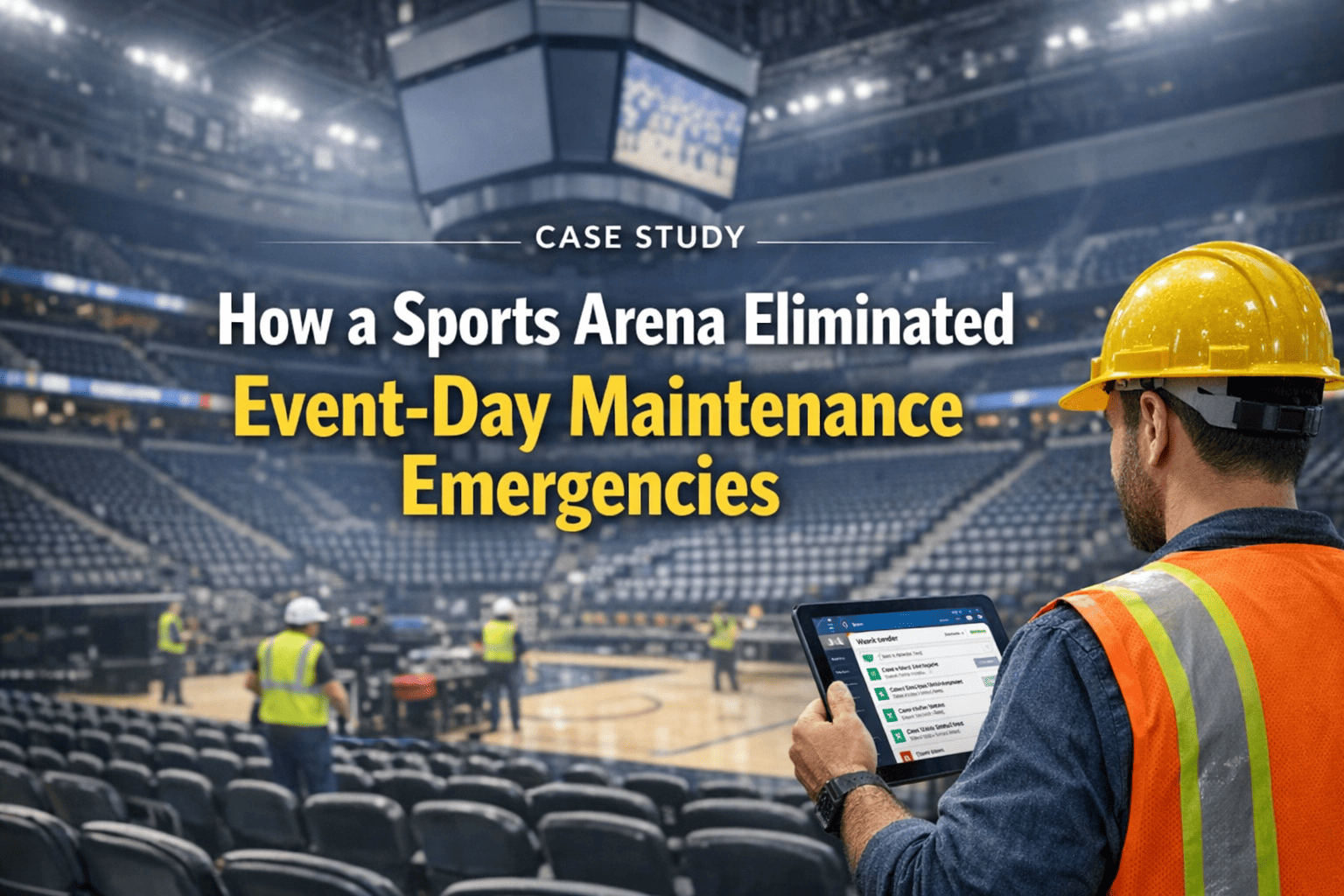
How a Sports Arena Eliminated Event-Day Maintenance Emergencies

By James smith on April 16, 2026

sports-arena-event-day-maintenance-emergency-elimination

When a 20,000-seat arena hosts back-to-back events — an NBA game Friday, a sold-out concert Saturday — the maintenance window between them is under 18 hours. A failed HVAC zone, a jammed turnstile, or a dark concourse becomes a safety risk and a social media moment within minutes. OxMaint's Work Order Management helped one major multi-purpose arena cut event-day emergency work orders by 73% in 12 months — without adding a single headcount.

Case Study · Sports Arena · Work Order Management

How a 20,000-Seat Arena Eliminated Event-Day Maintenance Emergencies

From 34 emergency work orders per event month to under 10. This is how structured work order management changed everything for a venue running 180+ events a year.

73%
Fewer event-day emergencies — Year 1
180+Events per year
18 hrsAvg. window between events
8 wksTo full deployment
$264KSaved in Year 1
Venue Profile
TypeMulti-purpose arena — NBA, NHL, concerts, family events
Capacity20,000 seats + premium suites and club level
Team28 full-time maintenance staff across mechanical, electrical, AV
BeforePaper forms, email dispatch, verbal shift handovers
SolutionOxMaint Work Order Management + PM Scheduling
The Problem — 3 Numbers
34
Emergency work orders per event month — HVAC, AV, plumbing, electrical — all discovered at gates-open
4.8x
Higher cost per repair during a live event vs. the same repair in a planned pre-event window
0%
Of 1,400 assets had a documented PM schedule — every fix was reactive, triggered by failure or fan complaint

Where the Money Was Going

Estimated annual reactive maintenance cost breakdown
Emergency Labor Premium
$186,000
Rushed Parts & Expediting
$94,000
Shortened Asset Lifespan
$72,000
Warranty Voids & Admin
$75,000
Total: $427,000/year — before any major single-equipment failure

What Changed in 8 Weeks

01
Every Asset Got a Digital Identity
All 1,400 assets — turnstiles, HVAC zones, scoreboards, AV, concession equipment, life safety — registered in OxMaint with QR codes. Any technician could scan any asset and see its full history, open work orders, and next scheduled PM. Zero paper work order forms remained in use after Week 3.
02
Pre-Event Checklists Became Automatic
OxMaint auto-generated pre-event inspection work orders 48 hours before every event — covering life safety, scoreboard, PA, HVAC, and entry systems. Post-event work orders captured damage and wear for next-day resolution. Event-calendar-linked scheduling meant nothing reached gates-open without a documented check.
03
P1 Alerts with 30-Minute SLA
Event-critical assets were classified P1 with auto-escalation to the operations director if not acknowledged within 30 minutes. Every technician received work orders on mobile with asset context and repair history pre-populated. Structured work order management dropped mean response time from 47 minutes to 9 minutes.

12-Month Results

34
9
Emergency WOs per month
73% down
47 min
9 min
P1 response time
81% faster
60%
97%
Pre-event inspection rate
+37 pts
$427K
$163K
Annual reactive cost
$264K saved
Savings Category Before After Year 1 Saved
Emergency labor premium 34 emergency WOs/month 9 WOs/month — 73% reduction $148,000
Rushed parts & expediting All parts reactive — no pre-ordering 94% of planned jobs pre-ordered $71,000
Asset lifespan & warranty 0 assets on PM schedule 1,400 assets on structured PM $45,000
Total Year 1 savings $264,000
20,000 fans deserve a venue that works. OxMaint makes sure it does — before gates open, not after.
"

The moment that convinced our leadership was when we ran the first 90-day report and saw Gate 7's turnstile cluster had generated 11 work orders — every one reactive, same bearing failure, same repair, different technician each time. Nobody had connected the pattern because each job was on a separate piece of paper. When that history was visible in one place, we changed the bearing spec, added a lubrication PM, and that cluster hasn't generated an emergency in 14 months. That's one cluster. We have 48. The data pays for itself before you finish reading it.
Director of Operations, Multi-Purpose Arena (20,000 seats)
22 years venue operations · OxMaint deployment lead for a 6-venue portfolio

Frequently Asked Questions

How does OxMaint handle back-to-back events with under 24 hours between them?
OxMaint links PM work orders directly to the event calendar — not a fixed schedule. For an 18-hour turnaround, the system auto-generates a compressed pre-event checklist covering only life safety and event-critical systems, and flags any outstanding post-event jobs as urgent carryovers. Supervisors see a live event-readiness dashboard counting down to gates-open. See how event-calendar scheduling works for large venues.
How quickly can a venue this size get fully operational on OxMaint?
This arena — 20,000 seats, 1,400 assets, 28 technicians — reached full operational deployment in 8 weeks. Asset registry, QR labeling, PM schedule setup, event calendar integration, and mobile training for the full team were all complete within that window. No IT project, no implementation consulting fees. Most venues in this size range are operational in 6 to 10 weeks. Start a free trial and see the platform configured for your venue before committing to full deployment.
Does OxMaint work for arenas hosting mixed events — sports, concerts, and conventions?
Yes. Each event type can have its own pre-event and post-event checklist template. A concert setup covers rigging points and PA infrastructure that an NBA checklist doesn't include. The same asset registry and automated work order system serves all event types simultaneously, with event-specific task routing assigning the right technician to the right system for every booking type on the calendar.
Stop Discovering Failures When 20,000 Fans Are Watching
Event-calendar PM scheduling, mobile work order execution, real-time SLA tracking, and complete asset history — in one platform built for venues that never slow down.

Share This Story, Choose Your Platform!