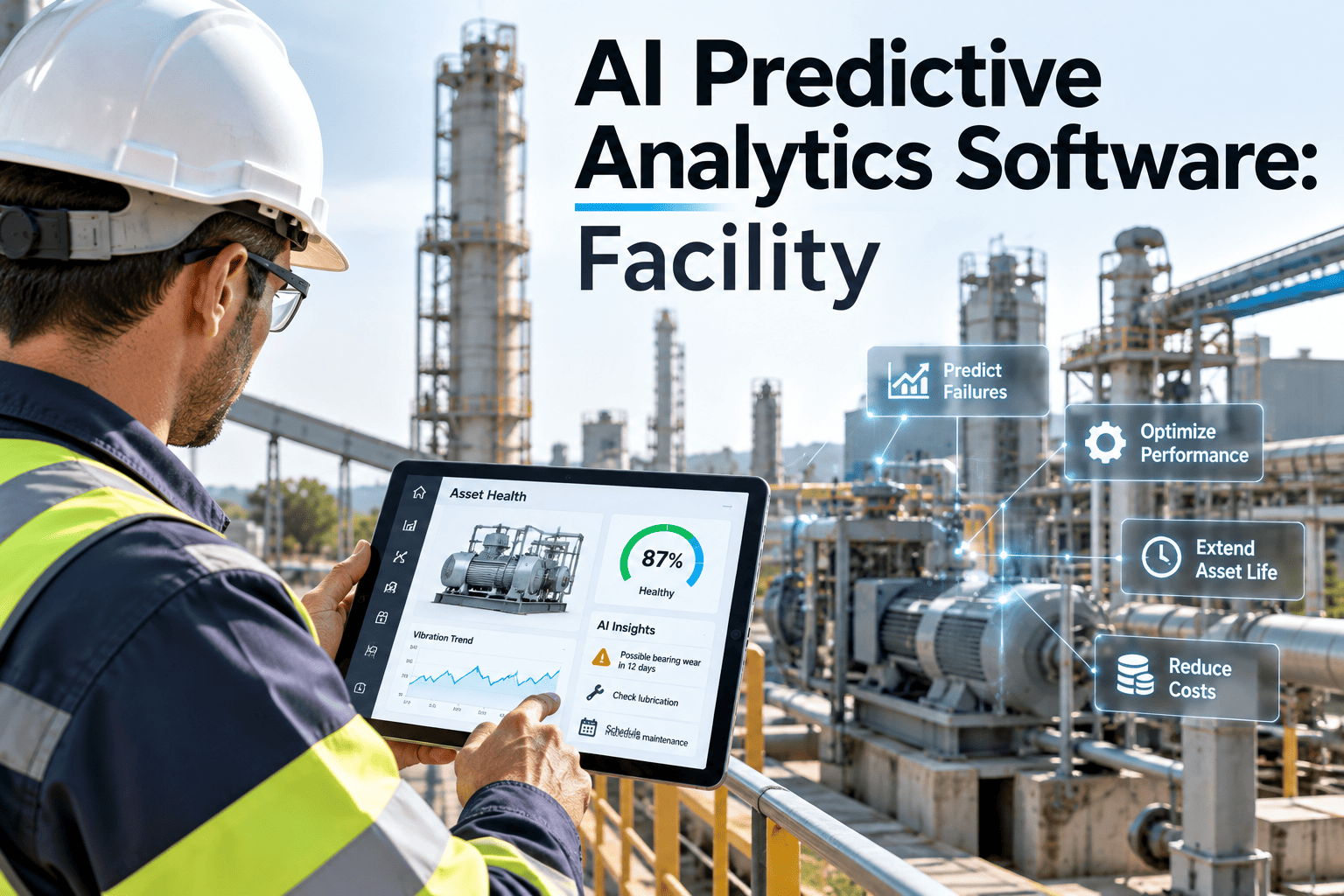
AI Predictive Maintenance for Facilities Complete Guide 2026

By Shreen on February 6, 2026

ai_predictive_maintenance_facilities_2026

Facility managers are under growing pressure to cut costs, reduce downtime, and extend the life of critical building systems. Traditional maintenance approaches—scheduled inspections, run-to-failure tactics, and spreadsheet-based tracking—leave too much to chance. AI-powered predictive maintenance changes the game by analyzing real-time sensor data, learning equipment behavior patterns, and forecasting failures weeks before they happen. The result: fewer emergencies, lower costs, and facilities that run at peak performance. Schedule a consultation to see how AI predictive maintenance can transform operations at your facility.

Why Facilities Are Shifting to AI Predictive Maintenance

Reactive maintenance costs 3 to 10 times more than planned repairs. Yet most facility teams still spend over half their time responding to breakdowns rather than preventing them. AI predictive maintenance uses IoT sensors, machine learning, and historical data to detect subtle warning signs that human inspectors miss—turning maintenance from a cost center into a strategic advantage.

$91B
Projected predictive maintenance market size by 2033, growing at 29.4% CAGR

50%
Reduction in unplanned downtime with AI-powered predictive maintenance systems

10:1
Average ROI ratio achieved within 12-18 months of predictive maintenance deployment
Ready to stop reacting and start predicting? Join thousands of facility teams using Oxmaint to centralize maintenance, automate workflows, and leverage data-driven insights.
Sign Up Free

How AI Predictive Maintenance Works for Facilities

AI predictive maintenance combines sensor hardware, connectivity, and intelligent software to continuously monitor every critical system in your facility. Rather than relying on calendar-based schedules or waiting for something to break, it detects the earliest signs of degradation and tells you exactly what needs attention and when.

AI Predictive Maintenance Workflow From sensor data to proactive action
01
Sensor Data Collection
IoT sensors installed on HVAC units, elevators, electrical panels, plumbing systems, and other critical assets continuously capture vibration, temperature, pressure, humidity, and energy consumption data at high-frequency intervals.
02
Data Aggregation and Cleaning
Edge computing devices and cloud platforms aggregate millions of data points from across all monitored assets. Automated validation removes noise and fills gaps, ensuring model accuracy and reliability.
03
Machine Learning Analysis
AI models compare real-time readings against learned baselines, flagging anomalies invisible to manual inspection. Neural networks detect patterns across multiple variables simultaneously—identifying issues months before failure occurs.
04
Predictive Alerts and Work Orders
When degradation patterns are detected, the system generates prioritized alerts and automatically creates work orders in your CMMS platform like Oxmaint, assigning the right technician with the right parts at the right time.
05
Continuous Learning and Optimization
AI models improve with every data point. As your facility generates more operational history, predictions become sharper and maintenance schedules become more efficient—reducing costs further each quarter.

Key Benefits of AI Predictive Maintenance

Facility teams that adopt AI-driven predictive maintenance consistently report measurable improvements across cost, uptime, asset lifespan, and safety. These are not theoretical gains—they are documented results from real-world deployments across commercial buildings, hospitals, manufacturing plants, and campus facilities.

Documented Benefits Across Facility Types
25-30%
Reduction in overall maintenance costs through optimized scheduling and eliminated unnecessary inspections
35-50%
Decrease in unplanned downtime with early failure detection and proactive intervention scheduling
20-40%
Extension in equipment lifespan through condition-based servicing instead of calendar-based replacement
73%
Fewer infrastructure failure incidents, with up to 75% reduction in equipment-related workplace safety events
See how predictive maintenance works in Oxmaint. Book a personalized demo and we will walk you through real-time asset monitoring, automated work orders, and maintenance analytics for your facility type.
Book a Demo

Facility Systems Best Suited for AI Predictive Maintenance

Not every piece of equipment needs AI monitoring. The biggest returns come from applying predictive analytics to systems that are expensive to repair, critical to operations, or prone to sudden failure. Here is where facility management teams using Oxmaint focus their predictive strategies first.

Priority Monitoring Systems for Facilities
Facility SystemKey SensorsFailure IndicatorsPredictive Value
HVAC SystemsVibration, temperature, airflow, refrigerant pressureCompressor degradation, belt wear, refrigerant leaks, filter cloggingPrevent comfort complaints, reduce energy waste by 15-20%
Elevators and EscalatorsMotor current, vibration, door sensors, speedMotor bearing wear, brake degradation, door mechanism failuresAvoid tenant disruption, prevent safety incidents, reduce callbacks
Electrical DistributionThermal imaging, current, power factor, harmonicsLoose connections, overloaded circuits, transformer degradationPrevent electrical fires, avoid outages, improve energy efficiency
Plumbing and Water SystemsFlow rate, pressure, acoustic, moisturePipe corrosion, leak development, pump cavitation, valve failureAvoid water damage, reduce water waste, maintain compliance
Fire and Life SafetyPressure, flow, battery voltage, detector sensitivityPump degradation, sprinkler blockage, panel communication issuesEnsure code compliance, maintain occupant safety, avoid violations
Building Automation (BAS)Network traffic, controller status, sensor driftSensor calibration drift, controller failures, communication errorsMaintain system accuracy, optimize energy management performance
Prioritize monitoring systems based on failure impact, repair cost, and criticality to building operations. Start with highest-impact assets and expand coverage over time.

Traditional vs. AI-Powered Facility Maintenance

The difference between traditional maintenance and AI-powered predictive maintenance is not incremental—it is transformational. Understanding this gap reveals why forward-thinking facility teams are making the switch.

Maintenance Approach Comparison
Traditional Maintenance
  • Calendar-based inspections regardless of actual equipment condition
  • Reactive repairs after breakdowns cause disruption
  • Spreadsheets and paper logs for tracking work orders
  • No visibility into real-time equipment health
  • Over-maintenance on healthy assets, under-maintenance on failing ones
5-20% manufacturing capacity lost to unplanned downtime
AI Predictive Maintenance
  • Condition-based monitoring with real-time sensor intelligence
  • Failures predicted weeks or months before they occur
  • Automated work orders triggered by AI anomaly detection
  • Dashboard visibility into every monitored asset in real-time
  • Resources allocated precisely where and when they are needed most
<2% unplanned downtime with continuous AI optimization
Move from Reactive to Predictive with Oxmaint
Oxmaint brings your facility maintenance into the AI era—centralizing asset data, automating work orders, tracking real-time equipment health, and giving your team the tools to prevent problems instead of chasing them. Start your predictive maintenance journey today.

Implementation Roadmap

Deploying AI predictive maintenance does not require ripping out your existing infrastructure overnight. The most successful facilities follow a phased approach—starting with quick wins on high-impact assets and expanding as ROI is proven. Integrating with a CMMS like Oxmaint from day one ensures every insight translates into action.

Phased Deployment Plan
Phase 1: Weeks 1-4
Assessment and Foundation
Audit critical assets and failure history Identify highest-impact monitoring targets Set up Oxmaint CMMS as central work order hub
Phase 2: Weeks 5-8
Sensor Deployment
Install IoT sensors on priority equipment Connect edge devices and validate data flow Integrate sensor feeds with CMMS platform
Phase 3: Weeks 9-12
AI Model Training
Import historical maintenance and failure data Train baseline models on normal operating patterns Calibrate anomaly thresholds and alert rules
Phase 4: Week 13+
Live Optimization
Activate real-time predictive monitoring Auto-generate work orders from AI alerts Expand to additional assets as ROI is proven
More than two-thirds of maintenance teams plan to adopt AI by the end of 2026. The question for facility managers is no longer whether to implement predictive maintenance, but how quickly they can move from reactive firefighting to proactive asset management before competitors leave them behind.
-- Industry Maintenance Technology Report, 2025

ROI of AI Predictive Maintenance for Facilities

The financial case for AI predictive maintenance is compelling across every facility type. Returns come from multiple value streams: reduced emergency repair costs, lower energy consumption, extended equipment life, fewer safety incidents, and optimized labor utilization.

Measured Performance Improvements Based on industry deployment data across commercial, industrial, and institutional facilities
70%
Reduction in equipment breakdowns with AI monitoring
50%
Less unplanned downtime across monitored assets
25%
Overall maintenance cost reduction documented by Deloitte
40%
Longer asset lifespan through condition-based servicing
Calculate your potential savings. Create a free Oxmaint account and our team will help you model the ROI for your specific facility and equipment portfolio.
Sign Up Free

Common Challenges and How to Overcome Them

Implementing AI predictive maintenance is not without hurdles. But every challenge has a proven solution, and facilities that plan ahead avoid the most common pitfalls.

Challenge Resolution Guide
ChallengeImpactSolution
Limited sensor infrastructureInsufficient data for accurate predictionsStart with wireless retrofit sensors on critical assets. Expand coverage as ROI is demonstrated with each phase.
Poor data quality or gapsInaccurate baselines and false alertsUse AI-powered data validation and cleaning. Import available maintenance history to accelerate model training.
Team resistance to new technologyLow adoption and underutilized insightsBegin with one visible quick win. Show technicians how AI saves them time rather than replacing their expertise.
Integration with legacy systemsSiloed data and manual workaroundsChoose a CMMS like Oxmaint with open APIs and pre-built integrations for BAS, SCADA, and ERP systems.
Budget constraints for initial deploymentDelayed implementation and missed savingsPhased rollout starting with 3-5 highest-impact assets. First-phase savings fund subsequent expansion.
Start Your AI Predictive Maintenance Journey Today
Every day of reactive maintenance is another day of unnecessary costs, unexpected failures, and wasted technician hours. Oxmaint gives your facility team the CMMS foundation to move from guesswork to precision—with real-time asset tracking, automated work orders, mobile-first workflows, and the data infrastructure you need for predictive intelligence. The facilities that act now will lead the industry by 2027.

Frequently Asked Questions

How quickly can we see ROI from AI predictive maintenance?
Most facilities identify significant savings within the first 30-60 days of monitoring. Quick wins from anomaly detection and prevented emergency repairs typically pay for the initial investment within 6-12 months, with ROI ratios of 10:1 to 30:1 commonly reported within 18 months. Schedule a consultation to discuss expected ROI for your specific facility.
Do we need to replace all our existing equipment to use predictive maintenance?
No. Modern wireless IoT sensors can be retrofitted onto virtually any existing equipment without disrupting operations. You do not need new machines—just sensors attached to the ones you already have. Most facilities start with 5-10 critical assets and expand from there.
What role does a CMMS play in predictive maintenance?
A CMMS like Oxmaint is the operational backbone that turns predictions into action. It receives AI-generated alerts, automatically creates and assigns work orders, tracks parts inventory, and builds the maintenance history that makes AI models smarter over time. Sign up for a free Oxmaint account to see how it works.
How does AI predictive maintenance differ from preventive maintenance?
Preventive maintenance follows a fixed schedule—for example, servicing an HVAC unit every 90 days regardless of its actual condition. Predictive maintenance monitors the real-time health of that unit and triggers service only when data shows early signs of degradation. This eliminates both over-maintenance and under-maintenance.
Is AI predictive maintenance only for large enterprises?
Not anymore. Declining sensor costs, cloud-based analytics, and affordable CMMS platforms like Oxmaint have made predictive maintenance accessible to facilities of all sizes. Small and mid-sized facilities can start with a modest sensor deployment and scale as savings accumulate. Book a demo to see options for your facility size.

Share This Story, Choose Your Platform!