Carbon Reporting Maintenance Data for Facilities

By Lewis Abbott on June 8, 2026

carbon-reporting-maintenance-data-facilities

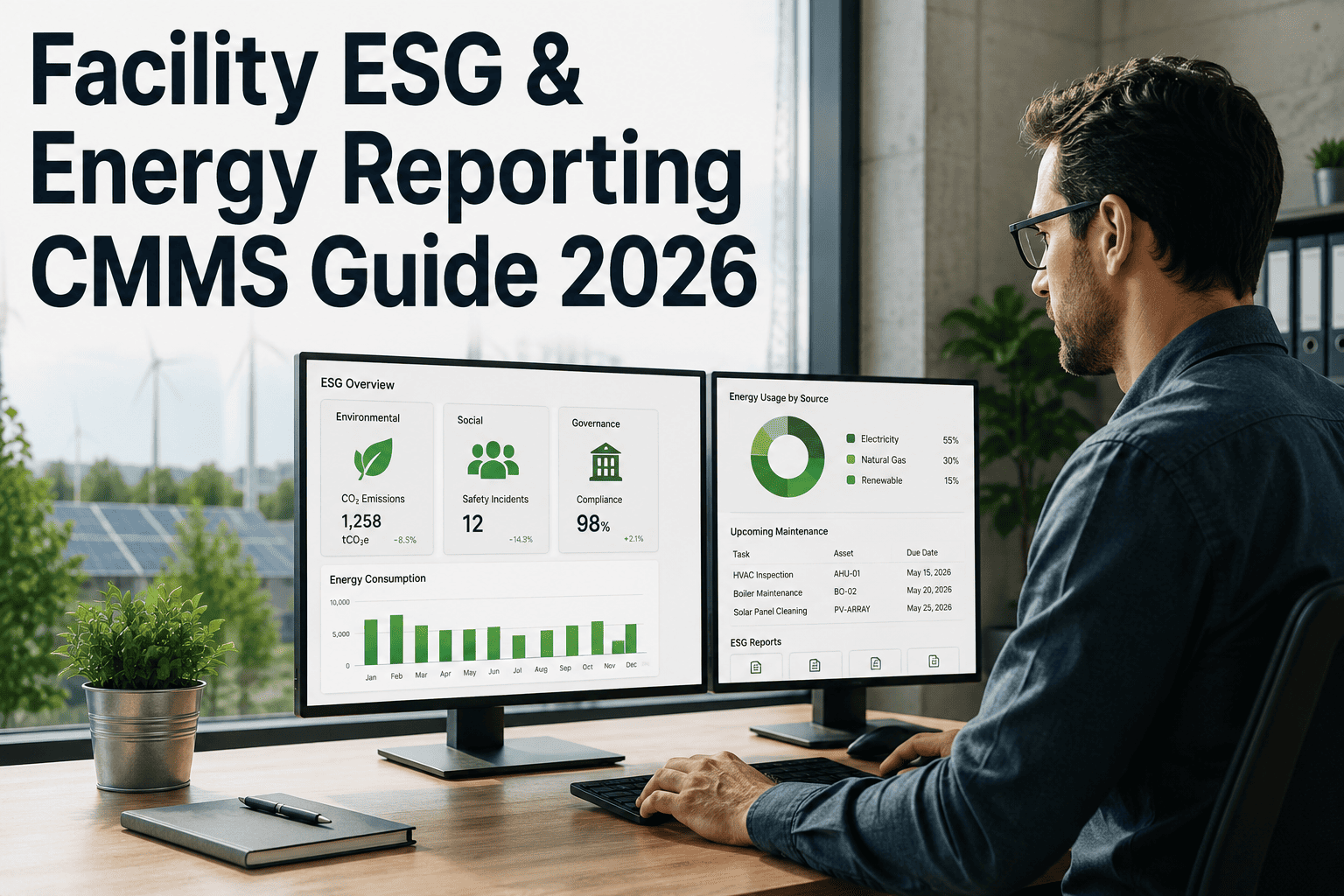
Facility teams responsible for carbon and ESG reporting face a data problem that most sustainability software doesn't solve: the records that prove what was actually done to reduce building emissions live in maintenance work orders, not in reporting dashboards. OxMaint AI connects your asset service history, energy repair records, and preventive maintenance data to the carbon reporting workflow — so your sustainability numbers are backed by operational evidence, not estimates.

Analytics & Reporting — Sustainability

Carbon Reporting Without Maintenance Data Is Just Guesswork

Regulatory frameworks like GRI 305, TCFD, and ENERGY STAR require more than meter readings — they require evidence that operational actions were taken to reduce building emissions. OxMaint connects maintenance records directly to your carbon reporting stack so every emission reduction claim is backed by a documented service record.

Reporting Frameworks Supported
GRI 305
TCFD
ENERGY STAR
LEED O+M
BREEAM
CDP

The Maintenance-to-Carbon Gap Most Facilities Have

Three systemic disconnects undermine facility carbon reporting — all of them solvable with the right CMMS data layer.

Gap 1
Energy Repairs Are Undocumented
When a chiller is serviced, a refrigerant charge replenished, or a motor rewound, the energy consumption impact is real and reportable — but only if the maintenance record captures it. Most CMMS platforms store what was done, not what the energy impact was, leaving a gap between operational records and emissions reporting.
Gap 2
PM Completion Doesn't Feed ESG Reports
Preventive maintenance completion rates are a leading indicator of building energy performance — a building that completes 95% of its scheduled PMs consistently uses 8-12% less energy than one at 70% completion. But PM data rarely flows into the ESG or sustainability reporting tool, leaving this operational evidence out of carbon disclosures.
Gap 3
Refrigerant and Emissions Events Are Missed
Refrigerant top-up events, emergency generator runs, and combustion system repairs all carry Scope 1 emissions implications under GHG Protocol reporting. Without a CMMS that flags and quantifies these events, facilities routinely under-report Scope 1 emissions — creating compliance and liability risk during third-party audits.

How OxMaint Connects Maintenance to Carbon Reporting

A five-layer data flow that makes maintenance records the foundation of carbon reporting, not an afterthought.

01
Tag Work Orders with Carbon Context
Every work order template in OxMaint includes optional carbon classification fields — energy system affected, estimated kWh impact, refrigerant type and quantity, and Scope classification. These are pre-populated from asset records and work order type templates.
02
Capture Emissions Events Automatically
Refrigerant top-up, emergency generator runtime, and fuel consumption events trigger automatic emissions event records in OxMaint using equipment-specific GWP factors and EPA/DEFRA emission factors.
03
Link PM Completion to Energy Baselines
OxMaint correlates PM completion rates with energy consumption trends per building, quantifying the energy and emissions impact of maintenance program effectiveness over time.
04
Generate Audit-Ready Carbon Reports
The OxMaint carbon reporting module produces Scope 1, 2, and maintenance-documented Scope 3 summaries with full work order evidence trails — exportable in formats compatible with major ESG reporting platforms.
05
Support Third-Party Verification
Every carbon report includes a linked evidence package: work order records, inspection logs, energy anomaly repair records, and PM completion history — structured for third-party auditor review without manual compilation.

Maintenance Actions and Their Carbon Reporting Relevance

Common facility maintenance activities and the carbon reporting data each generates when properly documented in OxMaint.

Maintenance Action Scope Classification Carbon Reporting Data Generated Reporting Impact
Chiller refrigerant top-up Scope 1 Refrigerant type, quantity, GWP-weighted CO2e Direct emissions event
Emergency generator test run Scope 1 Fuel type, run duration, combustion factor Direct fuel combustion
HVAC energy anomaly repair Scope 2 Pre/post kWh delta, avoided kWh from repair Indirect emissions reduction
LED lighting upgrade PM Scope 2 Wattage change per circuit, annual kWh avoided Documented reduction claim
BAS/HVAC schedule optimization Scope 2 Runtime reduction hours, baseline vs. adjusted Operational improvement evidence
Preventive maintenance completion Scope 2 PM completion rate vs. energy performance trend Program effectiveness proof
OxMaint AI — Sustainability Data Platform

Your next carbon audit will ask for evidence, not estimates. OxMaint makes sure your maintenance records are the evidence — structured, accessible, and audit-ready.

Expert Perspective


The most common weakness I see in facility carbon reporting is the absence of operational evidence. Sustainability teams can produce excellent meter-based Scope 2 calculations, but when auditors ask what actions were taken to achieve the reported reductions, the maintenance system and the reporting system are completely disconnected. The facility team knows the chiller was serviced and the refrigerant charge was corrected — but that information never made it into the carbon report. Bridging that gap between the CMMS and the ESG reporting workflow is not a technology problem; it is a process design problem. CMMS platforms that are built with carbon classification in mind solve it systematically, record by record.

Sustainability Reporting Consultant, CEM
Corporate ESG and Facilities Decarbonization Programs — 14 Years Experience

Frequently Asked Questions

OxMaint uses EPA eGRID regional electricity emission factors for Scope 2 calculations, EPA AP-42 combustion factors for on-site fuel use, and IPCC AR6 GWP values for refrigerant emission calculations. Users can override default factors with jurisdiction-specific or custom values, and the system logs which emission factor version was used for each calculation period to support audit transparency. OxMaint does not claim to replace a dedicated carbon accounting platform but provides the maintenance-evidence layer that those platforms require. Book a demo to review the emission factor configuration.
OxMaint supports data export to ESG reporting platforms via API integration and structured CSV export. Maintenance-to-carbon data packages include work order summary, emissions event records, PM completion rates, and energy anomaly repair outcomes — in formats that map to standard ESG data templates. Native API integrations with Measurabl and Watershed are under development; until available, structured export and ingestion is fully supported. Start your free trial to test the ESG data export format against your reporting platform.
ENERGY STAR Portfolio Manager certification requires documented evidence of ongoing operational best practices, including equipment PM schedules, energy anomaly response records, and building system commissioning activity. OxMaint generates a maintenance program evidence report that maps completed work orders, PM completion rates, and energy repair records to ENERGY STAR operational best practice categories — providing the documentation layer that Portfolio Manager scoring requires. Book a demo to see the ENERGY STAR documentation package OxMaint produces.
OxMaint's refrigerant management module tracks refrigerant type, charge quantity, top-up events, and leak rate history per equipment asset. When a refrigerant top-up work order is completed, the technician logs the refrigerant type and quantity added, and OxMaint automatically calculates the GWP-weighted CO2e impact using the current IPCC AR6 GWP values for that refrigerant type. Annual refrigerant emission totals are aggregated by building and portfolio for inclusion in Scope 1 reporting. Start your free trial and configure your refrigerant asset register today.
OxMaint AI — Facility Carbon Intelligence

Carbon reporting without maintenance evidence will fail your next audit. OxMaint gives you the operational proof behind every reduction claim — automatically, from the work order up.

Work order carbon tagging. Emissions event capture. Audit-ready ESG documentation. All in one CMMS platform.

Share This Story, Choose Your Platform!