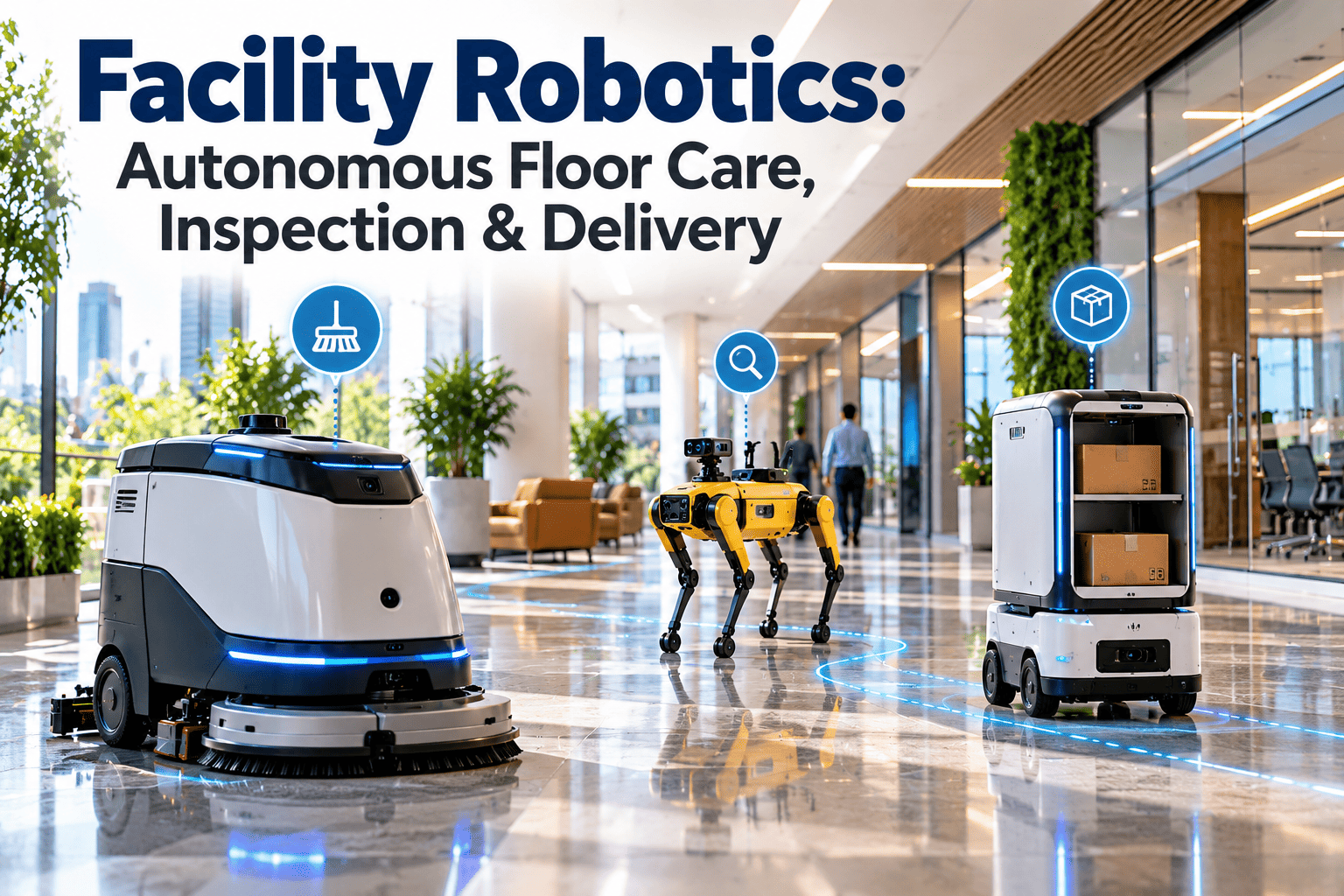
Commercial and industrial facilities lose thousands of labor hours annually to manual floor cleaning operations. Warehouse crews push walk-behind scrubbers through 100,000+ square foot spaces. Hospital EVS teams run overnight shifts scrubbing corridors that need to be dry by morning rounds. Retail staff squeeze cleaning between closing and opening with inconsistent results. Robotic floor scrubbers eliminate this inefficiency entirely — running autonomous cleaning routes overnight, maintaining consistent pressure and solution flow, and reporting completion data directly to facility management systems. When connected to a CMMS like Oxmaint, every cleaning cycle becomes a logged maintenance event with runtime tracking, consumable alerts, and service scheduling that keeps your fleet running at peak performance.
Clean Smarter. Schedule Automatically. Maintain Proactively.
70-85%Labor cost reduction
40-60%Water and chemical savings
2xEquipment lifespan with CMMS
Why Facilities Are Switching to Robotic Scrubbers
The economics of floor care have shifted decisively toward automation. Labor shortages, rising wages, and inconsistent cleaning quality make manual scrubbing increasingly expensive and unreliable. Robotic scrubbers deliver predictable results at predictable costs — but only when properly maintained. Oxmaint tracks every runtime hour, monitors consumable wear, and triggers preventive maintenance before breakdowns occur.
Average cost per 1,000 sq ft with robotic scrubbers vs $12-18 with manual labor
Of robotic scrubber failures are preventable with proper maintenance scheduling
Typical payback period for robotic scrubber investment in facilities over 50,000 sq ft
Robotic Scrubber Categories by Facility Type
Choosing the right robotic scrubber depends on your facility size, floor type, obstacle density, and operational hours. Each category has distinct maintenance requirements that Oxmaint automates based on actual runtime data rather than calendar estimates.
Compact Units
15-25 gal tank20-26" path3-4 hr runtime
Best for: Retail stores, healthcare corridors, office buildings under 50,000 sq ft with tight aisles and frequent obstacles.
Maintenance focus: Daily squeegee checks, weekly brush cleaning, monthly battery conditioning. Compact units work harder navigating obstacles — expect 15-20% faster brush wear than larger models.
Mid-Size Industrial
30-50 gal tank28-34" path4-6 hr runtime
Best for: Warehouses, distribution centers, light manufacturing 50,000-200,000 sq ft with wide aisles and concrete floors.
Maintenance focus: Weekly filter cleaning, bi-weekly brush rotation, monthly vacuum motor inspection. Higher water capacity means less frequent fills but heavier wear on drive systems.
Large-Format Units
60-100 gal tank36-48" path6-8 hr runtime
Best for: Manufacturing plants, airport terminals, convention centers exceeding 200,000 sq ft with minimal obstacles and long straight runs.
Maintenance focus: Daily debris filter cleaning, weekly drive motor checks, monthly hydraulic inspection. These workhorses cover massive areas — component wear scales with square footage cleaned.
Specialized Sanitation
20-40 gal tank24-32" path4-5 hr runtime
Best for: Food processing, pharmaceutical, cleanrooms requiring sanitization compliance, HEPA filtration, and contamination control.
Maintenance focus: Daily sanitization verification, weekly HEPA filter inspection, strict chemical compatibility monitoring. Compliance documentation is critical — every service must be logged.
Track every scrubber in your fleet from one dashboard. Oxmaint logs runtime hours, consumable usage, and maintenance history for each unit automatically.
Start Free Trial
The 5-Level Maintenance Schedule
Robotic floor scrubbers require structured maintenance at five distinct intervals. Missing any level leads to premature component failure and costly emergency repairs. Here is the scheduling framework that keeps fleets running at peak performance.
Maintenance Scheduling Framework
Daily
Post-Shift Checks
Empty recovery tank, rinse debris filter
Inspect squeegee blade for tears
Check brush condition for tangles
Log runtime and error codes
Weekly
Component Deep Clean
Remove and wash brushes/pads
Clean solution filter screen
Inspect vacuum hose for clogs
Wipe sensors and cameras
Monthly
Wear Assessment
Measure brush bristle height
Check belt tension and motor draw
Test emergency stop function
Calibrate solution dispensing
Quarterly
System Overhaul
Replace brushes and squeegees
Service vacuum motor and filters
Inspect battery health
Lubricate moving components
Manual vs. CMMS-Managed Maintenance
The difference between reactive and proactive maintenance shows up in equipment lifespan, repair costs, and cleaning consistency. Here is what changes when you move from spreadsheets to automated CMMS tracking.
Aspect
Spreadsheet/Manual
Oxmaint CMMS
Service Scheduling
Calendar-based guesses ignoring actual runtime
Runtime-triggered PMs based on operating hours
Consumable Orders
Emergency orders when parts run out
Automatic reorder alerts at inventory thresholds
Failure Tracking
No historical data; same failures repeat
Pattern analysis identifies recurring issues
Equipment Lifespan
3-4 years average before replacement
6-8 years with proper preventive care
35-50%
of repairs are emergency breakdowns
90%+
of maintenance is planned and scheduled
Six Features That Define Best-in-Class Scrubbers
When evaluating robotic floor scrubbers, these capabilities separate equipment that integrates seamlessly with maintenance workflows from units that create more problems than they solve.
01
Fleet Management API
REST API connectivity allows runtime data, error codes, and consumable status to flow directly into your CMMS.
Oxmaint receives this data automatically.
02
LiDAR Navigation with SLAM
Simultaneous Localization and Mapping creates accurate facility maps for consistent route coverage during overnight autonomous operation.
03
Modular Brush Systems
Tool-free brush changes reduce maintenance time from 30 minutes to under 5 minutes, minimizing downtime during scheduled service intervals.
04
Auto Docking and Charging
Self-docking capability enables true 24/7 operation. The scrubber returns to its station at battery threshold and resumes cleaning automatically.
05
Real-Time Consumable Monitoring
Sensors track solution level, brush wear, and squeegee condition. Alerts trigger before components fail — not after floors are left half-cleaned.
06
Cleaning Verification Reports
Coverage maps show exactly which areas were cleaned. Essential documentation for compliance audits and service level verification.
We deployed four robotic scrubbers across our distribution center and connected them to Oxmaint. Within six months, floor maintenance costs dropped 72% while cleaning consistency improved dramatically. The maintenance scheduling alone prevented two major breakdowns that would have cost us $8,000+ each.
— Facilities Director, Regional Distribution Center
Turn Every Cleaning Cycle into Tracked Maintenance Data
Oxmaint connects your robotic floor scrubbers to a unified maintenance platform. Runtime hours trigger preventive maintenance. Consumable alerts generate work orders. Cleaning logs build compliance documentation. One system managing your entire floor care operation.
Frequently Asked Questions
How does Oxmaint connect to robotic floor scrubbers?
Most commercial robotic scrubbers from Tennant, Nilfisk, ICE Robotics, and Brain Corp offer fleet management APIs that export operational data. Oxmaint integrates via REST API connections or scheduled data imports. Runtime hours, error codes, and consumable status flow into asset records automatically. For scrubbers without API access, technicians log data using Oxmaint's mobile app.
Create your free account to explore integration options.
What maintenance tasks can be automated with CMMS scheduling?
Oxmaint automates work order generation for runtime-based maintenance (brush replacement at 500 hours), calendar-based tasks (monthly battery conditioning), and condition-based alerts (squeegee replacement at wear threshold). The system also manages consumable inventory — triggering reorder notifications when stock falls below defined levels.
Schedule a demo to see automated scheduling in action.
Can robotic scrubbers operate safely in 24/7 facilities?
Yes. Modern robotic scrubbers use LiDAR, ultrasonic sensors, and 3D cameras to detect and avoid obstacles including people and equipment. Most facilities schedule primary cleaning during low-traffic periods but units can operate during business hours in designated zones with proper route programming.
What is the typical payback period for robotic scrubber investment?
Most facilities achieve payback within 12-18 months based on labor cost reduction alone. A single robotic scrubber replaces 2-3 manual cleaning shifts per day. Additional savings come from reduced chemical usage (40-60% less), lower slip-and-fall liability, and extended floor surface lifespan from consistent cleaning.
How do I choose between disc brush and cylindrical brush scrubbers?
Disc brush scrubbers excel on smooth surfaces like polished concrete and VCT — ideal for retail and healthcare. Cylindrical brush scrubbers handle textured surfaces and grout lines better — preferred for warehouses and food processing. Maintenance schedules differ: cylindrical brushes trap more debris and require more frequent cleaning.
Start Scheduling Smarter Floor Equipment Maintenance Today
Your robotic scrubbers generate operational data every shift. Oxmaint transforms that data into scheduled preventive maintenance, consumable alerts, and compliance documentation — automatically. Stop guessing when service is due. Start maintaining based on actual equipment condition.