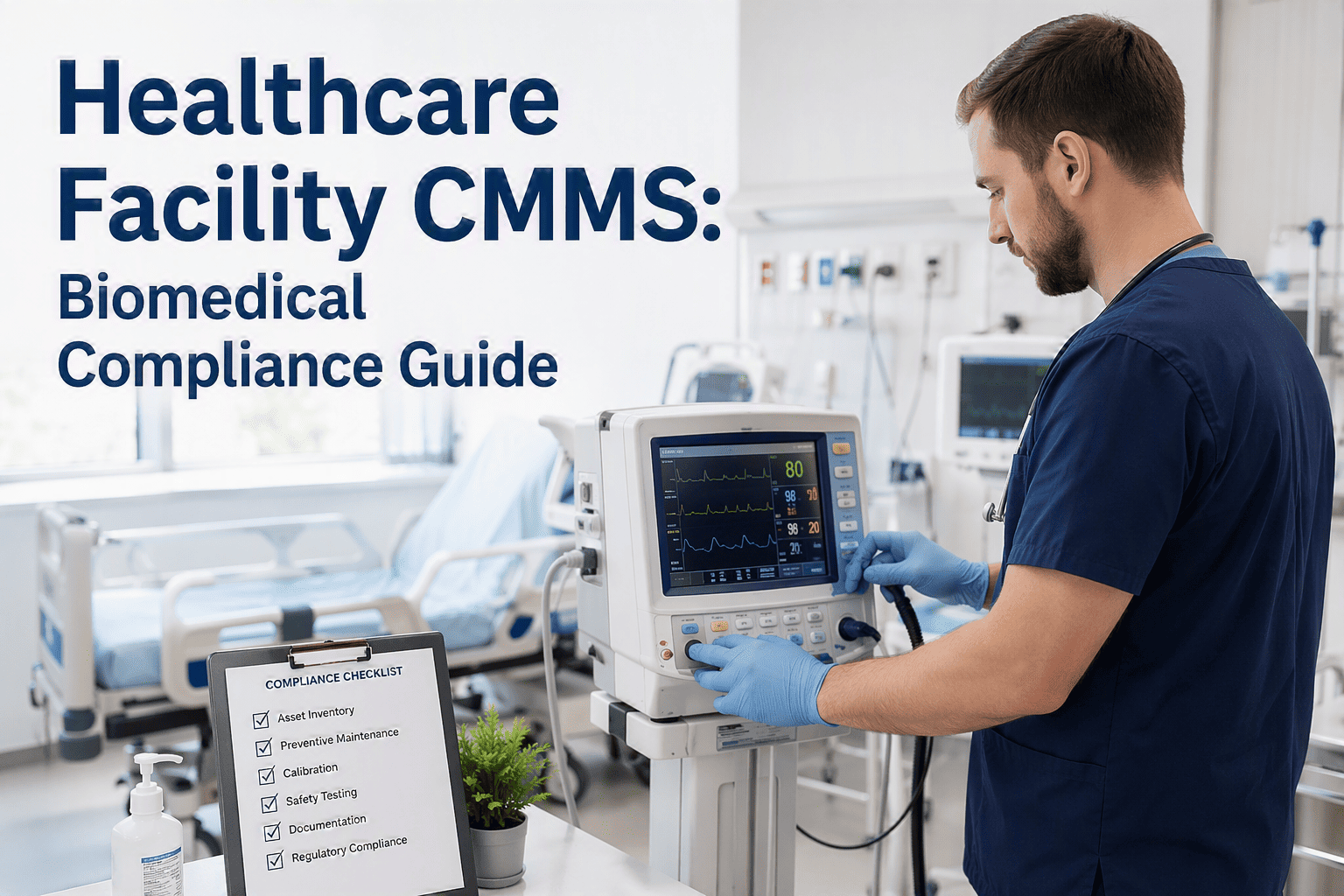
A 400-bed regional medical center operating across three campuses was recording 23 critical equipment failures per year — each requiring emergency contractor response, unplanned clinical procedure relocations, and compliance incident documentation. The Joint Commission survey team had cited the facility twice in three years for preventive maintenance documentation gaps on life-safety systems. With $4.1 million in annual maintenance expenditure and 67% PM compliance on critical systems, the facility's engineering leadership faced a straightforward reality: the gap between planned maintenance and reactive repair was not a staffing problem. It was a data infrastructure problem. Book a demo to see how Oxmaint deploys AI predictive maintenance for healthcare facility operations.
Case Study
9 min read
Facility Profile
400-bed regional medical center, 3 campuses, 1.2M sqft, 6 critical equipment classes
Baseline Problem
67% PM compliance, 23 critical failures/year, 2 Joint Commission citations in 3 years
Solution Deployed
AI predictive maintenance, IoT monitoring, automated compliance documentation, mobile work orders
Primary Result
99.9% critical system uptime, zero Joint Commission findings, $3.2M annual saving
99.9%
critical system uptime across all three campuses at 14 months post-deployment
$3.2M
annual saving from downtime prevention, reactive repair elimination, and compliance efficiency
Zero
Joint Commission findings at the first survey post-deployment, ending a 3-year citation cycle
8 wks
deployment across all 3 campuses including IoT integration and 94-technician mobile onboarding
Case Summary
A 400-bed regional medical center across three campuses deployed Oxmaint to connect existing IoT sensors to automated predictive maintenance work orders, replace paper-based compliance documentation with real-time digital records, and implement portfolio-level critical system monitoring for the first time. Within 14 months, PM compliance on life-safety and critical clinical systems climbed from 67% to 96%. Critical equipment failures fell from 23 per year to 3. The next Joint Commission survey produced zero findings. Total annual saving: $3.2 million.
The Problem: Critical Systems Without Predictive Visibility
The facility had invested $340,000 in IoT sensors across HVAC systems, medical gas infrastructure, emergency power systems, and sterilization equipment over two years. The investment was sound. The operational gap was that sensor alerts reached maintenance scheduling through a process that averaged 11 days — by which point fault progression in critical systems had often already required emergency response or clinical pathway modification.
01
23 Critical Equipment Failures Per Year
Emergency contractor calls averaging $18,400 each in premium labor, parts logistics, and expedited service. Four events required clinical procedure relocation with associated patient care risk documentation and insurance reporting obligations.
02
67% PM Compliance on Life-Safety Systems
Manual scheduling across 3 campuses produced consistent gaps on fire suppression, emergency power, and HVAC systems. Two consecutive Joint Commission surveys cited documentation deficiencies — creating regulatory risk to CMS reimbursement eligibility.
03
11-Day Sensor Alert Response Lag
IoT sensor alerts routed through email-to-engineering workflow with no automated escalation. Critical fault signatures on chillers and air handling units progressed from alert-level readings to emergency failures during the scheduling lag window.
04
Compliance Documentation Requiring 4-Week Prep
Joint Commission survey preparation required 4 weeks of manual compilation across 3 campuses and 6 department records systems — still producing incomplete maintenance histories for 12 of 80 randomly selected assets at the previous survey.
Why Oxmaint Was Selected
The facility's engineering leadership evaluated four CMMS platforms over a 90-day review process. Oxmaint was selected on four decisive criteria that eliminated the other three vendors.
IoT Integration Without Hardware Replacement
Existing BACnet and Modbus sensor infrastructure connected to Oxmaint in Week 2 without replacing hardware or adding middleware. All $340,000 of existing sensor investment preserved.
Joint Commission-Ready Documentation Export
Timestamped, technician-attributed records for all life-safety assets exportable in NFPA and JCAHO audit format. 80 assets documented for surveyors in under 3 hours versus 4 weeks previously.
Condition-Triggered Critical System Work Orders
Sensor threshold breach generates a work order automatically in under 60 seconds with asset ID, fault classification, urgency level, and assigned technician. Eliminated the 11-day manual scheduling lag on critical equipment.
8-Week Deployment Across All 3 Campuses
Asset registry, IoT integration, PM template configuration, and 94-technician mobile onboarding completed in 8 weeks. No CMMS migration project, no consultant fees, no clinical system integration required.
Implementation: 8 Weeks to Live Predictive Maintenance
Weeks 1-2
Asset Registry Built Across All 3 Campuses
Full asset hierarchy built from facility commissioning and preventive maintenance historical records. 1,847 assets registered across 6 critical equipment classes: HVAC, medical gas, emergency power, sterilization, life-safety, and elevators. Critical systems flagged Priority 1 with accelerated PM intervals and mandatory department head sign-off on work order closure.
Weeks 3-4
IoT Integration and Condition Monitoring Activation
All existing BACnet HVAC sensors, Modbus emergency power monitors, and medical gas pressure sensors connected to Oxmaint via native integration protocols. 94 field technicians trained and given mobile access. First live sensor readings appearing in Oxmaint asset records by Day 22.
Day 38 — The Pivotal Moment
First Condition Alert Prevents Surgical Suite HVAC Failure
On Day 38, the system generated a Priority 1 work order for the AHU serving Surgical Suite B. Vibration readings on the supply fan bearing had reached the alert threshold 4 days before the scheduled biweekly inspection. The planned repair cost $3,200 in parts and 6 hours scheduled off-shift. The avoided emergency failure — surgical suite temporary closure and emergency contractor HVAC repair — was estimated at $84,000 in direct costs and clinical schedule disruption.
Weeks 6-8
Compliance Dashboard Live, Joint Commission Templates Configured
Real-time PM compliance dashboard live across all 3 campuses and all 6 critical equipment classes. NFPA 70, NFPA 99, and JCAHO EC.02.05.01 inspection templates configured with correct interval enforcement and mandatory documentation fields. Zero paper inspection forms in use by end of Week 8.
Month 14 — Joint Commission Survey
First Clean Survey in 7 Years: Zero Findings
Surveyors requested documentation for 80 randomly selected assets. All 80 produced within 2.5 hours — complete with timestamped work orders, technician attribution, and maintenance history back to deployment. Zero findings cited. First clean environment-of-care survey in the facility's recorded history.
Results: 14-Month Outcomes
Critical System Uptime
99.9%
Across all 6 critical equipment classes, all 3 campuses at month 14 post-deployment
Joint Commission Outcome
Zero Findings
First clean environment-of-care survey in 7 years, citation cycle formally closed
Annual Net Saving
$3.2M
Downtime prevention, reactive repair elimination, and compliance preparation efficiency
96%
PM compliance on critical systems, up from 67% pre-deployment baseline
87%
Reduction in critical equipment failures, from 23 to 3 per year
60s
Average sensor-alert-to-work-order time, down from 11 days
2.5 hrs
Joint Commission documentation produced versus 4 weeks previously
Key Metrics: Before and After Deployment
| Metric |
Before Oxmaint |
After 14 Months |
| Critical equipment failures/year |
23 failures — avg $18,400 emergency response each |
3 failures — 87% reduction year-on-year |
| PM compliance (critical systems) |
67% — manual scheduling with no cross-campus visibility |
96% — automated scheduling with escalating alerts |
| Sensor alert response time |
11 days average — email routing to manual scheduling |
Under 60 seconds — automated work order generation |
| Joint Commission survey outcome |
2 citations in 3 surveys — documentation gaps cited |
Zero findings — first clean survey in 7 years |
| Compliance documentation prep |
4 weeks, still incomplete for 12 of 80 assets |
2.5 hours, complete for all 80 assets |
| Emergency contractor calls |
23 per year at 4.8x planned repair premium |
3 per year — $424,000 in emergency premium eliminated |
Deployment Cost
$318,000
8-week deployment across 3 campuses including IoT integration and training
Annual Net Saving
$3.2M
Downtime avoidance plus reactive repair and compliance efficiency
Payback Period
1.2 months
Day 38 surgical suite event alone recovered 26% of deployment cost
"Before deployment, we had $340,000 in sensor hardware generating condition data that reached the maintenance schedule 11 days after the reading. On Day 38, the system generated a Priority 1 work order for a surgical suite AHU bearing before our inspection team had flagged anything. That single intervention cost us $3,200 and saved the facility an estimated $84,000. The data was always there. We just did not have the infrastructure to act on it."
Director of Facilities Engineering
400-Bed Regional Medical Center, Mid-Atlantic Region
Platform Capabilities for Healthcare Facility Operations
Predictive Maintenance Console
IoT-connected predictive monitoring for HVAC, emergency power, medical gas, and sterilization equipment with automatic work order generation on threshold breach.
JCAHO Compliance Documentation
NFPA 70, NFPA 99, and JCAHO EC.02.05.01 templates with mandatory field enforcement. Complete asset documentation exportable in survey format in under 3 hours.
Multi-Campus Portfolio Dashboard
Real-time PM compliance, open work orders, and critical system status across all campuses on one screen. No cross-campus reporting cycle required.
Mobile Field Access with Offline Mode
Technicians complete work orders, capture photos, and submit readings from mobile devices. Full offline mode for mechanical spaces and areas with poor connectivity.
Priority Queue for Life-Safety Systems
Automatic Priority 1 flagging for fire suppression, emergency power, and medical gas systems with mandatory supervisor sign-off and escalating alerts at 14, 7, and 2 days before deadline.
CapEx Forecasting from Asset Condition
5-10 year capital replacement forecasts generated from asset condition scores and maintenance cost data. Hospital board-ready CapEx documentation produced automatically.
Frequently Asked Questions
QHow does Oxmaint integrate with existing healthcare facility IoT infrastructure without hardware replacement?
Oxmaint integrates via native BACnet, Modbus, and OPC-UA protocols — the same communication standards used by most commercial HVAC, emergency power, and medical gas monitoring systems. No hardware replacement, no middleware, and no additional licensing required. All existing sensors begin routing readings to Oxmaint asset records within the first 2 weeks.
Book a demo to confirm integration compatibility with your specific sensor hardware.
QWhat Joint Commission documentation does Oxmaint generate for environment-of-care surveys?
Oxmaint generates timestamped, technician-attributed maintenance records for all life-safety assets — NFPA 99 medical gas, NFPA 70 electrical, NFPA 72 fire systems, and JCAHO EC.02.05.01 preventive maintenance requirements — exportable as a complete survey package. This facility produced documentation for 80 assets in under 2.5 hours at its Joint Commission survey.
Start free to configure JCAHO documentation templates for your specific survey preparation requirements.
QHow long does deployment take for a multi-campus hospital system with complex equipment hierarchies?
This 3-campus, 1,847-asset deployment completed in 8 weeks including asset registry build, IoT integration, PM template configuration, and 94-technician mobile onboarding. Single-campus deployments typically complete in 4-5 weeks.
Book a demo to build a deployment timeline for your specific campus count and asset complexity.
QHow do we build the ROI case for a CFO facing constrained capital budgets in a healthcare system?
This facility spent $4.1M on maintenance annually with 23 emergency contractor calls at 4.8x planned repair premiums. Year 1 net saving was $3.2M on a $318,000 deployment cost. The surgical suite event on Day 38 alone recovered 26% of the deployment cost.
Book a demo to model the ROI for your facility's specific equipment failure frequency and emergency repair premium history.
99.9% Critical System Uptime. Zero Joint Commission Findings. Live in 8 Weeks.
Oxmaint deploys across your healthcare facility portfolio with IoT-connected predictive maintenance, automated JCAHO documentation, and multi-campus compliance dashboards from day one. Start your free trial or book a 30-minute demo to see healthcare facility maintenance configured for your campus structure today.
Continue Reading
$3.2M Saved. 99.9% Uptime. Zero Joint Commission Findings. Your Campus Is the Starting Point.
Oxmaint deploys across your healthcare facility with IoT-connected predictive maintenance, automated JCAHO documentation, and multi-campus compliance dashboards — live in 8 weeks, no hardware replacement required. Book a 30-minute demo to model the compliance and uptime ROI for your specific campus structure.
Predictive Maintenance Console
JCAHO Compliance Documentation
IoT Integration Without Hardware Replacement
Multi-Campus Dashboard