A single hour of data center downtime costs an average of $300,000. Cooling failures, UPS faults, and power distribution anomalies don't announce themselves — they build silently until a critical threshold is crossed. By then, your SLA breach is already happening.
OxMaint's Predictive Maintenance AI monitors the behavioral signatures of every critical asset — CRAC units, chillers, UPS systems, PDUs, and generators — flagging deviations before they become failures. What used to take an experienced engineer months to notice, OxMaint detects in minutes.
What Fails in Data Centers — And When
Data center failures follow predictable patterns. Understanding the failure hierarchy of critical infrastructure is step one. Detecting those failures 2–6 weeks before impact is what OxMaint's Predictive Maintenance AI delivers.
AI detected gradual heat load imbalance. Predictive model shows 73% probability of compressor fault within 8–12 days. Auto work order #WO-4821 generated.
Battery strings showing 18% resistance increase over 45 days. Estimated runtime degradation: 23%. Replacement window: within 30 days. Work order #WO-4822 scheduled.
Load bank testing revealed coolant temp 4°C above baseline during 80% load run. Thermostat inspection recommended before next scheduled test. WO #WO-4823 created.
Phase imbalance detected 3 days ago. Maintenance team rebalanced circuit allocation. Current phase variance within 3% — within acceptable range. Ticket closed.
See OxMaint AI detect your data center failures before they cause outages
Predictive Maintenance AI — How It Works for Data Centers
OxMaint continuously collects sensor telemetry from critical assets and runs it through trained failure prediction models specific to data center equipment classes. The detection-to-resolution workflow is fully automated.
Continuous Sensor Ingestion
Temperature, humidity, vibration, power draw, and airflow data collected every 30 seconds from all monitored assets via IoT sensors and BMS integration.
Anomaly Detection — AI Model
OxMaint's trained models establish behavioral baselines per asset and flag deviations. Cooling drift, vibration signature change, power factor shift — detected in real time.
Failure Probability Scoring
Every anomaly is assigned a failure probability score with a predicted time-to-failure window. High-probability events auto-escalate to critical work order status.
Auto Work Order Generation
Work orders are automatically created, assigned to the right technician, and scheduled within the maintenance window least likely to impact production loads.
Resolution and Learning Loop
Post-maintenance data is fed back into the AI model. Each resolution improves future prediction accuracy. OxMaint's models get smarter with every intervention.
Live KPI Dashboard — Data Center Operations
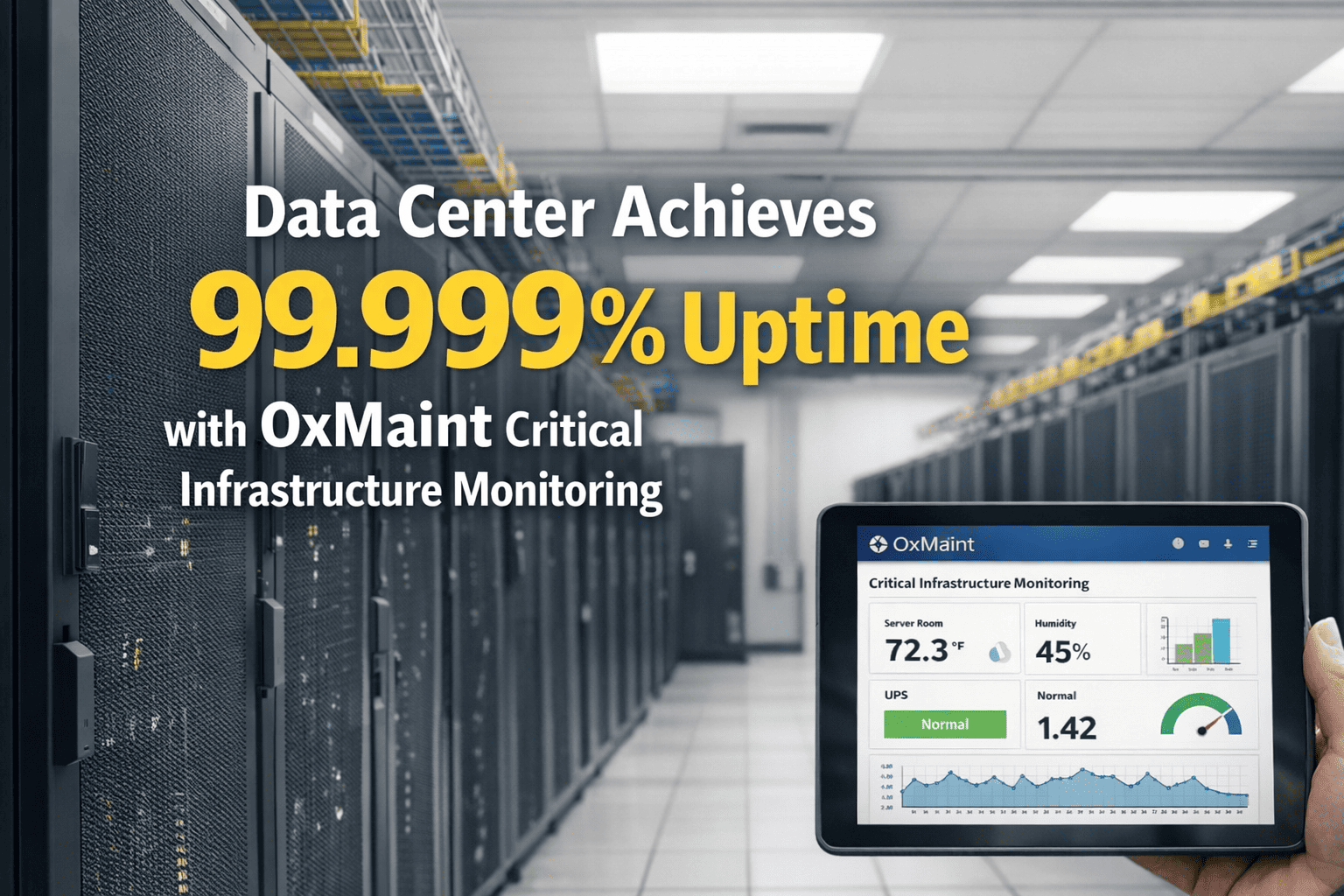
OxMaint gives data center facility managers a real-time view of infrastructure health, open incidents, maintenance compliance, and predictive risk across all critical systems.
| Asset | System | Health Score | AI Risk Level | Last PM | Next Action |
|---|---|---|---|---|---|
| CRAC Unit 1 — Hall A | Cooling | 92 | LOW | 8 days ago | Scheduled PM — 22 days |
| CRAC Unit 3 — Hall B | Cooling | 51 | CRITICAL | 18 days ago | Urgent inspection — WO #4821 |
| UPS Module 2A | Power | 67 | MEDIUM | 45 days ago | Battery replacement — 30 days |
| Chiller Unit 1 | Cooling | 88 | LOW | 3 days ago | Routine PM — 27 days |
| Generator G1 | Backup Power | 74 | MEDIUM | 12 days ago | Coolant inspection — WO #4823 |
Reactive vs Predictive: The Cost Impact
The financial case for predictive maintenance in data centers is unambiguous. The comparison below shows average outcomes from facilities operating reactive maintenance vs those using OxMaint's Predictive Maintenance AI.
"The margin for error in data center maintenance is effectively zero. A well-functioning predictive maintenance system doesn't just prevent failures — it transforms how you plan capacity, schedule maintenance windows, and negotiate SLAs. The ROI calculation is simple: the cost of OxMaint is a rounding error compared to a single unplanned cooling failure affecting production racks."
Protect Your Uptime. Eliminate Unplanned Outages.
OxMaint's Predictive Maintenance AI monitors your critical infrastructure 24/7 — detecting failures weeks before they impact operations.
Frequently Asked Questions
Which data center assets can OxMaint monitor for predictive maintenance?
OxMaint monitors all critical data center infrastructure including CRAC and CRAH units, chillers, cooling towers, UPS systems, battery strings, PDUs, switchgear, generators, fuel systems, fire suppression systems, and environmental sensors. Integration with BMS, SCADA, and IoT gateway platforms enables comprehensive telemetry collection without requiring hardware replacement.
How early can OxMaint detect a cooling system failure?
OxMaint's predictive models typically identify cooling anomalies 2–6 weeks before a critical failure event. Detection lead time varies by failure type: gradual refrigerant loss and compressor wear are detectable 3–5 weeks out, while rapid thermal events may provide 48–72 hours of warning. Even short lead times allow planned intervention, which is dramatically cheaper than emergency response.
Does OxMaint integrate with existing BMS and DCIM platforms?
Yes. OxMaint integrates with leading BMS and DCIM platforms via REST API, MQTT, Modbus, and BACnet protocols. The platform supports both direct sensor integration and data aggregation from existing monitoring layers. Implementation typically requires 2–4 weeks for full integration with enterprise-scale data center environments.
How does OxMaint support compliance requirements for data center operations?
OxMaint automatically generates audit-ready maintenance logs, inspection records, and compliance reports aligned with Uptime Institute Tier Standards, ISO 22237, and ASHRAE thermal guidelines. Every work order, inspection, and technician action is time-stamped and retained in an immutable digital audit trail. Compliance reports can be exported on demand in PDF or CSV format.