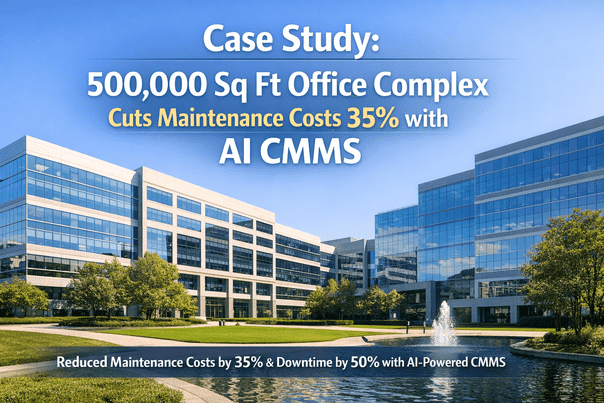
A 500,000 square foot commercial office campus spanning 8 buildings was spending $2.8 million annually on maintenance while 41% of all work orders were reactive emergency responses — repairs triggered by equipment failures rather than planned preventive maintenance. The property management team had real-time energy monitoring data, a work order ticketing system, and 34 maintenance staff. What it lacked was a platform that connected those three elements into a predictive maintenance program that could see failures coming rather than respond to them after they happened. The 35% maintenance cost reduction and 50% downtime reduction achieved in Year 1 were not the result of a staffing increase or a capital equipment replacement program. They came from connecting data that already existed. Book a demo to see how Oxmaint delivers AI predictive maintenance for commercial office portfolios.
Case Study
8 min read
Property Profile
500,000 sqft, 8 buildings, mixed-use commercial campus, Class A office
Baseline Problem
$2.8M maintenance spend, 41% reactive work orders, 22% tenant complaint rate on facilities
Solution Deployed
AI predictive maintenance, condition-based work orders, portfolio dashboard, mobile field access
Primary Result
35% maintenance cost reduction, 50% downtime drop, $980K annual saving, 6-week deployment
35%
maintenance cost reduction in Year 1, from $2.8M to $1.82M annual spend across all 8 buildings
50%
reduction in equipment downtime events across the 8-building portfolio at 12 months post-deployment
$980K
annual net saving from reactive repair premium elimination and PM-driven asset life extension
6 wks
deployment across all 8 buildings including asset registry build and 34-technician mobile onboarding
Case Summary
Before deployment, this 500,000 sqft campus was operating with a 41% reactive work order ratio — nearly half of all maintenance activity was emergency response rather than planned prevention. Oxmaint was deployed across all 8 buildings in 6 weeks, connecting existing energy monitoring data to condition-triggered work orders and replacing a legacy ticketing system with a portfolio-wide CMMS. By Month 12, reactive work order ratio had fallen from 41% to 14%, equipment downtime had dropped 50%, and maintenance spend had declined from $2.8M to $1.82M annually.
The Problem: Data Without Action
The property management team was not lacking data. Energy monitoring showed HVAC inefficiencies developing weeks before they became service calls. The work order system recorded equipment failure patterns across 8 buildings. The problem was that no system connected the monitoring data to the scheduling system. The result was 41% reactive maintenance — the industry average for portfolios without predictive maintenance programs — at 4.8x the cost of planned repairs.
01
41% Reactive Work Order Ratio
Industry benchmark for unmanaged commercial office portfolios. At 4.8x the planned repair cost, each reactive dollar spent was consuming $3.80 more than its planned equivalent. Across $2.8M total spend, eliminating half the reactive ratio represented over $900,000 in recoverable cost.
02
No Cross-Building Asset Visibility
8 buildings maintained by one team with no consolidated asset registry. Equipment age, PM history, and condition scores existed in building-level spreadsheets. Failure patterns repeating across multiple buildings — the same HVAC model failing at the same interval in 4 buildings — were invisible to the maintenance team.
03
22% Tenant Complaint Rate on Facilities
Tenant satisfaction surveys consistently rated facilities as the second-highest pain point behind lease terms. Most complaints originated from HVAC temperature inconsistency and response time to maintenance requests — both addressable through predictive scheduling rather than reactive complaint-driven response.
04
CapEx Decisions Made on Guesswork
Annual capital budget submissions for equipment replacement relied on age-based estimates rather than condition-based evidence. Three HVAC units replaced in Year 0 on age criteria were subsequently found by the Oxmaint FCI model to have had 4-6 years of remaining useful life — $310,000 in premature capital expenditure.
Why Oxmaint Was Selected
Condition-Based Work Order Triggering
Energy monitoring data connected to Oxmaint via API. HVAC performance degradation above configured thresholds generates a preventive work order automatically — before the condition becomes a service call.
8-Building Portfolio Dashboard
Real-time PM compliance, asset condition scores, and open work order counts across all 8 buildings on one screen. Portfolio manager sees the full picture without building-by-building spreadsheet review.
FCI-Backed CapEx Forecasting
Facility condition index scoring per building and per equipment class, generating 5-10 year capital replacement forecasts from actual condition data rather than age estimates.
6-Week Full Portfolio Deployment
Asset registry, energy API integration, PM template configuration, and mobile onboarding for 34 technicians across all 8 buildings completed in 6 weeks without disrupting existing operations.
Implementation: 6 Weeks Across All 8 Buildings
Weeks 1-2
Asset Registry Built from Building Records
Full asset hierarchy built from existing building management records and maintenance logs. 2,140 assets registered across all 8 buildings organized by system class: HVAC, electrical, plumbing, elevators, fire safety, and building envelope. PM schedules loaded per asset class with Oxmaint's commercial office templates as baseline, adjusted for campus-specific equipment ages and vendor service agreements.
Weeks 3-4
Energy Monitoring Integration and Condition Trigger Configuration
Existing Siemens BMS energy monitoring platform connected to Oxmaint via REST API. HVAC kW/ton performance thresholds configured per unit based on OEM efficiency specifications and historical baseline data. 34 field technicians given mobile access and QR asset tag scanning activated across all 8 buildings. First condition-triggered work order generated on Day 24.
Week 5 — Pivotal Event
First Predictive Work Order Saves $34,000 Chiller Emergency
On Day 29, Oxmaint generated a Priority 2 work order for the 250-ton chiller serving Building 3. kW/ton efficiency had degraded 18% over 6 weeks — the threshold Oxmaint was configured to flag. Planned intervention found fouled condenser tubes and an undercharged refrigerant circuit. Repair cost: $4,100. Avoided emergency chiller failure in peak summer cooling season: estimated $34,000 in emergency service and tenant impact costs. This single event recovered 4.2% of the total deployment cost.
Month 3-12
Reactive Work Order Ratio Drops from 41% to 14%
By Month 6, the reactive work order ratio had fallen from 41% to 22% as condition-triggered PMs intercepted developing equipment faults before failure. By Month 12, it had reached 14% — the portfolio-wide target set at project approval. PM compliance rate across all 8 buildings reached 91%. Tenant complaint rate on facilities fell from 22% to 8% as predictive HVAC maintenance eliminated the temperature inconsistency complaints that had dominated the survey results.
Results: Year 1 Outcomes
Maintenance Cost Reduction
35%
From $2.8M to $1.82M annual maintenance spend across the 8-building portfolio
Equipment Downtime Reduction
50%
Downtime events across all building systems at 12 months versus pre-deployment baseline
Annual Net Saving
$980K
Net saving after deployment cost, from reactive repair elimination and PM-driven asset life extension
14%
Reactive work order ratio at Month 12, down from 41% pre-deployment baseline
91%
PM compliance rate across all 8 buildings at 12 months post-deployment
8%
Tenant facility complaint rate at Month 12, down from 22% pre-deployment
2.2 mo
Full deployment cost payback period from net maintenance saving in Year 1
Before and After: Key Metrics
| Metric |
Before Oxmaint |
After 12 Months |
| Annual maintenance spend |
$2.8M with 41% reactive work order ratio |
$1.82M — 35% reduction across all 8 buildings |
| Reactive work order ratio |
41% — industry average for unmanaged portfolios |
14% — 66% reduction in reactive maintenance ratio |
| Equipment downtime events |
Baseline year: 47 documented downtime events |
24 events at Month 12 — 50% reduction year-on-year |
| PM compliance rate |
62% — manual scheduling across 8 disconnected buildings |
91% — automated scheduling with escalating alerts |
| Tenant complaint rate |
22% of tenants citing facilities as a top-3 complaint |
8% — HVAC complaints eliminated by predictive PM |
| CapEx forecast basis |
Age-based estimates — 3 units replaced prematurely at $310,000 |
FCI condition scoring — replacements deferred or advanced by evidence |
Deployment Investment
$178,000
6-week deployment across 8 buildings including BMS integration and training
Annual Net Saving
$980,000
Reactive repair elimination plus PM-driven asset life extension
Payback Period
2.2 months
Full deployment cost recovered before end of Month 3
"We had energy monitoring showing us our equipment performance data and a work order system recording failures — but they had never been connected. The first condition work order from Oxmaint on our Building 3 chiller found exactly what the efficiency degradation curve had predicted. We fixed it for $4,100. The same failure in peak August would have cost us $34,000 and three floors of tenant complaints. Connecting that data was worth more than any equipment upgrade we had budgeted."
Vice President, Property Operations
500,000 Sq Ft Commercial Office Campus
Frequently Asked Questions
QHow does Oxmaint connect to existing building management systems without replacing infrastructure?
Oxmaint integrates with Siemens, Johnson Controls, Schneider, and most commercial BMS platforms via REST API or BACnet connectivity. Existing energy performance data begins routing to Oxmaint asset condition records within the first 2 weeks of deployment, with no BMS hardware changes required.
Book a demo to confirm integration compatibility with your specific BMS vendor and configuration.
QWhat is a realistic reactive work order ratio target for a multi-building commercial office portfolio?
Industry average for unmanaged commercial office portfolios is 38-43% reactive. Most Oxmaint-deployed portfolios reach 12-18% within 12 months. This portfolio reached 14%. The economic difference between 41% and 14% reactive at $2.8M total spend is approximately $760,000 annually in avoided emergency premiums.
Start free to calculate the reactive ratio target for your specific portfolio and maintenance spend level.
QCan Oxmaint generate tenant-facing maintenance performance reports for commercial lease agreements?
Yes. Oxmaint generates tenant maintenance performance reports by floor, system, and date range, including response time averages, PM compliance rates, and work order completion records. These reports can be configured for quarterly tenant review submissions or included as lease transparency documentation.
Book a demo to see tenant reporting configured for your specific lease requirements.
QHow does Oxmaint's FCI scoring improve CapEx decisions for commercial office portfolio management?
Oxmaint calculates FCI scores per asset and per building from actual maintenance cost data and condition readings, replacing age-based replacement estimates with evidence-based forecasts. This portfolio avoided three premature equipment replacements worth $310,000 after the FCI model showed remaining useful life well beyond the age-based estimate.
Book a demo to see FCI-backed CapEx forecasting configured for your building portfolio.
35% Lower Maintenance Costs. 50% Less Downtime. Deployed in 6 Weeks.
Oxmaint connects your commercial building portfolio's existing energy monitoring to predictive maintenance work orders and delivers cross-building compliance dashboards from day one of deployment. Start your free trial or book a 30-minute demo to see AI maintenance configured for your commercial office portfolio today.
Continue Reading
$980K Saved. 41% Reactive Ratio Cut to 14%. Tenants Notice the Difference.
Oxmaint connects your commercial office portfolio to condition-triggered predictive maintenance, portfolio-wide compliance dashboards, and FCI-backed CapEx forecasting — live across all buildings in 6 weeks. Book a 30-minute demo to model the reactive ratio and cost reduction case for your portfolio.
Predictive Maintenance Console
BMS Integration
8-Building Portfolio Dashboard
FCI CapEx Forecasting