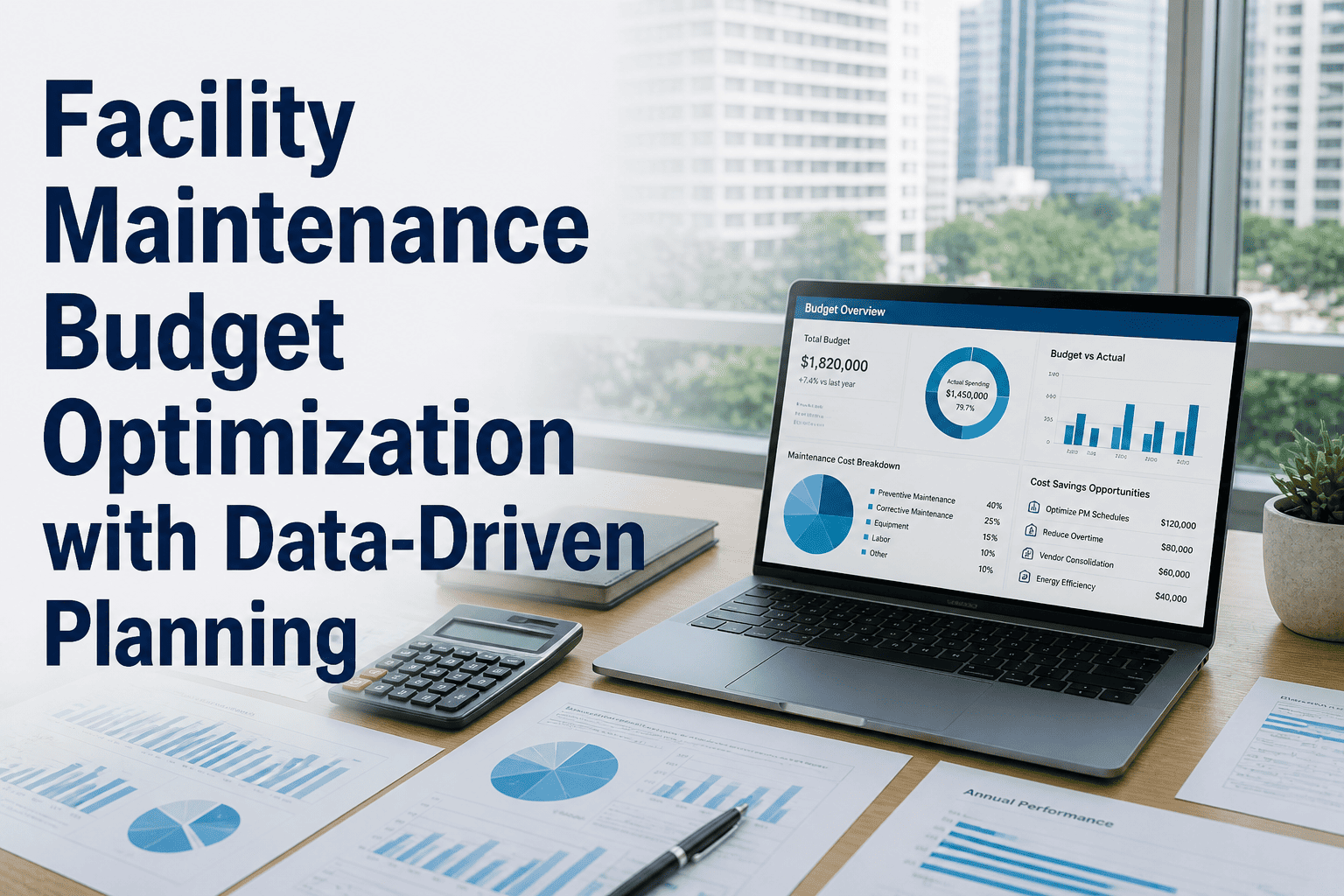
Most facility managers facing budget pressure make the same mistake: they cut maintenance frequency first and hope service quality holds. It doesn't. Within six to twelve months, deferred maintenance compounds into emergency repairs that cost three to five times more than the PM work that was skipped. The real path to sustainable cost reduction is not cutting maintenance — it is eliminating the waste inside your current programme. OxMaint's analytics and preventive maintenance platform helps facility teams identify exactly where money is being wasted and replace reactive spending with planned, efficient maintenance that costs 20–35% less while maintaining every SLA commitment.
Blog · Facility Management · Cost Optimization
Facility Manager's Guide to Reducing Maintenance Costs Without Cutting Service Quality
A tactical guide to cutting FM costs by 20–35% through smarter PM scheduling, contractor management, energy maintenance, and data-driven prioritisation — not service cuts
20–35%
Cost reduction achievable without service quality impact
9 months
Average payback period for CMMS investment
3–5×
Higher cost of emergency repair vs. planned PM
$2.80
Avg per-sqft savings from structured PM programme
What This Guide Covers
01 · Where FM Costs Are Actually Wasted
02 · PM Optimisation Tactics
03 · Contractor Cost Control
04 · Energy Maintenance ROI
05 · Data-Driven Prioritisation
06 · 30-Day Quick Wins
01 — Where FM Money Is Actually Being Wasted
Before cutting anything, facility managers need to know where money is leaking. Across 2,400+ properties benchmarked in OxMaint's 2026 dataset, four cost categories consistently account for 60–70% of preventable FM overspend.
38%
Reactive & Emergency Repairs
Emergency callouts, after-hours labour premiums, and expedited parts procurement. Each reactive repair costs 3–5× the equivalent planned PM. Buildings in the top quartile of reactive spend have PM completion rates under 60%.
Fix: Increase PM completion rate to 85%+ using CMMS scheduling
24%
Contractor Over-Servicing
Service contracts with no performance measurement, no work order verification, and no comparison to benchmark rates. Contractors invoice for tasks that were not performed or upsell work that isn't needed — with no documentation to challenge it.
Fix: Require WO sign-off for every contractor visit, benchmark rates quarterly
21%
Energy Waste from Poor Equipment Maintenance
Dirty HVAC coils, clogged filters, and poorly calibrated controls add 20–35% to energy costs across HVAC and lighting systems. This waste is invisible without performance trending — and grows every quarter that maintenance is deferred.
Fix: Quarterly coil cleaning and filter replacement with performance logging
17%
Duplicate and Redundant Labour
Without a CMMS, technicians re-diagnose the same recurring faults from scratch every time. The average commercial building loses 14 hours per technician per month to tasks that were already completed and not documented — including re-ordering parts that are in the store room.
Fix: Asset history in CMMS eliminates repeat diagnosis and parts re-ordering
OxMaint shows you exactly where your FM spend is leaking — by asset, by cost category, and by technician — from day one of deployment. Book a demo or start free today.
02 — PM Optimisation: Doing More With the Same Team
The fastest route to cost reduction without service cuts is improving the efficiency of your existing PM programme. Most facilities are running at 60–74% PM completion — meaning 26–40% of scheduled tasks are never done. Closing that gap reduces reactive spend more than any budget cut.
PM Completion Rate
62–74%
88–96%
Time to Create Work Order
Manual — 15–20 min
Auto-generated — 0 min
Overdue Task Visibility
Discovered after complaint
Real-time dashboard alert
Technician Travel Efficiency
Unrouted — avg 22% idle travel
Location-grouped tasks — 8% idle
Repeat Fault Rate (90 days)
34% of faults recur
Under 8% recurrence
Annual Cost per Sqft (Median)
$9.80
$7.00 (−29%)
03 — Contractor Cost Control Without Damaging Relationships
Contractor and vendor spend typically represents 55–70% of total FM cost. Most FM teams have no structured way to verify that contracted work was performed, compare rates against benchmarks, or identify which contractors consistently deliver on SLAs. These three tactics are low-friction and produce measurable savings within 90 days.
A
Require Digital Work Order Sign-Off on Every Visit
Contractors who must log their work in OxMaint — with task completion, parts used, and technician name — invoice 12–18% less than those invoicing against verbal agreements. Not because they are dishonest, but because the documentation discipline prevents billing for tasks deferred or not completed. Implement this as a contract requirement for all service vendors at next renewal.
B
Benchmark Rates Annually Against FM Cost Data
Service rates for HVAC, electrical, plumbing, and elevator maintenance drift upward 4–8% annually without challenge. Most FM teams don't benchmark because the data is hard to find. The OxMaint 2026 cost-per-sqft dataset provides service category benchmarks by building type — use them to open rate renegotiations with factual market data, not just budget pressure.
C
Consolidate Vendors Where Response SLAs Allow
Buildings with 8–12 separate service contractors for HVAC, electrical, fire, plumbing, and elevators typically pay 15–22% more per service than portfolios that have consolidated to 3–4 preferred suppliers with volume pricing. Consolidation requires SLA monitoring to ensure performance doesn't slip — which is exactly what a CMMS provides.
04 — Energy Maintenance ROI: The Most Overlooked Saving
| Asset |
Maintenance Task |
Energy Saving |
Annual $ Saving (10,000 sqft) |
PM Cost |
| AHU Cooling Coil |
Quarterly chemical clean |
15–25% HVAC energy |
$1,800–$3,200 |
$280/clean |
| RTU Condenser Coil |
Quarterly coil clean |
10–18% compressor energy |
$900–$1,600 |
$180/clean |
| HVAC Filters |
Monthly pressure-based replacement |
8–15% fan energy |
$600–$1,100 |
$40–$120/set |
| BMS Controls Calibration |
Semi-annual setpoint audit |
5–12% total HVAC energy |
$800–$1,900 |
$400/visit |
| Chiller Tubes |
Quarterly brush clean |
10–20% chiller energy |
$2,400–$4,800 |
$600/clean |
05 — 30-Day Quick Wins: Start Saving Without New Contracts
Week 1
Audit PM Completion Rate
Pull the last 90 days of PM records and calculate what percentage of scheduled tasks were completed on time. If you're under 80%, the gap between scheduled and actual maintenance is your first cost reduction opportunity — before spending a dollar on anything else.
Week 2
List Top 10 Reactive Callouts
Identify your 10 most expensive reactive maintenance events in the last 12 months. For each one, ask: was there a PM task that should have prevented this? In most buildings, 6–8 of the top 10 reactive events are traceable to a missed or deferred PM. This list becomes your PM priority upgrade list.
Week 3
Check Every HVAC Filter and Coil
Walk every AHU and RTU. Log filter static pressure drop and visually inspect condenser and cooling coils. In most buildings that haven't done this in 90 days, you will find at least one coil with visible fouling — and every fouled coil is costing more in energy daily than the cleaning costs.
Week 4
Set Up OxMaint for Your Top 20 Assets
You don't need to digitise your entire facility on day one. Start with your 20 highest-cost or highest-risk assets — chillers, AHUs, generators, elevators, fire systems. Enter them in OxMaint, set PM schedules, and assign to technicians. In most buildings, these 20 assets represent 70–80% of total FM cost. Start at
app.oxmaint.ai.
Cut FM Costs 20–35% — Without Cutting a Single Service
OxMaint gives facility managers the analytics to find waste, the scheduling to prevent reactive spend, and the reporting to prove ROI to their CFO. Most teams start seeing measurable cost reduction within 30 days of deployment.
Expert Review
SC
Sandra Chen
VP of Facilities & Real Estate Operations — Fortune 500 Portfolio (18M sqft), 26 years · IFMA Fellow, CFM
"Every CFO I have worked with believes that FM cost reduction means fewer maintenance visits. Every one of them has been wrong — and some learned it expensively. The most effective cost reduction I have delivered in my career came from two changes: moving from paper PM tracking to a CMMS, and requiring digital sign-off on every contractor visit. The first change increased PM completion from 68% to 94% and cut reactive spend by 41% in 18 months. The second change reduced contractor invoice disputes and eliminated billing for deferred work, saving 14% on service contracts without renegotiating a single rate. Together, these two changes reduced our portfolio FM cost-per-square-foot from $11.20 to $7.80 — a $62 million annual saving across the portfolio. The technology investment was under $400,000. The platform I now recommend to every FM director is OxMaint — it delivers both changes in a single deployment."
Frequently Asked Questions
How can I reduce facility maintenance costs without affecting tenant satisfaction?
The key is distinguishing between maintenance spend that prevents service failures (high-value PM) and spend that is wasteful or duplicative (reactive repairs, over-servicing, deferred work that compounds). By increasing PM completion rates and eliminating the reactive spend cascade, most facility teams reduce total costs by 20–35% while improving response times and SLA compliance — because fewer things fail unexpectedly.
OxMaint's analytics module breaks down your current spend by category and identifies which assets are driving reactive cost, giving you a prioritised action plan that cuts cost without touching service quality.
What is the fastest way to reduce emergency maintenance costs?
The fastest route to reducing emergency repair spend is to identify your top 10 reactive events from the past 12 months and trace each back to its underlying PM failure. In most commercial buildings, 60–80% of emergency repairs are preventable with an existing PM task that was not executed on schedule. Increasing PM completion rate from 65% to 90% typically reduces reactive spend by 30–45% within 6 months — without adding any new maintenance tasks. The constraint is almost always scheduling visibility and accountability, not knowledge.
Book a demo to see how OxMaint tracks this in real time.
How much does a CMMS actually save in a commercial building?
Based on OxMaint's 2026 benchmark dataset covering 2,400+ properties, buildings that deployed a CMMS reduced total FM cost per square foot by an average of $2.80 across all property types. For a 100,000 sqft office building, this represents $280,000 in annual savings. Healthcare facilities saw the largest savings ($4.20–$6.80/sqft) due to higher compliance costs and critical system requirements. The average payback period was 9 months. Savings come from three sources: fewer emergency repairs, better contractor invoice control, and reduced energy waste from maintained equipment. Start calculating your savings at
app.oxmaint.ai.
Should I cut PM frequency to reduce costs during a budget crunch?
Cutting PM frequency to save money is almost always a false economy. For high-criticality assets like chillers, AHUs, generators, and elevators, skipping a quarterly service typically results in 3–5× that service cost in emergency repair spend within 6–12 months. The correct response to a budget crunch is to prioritise PM spend on assets with the highest reactive cost risk — not to reduce frequency across the board. OxMaint's asset criticality scoring helps facility managers make this distinction, ensuring that budget pressure is absorbed by low-risk assets rather than critical ones.
Your FM Cost Reduction Starts With Knowing Where You're Wasting Money
OxMaint's analytics dashboard shows your reactive vs. planned spend ratio, PM completion rate, contractor performance, and cost-per-sqft benchmarks — all automatically, from your work order data. Start your free account today or book a 30-minute walkthrough.