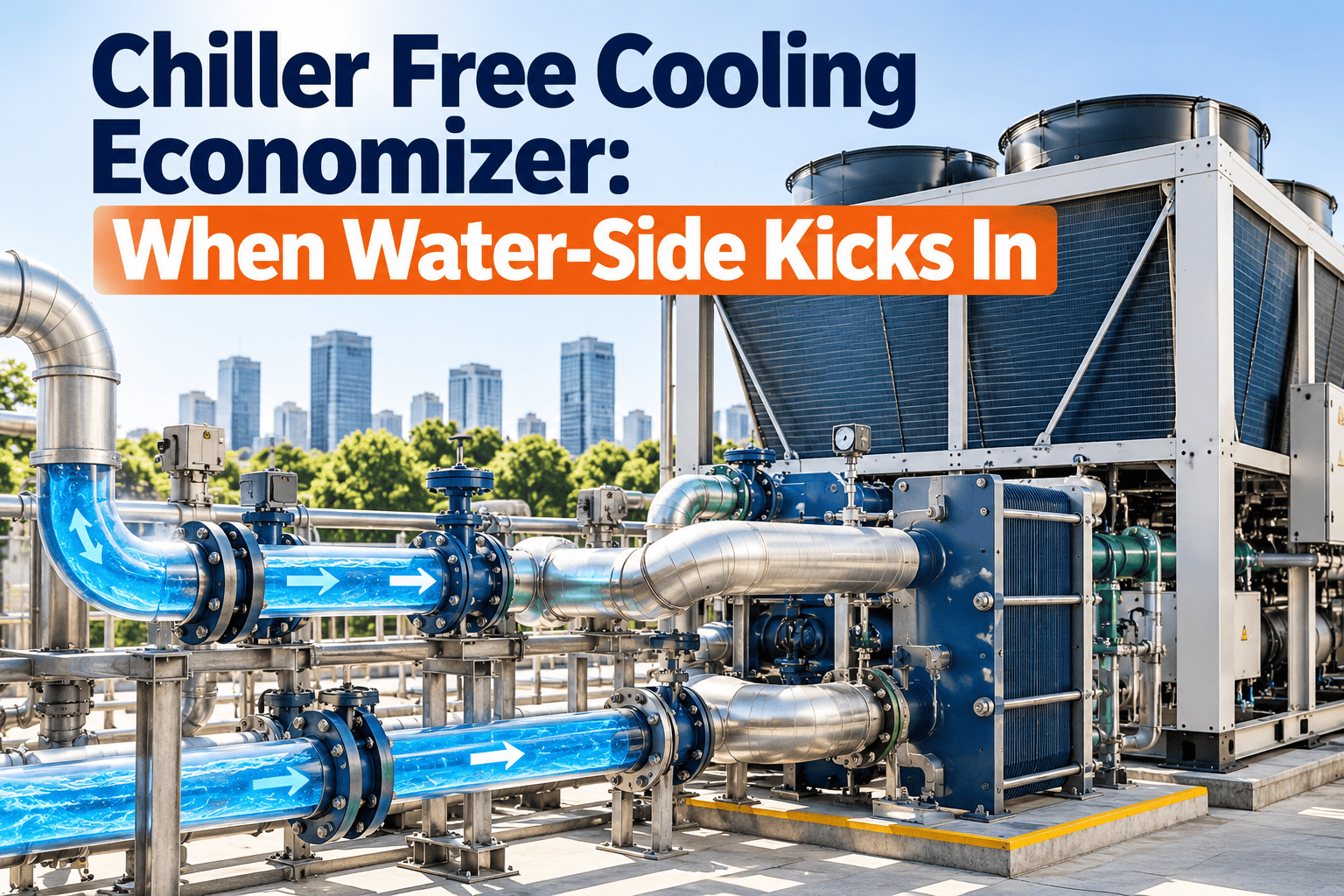
When outdoor conditions are cool enough, a cooling tower can make chilled water without running the compressors at all. A water-side economizer routes that cold tower water through a heat exchanger, letting chillers idle for part of the year. The savings are real, but only if the heat exchanger is clean, the controls switch modes correctly, and the tower is healthy. This guide covers modes, sizing, control logic, and maintenance, and shows how preventive maintenance software keeps the loop ready each season.
Chiller Free Cooling Economizer: When Water-Side Kicks In
Let the cooling tower do the work when the weather allows, and keep every part of the free cooling loop maintained so it actually switches on.
Cold weather
Full free cooling. Chillers off.
Cool weather
Partial or integrated mode. Chillers trim.
Warm weather
Mechanical cooling carries the load.
How water-side economizing works
Cooling tower makes cold water
Plate heat exchanger
Chilled water loop
Building coils
The tower water and the building loop stay separate. The plate heat exchanger transfers heat between them, which keeps the chilled water loop clean.
- Works best when wet-bulb temperatures are low enough to produce usable tower water
- Suits buildings with year-round cooling loads such as data rooms, labs, and interior zones
- Depends on tower performance, heat exchanger approach, and loop temperatures
Three operating modes
| Mode | What happens | Chiller status | Typical conditions |
|---|---|---|---|
| Mechanical only | Chillers meet the entire load | Fully loaded | Warm and humid weather |
| Integrated (partial) | Heat exchanger pre-cools return water, chillers finish the job | Reduced load | Moderate wet-bulb temperatures |
| Non-integrated (full) | Heat exchanger carries the whole load | Off | Cold weather with sufficient tower water cooling |
Integrated designs capture more hours but need controls that blend modes smoothly without upsetting chilled water temperature.
How many hours can free cooling run
Estimates often quoted for water-side economizers range from a few hundred to over a thousand hours per year, depending on climate, load profile, and design temperatures. Treat any range as a starting point and model it with local weather data.
Climate
Hours with wet-bulb temperatures low enough for the required supply temperature.
Chilled water setpoint
Higher supply temperatures widen the free cooling window.
Load profile
Constant year-round load gives more savings than seasonal load.
Approach temperatures
Tower and heat exchanger approach limit how cold the water gets.
Make sure free cooling is ready before the first cool week
Schedule seasonal startup checks for towers, heat exchangers, valves, and controls in one platform.
Sizing and design checkpoints
1
Define the load
Identify loads that persist in cool weather, such as interior zones and process cooling.
2
Set temperatures
Choose chilled water supply and return temperatures with the economizer in mind.
3
Size the heat exchanger
Select for a realistic approach temperature and allow for fouling.
4
Check tower capability
Confirm the tower can operate reliably at low load and low ambient temperatures.
5
Plan freeze protection
Address basin heaters, drain-down, and bypass control for cold weather.
6
Model the savings
Use hourly weather data and your electricity rate to estimate payback.
Code context: ASHRAE 90.1 economizers
ASHRAE Standard 90.1 includes economizer requirements for many cooling systems, depending on climate zone and system capacity. Water-side economizers are one allowed approach. Exceptions exist, and local code adoption varies, so confirm the edition and exceptions that apply to your project.
- Document why an economizer is or is not required for the system
- Keep commissioning and functional test records
- Re-verify controls after major equipment or sequence changes
Control logic that decides when it switches on
Enable conditions
- Tower leaving water temperature is low enough versus return water
- Outdoor wet-bulb is below the enable limit
- Heat exchanger and pumps are proven ready
Transition logic
- Time delays to prevent short cycling
- Deadbands between modes
- Valve staging to avoid temperature swings
Disable conditions
- Return to mechanical when approach is lost
- Alarm on high heat exchanger approach
- Lockout on freeze risk or sensor faults
Sensor accuracy is critical. A drifting wet-bulb or temperature sensor can lock out free cooling for months without anyone noticing.
Why free cooling quietly stops working
Fouled heat exchanger
Higher approach reduces hours and capacity.
Drifting sensors
Bad readings disable the mode.
Stuck valves
Isolation valves fail to move after long idle periods.
Tower issues
Scale, fill damage, or fan problems limit cold water.
Overrides left on
Manual overrides force mechanical cooling.
Winter neglect
Idle equipment is not exercised before cold weather.
Maintenance and PdM for the free cooling loop
- Track heat exchanger approach temperature and clean plates when it rises
- Inspect and exercise isolation, bypass, and modulating valves before the cool season
- Calibrate wet-bulb, supply, and return temperature sensors on a schedule
- Review tower water treatment, fill condition, strainers, and basin cleanliness
- Test mode transitions during commissioning and after software changes
- Verify pump operation and alarms for flow loss
- Check for manual overrides and log every one with a reason
Cooling tower water systems need a water management plan that includes Legionella risk control. Follow site and public health guidance.
Proving the savings
Free cooling hours logged
Chiller run hours avoided
Heat exchanger approach trend
Cooling kWh per ton-hour
Mode transition faults
Seasonal readiness checks done
Compare actual run hours with the model each season. A gap points to a maintenance or controls issue worth a work order.
How Oxmaint supports free cooling maintenance
- Asset records linking chillers, towers, heat exchangers, pumps, and valves
- Seasonal preventive maintenance schedules and startup checklists
- Condition-based workflows that open work when approach temperature drifts
- Work orders for cleaning, calibration, and valve service with history
- Dashboards for overdue tasks and critical equipment readiness
Frequently asked questions
Is a water-side economizer worth it?
It can be, with year-round cooling loads and cool climates. Model it with local weather.
What is the difference between integrated and non-integrated?
Integrated works alongside chillers. Non-integrated runs only when chillers can be off.
Why is my economizer not running?
Check sensors, valves, overrides, and approach temperature first.
How do I schedule seasonal checks?
Use recurring tasks. Try Oxmaint for schedules and records.
Can we track approach trends?
Yes. Book a demo to see condition-based workflows.
Keep free cooling ready every cool season
Maintain towers, heat exchangers, valves, and sensors with scheduled work and records your team can trust.