A chiller can look healthy on the controls while its water is quietly attacking it. Corrosion eats metal from the inside, scale insulates heat transfer surfaces, and biofilm coats tubes and piping with a living layer that shelters bacteria. These three failure paths feed one another, so treating only one rarely works. For facility teams, chiller water treatment is a maintenance program with testing, dosing, inspections, and records, and it works best when those tasks are scheduled and tracked in Oxmaint preventive maintenance software.
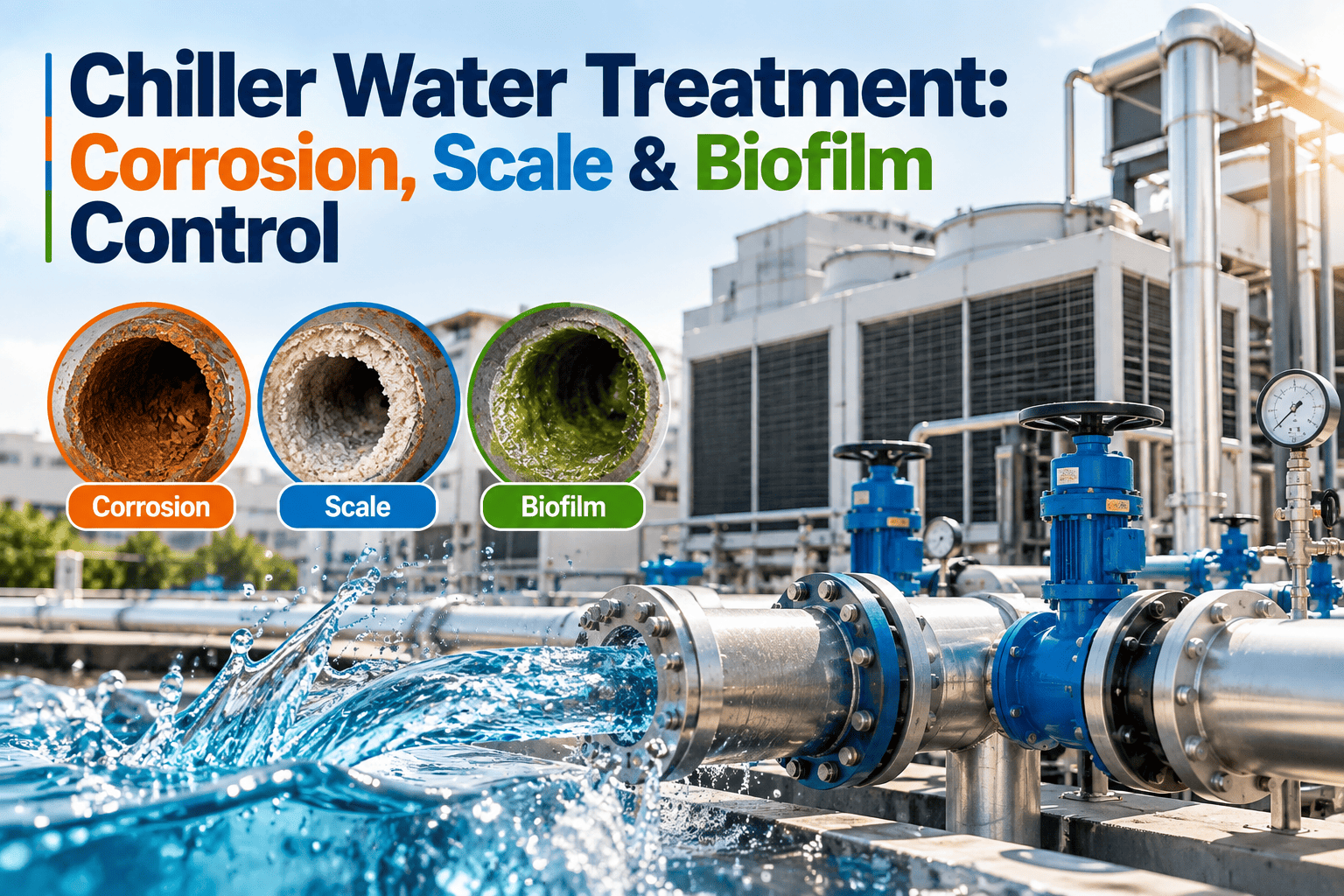
Chiller Water Treatment: Corrosion, Scale and Biofilm Control
One water loop, three ways to lose efficiency and equipment life. Control all three with a program your team can schedule, measure, and document.
CorrosionMetal loss, leaks, deposits
ScaleMineral crust on tubes
BiofilmSlime layer, fouling, health risk
leads to
Higher approach temperature, more energy use, tube failures, unplanned shutdowns
Anatomy of the three failure paths
Path
What drives it
What you notice
Why it matters
Corrosion
Dissolved oxygen, low or unstable pH, aggressive chlorides, mixed metals, stagnant lines
Red or black water, pinhole leaks, rising iron or copper in samples
Thinned pipe and tube walls, fouled strainers, refrigerant-to-water leaks in severe cases
Scale
Hardness and alkalinity concentrating as water evaporates, high skin temperatures
Rising condenser approach, higher head pressure, white or tan crust inside tubes
Thin mineral layers act as insulation, so the chiller works harder for the same cooling
Biofilm
Warm water, nutrients, weak biocide control, dead legs, poor tower hygiene
Slime, odor, cloudy water, unexplained fouling, microbial counts above target
Reduces heat transfer, supports under-deposit corrosion, and can harbor Legionella
Biofilm, scale, and corrosion products also trap each other. A slime layer protects bacteria from biocide, and deposits create sites where under-deposit corrosion starts.
Closed loop vs open loop: two different programs
Closed chilled water loop
- Water recirculates in a sealed system with very little makeup.
- Main risks are oxygen corrosion, microbial growth, and contamination after leaks or repairs.
- Treatment is typically a corrosion inhibitor package, sometimes with a biocide, and glycol where freeze protection is needed.
- Success depends on keeping the loop tight and measuring inhibitor level and iron or copper trends.
Open condenser water loop
- Cooling towers evaporate water, so dissolved solids concentrate until blowdown removes them.
- Main risks are scale, corrosion, fouling, and microbial growth, including Legionella.
- Treatment combines scale and corrosion inhibitors, controlled cycles of concentration, and a biocide program.
- The loop is exposed to air, sunlight, dust, and debris, so cleanliness matters as much as chemistry.
Corrosion control: protect the metal first
Chiller loops include steel, copper alloys, and sometimes stainless steel, galvanized components, or aluminum. A treatment that protects one metal can attack another, so the program should match the actual materials.
01
Know the metallurgy
List the metals in tubes, pipe, pumps, heat exchangers, and valves in the asset record.
02
Set pH and inhibitor targets
Work with your water treatment provider and chiller manufacturer to define control ranges for your system.
03
Limit oxygen ingress
Fix leaks, check expansion tanks and air separators, and avoid uncontrolled makeup.
04
Monitor with coupons and samples
Corrosion coupons, iron and copper analysis, and visual inspections show whether the program is working.
05
Remove stagnation
Dead legs, idle branches, and seasonal shutdown sections need flushing or isolation procedures.
Scale control: manage concentration and heat
Scale forms when dissolved minerals exceed what the water can hold, especially on hot surfaces such as condenser tubes. Cooling towers make this worse because evaporation concentrates minerals in the basin.
Levers a facility team controls
Cycles of concentration
Higher cycles save water but raise scaling risk. Set a target based on makeup water quality and verify it by comparing conductivity of makeup and tower water.
Blowdown control
Automatic conductivity-based blowdown is more stable than manual valves. Check the controller, probe, and solenoid on a schedule.
Scale inhibitor feed
Chemical feed pumps need calibration, tank-level checks, and verification that product is reaching the loop.
Makeup water quality
Softening or other pretreatment can change what the loop must tolerate. Track changes in the supply.
A common leading signal is a creeping rise in condenser approach temperature at similar load. Trend it with each log reading rather than waiting for a high-pressure trip.
Biofilm control and Legionella risk management
Biofilm forms on nearly any wet surface where nutrients and warmth are present. It lowers heat transfer and shelters microorganisms from biocides, so effective control combines chemistry with cleaning and hygiene.
Layer 1: Design and hygiene
Remove dead legs, keep basins clean, protect from sunlight and debris, and maintain drift eliminators.
Layer 2: Biocide program
Use oxidizing and non-oxidizing biocides as your provider specifies, and rotate where microbial resistance is a concern.
Layer 3: Monitoring
Test oxidant residual, run dip slides or lab counts for total bacteria, and follow your plan for Legionella testing.
Layer 4: Response
Define corrective actions in advance, such as shock dosing, cleaning, retesting, and escalation to responsible persons.
ASHRAE Standard 188 sets requirements for Legionellosis risk management in building water systems, and ASHRAE Guideline 12 gives practical guidance on minimizing the risk. Local health codes and regulations may add requirements, so confirm what applies to your site.
Schedule the program before the water fails
Turn testing, dosing checks, and cleaning into recurring tasks with owners and due dates. See a chiller maintenance workflow in a short demo.
Testing calendar: who checks what, and when
| Frequency | Typical task | Record kept |
|---|---|---|
| Daily or each shift | Walk-through, check chemical tank levels, basin condition, visible leaks, and controller alarms | Round sheet with notes and photos |
| Weekly | Conductivity, pH, oxidant residual, and feed pump confirmation on open systems | Test results against targets |
| Monthly | Microbial testing, closed loop inhibitor checks, strainer and filter inspection | Lab or dip slide result |
| Quarterly | Corrosion coupon review, deposit inspection, treatment provider report review | Service report and action list |
| Annual or outage | Tube inspection and cleaning, basin cleaning, calibration of probes and controllers | Inspection findings and work order close-out |
Frequencies depend on your water treatment provider, equipment manufacturer, risk assessment, and local regulations. Use this as a structure for the schedule, not a substitute for your plan.
Reactive vs scheduled water treatment
Reactive habit
- Chemical levels are checked when someone remembers.
- Lab reports sit in email and are not tied to actions.
- Tube cleaning is booked after a high-pressure trip.
- Audit prep means hunting for paper logs.
Scheduled program
- Recurring checks assigned to named technicians.
- Out-of-range results create corrective work orders.
- Cleaning is planned from trends in approach temperature.
- Records are searchable by chiller, tower, and date.
Reading chiller performance as a treatment signal
Water treatment results show up in equipment behavior before they appear in a failure report. Trend these readings at comparable loads and ambient conditions.
Condenser approach
Rising approach can point to fouling or scale on condenser tubes.
Evaporator approach
Changes may reflect fouling, refrigerant issues, or flow problems.
Pressure drop
Higher differential across heat exchangers or strainers suggests deposits or debris.
kW per ton
Energy use drifting upward at stable load is a prompt to inspect water side conditions.
Chiller condition monitoring, vibration analysis, and refrigerant leak checks sit beside water treatment. Together they show whether efficiency loss is water side, refrigerant side, or mechanical.
Chemical dosing: where programs quietly fail
Even a well-designed chemistry program fails when delivery fails. Dosing equipment is mechanical equipment, and it needs the same planned care as the chillers it protects.
| Component | Typical failure | Preventive check |
|---|---|---|
| Metering pump | Lost prime, worn diaphragm, blocked injection quill | Calibration draw test and visual inspection of tubing |
| Conductivity probe | Fouling or drift gives false blowdown signals | Clean, compare with a handheld meter, and recalibrate |
| Chemical tank | Empty tank, wrong product, contaminated drum | Level checks, label verification, and storage inspection |
| Blowdown valve | Sticking solenoid or scaled orifice | Function test and cycles of concentration check |
| Biocide feed timer | Programming errors after power loss | Verify schedule and log each correction |
Spill containment, safety data sheets, and personal protective equipment also belong in the inspection checklist, because chemical handling is part of the maintenance workflow.
Cleaning and restart: the work between treatment cycles
A
Inspect first
Document tube sheet, basin, fill, and pipe condition with photos before any cleaning starts.
B
Clean mechanically or chemically
Use methods approved by the chiller manufacturer and treatment provider, and confirm material compatibility.
C
Flush and neutralize
Remove cleaning residues and manage wastewater in line with local discharge rules.
D
Disinfect where required
Follow the water management plan after cleaning towers, basins, or opened systems.
E
Retest and restart
Verify chemistry and microbial results before returning the loop to normal operation.
Capture each stage as a checklist item on a work order. That gives you proof of what was done and a baseline for the next shutdown.
Seasonal and operating conditions that change the plan
Cooling season start-up
Idle towers and loops may have grown biofilm. Clean, treat, and test before full operation.
Hot weather and high load
Higher evaporation raises concentration and warm water favors microbial growth, so check test frequency.
Low load or standby chillers
Water that sits still is a risk. Rotate lead and lag equipment and keep circulation where the plan requires it.
Winter shutdown and freeze risk
Check glycol concentration, drain or protect exposed lines, and document layup conditions.
Who owns what in a water treatment program
| Role | Responsibility | Hand-off to watch |
|---|---|---|
| Facility technician | Rounds, basic tests, feed checks, visual inspections | Out-of-range results must reach the supervisor quickly |
| Maintenance supervisor | Schedules, work order priorities, repair follow-up | Provider recommendations must become dated tasks |
| Water treatment provider | Chemistry design, lab analysis, service reports | Report findings should map to specific assets |
| Facility manager | Budget, compliance, risk acceptance, audit readiness | Needs summary data, not raw logs |
| Chiller OEM or service contractor | Tube inspection, eddy current testing, warranty guidance | Water records often affect warranty discussions |
Unclear ownership is a root cause behind many treatment failures. Reports get filed, but nobody turns a recommendation into a scheduled job.
Ask your provider to reference asset names in every report. When a finding names the chiller, tower, or loop, the follow-up work order can be raised against the same record.
Common program gaps
- Probes drift: conductivity and pH sensors lose accuracy. Calibrate them and compare against handheld tests.
- Feed pumps lose prime: a pump that appears to run may not be delivering chemical. Verify with tank drawdown.
- Seasonal shutdowns are ignored: idle systems stagnate. Define layup and restart procedures with cleaning and retesting.
- Repairs introduce contamination: opened systems need flushing, refilling with treated water, and fresh samples.
- Treatment vendor changes are not documented: track product changes, target ranges, and contact details in one place.
- Test results are not trended: a single reading in range can hide a steady move toward a limit.
Compliance records worth keeping
Water management plan
Scope, responsible persons, control points, limits, and corrective actions.
Test and lab results
Chemistry, microbial counts, and Legionella results with dates and sample points.
Treatment service reports
Provider visits, recommendations, and the work orders that closed each one.
Cleaning and disinfection logs
Who did what, which method, and what verification followed.
Equipment inspection history
Tube inspection results, repair records, and replacement dates for each chiller and tower.
Pre-audit checklist
- Water management plan is current and names responsible persons.
- Every scheduled test in the last year has a result and a date.
- Each out-of-range result has a documented corrective action and retest.
- Probe calibration and feed pump checks are recorded.
- Cleaning, disinfection, and restart records are attached to the right asset.
How Oxmaint supports chiller water programs
Recurring tests and rounds
becomes
Preventive maintenance schedules with checklists and assigned technicians
Out-of-range result
becomes
Corrective work order linked to the chiller or tower asset
Chemical and probe stock
becomes
Inventory tracking with reorder visibility
Audit and inspector requests
becomes
Stored inspection records, photos, and reports by asset and date
Trend discussions
becomes
Dashboards for overdue tasks, repeat failures, and work completed
Where your team captures readings from sensors or manual logs, those results can support condition-based work orders instead of fixed calendar tasks alone.
Measures that show the program is working
Tests completed on time
Percent of scheduled tests closed by due date.
Parameters in range
Share of readings within target limits.
Time to correct
Hours from an out-of-range result to a closed action.
Approach trend
Direction of condenser approach at similar load.
Unplanned water side repairs
Count of leaks, tube plugging, and emergency cleanings.
Chiller water treatment questions
What is the main purpose of chiller water treatment?
It controls corrosion, scale, and biological growth so heat transfer stays efficient and equipment lasts longer.
How often should chiller water be tested?
It depends on system type and risk assessment, but many sites test weekly or more. Schedule recurring tests to keep it consistent.
Does a closed chilled water loop need treatment?
Yes. Even sealed loops can corrode or grow microbes, so inhibitors and periodic testing are usually needed.
How does scale affect chiller efficiency?
Scale insulates tubes, raising approach temperature and energy use for the same cooling load.
Can software help with water treatment compliance?
It can store tests, work orders, and inspection records by asset. Request a walkthrough to see how.
Keep chiller water under control and on record
Give your team one place for schedules, results, corrective actions, and inspection history across every chiller and tower.