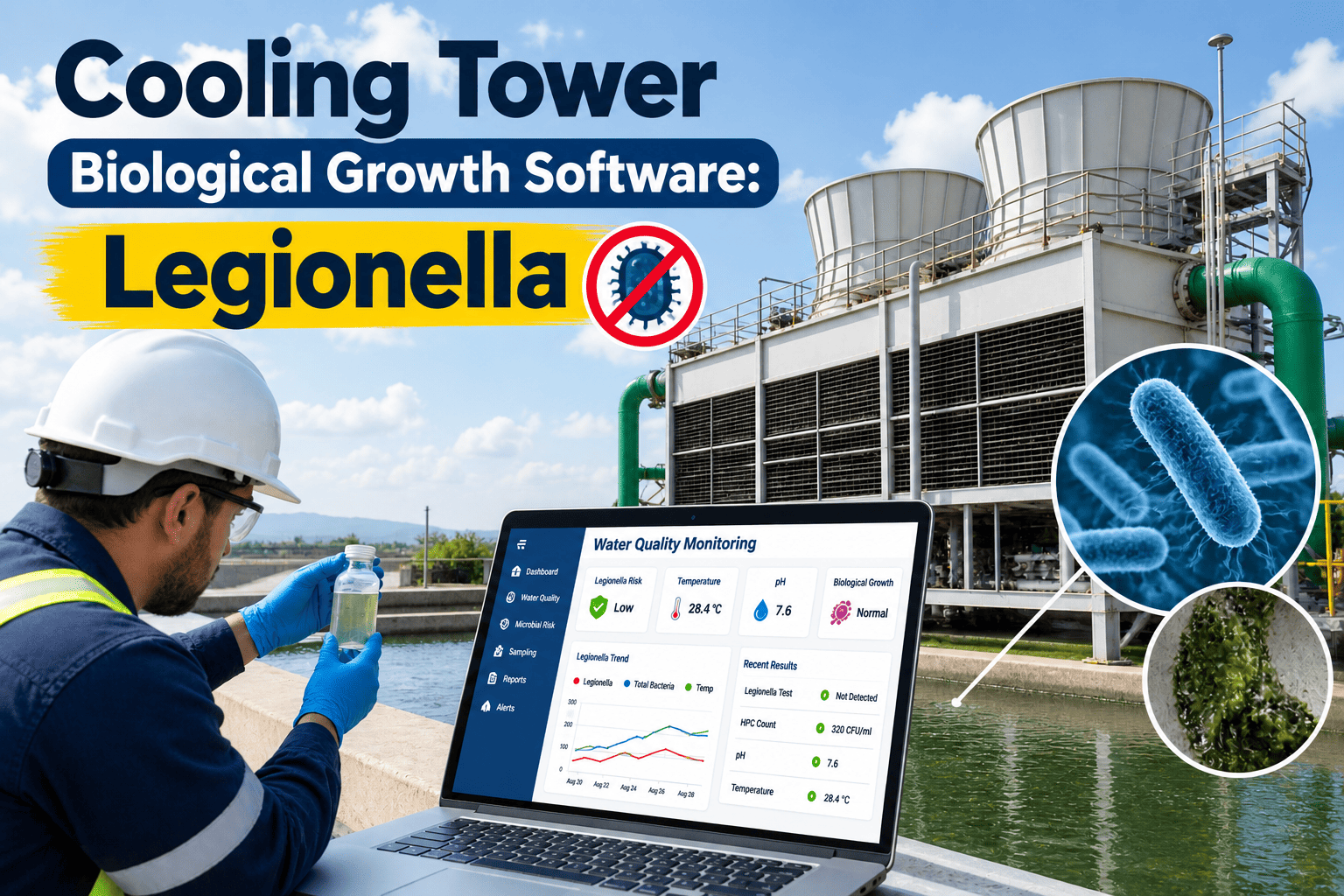
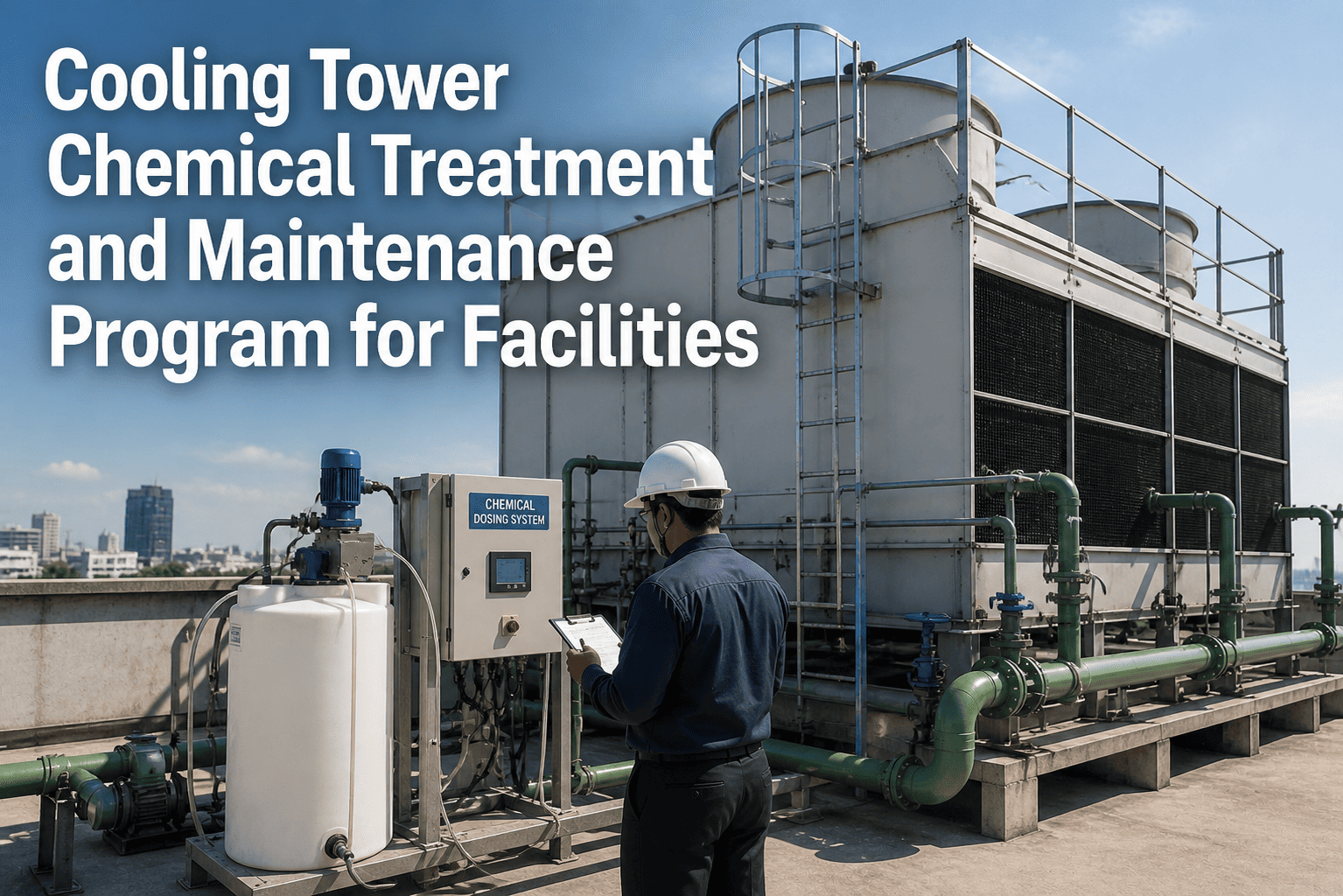
Commercial cooling towers are often the most neglected asset in building mechanical systems — out of sight on rooftops, running continuously during cooling season, and quietly harbouring conditions that lead to Legionella outbreaks, corrosion failures, and catastrophic fan motor breakdowns. A single Legionella incident in a commercial building carries legal liability exceeding $1 million and immeasurable reputational damage. OxMaint's preventive maintenance platform helps facility managers schedule, execute, and document every cooling tower inspection and water treatment task — with full compliance traceability for health authority audits.
Article · HVAC & Energy · Facility Management
Cooling Tower Analytics & Water Treatment for Commercial Buildings
Water treatment programmes, fill media inspection, drift eliminator maintenance, and Legionella prevention — the complete facility management guide for commercial cooling tower operation
Cooling towers are the primary risk vector for Legionella in commercial buildings — documented water management plans are now mandatory in most jurisdictions
Why Cooling Tower Maintenance Fails in Commercial Buildings
01
Water Treatment Drift
Without daily chemical monitoring, cycles of concentration climb, biocide residuals drop below effective levels, and Legionella risk escalates within days. Most buildings rely on monthly contractor visits — which is 28 days of unmonitored drift.
02
Fill Media Fouling
PVC fill media accumulates biological growth, scale, and debris over cooling seasons. Fouled fill reduces heat transfer effectiveness by 15–30%, forcing the chiller to work harder and increasing energy costs across the entire system.
03
Drift Eliminator Degradation
Damaged or missing drift eliminators allow water droplets containing bacteria to be discharged into the air — creating Legionella exposure risk for building occupants and neighbouring properties. Visual inspection is only possible during shutdown.
04
Basin Sediment Accumulation
Sump basins collect sediment, debris, and biological film that harbour Legionella, corrode basin steel, and clog strainers — reducing condenser water flow to the chiller. Annual basin cleaning is mandatory, but rarely documented properly.
Water Treatment Programme — Key Parameters
Cooling tower water chemistry must be actively managed to control scale, corrosion, and biological growth simultaneously. The table below shows target ranges for an open cooling tower system using a standard inhibitor/biocide programme.
| Parameter |
Target Range |
High Risk Threshold |
Consequence if Out of Range |
Check Frequency |
| pH |
7.0 – 8.5 |
< 6.5 or > 9.0 |
Corrosion (low) or scale (high) |
Daily |
| Conductivity (TDS) |
800 – 2,500 µS/cm |
> 3,500 µS/cm |
Scale formation, corrosion acceleration |
Daily |
| Cycles of Concentration |
3 – 6 cycles |
> 8 cycles |
Scale, fouling, Legionella risk increase |
Weekly |
| Oxidising Biocide (free Cl₂) |
0.5 – 2.0 ppm |
< 0.3 ppm |
Legionella growth window opens |
Daily |
| Non-Oxidising Biocide |
Per product label |
Overdose or skip |
Biofilm growth or chemical overdose |
Weekly dose |
| Inhibitor Residual |
Per product spec |
Below minimum residual |
Scale and corrosion protection lost |
Weekly |
| Legionella Culture Test |
< 100 CFU/L |
> 1,000 CFU/L |
Mandatory remediation, authority notification |
Quarterly (minimum) |
OxMaint logs every water treatment test result, generates alerts when parameters drift out of range, and maintains a dated compliance record for health authority audits. Book a demo or start free today.
Inspection & Maintenance Schedule
Weekly
1Test and log all water chemistry parameters
2Visually inspect basin water level and make-up float
3Check blowdown valve operation and conductivity controller
4Inspect fan motor for abnormal vibration or noise
5Verify chemical dosing pump output
Monthly
1Strainer basket — clean and inspect
2Drift eliminator — visual check for damage or displacement
3Distribution nozzles — check for blockage and even coverage
4Fan belt tension and alignment check
5Legionella risk review — log and sign
Annual
1Full basin drain, clean, and disinfection
2Fill media inspection — replace if > 30% fouled
3Fan motor bearing replacement per OEM schedule
4Gear reducer oil change (if applicable)
5Legionella culture test + compliance certificate
Legionella Risk — Conditions That Accelerate Bacterial Growth
Water temp 20–45°C (optimal Legionella range)
Biocide residual below minimum
Biofilm on fill media or basin
Stagnant water in low-flow sections
Seasonal shutdown without disinfection
High cycles of concentration (> 8)
Manage Cooling Tower Compliance Without the Paperwork
OxMaint automates your water treatment logging, inspection scheduling, and Legionella compliance records — with instant export for health authority submissions. One platform, full traceability.
Expert Review
NP
Natalie Pearce
Water Hygiene & Legionella Specialist — Commercial Property, 18 years · Legionella Risk Assessor Certified
"The single most important thing a building engineer can do for Legionella risk management is maintain a dated, technician-signed record of every water treatment check and corrective action. Regulators and insurers don't just want to see that you have a water management plan — they want evidence that it was executed. In my experience auditing commercial buildings, the primary compliance failure is not negligence — it is inadequate record-keeping. Biocide was added but never logged. Conductivity was in range but never recorded. OxMaint's platform closes this gap completely: every water treatment reading is date-stamped, technician-attributed, and instantly retrievable. When you're facing a health authority audit or an insurance claim, that record is worth more than any equipment upgrade. Start today at app.oxmaint.ai."
Frequently Asked Questions
How often should commercial cooling tower water be tested for Legionella?
Most health authority guidelines (ASHRAE 188, UK HSE L8, Australian AS/NZS 3666) require a minimum of quarterly Legionella culture testing for cooling towers, with additional testing after any system disruption such as shutdown, significant make-up water event, or detection of Legionella above 100 CFU/L. Some jurisdictions and high-risk buildings (hospitals, aged care, hotels) require monthly testing. All test results must be logged with dates, sample locations, and actions taken.
OxMaint stores all culture test results against the asset record with expiry tracking for the next required test.
What is the correct cycles of concentration for a commercial cooling tower?
Target cycles of concentration for most commercial cooling towers is 3–6 cycles, depending on make-up water quality and inhibitor programme. Higher cycles reduce water consumption but increase scaling and Legionella risk. The correct target is set by the water treatment contractor based on a make-up water analysis, and should be documented in the Water Management Plan. Conductivity controllers should be calibrated to blowdown automatically when the conductivity setpoint is exceeded.
Book a demo to see OxMaint's conductivity trending log.
When should cooling tower fill media be replaced?
Fill media should be inspected annually and replaced when more than 25–30% shows fouling, biological growth, structural collapse, or scaling that cannot be removed by chemical cleaning. PVC fill typically has a service life of 8–12 years under good water management. Fouled fill that reduces heat transfer performance by more than 10% costs more in chiller energy than replacement fill — making annual inspection a straightforward ROI decision. Replace fill during the annual basin clean to minimise system downtime.
What documentation is required for a cooling tower Water Management Plan audit?
A ASHRAE 188 or equivalent WMP audit requires: the written Water Management Plan with risk assessment, dated records of all water chemistry tests, Legionella culture test certificates, corrective action logs when parameters were out of range, system schematic showing all water flow paths and dead legs, contractor service reports, and evidence of annual system disinfection. OxMaint maintains all these records in a single platform with one-click export for authority submission. All records are technician-signed, date-stamped, and tied to the specific asset in your building. Start at
app.oxmaint.ai.
Don't Let Cooling Tower Compliance Become a Crisis
OxMaint keeps your water treatment records, inspection logs, and Legionella test certificates current and audit-ready — automatically. No more scrambling before authority visits. No more compliance gaps that create legal exposure.