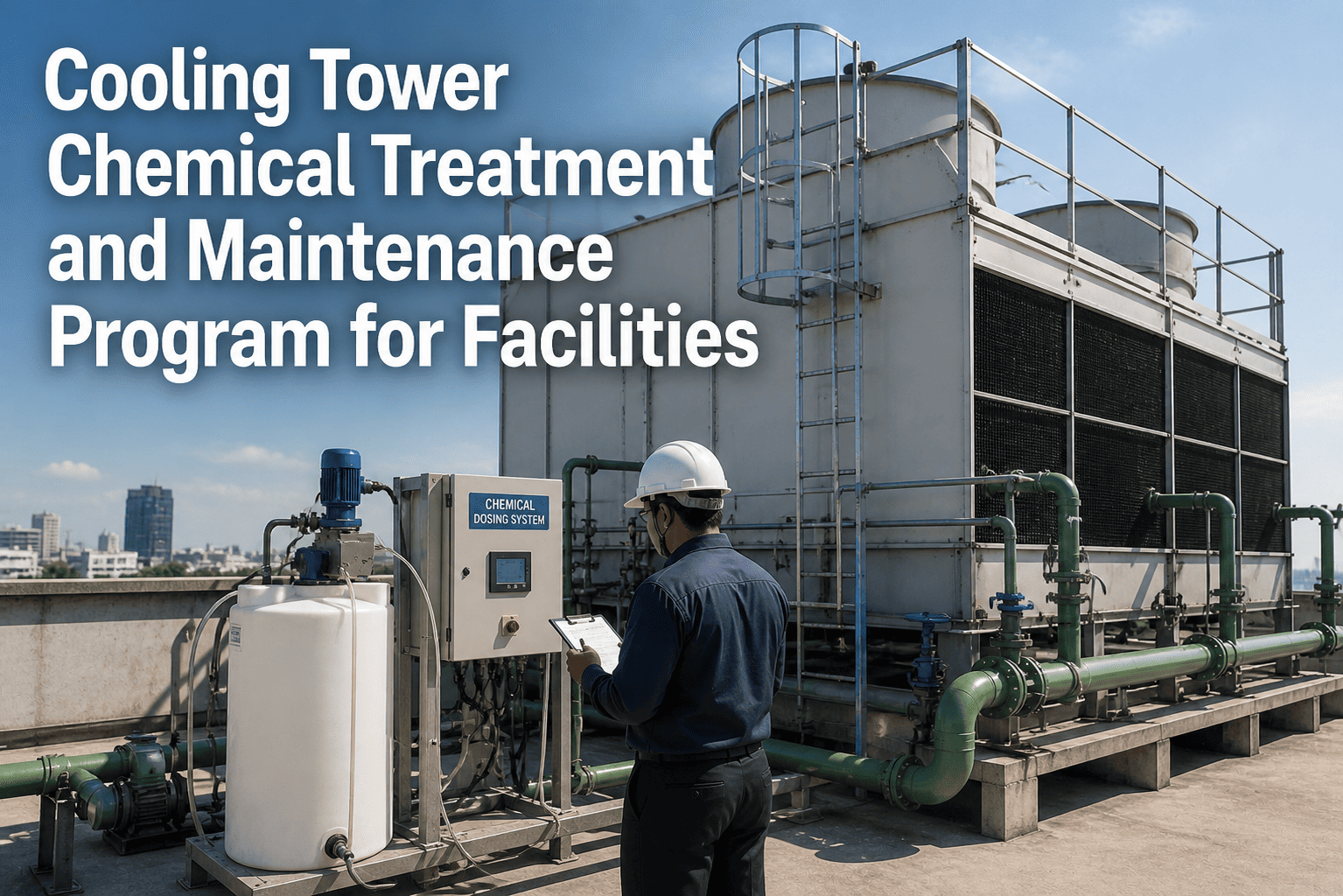
Legionnaires' disease is not a historical relic or a rare medical curiosity — it is an active, recurring public health threat that killed 286 people in the United States in 2022 alone, with cooling towers, hot water systems, and decorative fountains in commercial buildings as the leading transmission vectors. Facilities that operate without a documented Water Management Plan are not just managing a maintenance risk — they are managing a legal liability, a regulatory exposure, and a public health responsibility. ASHRAE Standard 188 makes WMP implementation a professional standard of care for facilities managers, and states including New York, California, and Maryland have converted that standard into binding law. OxMaint's compliance tracking platform converts your Legionella prevention requirements into automated, documented, audit-ready work orders — ensuring every water system inspection, biocide dosing record, and culture test result is captured, signed, and available for regulatory review within seconds.
Legionella Prevention in Facilities: Water Safety and Compliance Guide
A complete operational guide to Legionella risk management in commercial and institutional buildings — covering ASHRAE 188 requirements, water system monitoring, testing protocols, and CMMS-based compliance documentation.
ASHRAE 188 & Regulatory Compliance Framework
ASHRAE Standard 188-2018 establishes the Water Management Plan as the foundational compliance document for Legionella control in commercial buildings. It is not a checklist — it is a risk-based operational framework that must be customized to each building's specific water systems and reviewed annually. Understanding what ASHRAE 188 actually requires (and what it does not) is the starting point for any compliant program.
| Regulatory Framework | Applies To | Key Requirement | Documentation Mandate | Penalty Exposure |
|---|---|---|---|---|
| ASHRAE 188-2018 | All commercial buildings with defined water systems | Written Water Management Plan | WMP + control limit logs | Standard of care in litigation |
| NYC Local Law 77 | All NYC buildings with cooling towers | Annual registration + 30-day inspection | Quarterly culture tests on file | Up to $10K/day non-compliance |
| California Health Code | Healthcare, lodging, large commercial | WMP + ongoing monitoring program | Inspection records + corrective action | License revocation risk |
| Joint Commission (healthcare) | Accredited hospitals and care facilities | WMP per EC.02.05.01 | All testing + monitoring records | Accreditation risk |
| OSHA General Duty Clause | All employers with implicated water systems | Eliminate recognized hazards | Inspection + training records | Civil and criminal liability |
Legionella Growth Conditions — What You Are Preventing
Legionella pneumophila thrives in specific environmental conditions that are, unfortunately, common in commercial building water systems. Understanding the biology is essential for designing a Water Management Plan that addresses actual risk rather than just checking boxes.
Legionella multiplies most rapidly in this range — the same temperature range found in inadequately maintained hot water systems, cooling towers with poor heat rejection, and stagnant building loop systems. Water stored above 140°F (60°C) or below 68°F (20°C) does not support growth.
Dead-end piping, low-use outlets, and building systems taken offline for weeks or months create stagnant water zones where Legionella concentrations can increase 1,000-fold. Flushing protocols for building restarts are not optional — they are a documented ASHRAE 188 requirement.
Legionella lives inside biofilm communities on pipe surfaces — protected from biocides that would kill planktonic bacteria in the water column. Controlling Legionella requires controlling biofilm, which requires physical cleaning in addition to chemical treatment. Biocide alone is insufficient in established biofilm environments.
Legionella is not transmitted person-to-person — it is inhaled from aerosols generated by cooling tower drift, shower heads, decorative fountains, and HVAC humidifiers. Drift eliminators on cooling towers and flow restrictors on shower heads reduce transmission risk; they do not eliminate the pathogen.
Water Management Plan — 7 Required Components
Schematic or description of all building water systems — potable, recirculating, cooling, decorative — identifying every point where Legionella risk exists.
Documented evaluation of each water system's Legionella risk based on building population vulnerability, system characteristics, and historical performance.
Defined control parameters for each system — temperature ranges, biocide residual targets, and physical maintenance requirements — with acceptable limits for each.
Documented frequency for temperature monitoring, biocide residual testing, HPC culture testing, and Legionella culture testing — with responsible parties named for each.
Pre-defined response procedures for each type of out-of-range event — from a single elevated temperature reading to a positive Legionella culture result requiring immediate remediation.
Documented chain of responsibility for WMP execution, verification of control measure completion, and escalation path when any control limit is exceeded.
WMP must be reviewed and updated annually — and whenever a building undergoes significant water system changes, renovation, extended shutdown, or a Legionella-related incident.
OxMaint digitizes your Water Management Plan — scheduling every monitoring task, capturing every test result with timestamps, and generating compliance reports for regulators, accreditation bodies, and legal review in seconds, not days.
Legionella Testing Schedule — Minimum Requirements
| Test Type | System | Minimum Frequency | Action Threshold | Documentation |
|---|---|---|---|---|
| Biocide Residual (oxidizing) | Cooling tower, hot water | Daily | Below WMP minimum | Logged per event with timestamp |
| Temperature Monitoring | Hot water storage, return, outlets | Monthly (all; daily for high-risk) | Below 140°F / Above 68°F storage | Date, location, reading, technician |
| Heterotrophic Plate Count (HPC) | Cooling tower, potable | Monthly | >10,000 CFU/mL — escalate to Legionella culture | Lab report on file 3 years |
| Legionella Culture Test | Cooling towers, high-risk outlets | Quarterly minimum (ASHRAE 188) | >10 CFU/mL — immediate remediation | ISO 11731 certified lab report |
| Post-Remediation Culture | Any remediated system | After every remediation event | Clearance required before return to service | Before + after results with clearance sign-off |
"The legal landscape around Legionella has changed fundamentally in the past decade. Courts now treat ASHRAE 188 as the professional standard of care — meaning if you do not have a Water Management Plan and a Legionella outbreak is linked to your building, the absence of documentation is treated as negligence regardless of whether your water treatment was actually adequate. Facilities managers need to understand that Legionella compliance is not about preventing a bad outcome — it is about demonstrating, with contemporaneous documentation, that you met the professional standard of care that ASHRAE and the CDC have defined. A CMMS that timestamps every test, every biocide dose, and every corrective action is not just operationally convenient — it is your legal protection."
— Certified Water Technologist (CWT), ASHRAE 188 WMP Auditor — 20 years in institutional water safety and Legionella litigation support
CDC Legionellosis surveillance data (2023) confirms that 79% of building-associated Legionnaires' disease outbreaks occurred in facilities that had either no Water Management Plan or incomplete documentation records — even when physical water treatment programs were in place. Documentation is not supplementary to water safety; it is half of compliance.
Your WMP Is Only as Strong as Its Documentation
A Water Management Plan that exists on paper but has no documented execution trail provides zero legal protection and zero regulatory compliance in an audit or investigation. OxMaint converts every WMP requirement into scheduled, signed, timestamped digital records — giving you the compliance documentation that ASHRAE 188, the Joint Commission, and state regulators actually require. Book a demo to see water safety compliance tracking configured for your building type.