Commercial Building Maintenance & Safety Inspection Checklist (Complete 2026 Guide)
By shreen on March 14, 2026
Commercial building inspections account for over $4.7 billion in annual compliance penalties across the United States — not from structural failures, but from missed documentation, expired certifications, and inspection gaps that accumulate between audit cycles. A 500,000 sq ft office complex received 23 code violations during a single fire marshal visit because the facility team was tracking HVAC filter replacements on spreadsheets, fire door inspections on clipboards, and elevator certifications in a filing cabinet nobody had opened in 11 months. Facilities that digitize their entire inspection workflow with a centralized CMMS platform like Oxmaint reduce violation rates to zero across consecutive audit cycles, hit 99% inspection completion rates, and save over 26 hours per week previously spent compiling paper records. This complete 2026 checklist covers every critical building system — structural, HVAC, electrical, plumbing, fire safety, and building envelope — with actionable inspection points that keep your facility compliant, safe, and audit-ready.
$4.7B
Annual compliance penalties from missed inspections and expired certifications across U.S. commercial buildings
40%
Of commercial building energy consumed by HVAC systems — the most common source of tenant complaints and code violations
18%
Of commercial building fires caused by electrical failures — the leading cause of arc flash incidents injuring maintenance workers
99.2%
Inspection completion rate achieved by facilities using digital CMMS workflows versus 64% with paper-based tracking
Why Paper-Based Building Inspections Fail Every Audit
Paper inspection logs create a false sense of compliance. Forms get signed without field verification, certification expiry dates sit buried in filing cabinets, and corrective actions remain untracked months after deficiencies are identified. When a fire marshal, insurance underwriter, or OSHA inspector arrives, the gap between what your records say and what actually exists in the building becomes the basis for violations, fines, and coverage denials. Sign up for Oxmaint to digitize every inspection checkpoint and close the documentation gaps that turn routine audits into regulatory disasters.
Disconnected System Records
HVAC filter logs sit on one spreadsheet, fire extinguisher inspections on another clipboard, and elevator certifications in a physical folder. No single view connects all building systems, so gaps between them are invisible until an auditor finds them.
Expired Certification Blind Spots
Fire alarm panel certifications, backflow preventer tests, and elevator permits all expire on different cycles. Paper systems have no automated alerting — certifications lapse silently, discovered only when an inspector flags them or an insurer denies a claim.
Untracked Corrective Actions
An inspector notes a deficiency, a technician writes it on a paper form, and the form goes into a stack. Without automated work order generation and escalation, corrective actions stall — 38% of paper-documented deficiencies are never resolved before the next audit cycle.
Missing Photo Documentation
Modern code enforcement increasingly requires photographic evidence of inspections — before-and-after repair photos, condition documentation, and timestamp verification. Paper checklists cannot attach photos, making it impossible to prove inspection thoroughness.
Key Insight
Every $1 in Preventive Maintenance Saves $5 in Reactive Repairs
A $200 HVAC filter replacement ignored during a routine inspection becomes a $15,000 compressor failure. A cracked heat exchanger caught during a fall walkthrough costs $2,000 to repair — left undetected, it pumps carbon monoxide into tenant spaces and triggers a multimillion-dollar liability event. Systematic inspections are not overhead — they are insurance against catastrophic cost escalation and occupant safety incidents.
Each section below covers a critical building system requiring documented inspections. Facilities using Oxmaint's automated inspection workflows complete these checks in structured sequences with enforced sign-off dependencies, photo documentation, and automatic corrective work order generation when deficiencies are found.
8 Core Inspection Areas
Tap any system below for full checklist details
STR
Structural Integrity
Foundation cracks, load-bearing wall deflection, and floor slab settlement are the most expensive building deficiencies to remediate — averaging $2,200 to $8,100+ per incident when caught late.
Foundation and basement inspection — check for new or expanding cracks, water intrusion evidence, efflorescence on walls, and settlement indicators at bearing points
Load-bearing wall assessment — inspect for cracking patterns, bowing, water damage staining, and verify structural modifications have proper engineering approvals
Floor slab and parking structure survey — document spalling, rebar exposure, expansion joint condition, and drainage functionality in all parking levels
What This Section Detects
+ Early-stage settlement that prevents $50K+ emergency shoring
+ Water intrusion paths before mold remediation becomes necessary
HVC
HVAC Systems
HVAC systems consuming 40% of building energy are the single largest operational expense. Poorly maintained systems consume 20–30% more energy than properly tuned equipment. Book a demo to see automated HVAC inspection scheduling.
AHU filter replacement and logging — replace per manufacturer schedule, record differential pressure readings before and after, log MERV ratings for ASHRAE 62.1 compliance
Refrigerant charge and leak testing — verify EPA Section 608 compliance, document refrigerant types and quantities, check for leak indicators at service valves and joints
Thermostat and BAS controls verification — confirm zone setpoints, occupancy scheduling, economizer operation, and demand-controlled ventilation sequences
What This Section Detects
+ Energy waste from dirty coils and clogged filters costing $15K+ annually
+ Indoor air quality violations before tenant health complaints escalate
ELC
Electrical Systems
Electrical failures cause 18% of commercial building fires. NFPA 70B recommends annual thermographic surveys of all switchgear, while NFPA 70E requires documented arc flash hazard assessments for every panel. Sign up for Oxmaint to schedule all electrical inspection cycles.
Infrared thermographic survey — scan all switchgear, panel boards, transformers, and bus connections for hot spots indicating loose connections or overloaded circuits
Ground fault protection testing — verify GFP devices on main switchboards operate within NFPA-specified trip times and current thresholds across all distribution panels
Panel schedule and load audit — verify all circuits are accurately labeled, check for scorching or corrosion, confirm capacity for planned expansions
What This Section Detects
+ Loose connections causing hot spots before they ignite arc flash events
+ Overloaded panels exceeding rated capacity as tenant loads grow
FLS
Fire & Life Safety
Missing smoke detectors, blocked exits, and faulty sprinklers expose owners to fines exceeding $25,000 per violation. Fire safety inspections are legally mandated in virtually every jurisdiction for commercial occupancies.
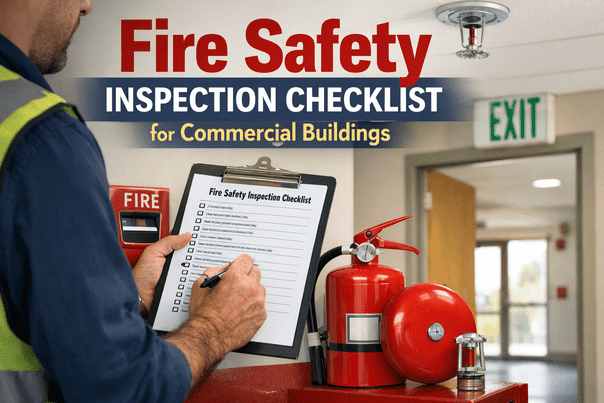
Fire extinguisher monthly and annual inspection — verify accessibility, pressure gauge readings, tamper seal integrity, and six-year maintenance or 12-year hydrostatic test compliance
Sprinkler system flow and tamper test — conduct quarterly flow tests, verify tamper switch supervision, inspect heads for paint or loading, and document all test results
Emergency egress and exit lighting — walk all evacuation routes, verify paths are unobstructed and well-lit, confirm exit signs illuminate and emergency lights hold 90-minute battery charge
What This Section Detects
+ Expired fire alarm panel certifications before insurance audits flag them
Undetected plumbing leaks cause more commercial property insurance claims than any other single maintenance failure category. Annual backflow preventer testing is legally required in most jurisdictions to protect municipal water supplies.
Backflow preventer annual test — certified tester verifies all RPZ and double-check assemblies, submits results to municipal water authority within required timeframe
Water heater and boiler inspection — check relief valves, verify operating pressures, inspect flue connections, document age and remaining service life estimates
Fixture and drain line assessment — test water pressure at representative fixtures, run drains to check flow rates, inspect visible piping for corrosion and leak evidence
+ Backflow device failures that trigger municipal water authority violations
ENV
Building Envelope
The building envelope is the physical barrier protecting the conditioned interior from weather, moisture, and energy loss. Compromised seals, damaged roofing, and failed weatherproofing drive energy costs up 20–30% and accelerate interior deterioration.
Roof membrane and drainage survey — check for ponding water 48 hours post-rain, inspect flashings, document membrane condition, verify all roof drains are clear
Window and door seal inspection — test weather stripping integrity, check caulking at all penetrations, verify operable windows close and lock properly
Exterior wall and cladding assessment — inspect siding, masonry, and curtain wall systems for cracking, spalling, water staining, and sealant failure at all joints
What This Section Detects
+ Water intrusion paths before interior damage requires costly restoration
+ Energy loss from failed seals driving utility costs 20–30% above baseline
Stop tracking inspections on spreadsheets and clipboards. Oxmaint schedules every inspection cycle, assigns qualified inspectors with mobile push notifications, enforces photo documentation, and auto-generates corrective work orders when deficiencies are found.
The difference between failing and passing consecutive audits often comes down to how inspections are documented, tracked, and escalated. Here is what changes when facilities move from paper-based tracking to Oxmaint's digital inspection platform.
Paper-Based Inspections
64% completion rate — inspections missed due to no automated reminders or accountability tracking
38% of deficiencies unresolved — corrective actions lost in paper stacks with no follow-up
26+ hours per week — spent compiling, filing, and searching for inspection records
No photo evidence — auditors cannot verify inspection thoroughness or condition at time of check
Oxmaint Digital Inspections
99.2% completion rate — auto-recurring work orders with mobile push notification reminders
100% deficiency tracking — auto-generated corrective work orders with escalation chains
26 hours per week saved — all records digital, searchable, and instantly accessible for audits
Timestamped photo evidence — required photos attached to every inspection with GPS coordinates
Recommended Inspection Frequency by System
Inspection frequency should match each system's criticality, failure likelihood, and regulatory mandate. The timeline below shows the minimum intervals recommended by NFPA, ASHRAE, and standard building codes — all configurable as auto-recurring schedules in Oxmaint's inspection management module.
D
Daily
Life safety egress path walkthroughs, emergency lighting spot checks, HVAC system operational verification, security system status review
W
Weekly
Common area cleanliness and maintenance, exterior grounds inspection, elevator cab and door operation check, parking structure lighting audit
M
Monthly
Fire extinguisher visual inspection, HVAC filter differential pressure check, plumbing fixture leak inspection, emergency generator test run
Q
Quarterly
Sprinkler flow and tamper testing, HVAC seasonal changeover, exterior envelope walkthrough, pest control perimeter inspection
A
Annually
Full fire alarm certification, backflow preventer test, elevator permit renewal, roof survey, thermographic electrical scan, comprehensive structural review
How Oxmaint Powers Building Inspections
Oxmaint turns your inspection checklist into an automated, accountable maintenance system across every building in your portfolio. Here is how each capability eliminates a specific inspection management pain point.
Auto-Recurring Schedules
Configure inspection intervals by system — daily, weekly, monthly, quarterly, and annual cycles. Work orders auto-generate and assign to qualified inspectors with mobile notifications.
SchedulingAutomation
Mobile Checklist Execution
Inspectors complete checklists on their phone with pass/fail fields, measurement inputs, required photo capture, and severity flagging — all from the field, no paper needed.
MobileField Ops
Auto Corrective Work Orders
When an inspector flags a deficiency, Oxmaint auto-generates a corrective work order with the deficiency details, photos, priority level, and assigns it to the right trade.
Deficiency TrackingEscalation
Compliance Dashboard
Real-time visibility into inspection completion rates, overdue items, open deficiencies, and certification expiry dates across your entire building portfolio in one dashboard.
AnalyticsReporting
We went from failing two consecutive fire marshal inspections to scoring 100% compliance across all 14 buildings in our portfolio. The difference was not that we started inspecting differently — we started documenting every inspection through Oxmaint so nothing fell through the cracks.
— Facility Director, Regional Property Management Group (42-building portfolio)
Turn Your Inspection Checklist Into an Automated Compliance System
Oxmaint replaces every clipboard, spreadsheet, and filing cabinet with a single platform that schedules, assigns, verifies, and reports on every inspection point across your entire building portfolio. When inspections are overdue or deficiencies remain unresolved, automated escalation notifies facility directors, property managers, and maintenance supervisors in sequence until the issue is addressed.
What inspections are legally required for commercial buildings?
Requirements vary by jurisdiction, but nearly all commercial buildings must maintain current fire alarm, sprinkler, elevator, and backflow preventer inspections. Most municipalities also require annual fire safety inspections and periodic structural assessments for buildings over a certain age. Sign up for Oxmaint to configure jurisdiction-specific inspection schedules that keep every certification current automatically.
How often should commercial buildings be inspected?
Commercial properties require annual full inspections at minimum, with quarterly walkthroughs as best practice. Fire safety systems need monthly visual checks and quarterly functional tests. HVAC systems require seasonal changeover inspections plus monthly filter checks. The exact frequency depends on system criticality, regulatory mandates, and equipment age.
What are the most common commercial building code violations?
The top violations are expired fire alarm certifications, blocked emergency egress paths, missing or expired fire extinguishers, obstructed electrical panels lacking required clearances, and overdue backflow preventer tests. Most of these are documentation failures — the equipment may be functional, but without current inspection records, the building is non-compliant.
How does a CMMS improve building inspection compliance?
A CMMS like Oxmaint automates the entire inspection lifecycle — scheduling recurring inspections, assigning qualified personnel, enforcing mobile completion with photo evidence, auto-generating corrective work orders for deficiencies, and escalating overdue items through management chains. Book a demo to see the automated inspection workflow in action.
What does a building inspection checklist cover?
A comprehensive checklist covers eight core areas: structural integrity, roof and building envelope, electrical systems, plumbing and water systems, HVAC and air quality, fire and life safety, exterior and site conditions, and code compliance documentation. Each area includes specific checkpoint items, condition ratings, and photo documentation requirements. Sign up free to digitize and automate this entire checklist in Oxmaint.
.jpeg)