Commercial Building Inspection Checklist (Complete 2026 Guide)
By shreen on March 9, 2026
Commercial building inspections account for over $4.7 billion in annual compliance penalties across the United States — not from structural failures, but from missed documentation, expired certifications, and inspection gaps that accumulate between audit cycles. A 500,000 sq ft office complex in Houston received 23 code violations during a single fire marshal visit because the facility team was tracking HVAC filter replacements on spreadsheets, fire door inspections on clipboards, and elevator certifications in a filing cabinet nobody had opened in 11 months. After migrating their entire inspection workflow to Oxmaint CMMS — Sign Up Free to digitize your inspections, violation rates dropped to zero across three consecutive audit cycles, inspection completion rates hit 99.2%, and the facility team saved 26 hours per week previously spent compiling paper records.
$4.7B
Annual compliance penalties from missed commercial building inspections across U.S. facilities
73%
Of building code violations stem from documentation gaps — not actual structural or safety deficiencies
99.2%
Inspection completion rate achieved by facilities using CMMS-driven digital checklist workflows
Why Paper-Based Building Inspections Fail Every Audit Cycle
Commercial buildings operate under overlapping regulatory frameworks — IBC structural codes, NFPA fire safety standards, ASHRAE mechanical requirements, ADA accessibility mandates, and local municipal ordinances that vary by jurisdiction. Paper inspection systems cannot track the interdependencies between these requirements. A fire door that passes its annual swing test still fails compliance if the adjacent fire-rated wall assembly was penetrated during a tenant improvement and never re-inspected. Facilities relying on manual tracking miss these cascading dependencies until an inspector finds them. Sign up for Oxmaint to link every inspection point across your building systems into a single compliance timeline.
Paper-Based Inspections
−
Fragmented records across departments — fire safety on one clipboard, HVAC on another, elevator certs in a separate cabinet with no cross-referencing capability
−
Expired certifications go unnoticed — backflow preventer tests, fire alarm panel inspections, and generator load bank tests expire silently without automated alerts
−
No photo or timestamp verification — inspectors check boxes without proof that the physical inspection actually occurred at the documented location
−
Audit preparation takes 40+ hours — facility teams scramble to locate, compile, and organize paper records before every scheduled regulatory visit
Digital CMMS-Driven Inspections
+
Unified inspection dashboard — every building system, certification, and compliance deadline visible in a single platform with dependency mapping
+
Automated expiration alerts — 90/60/30-day warnings for every certification, with escalation to facility directors when deadlines approach
+
GPS-stamped photo verification — every inspection requires geotagged photos proving the inspector was physically present at the inspection point
+
Instant audit-ready reports — generate full compliance documentation in under 5 minutes with complete inspection history and photographic evidence
Key Insight
82%
of commercial building owners who switch from paper to digital inspection management pass their next regulatory audit with zero findings — compared to a 34% first-pass rate for facilities still using manual tracking methods. The difference is not inspection quality — it is documentation completeness and traceability.
This checklist covers every critical inspection domain for commercial facilities — from structural integrity and life safety systems to mechanical equipment, electrical infrastructure, and exterior envelope. Each section maps directly to applicable IBC, NFPA, and ASHRAE standards. Manage all of these inspection workflows through Oxmaint's digital inspection platform — Sign Up Free to automate scheduling, track completion, and generate audit-ready reports.
Building Inspection Hub
6 Critical Domains
STR
Structural Systems
LSF
Life Safety & Fire
MEC
Mechanical / HVAC
ELC
Electrical Systems
PLB
Plumbing & Water
EXT
Exterior & Envelope
01
STR
Structural Systems Inspection
Structural inspections verify the load-bearing integrity of foundations, columns, beams, floor slabs, and connections. IBC Chapter 17 mandates periodic structural assessments for occupied commercial buildings, with increased frequency for structures older than 30 years or those in seismic zones.
Foundation crack mapping and monitoring — document all visible cracks with width measurements, photograph each location, and compare against previous inspection records to identify progressive movement
Steel connection inspection — verify bolted and welded connections at beam-to-column joints for corrosion, loose fasteners, cracked welds, and fire protection integrity
Floor slab deflection assessment — check for excessive deflection, ponding water evidence, and rebar exposure that indicates carbonation-driven deterioration
Parking structure condition survey — inspect expansion joints, waterproofing membranes, rebar corrosion, and vehicle barrier integrity per ACI 362.2R guidelines
Identifies progressive foundation settlement before it affects occupied spaces
Catches fire-protection coating degradation on structural steel elements
02
LSF
Life Safety and Fire Protection
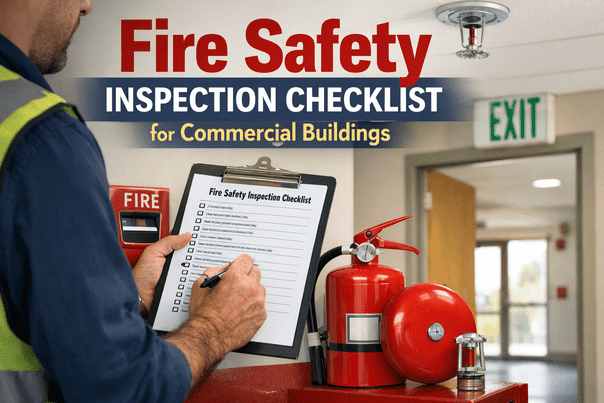
Life safety inspections are the highest-stakes category — failures here result in building closure orders, insurance policy cancellations, and potential criminal liability. NFPA 25, NFPA 72, and NFPA 101 define inspection frequencies for sprinkler systems, fire alarm panels, emergency lighting, exit signage, and fire-rated assemblies. Track every inspection deadline through Oxmaint's automated scheduling — Sign Up Free.
Fire sprinkler system quarterly inspection — verify valve positions, check for obstructed heads, test alarm switches, and confirm adequate water pressure at test connections per NFPA 25
Fire alarm panel annual testing — test every initiating device, notification appliance, and supervisory signal per NFPA 72 with documented sensitivity readings for smoke detectors
Emergency and exit lighting verification — conduct 90-second monthly tests and annual 90-minute battery discharge tests on all emergency luminaires and illuminated exit signs
Fire-rated assembly integrity audit — inspect fire doors for proper latching, self-closure, and seal integrity; check fire-rated walls for unauthorized penetrations
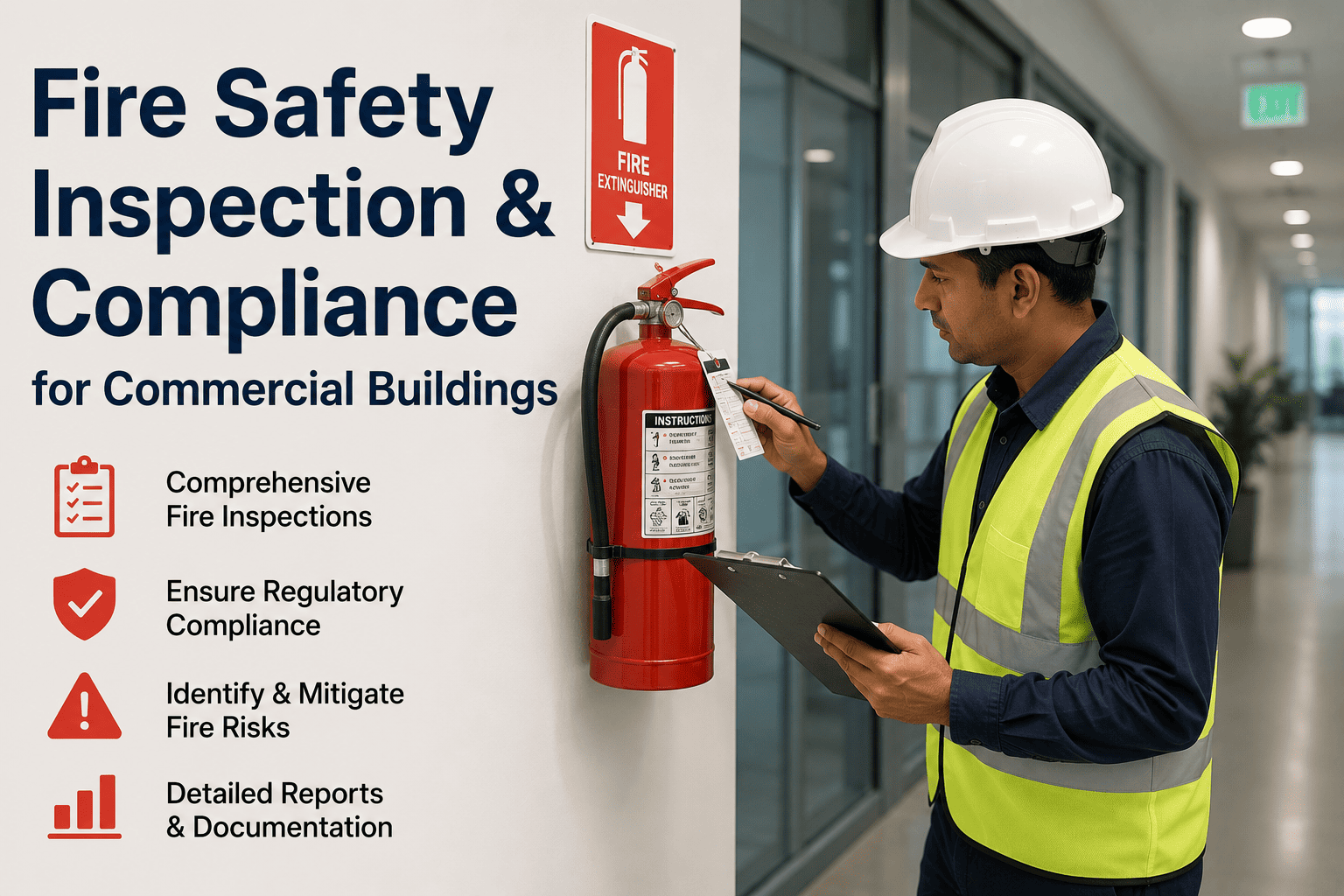
Fire extinguisher monthly and annual inspection — verify accessibility, pressure gauge readings, tamper seal integrity, and six-year maintenance or 12-year hydrostatic test compliance
Detects impaired fire protection that could trigger building closure orders
Flags expired fire alarm panel certifications before insurance audits
03
MEC
Mechanical and HVAC Systems
HVAC systems account for 40% of commercial building energy consumption and are the most common source of tenant comfort complaints. ASHRAE Standard 62.1 ventilation requirements, refrigerant management under EPA Section 608, and filter replacement schedules all require documented inspection records that auditors review during both energy compliance and indoor air quality assessments.
AHU filter replacement and logging — replace filters per manufacturer schedule, record differential pressure readings before and after replacement, and log filter MERV ratings
Chiller and boiler annual inspection — verify operating pressures, check for refrigerant leaks using electronic detectors, inspect tube bundles, and confirm safety relief valve certifications
Ductwork integrity assessment — inspect accessible duct sections for leaks, insulation damage, microbial growth, and verify damper operation on all zone control points
Building automation system verification — confirm setpoint accuracy, test occupied/unoccupied scheduling, and validate economizer sequences against design intent
Identifies refrigerant leak rates that trigger EPA reporting thresholds
Catches ventilation deficiencies before indoor air quality complaints escalate
Switch to Digital Inspections
Stop Tracking Inspections on Spreadsheets
Oxmaint replaces every clipboard, spreadsheet, and filing cabinet with a single platform that schedules, assigns, verifies, and reports on every inspection point across your entire building portfolio.
Electrical failures cause 18% of commercial building fires and are the leading cause of arc flash incidents that injure maintenance workers. NFPA 70B recommends thermographic surveys of all switchgear annually, while NFPA 70E requires documented arc flash hazard assessments for every panel. Schedule all electrical inspection cycles through Oxmaint — Book a demo to see the workflow.
Infrared thermographic survey — scan all switchgear, panel boards, transformers, and bus connections for hot spots indicating loose connections or overloaded circuits
Ground fault protection testing — verify GFP devices on main switchboards operate within NFPA-specified trip times and current thresholds
Emergency generator load bank test — run annual full-load test per NFPA 110 to verify generator can sustain rated output for required duration under building emergency load
Arc flash label verification — confirm every panel has current arc flash labels with incident energy values, PPE requirements, and approach boundaries per NFPA 70E
Catches thermal anomalies that indicate imminent connection failures
Identifies outdated arc flash studies that expose workers to unquantified hazards
05
PLB
Plumbing and Water Systems
Plumbing inspections extend beyond leak detection to include backflow prevention, water heater safety, Legionella risk management, and storm drainage capacity — all areas where compliance failures carry public health consequences and potential building closure orders.
Backflow preventer annual testing — certified test of all RPZ and DC assemblies with documented pass/fail results submitted to the local water authority by regulatory deadline
Water heater safety inspection — verify T&P relief valve operation, check for sediment accumulation, confirm seismic strapping where required, and log combustion analysis for gas units
Legionella water management program — verify water temperature monitoring at sentinel outlets, confirm flushing schedules for low-use fixtures, and document treatment chemical levels
Storm drainage and sump pump testing — inspect roof drains, overflow scuppers, and below-grade sump pumps with float switch operation verification before rainy season
Prevents Legionella exposure liability from undocumented water management
Catches expired backflow certifications before municipal compliance deadlines
06
EXT
Exterior Envelope and Site
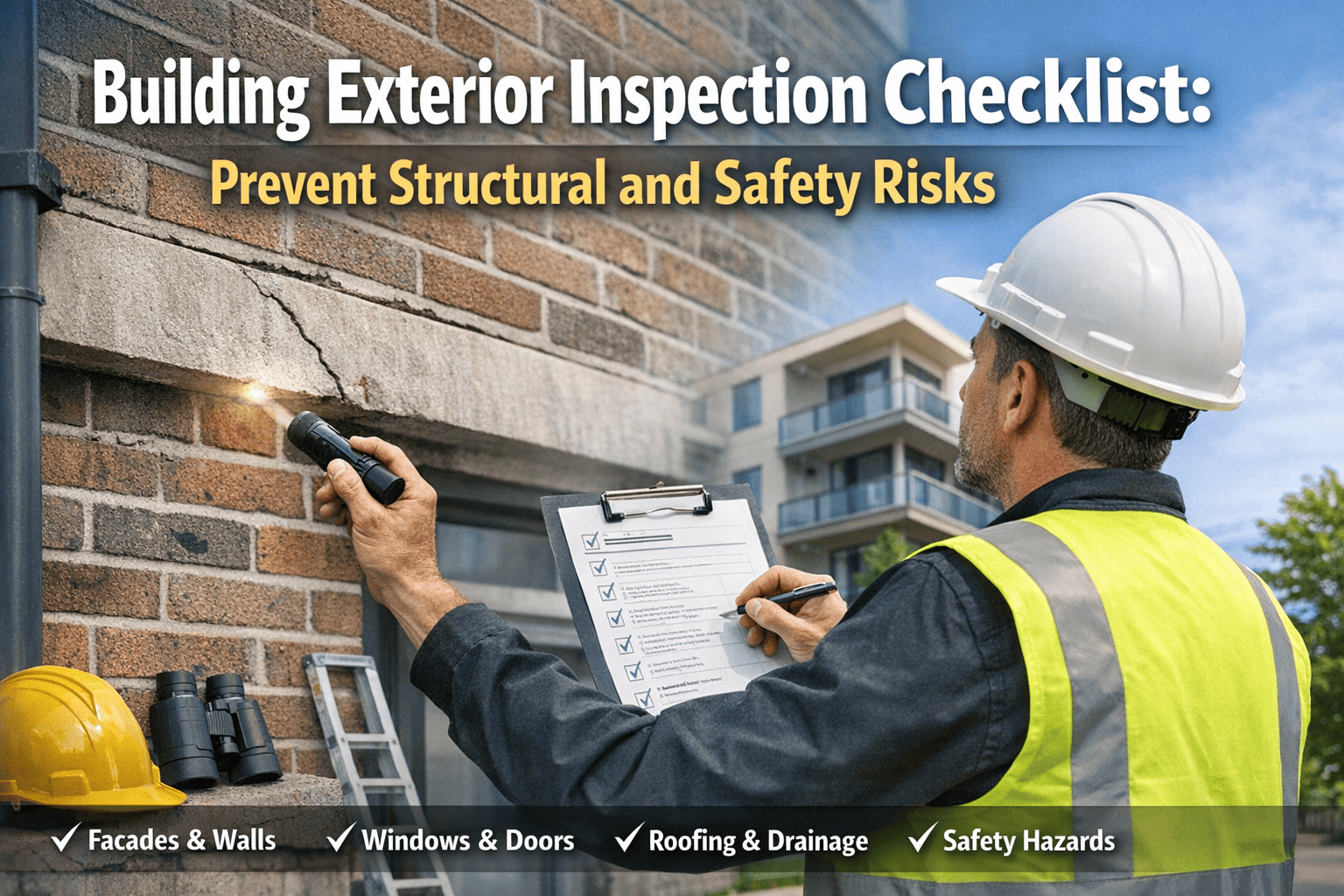
Envelope failures account for 40% of all commercial building insurance claims. Roof leaks, facade deterioration, and parking lot deficiencies accumulate damage costs exponentially when inspections are delayed. A biannual exterior inspection program managed through Oxmaint — Sign Up Free to schedule recurring inspections catches deficiencies at the repair stage before they become replacement-level capital expenditures.
Roof membrane and flashing inspection — walk the entire roof surface, check membrane seams, inspect flashing at penetrations and perimeters, clear drains, and photograph any deficiencies
Facade and curtain wall assessment — inspect sealant joints, check for cracked or displaced panels, verify weep holes are clear, and assess any staining patterns indicating water intrusion
Parking lot and structure survey — document pavement cracking, faded striping, ADA signage compliance, lighting fixture operation, and structural joint conditions
Landscaping and site drainage — verify grading directs water away from foundation, inspect retention basins, and confirm irrigation system winterization or startup
Identifies roof deficiencies before they become multi-floor water damage events
Catches ADA parking lot compliance issues before accessibility complaints
How Oxmaint Transforms Building Inspection Workflows
Digital inspection management replaces every paper form, spreadsheet, and filing cabinet with a single platform that schedules, assigns, tracks, verifies, and reports on every inspection point in your building portfolio.
Automated Scheduling
Every inspection frequency — monthly fire extinguisher checks, quarterly sprinkler tests, annual generator load tests — auto-generates work orders at the correct interval with the right inspector assigned.
NFPA CompliantAuto-Assign
Photo Verification
Inspectors capture geotagged, timestamped photos for every checkpoint. No more checkboxes without proof — every inspection includes visual evidence tied to the specific asset and location.
GPS-StampedAudit-Ready
Compliance Reporting
Generate inspection history reports, deficiency tracking summaries, and certification status dashboards with one click. Provide auditors and inspectors with complete records in under 5 minutes.
One-Click ReportsIBC / NFPA
Escalation Alerts
When inspections are overdue or deficiencies remain unresolved, automated escalation notifies facility directors, property managers, and maintenance supervisors in sequence until the issue is addressed.
Multi-LevelReal-Time
Inspection Frequency Reference by Building System
Inspection Item
Frequency
Standard
Risk If Missed
Fire extinguisher visual check
Monthly
NFPA 10
Building closure order
Sprinkler valve inspection
Quarterly
NFPA 25
Insurance cancellation
Emergency lighting test
Monthly / Annual
NFPA 101
Life safety citation
Elevator inspection
Annual
ASME A17.1
Equipment shutdown order
Backflow preventer test
Annual
Local Code
Water service disconnection
Roof membrane inspection
Biannual
ASTM E2018
Warranty voiding
Electrical thermographic scan
Annual
NFPA 70B
Arc flash / fire risk
Generator load bank test
Annual
NFPA 110
Emergency power failure
We went from failing two consecutive fire marshal inspections to scoring 100% compliance across all 14 buildings in our portfolio. The difference was not that we started inspecting differently — we started documenting every inspection through Oxmaint so nothing fell through the cracks.
— Facility Director, Regional Property Management Group (42-building portfolio)
Frequently Asked Questions
What inspections are legally required for commercial buildings?
Requirements vary by jurisdiction, but nearly all commercial buildings must maintain current fire alarm, sprinkler, elevator, and backflow preventer inspections. Most municipalities also require annual fire safety inspections and periodic structural assessments for buildings over a certain age. Sign up for Oxmaint to build jurisdiction-specific inspection schedules that ensure nothing expires unnoticed.
How often should commercial buildings be inspected?
Inspection frequencies range from daily (fire stairwell doors) to monthly (fire extinguishers, emergency lighting) to quarterly (sprinkler systems) to annual (elevators, generators, electrical systems) to multi-year (structural assessments). The key challenge is tracking all of these overlapping cycles simultaneously — which is exactly what a CMMS automates.
What are the penalties for missed building inspections?
Penalties range from $500 per-day fines for expired elevator certifications to $156,259 per willful OSHA violation for safety system failures. Fire marshal findings can trigger immediate building closure orders until deficiencies are corrected. Insurance carriers may also deny claims or cancel policies if inspection records show gaps.
Can one platform manage inspections across multiple buildings?
Yes. Book a demo of Oxmaint to see how property management firms track inspections across entire portfolios — with building-specific schedules, inspector assignments, and consolidated compliance dashboards that show the status of every inspection point across all properties.
How does digital inspection management improve audit outcomes?
Digital systems provide timestamped, photo-verified, inspector-attributed records for every inspection. When an auditor asks for proof that a fire door was inspected on a specific date, you produce the record in seconds — with the inspector's name, GPS location, photos, and any deficiency notes — instead of searching through filing cabinets.
Digitize Your Building Inspections Today
Join thousands of facility managers who have eliminated paper-based inspection tracking. Oxmaint automates scheduling, captures photo-verified evidence, tracks deficiency resolution, and generates audit-ready compliance reports across your entire building portfolio.



.jpeg)
