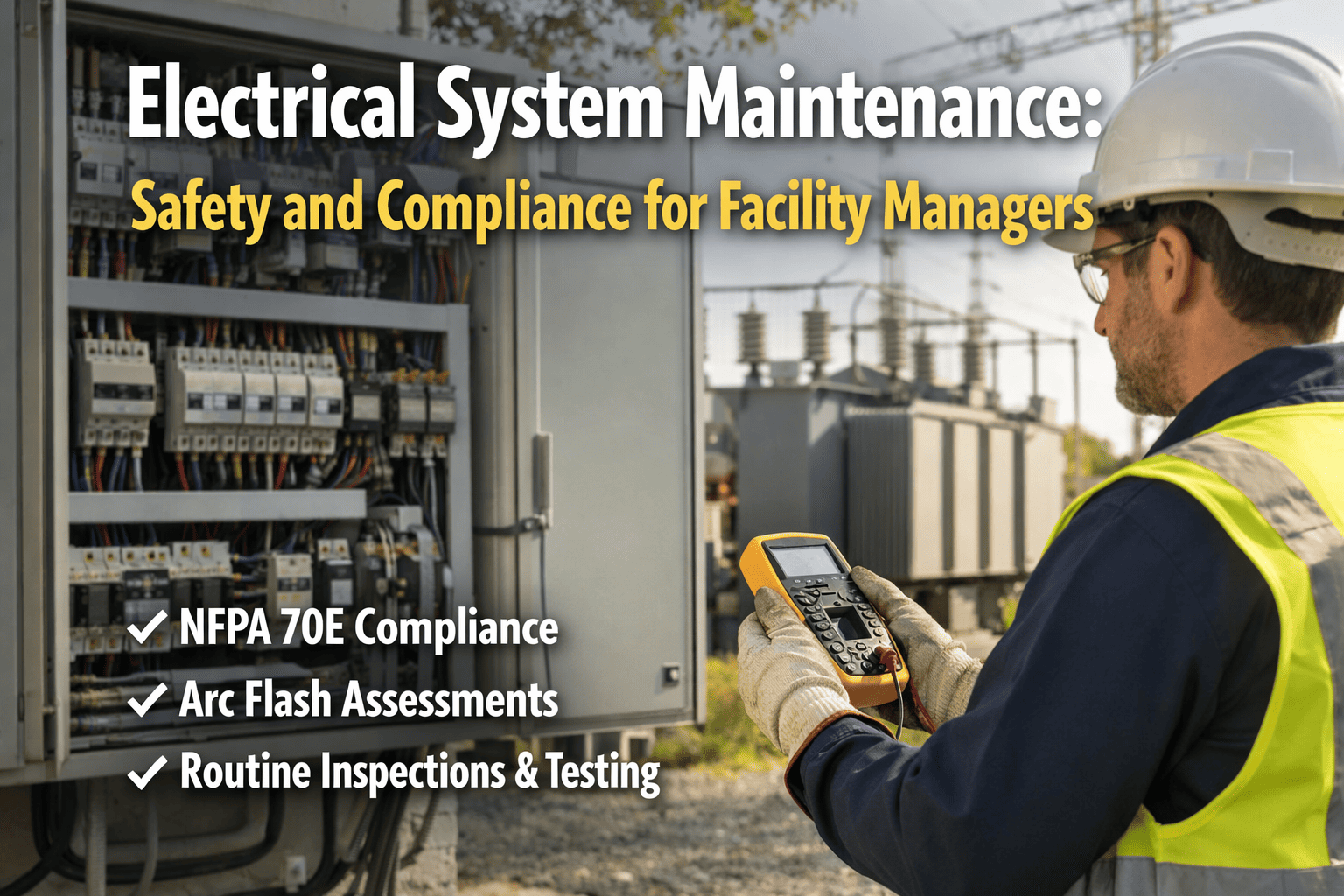
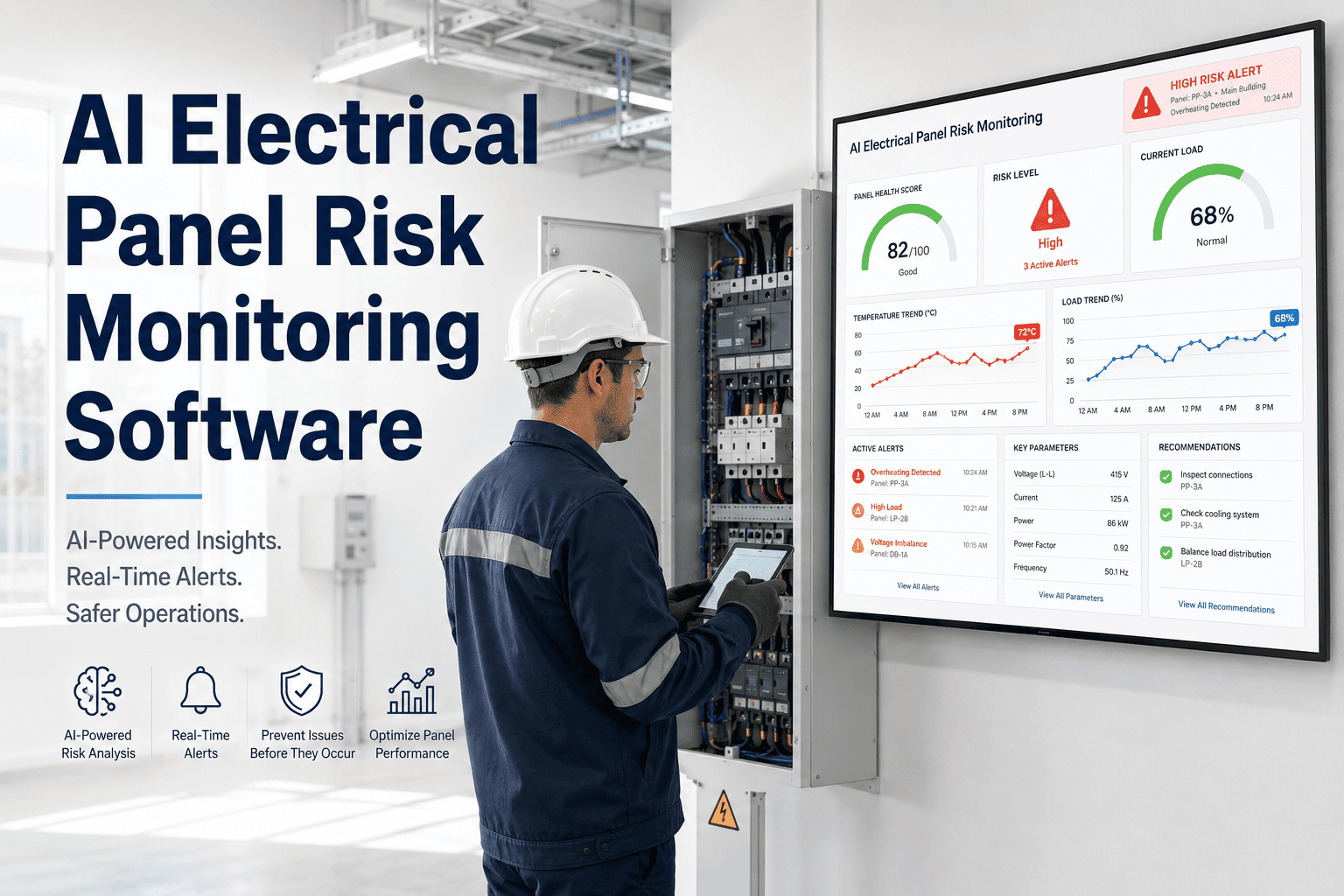
Electrical System Maintenance: Safety and Compliance for Facility Managers
By Lewis Abbott on April 5, 2026
An electrical system that fails without warning does not just interrupt operations — it creates arc flash events that kill, fires that destroy buildings, and regulatory exposure that shuts facilities down. OxMaint's Compliance Tracking module automates NFPA 70E inspection schedules, stores arc flash assessment records, and keeps facility managers survey-ready for OSHA, insurance, and authority-having-jurisdiction reviews. Book a 15-minute demo to see electrical compliance tracking in OxMaint.
Safety & Compliance · Electrical · OxMaint
Electrical System Maintenance: Safety & Compliance for Facility Managers
NFPA 70E inspections, arc flash assessments, switchgear PM, and compliance documentation — tracked automatically across every electrical asset in your facility.
NFPA 70E Table 130.5(G) — PPE categories by incident energy
400+
arc flash incidents in the US annually — most occur during routine electrical maintenance
NFPA 70E
the electrical safety standard OSHA uses to cite workplaces for unsafe electrical work practices
5 years
maximum interval for arc flash risk assessment review under NFPA 70E — many facilities have never done one
$1.5M+
average cost of a serious arc flash incident including injury, equipment replacement, and downtime
NFPA 70E at a Glance
What NFPA 70E Requires — Three Core Obligations
01
Risk Assessment
Arc Flash Risk Assessment
Conduct a formal assessment on all electrical equipment before any work is performed on energized equipment. The assessment must determine incident energy levels, establish arc flash boundaries, and specify required PPE for each piece of equipment.
Review every 5 years or after major system change
02
Equipment Labeling
Arc Flash Warning Labels
All electrical equipment that may require examination, adjustment, servicing, or maintenance while energized must have arc flash warning labels showing incident energy level, required PPE category, arc flash boundary, working distance, and equipment voltage.
Update labels after each arc flash study review
03
Safe Work Practices
Electrical Safe Work Program
Documented procedures for energized electrical work including lockout/tagout (LOTO), PPE selection, working distances, and qualified person requirements. The program must be reviewed annually and workers must receive NFPA 70E training every 3 years.
Program review annual · Training every 3 years
Inspection Schedule
Electrical PM Tasks — Visual Frequency Guide
Monthly
Panel board visual inspection — signs of overheating, corrosion, or moisture
Emergency lighting function test — all circuits 30-second discharge
Exit sign illumination check — all locations
UPS battery visual and indicator check
Ground fault circuit interrupter (GFCI) test — all wet locations
Quarterly
Transformer thermal scan — infrared inspection of connections and windings
Generator load test — minimum 30% rated load, 30-minute run
ATS (automatic transfer switch) functional test
Switchgear visual inspection — bus bars, insulators, connections
Motor control centre inspection — overload relays, contactors, wiring
Annual
Full electrical panel thermographic scan — all connections
Circuit breaker testing — trip time and mechanism function
Emergency lighting 90-minute full discharge test (NFPA 101)
Ground resistance testing — all earth electrodes
Power quality analysis — harmonics, voltage imbalance, power factor
Generator full-load bank test — annual exercise at rated capacity
Insulation resistance (megger) test — motors and cables
Every 5 Years
Arc flash risk assessment (NFPA 70E) — full study update
Switchgear full internal inspection — contacts, bus, insulation
Monthly inspectionAnnual power qualityLoad balancing check
Arc Flash Risk: Low–Medium
Expert Review
What Electrical Safety and Facility Engineering Leaders Say
"
The two most common electrical safety failures in facility management are both documentation failures, not equipment failures. The first: an arc flash risk assessment was performed by a contractor three or eight years ago, the labels exist on the equipment, but nobody knows where the study report is and it has never been reviewed since. The second: monthly electrical inspections are being performed by the facilities team, but the results are in a paper logbook in a drawer — which means they cannot be produced during an OSHA inspection or an insurance audit. NFPA 70E compliance is not about doing the right things. It is about being able to prove it in a retrievable format when someone asks.
Jim Phillips, PE, CESCP
Principal, Brainfiller Inc. · IEEE Senior Member · NFPA 70E Technical Committee Member · Author, Electrical Safety-Related Work Practices · 30+ years electrical safety consulting
5 years
max NFPA 70E arc flash study review interval — most facilities exceed this without a tracking system
400+
arc flash incidents annually in US workplaces — most involving facilities and maintenance personnel
$1.5M+
average cost per serious arc flash event — equipment, downtime, injury, and liability combined
OxMaint for Electrical Safety
How OxMaint Manages Electrical Compliance
Arc Flash Assessment Records — 5-Year Review Tracked
Arc flash study reports are stored against each electrical asset in OxMaint. The 5-year review deadline is tracked per piece of equipment — a review WO is auto-generated 90 days before expiry. Incident energy levels, PPE categories, and arc flash boundaries are stored per equipment ID and retrievable in seconds during an OSHA or insurance inspection. Sign in to register your electrical assets and arc flash records.
Automated Inspection Schedules — Monthly to 5-Year
Every inspection in this guide — monthly panel checks, quarterly generator tests, annual thermographic scans, 5-year circuit breaker testing — is configured as an OxMaint PM template and auto-generated on schedule per asset. Overdue inspections are visible the day they lapse. All results are stored per asset with timestamps and technician ID. Book a demo to see electrical PM scheduling in OxMaint.
Thermographic Scan Reports Linked to Assets
Infrared thermography reports — including thermal images, hot spot temperatures, and severity classification — are attached as PDFs to the relevant electrical asset WO in OxMaint. Findings that exceed temperature thresholds auto-generate a corrective action work order with a defined resolution deadline. Year-on-year thermal data trends are available per asset. Sign in to configure thermographic scan WOs in OxMaint.
OSHA and Insurance Audit-Ready Reports — On Demand
OxMaint generates a complete electrical compliance report — all inspection WOs by asset and date, arc flash study currency, thermographic scan findings and resolution, generator test logs, and NFPA 70E training records — exportable as a PDF within 2 minutes of an auditor's request. No paper binder searches. No missing records. Book a demo to see compliance reporting in OxMaint.
Book a Demo — See OxMaint Tracking Electrical Compliance Across Your Facility.
Arc flash records per asset · NFPA 70E inspection schedule · Thermographic scan reports · Generator test logs · Circuit breaker testing records · OSHA audit-ready documentation. Never scrambling for records during an inspection again.
How often must arc flash risk assessments be reviewed under NFPA 70E?
NFPA 70E requires arc flash risk assessment review every 5 years at minimum — or sooner after any major change to the electrical system, such as utility supply changes, equipment replacement, or load additions. Many facilities let this lapse because there is no automated tracking. OxMaint generates a review WO 90 days before the 5-year expiry per equipment asset. Sign in to track arc flash study expiry dates in OxMaint.
Is thermographic scanning of electrical panels required by NFPA 70E?
NFPA 70E does not mandate thermographic scanning but strongly supports it as a condition-assessment tool. NFPA 70B (Recommended Practice for Electrical Equipment Maintenance) and most commercial insurance underwriters recommend annual infrared scans of switchgear, panelboards, and connections. A hot spot identified by thermography and not corrected is also strong evidence of negligence in liability claims. Book a demo to see thermographic PM scheduling in OxMaint.
What generator testing frequency is required for facility compliance?
NFPA 110 requires monthly exercise of emergency generators for 30 minutes minimum, with at least 50% rated load annually. For life safety systems (hospitals, data centres), NFPA 99 and CMS requirements add quarterly full-load testing. OxMaint auto-generates monthly exercise WOs and annual full-load test WOs per generator asset — with run time, load percentage, and fuel consumption recorded. Sign in to configure generator PM schedules in OxMaint.
Can OxMaint store LOTO procedures for electrical maintenance tasks?
Yes. Equipment-specific LOTO procedures are stored as procedure attachments against each electrical asset in OxMaint. When a work order is created for a specific panel, switchgear section, or motor control centre, the relevant LOTO procedure is pre-attached to the WO — ensuring technicians have the correct isolation sequence before starting work. LOTO completion is captured as a mandatory field before the WO closes. Book a demo to see LOTO procedure management in OxMaint.