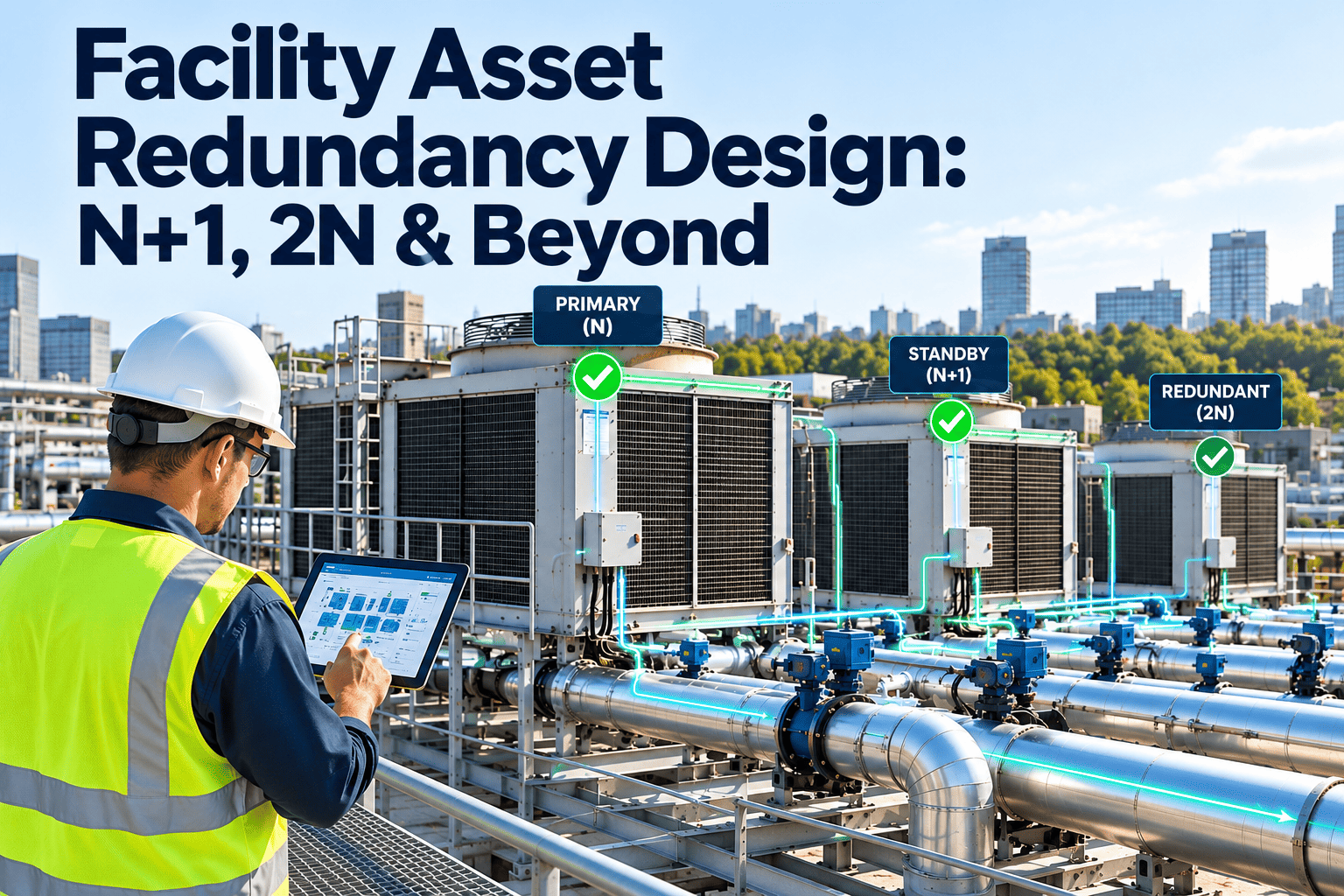
Redundancy is how a facility keeps critical systems running while parts of them fail or are taken offline for service. The hard part is choosing how much to buy: every extra chiller, pump, generator, or power path adds cost, floor space, and a new asset to maintain. This guide explains N, N+1, N+2, 2N, and 2N+1 designs, how they relate to Uptime Institute tier thinking, and why maintenance discipline decides whether redundancy actually works. Teams can track every redundant asset in asset management software built for maintenance workflows.
Facility Asset Redundancy Design: N+1, 2N and Beyond
Match the redundancy level to the cost of downtime, then maintain every standby asset as if it were the only one running.
N
N+1
N+2
2N
2N+1
What N actually means
N is the number of units needed to carry the full design load. If a cooling plant needs three chillers at peak, N equals three. Any unit beyond that is redundancy.
- N has no tolerance for a single failure at peak load
- Maintenance on any unit means reduced capacity or a planned outage
- Load assumptions must be current, since added equipment quietly raises N
Redundancy configurations compared
| Design | How it works | Survives | Relative cost | Best fit |
|---|---|---|---|---|
| N | Exactly enough units | No unit failure at peak | Lowest | Non-critical spaces |
| N+1 | One extra unit shares or stands by | One failure or one unit in maintenance | Moderate | Offices, labs, most commercial plants |
| N+2 | Two extra units | Failure during maintenance, or two failures | Higher | Healthcare, large campuses |
| 2N | Two independent systems, each sized for full load | Loss of an entire system or path | High | Mission-critical operations |
| 2N+1 | Two full systems plus an extra unit | Loss of a system and an additional failure | Highest | Facilities where outage is unacceptable |
Where tier classification fits
The Uptime Institute Tier Classification was written for data centers, but its logic is useful for any critical facility. It separates redundant components from redundant distribution paths.
Tier I
Basic capacity with no redundancy.
Tier II
Redundant capacity components, usually N+1, on a single path.
Tier III
Concurrently maintainable. Any component can be serviced without shutting down the load.
Tier IV
Fault tolerant. A single event does not interrupt the load, often with 2N or 2N+1.
Commercial buildings rarely certify, but they borrow the question: can we service this system without turning off the load?
Component redundancy versus path redundancy
Component redundancy (N+1)
- Extra chillers, pumps, or UPS modules
- Shared piping, switchgear, or controls
- Single points of failure often remain
Path redundancy (2N)
- Separate piping loops or electrical feeds
- Independent controls and distribution
- Higher cost but isolates entire fault domains
Many failures happen in shared parts: a header, a valve, a transfer switch, a controller. Adding units does not help if they all depend on one component.
Know which assets your uptime depends on
Rank critical assets, record their redundancy, and schedule maintenance around them in one platform.
How to choose a redundancy level in five steps
1
Identify critical loads
List processes and spaces where interruption causes safety, regulatory, or financial harm.
2
Estimate downtime cost
Use your own numbers per hour, including recovery effort and lost operations.
3
Map single points of failure
Trace power, water, and control dependencies back to shared components.
4
Decide the maintenance rule
Must service be possible with the load running? That points toward concurrent maintainability.
5
Compare options
Weigh capital, energy, space, and ongoing maintenance against the risk reduced.
Redundancy fails quietly without maintenance
Hidden failures
A standby unit that never runs may not start when called.
Uneven wear
Always using the same lead unit leaves the others untested.
Deferred service
Teams skip PM because the spare covers it, then lose the spare.
Stale settings
Failover setpoints and sequences drift after changes.
Spare parts gaps
A redundant system with no parts is only redundant on paper.
Poor records
No test history means no proof of readiness.
Maintenance routines that keep spare capacity real
- Rotate lead, lag, and standby roles on a schedule
- Run scheduled start tests and failover drills, then log the results
- Apply the same preventive maintenance to standby and duty assets
- Stagger maintenance so only one redundant unit is out at a time
- Verify transfer switches, valves, and control sequences, not only the main equipment
- Keep critical spares for the shared components that redundancy does not cover
For fire pumps, emergency power, and life safety systems, follow the applicable codes and the authority having jurisdiction for test frequency and records.
Redundancy readiness checklist
Critical assets are ranked and tagged
N is documented for each system
Single points of failure are mapped
Standby units are tested on a schedule
Role rotation is tracked in work orders
Failover results are recorded
Critical spares are stocked
Maintenance windows are planned per path
Metrics for redundant systems
PM compliance on critical assets
Failover test pass rate
Time to restore redundancy after a failure
Run-hour balance across units
Overdue work on standby assets
Critical spare availability
How Oxmaint supports redundant systems
- Asset records that link duty, standby, and shared components
- Preventive maintenance and test schedules for every unit
- Work orders and inspections with results kept as evidence
- Inventory tracking for critical spares
- Dashboards for overdue work, backlog, and compliance records
Frequently asked questions
Is N+1 enough for most commercial buildings?
Often yes, if maintenance is strong and shared components are addressed.
What is the difference between N+1 and 2N?
N+1 adds one spare. 2N duplicates the whole system and its path.
Does redundancy reduce maintenance?
No. It adds assets to maintain. Track them in Oxmaint.
How often should standby units run?
Follow manufacturer and code guidance, and rotate duty roles regularly.
Where should we start?
Rank critical assets first. Book a demo for a walkthrough.
Prove your spare capacity will work when needed
Maintain every duty and standby asset with scheduled work, tests, and records in one place.