Capital budgets in facilities often go to whoever complains loudest or whatever failed last month. Meanwhile the quiet asset that would shut the building down sits at the bottom of the list. Criticality-driven capital planning ranks renewals by what failure would cost the operation, not by noise. This guide explains the model, using the risk-based thinking in ISO 55001, and shows how a CMMS with asset history and criticality scoring supplies the evidence finance teams ask for.
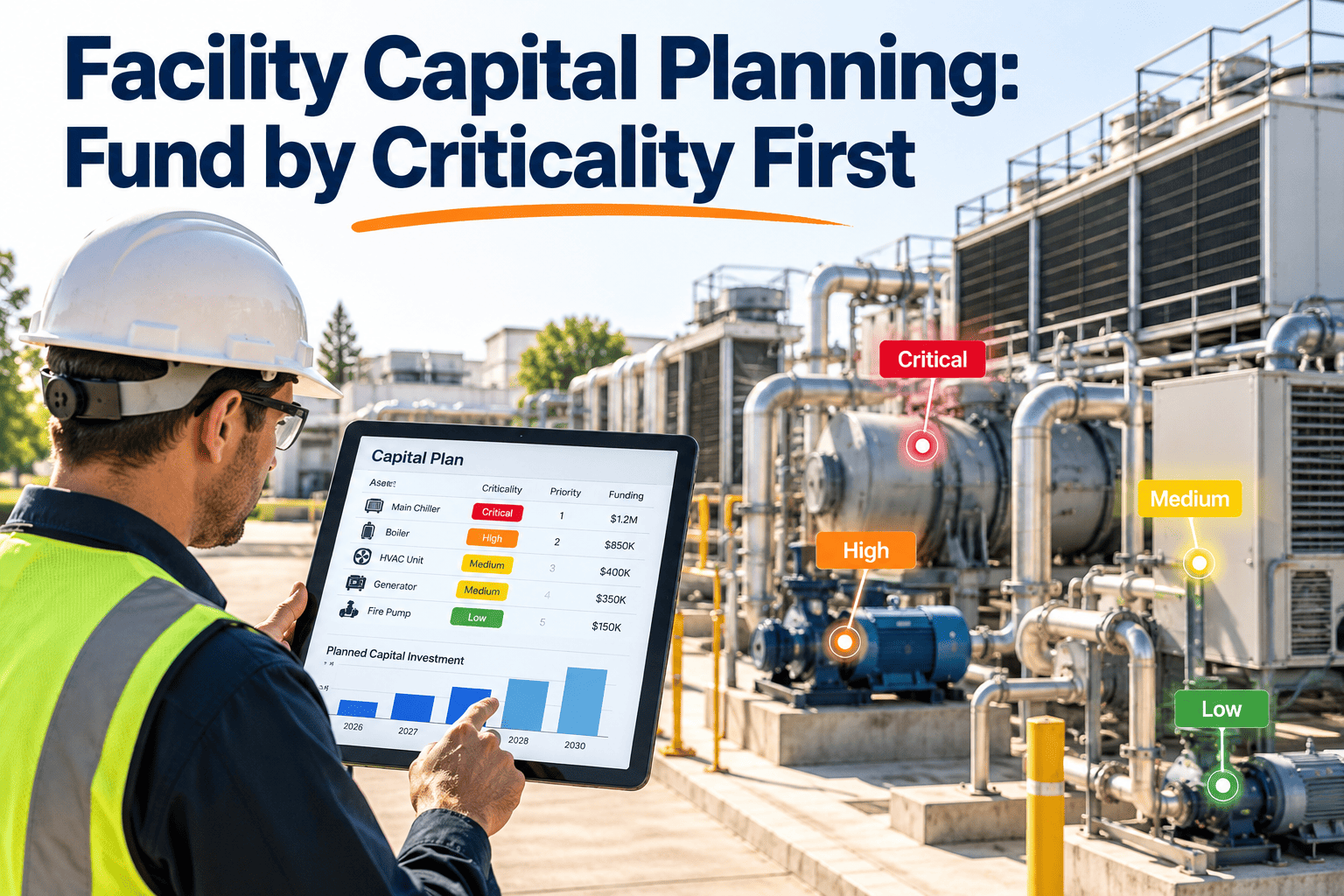
Facility Capital Planning: Fund by Criticality First
Combine how critical an asset is with how poor its condition has become, and the capital priority list builds itself from data rather than lobbying.
Loudest Versus Most Critical
Squeaky-wheel funding
- Requests win on urgency and persuasion
- Recent failures dominate decisions
- Hidden single-path assets stay unfunded
- Budget swings year to year
Criticality-driven funding
- Every request scored on the same scale
- Failure history and condition are evidence
- Risk to operations sets the order
- Forecast stays stable and defensible
The Five-Step Planning Model
Build the register
One clean list of assets with age, location, and replacement value estimates.
Score criticality
Rate safety, operational, financial, and compliance impact of failure.
Assess condition
Use inspections, repair frequency and remaining life, not age alone.
Rank by risk
Multiply or combine scores, then compare repair against replacement cost.
Phase and review
Spread projects across years and rescore as conditions change.
An Illustrative Scoring Example
The numbers below are an example scale, not benchmarks. Use your own weights and definitions.
| Asset | Criticality (1-5) | Condition risk (1-5) | Priority score | Action |
|---|---|---|---|---|
| Main chiller | 5 | 4 | 20 | Plan replacement |
| Emergency generator | 5 | 3 | 15 | Overhaul and test |
| Lobby air handler | 3 | 5 | 15 | Repair, review next cycle |
| Storage room fan | 1 | 5 | 5 | Run to failure |
Bring Evidence to Your Next Budget Meeting
Show finance the failure history, condition, and risk behind every capital request.
Repair, Refurbish or Replace
- Compare cumulative repair cost against replacement cost over remaining life.
- Count downtime and disruption, not just parts and labor.
- Check whether newer equipment reduces energy or compliance burden.
Data That Makes the Case Credible
Aligning With ISO 55001 Thinking
- Tie asset decisions to organizational objectives, not department wish lists.
- Treat risk as the basis for prioritizing spending.
- Consider the full lifecycle cost, from acquisition through disposal.
- Document decisions so they can be reviewed and improved.
- Review plans on a regular cycle and after significant change.
Metrics to Track the Plan
Why Capital Budgets Drift Toward the Wrong Assets
Visibility beats importance
Equipment that occupants notice, such as lobby lighting or noisy fans, attracts requests. Systems behind walls and ceilings may be far more important, yet nobody sees them until they fail.
Recent failures dominate memory
The last outage shapes the next budget. A rare but severe failure mode can be forgotten for years, then return as an emergency purchase.
Age is a poor proxy
Replacing by age alone wastes money on healthy old equipment and misses young assets that are failing early. Condition and criticality tell a more useful story.
Maintenance and capital are split
When the maintenance team and the capital committee use different data, requests arrive without evidence. A shared asset record closes that gap.
Defining Criticality Criteria Everyone Accepts
| Criterion | Question to ask | Example high score |
|---|---|---|
| Safety | Could failure injure people? | Fire pump, life safety power |
| Operations | Does failure stop core activity? | Main chiller in a lab |
| Compliance | Could failure breach a regulation? | Required ventilation or monitoring |
| Financial | How costly is downtime and repair? | Refrigeration in cold storage |
| Redundancy | Is there a backup path? | Single unit, no standby |
| Recovery | How long to restore service? | Long-lead-time equipment |
Agree the scale in advance with operations, finance, and safety. Scores that nobody argued about are scores people will trust.
Assessing Condition Without Guesswork
- Review work order history: repeated corrective repairs signal a declining asset.
- Use structured inspection checklists with consistent condition ratings.
- Include condition data from monitoring, such as vibration, temperature, or electrical readings, where available.
- Check manufacturer support: parts availability and end-of-support dates affect remaining life.
- Compare actual remaining life against the expected service life for similar equipment.
Condition scores need dates
A rating from five years ago is not evidence. Record when each assessment was made and refresh those on the highest-risk assets first.
Lifecycle Cost Thinking
The lowest purchase price is not always the lowest cost. Include energy, maintenance, and downtime when comparing options.
Managing the Deferred Renewal Backlog
Unmanaged backlog
- A long list with no ranking
- Emergency replacements dominate spend
- Maintenance covers for overdue renewals
- Risk is unknown until failure
Managed backlog
- Ranked by risk and tied to a plan
- Planned replacements outnumber emergencies
- Interim controls documented for deferred items
- Risk is reported to decision-makers
Deferral with controls
Some renewals will be postponed. When they are, raise inspection frequency, stock critical spares, and write a recovery plan, so the risk is managed rather than ignored.
How Preventive Maintenance Affects Capital Timing
- Well-executed PM can extend useful life and push replacement later.
- Poor PM compliance shortens life, so poor condition may reflect neglect rather than age.
- Track PM completion before recommending replacement, to avoid replacing assets that were never maintained.
- Use predictive or condition-based checks on critical assets to refine remaining-life estimates.
Separate cause from symptom
An asset with high repair cost may need a process fix rather than a new unit. Review failure causes before committing capital.
Presenting the Plan to Finance and Leadership
The ranked list
Present the top assets with criticality, condition, and cost, so the logic is visible.
The consequence
Describe what stops, who is affected, and how long recovery would take.
The options
Show repair, refurbish, and replace costs over the remaining life.
The timeline
Spread projects across years so spending is steady and predictable.
The risk appetite
Let leadership decide what risk to accept, with the facts in front of them.
Other Drivers That Belong in the Model
Common pitfalls
- Scoring everything as critical, which removes the ranking.
- Using age alone as the trigger for replacement.
- Skipping annual rescoring after major changes.
- Keeping asset data in separate spreadsheets that never match.
A Multi-Year Capital Roadmap
Stabilize the highest risk
Fund replacements or major repairs for assets that are both critical and in poor condition, and add interim controls for the rest.
Address the next tier
Move to critical assets in fair condition and important supporting systems, using updated condition data.
Balance renewal and efficiency
Include projects driven by energy savings, regulation, or capacity changes, now ranked on the same scale.
Rescore and adjust
Review scores yearly, since failures, repairs, and changes in use shift the ranking.
Smoothing the spend
Clustering big replacements in one year creates a budget spike. Staggering them according to risk keeps spending steady and lowers the chance of several failures arriving together.
Contingency, Emergencies and the Reserve
- Hold a reserve for failures that no ranking can predict, and size it using past emergency spend.
- Record every emergency replacement, so the reserve and the plan can be adjusted.
- Review whether each emergency was foreseeable. If so, the scoring may need to change.
- Keep a short list of pre-approved options for critical assets, so decisions are fast when failure happens.
- Stock critical spares for equipment with long lead times, reducing outage length while capital is pending.
Turning emergencies into learning
After each unplanned failure, ask why the asset was not ranked higher. The answer often shows missing data, an unclear criterion, or a maintenance gap.
What the CMMS Contributes at Each Stage
Keeping the plan connected to daily work
A plan built once in a spreadsheet goes stale. When the same system records repairs, inspections, and parts use, the capital ranking updates as conditions change.
Closing the loop after replacement
When a new asset is installed, record it, set its PM plan, and retire the old record. Compare actual cost and performance to the business case to improve the next one.
Questions to Ask Before Approving Any Capital Request
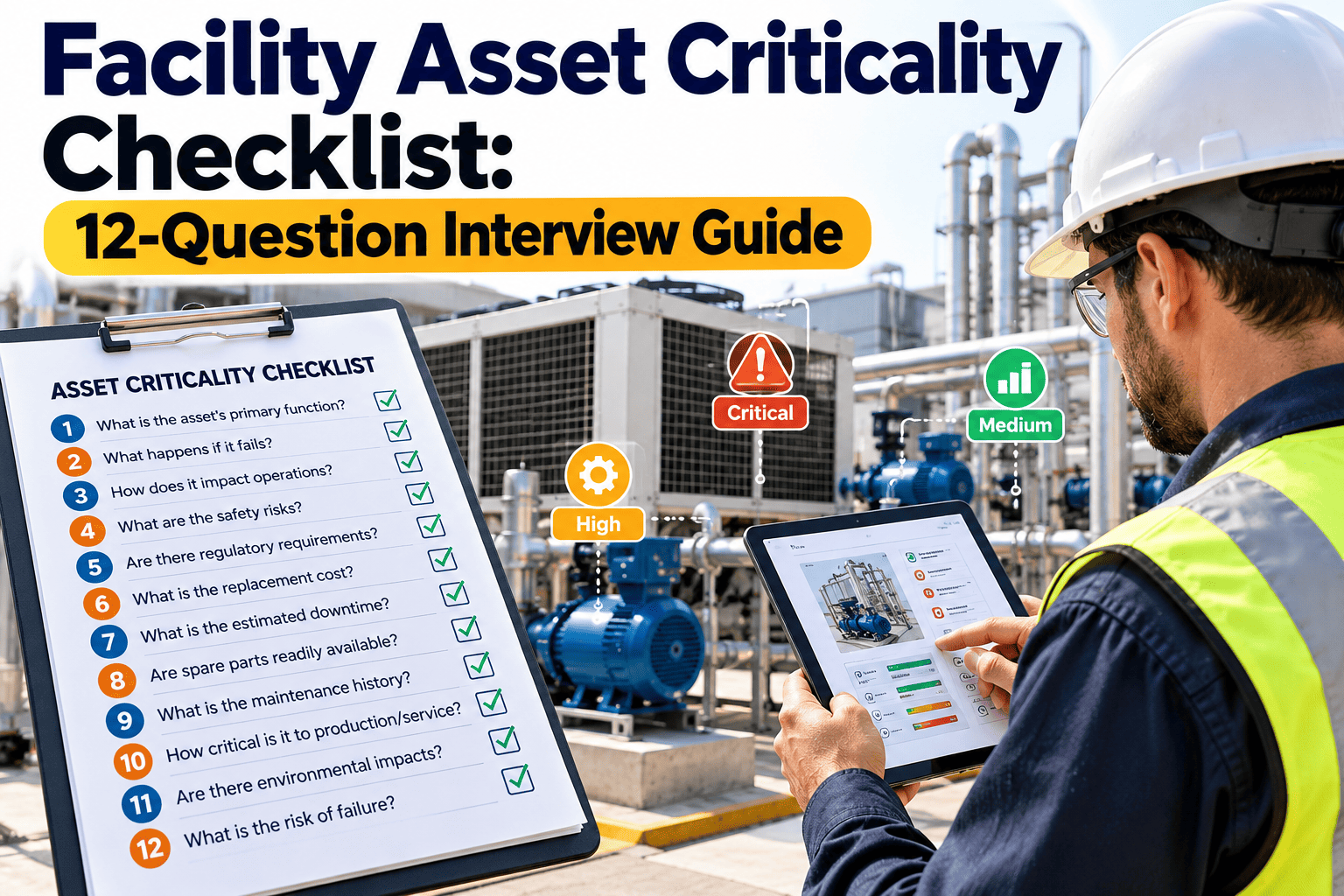
- What does this asset do, and what stops if it fails?
- What is its condition, and what evidence supports that rating?
- Has it been maintained to plan, and what do the work orders show?
- What are the repair, refurbish, and replace options over the remaining life?
- What is the recovery time if it fails before replacement?
- Is there a backup path, spare, or manual fallback?
- How does this rank against other requests on the same scale?
Building the Business Case for a Single Project
Weak request
- The unit is old and keeps breaking
- No cost history or downtime figures
- One quote and no alternatives
- No view of what happens if it is deferred
Strong request
- Criticality and condition scores with dates
- Repair history, downtime, and parts availability
- Repair, refurbish, and replace options compared
- Risk of deferral and interim controls stated
Include the cost of doing nothing
Estimate what a failure would cost in repair, lost operations, and recovery time. Decision-makers weigh a project against that risk, not against zero.
Asset Classes to Review First
Why the order matters
Failures in power, cooling, and life safety systems spread to everything they support. Reviewing them first captures the biggest risk reduction per dollar.
Governance: Keeping the Process Fair and Repeatable
- Publish the scoring method, so every department knows how requests are ranked.
- Use a committee with maintenance, operations, finance, and safety representatives.
- Record the reason for each approval or deferral for later review.
- Allow documented overrides for strategic or regulatory needs, with leadership sign-off.
- Review the process annually and adjust criteria when the business changes.
Transparency builds trust
When requesters see how decisions are made, fewer requests rely on lobbying. Data quality improves too, since better records lead to better rankings.
Starting Small: A 30-Day Pilot
Pick the scope
Choose one building or one system, such as the cooling plant, and list its assets.
Score criticality
Run a short workshop with operations and maintenance to rate each asset.
Assess condition
Pull work order history and inspect the highest-scoring assets.
Rank and review
Produce the ranked list, compare it to the current wish list, and discuss the gaps.
Common Objections and How to Answer Them
Keep the tone factual
Most disagreements fade when each side can see the same data. Share the asset record, the scoring, and the assumptions, and invite challenge on the evidence.
Frequently Asked Questions
How is criticality different from condition?
Criticality is impact if it fails. Condition is how likely failure is.
Do we need perfect data to start?
No. Start with critical assets and improve data as you go.
How often should we rescore?
Annually, and after major failures, upgrades, or changes in use.
How do we persuade finance?
Show cost, downtime, and risk per asset. Book a demo to see the reports.
Where should we begin?
Load your asset list and sign up to score criticality.
Fund What Matters Most First
Move from reactive requests to a ranked, evidence-based capital plan your team can defend.