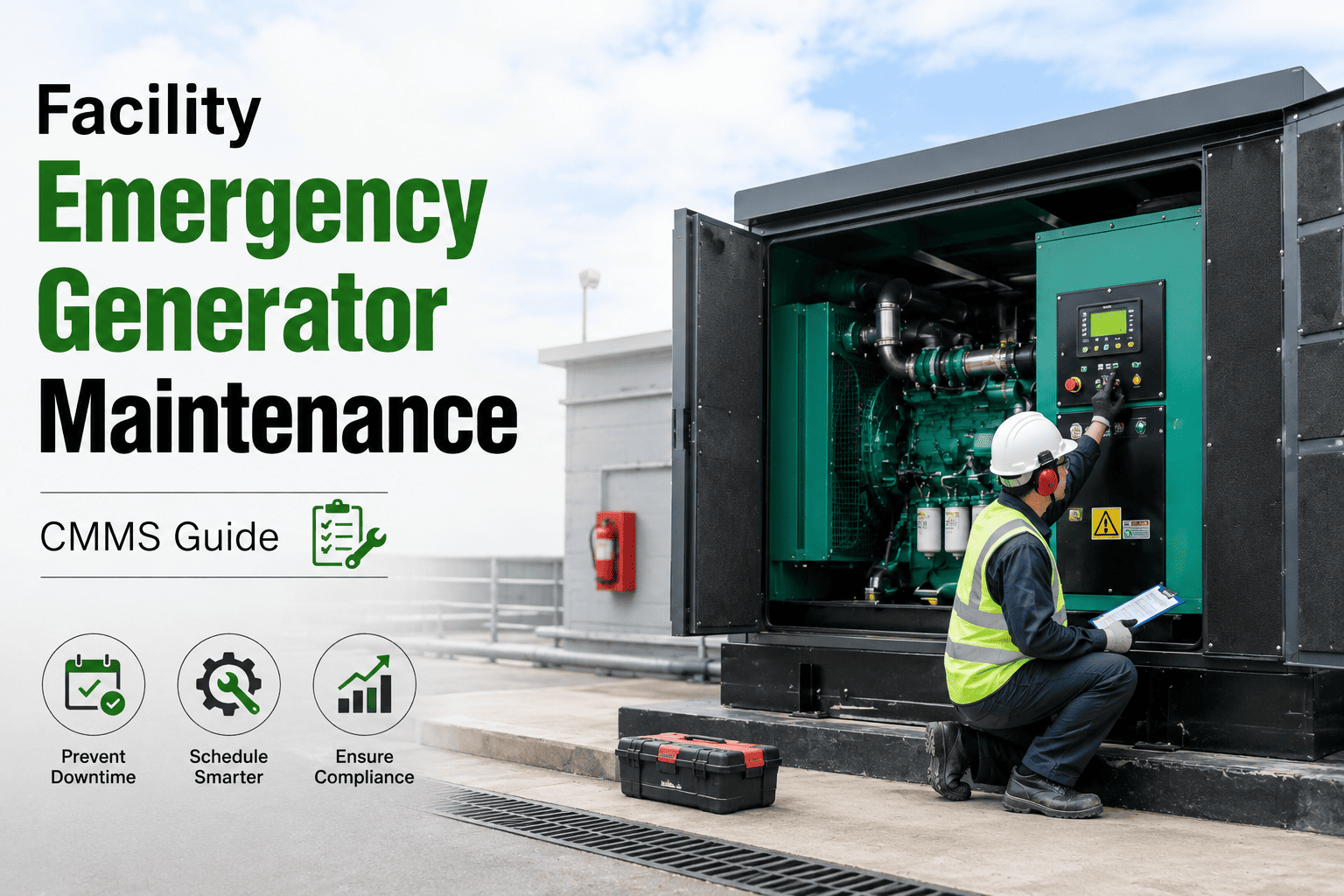
At 3:47 AM during Hurricane Ian, a Tampa senior-living facility lost power. The 500 kW generator that had passed its monthly test eleven days earlier refused to start — clogged fuel filter, microbial sludge from diesel that had sat fourteen months without polishing. That pattern is not rare: 27% of emergency generators that fail during real outages had passed their last scheduled test, because no-load exercises never expose fuel, ATS, or battery weaknesses. OxMaint automates the full NFPA 110 maintenance calendar — see it configured for your facility in a 30-minute demo.
Facility Emergency Power — OxMaint CMMS
Every NFPA 110 Test. Every Fuel Sample. Every ATS Cycle. Documented.
Weekly runtime checks. Monthly loaded exercises. Annual load bank testing. Fuel polishing. Battery testing. Transfer switch PM. One platform. One audit-ready record per generator.
27%
Of emergency generators that fail during real grid outages passed their last scheduled test — the gap is testing protocol, not equipment
$9,000
Average hourly cost of unplanned facility downtime in commercial and industrial operations across North America
2.4x
Higher NFPA 110 compliance-finding rate at facilities using spreadsheets and paper logs versus CMMS-driven programs
Why Backup Generators Fail When The Grid Goes Down
The uncomfortable truth about emergency power is that most facility generators are not tested the way they will actually be used. A monthly no-load exercise proves the engine will start. It does not prove the fuel is clean, the alternator will hold voltage under transient load, the ATS will transfer within its rated Type 10 window, or the batteries have enough cranking amps to start the engine at 4 AM in February. Those subsystems are what fail — and they fail invisibly until the day they cost you the building. OxMaint schedules the tests that actually catch these failures before an outage does.
Where Emergency Generators Actually Fail — Root-Cause Distribution
Fuel system contamination and filter blockage
Battery starting failure and low cranking amps
ATS transfer failure, stuck relay, or contact wear
Coolant, radiator, or engine overheat under load
Alternator, voltage regulator, and controller faults
Fuel contamination is the largest single cause — and the one a monthly no-load exercise never catches. Only load bank testing and scheduled fuel sampling expose it.
NFPA 110 — What Compliance Actually Requires
NFPA 110, Standard for Emergency and Standby Power Systems, sets the testing baseline for every Level 1 and Level 2 EPSS in the United States. Most facilities know the code exists. Fewer facilities can produce documented evidence of every required interval on demand for an insurance carrier, a Joint Commission surveyor, or an AHJ inspection. The schedule below is what NFPA 110 (2025 edition) requires — and what OxMaint schedules and documents automatically against every asset in your generator fleet.
Weekly
Visual Inspection And Battery Check
Fuel and coolant levels verified. Battery voltage logged. Block heater operation confirmed. Fluid leaks and shelter condition inspected. Enclosure air intake and exhaust unobstructed.
NFPA 110 §8.4.1 — Visual observation required weekly
Monthly
Loaded Exercise Run — 30 Minutes Minimum
Generator exercised under load for a minimum of 30 minutes, transferring through the ATS to at least 30% of nameplate kW or to the manufacturer's minimum exhaust gas temperature. No-load exercise does not satisfy this requirement.
NFPA 110 §8.4.2 — 12 tests per year, intervals 20–40 days
Quarterly
Fuel Sampling And ATS Function Test
Diesel fuel sample sent to ASTM D975 accredited lab for water, sediment, microbial, and stability testing. ATS transfer function verified under simulated utility failure — transfer time recorded against Type 10 or Type 60 specification.
NFPA 110 §8.3.4 — ATS included in maintenance program
Annual
Full Load Bank Test — 50%/75% Protocol
Load bank test at 50% nameplate kW for 30 minutes followed by 75% nameplate kW for 60 minutes. Fuel polishing on tanks over 12 months since last polish. Battery load test, coolant service, injector inspection, oil and filter change.
NFPA 110 §8.4.2.4 (2025 edition) — 90-minute protocol
Triennial
4-Hour Continuous Loaded Run
Level 1 EPSS installations require a comprehensive 36-month test at continuous rated load. Combined annual and triennial permitted as a single 4-hour test — 3 hours at 30% and final hour at 75% nameplate kW.
NFPA 110 §8.4.9 — Level 1 EPSS every 36 months
The Four Systems That Actually Break — And What OxMaint Schedules For Each
Generator maintenance is not one program. It is four parallel programs — engine, fuel, electrical transfer, and starting battery — each with its own failure mode, its own testing cadence, and its own documentation requirement. When any one of them is out of interval, the whole EPSS is technically non-compliant. OxMaint tracks each system as a separate PM plan against the same parent asset, so a fuel sample past due does not hide behind an engine service that is on time.
01
Load Bank & Engine System
Annual load bank testing at 50% then 75% of nameplate kW is the single most important PM task — it is the only test that proves the engine, cooling system, and alternator can hold rated output. OxMaint schedules the test window, generates the technician procedure, records step-by-step kW readings, and files the completed report as the NFPA 110 evidence package.
Load bank scheduling
kW step recording
Coolant service
02
Fuel System & Diesel Quality
Diesel begins to degrade 3 to 6 months after refining. Facilities storing fuel for 12 months or longer without polishing accumulate water, microbial growth, and sludge that clog primary filters exactly when the generator is called on. OxMaint tracks tank age, schedules fuel sampling by ASTM D975 protocol, and generates polishing work orders when contamination thresholds are exceeded.
Fuel sampling calendar
Polishing work orders
Stability tracking
03
Automatic Transfer Switch
A generator that starts perfectly and cannot transfer load is operationally identical to a generator that never starts. ATS contact wear, relay failure, and control-logic drift are the failures that show up only when the switch is exercised through a real transfer sequence. OxMaint schedules quarterly ATS function tests, records transfer times against Type 10 or Type 60 spec, and flags contact wear before it strands the load.
Quarterly ATS PM
Transfer-time logging
Contact inspection
04
Starting Batteries & Charger
Batteries are the number two cause of no-start events after fuel. A battery reading 12.4 volts at rest can still fail its cranking test at cold ambient. OxMaint schedules monthly voltage logging, quarterly load testing under conductance meter, and calendar-based replacement at 24 to 36 months regardless of test results — because the cost of a battery is a rounding error against the cost of a failed start.
Load testing PM
Charger monitoring
Calendar replacement
Turn NFPA 110 Compliance From A Spreadsheet Into A System
Every scheduled test, every fuel sample, every ATS transfer, every load bank report — captured against the asset, timestamped by technician, and packaged for the surveyor before they walk in.
Failure Modes CMMS Catches Before The Grid Goes Down
Every generator failure that shuts a building down was preceded by a warning sign that a scheduled inspection would have caught. The problem is not that facility teams do not know what to look for. The problem is that between weekly walkarounds, monthly runs, quarterly samples, and annual load banks, nothing enforces the interval. OxMaint enforces every interval and logs every finding — turning failure signals into work orders before they turn into outages.
Wet Stacking & Injector Deposit
Generators run repeatedly under 30% load never reach the exhaust gas temperature needed to burn fuel completely. Unburned fuel and soot deposit in the exhaust manifold and injectors, degrading performance and eventually preventing full-load operation. OxMaint flags any run recorded below the 30% threshold and schedules a corrective load bank cycle.
Tank Condensation & Microbial Growth
Every temperature swing draws humid air into a partially filled fuel tank. Water settles below the diesel. The water-fuel interface is where microbial colonies grow — and where the primary fuel pickup draws from during a start. OxMaint schedules monthly water-in-fuel visual checks and quarterly bottom sampling to catch it before it reaches the filter.
Contact Erosion & Time-Delay Drift
ATS contacts erode with every transfer cycle. Control-board timers drift with heat and age. A switch specified at Type 10 that now transfers in 14 seconds is out of NFPA 110 compliance and puts life-safety load at risk. OxMaint records every transfer time and alerts when a switch trends beyond spec — before it fails an audit or a real event.
Silicate Dropout & Radiator Fouling
Extended-life coolant that sits stationary for years develops silicate dropout that plugs radiator cores. The engine runs cool at no-load exercise and overheats within 20 minutes of full-load application. OxMaint schedules coolant sampling by pH and refractive index every 12 months and flushing at 5-year intervals or by test result.
Sulfation & Charger Failure
Standby batteries at partial state of charge sulfate over months and lose cranking capacity long before voltage drops. A trickle charger stuck in float mode masks the problem entirely. OxMaint schedules quarterly conductance testing, monitors charger output current, and forces 24 to 36 month calendar replacement regardless of test results.
Missing Records & Audit Findings
Joint Commission, CMS, and insurance auditors do not accept "we did the test but did not log it" as evidence. Missing runtime logs, incomplete load bank reports, and undated fuel samples are the finding — even if the generator itself is perfectly maintained. OxMaint captures every reading as the technician takes it, timestamped, geolocated, and audit-ready.
Compliance Outcomes Facility Teams Report Within 90 Days
The measurable difference between paper-log generator programs and CMMS-driven programs shows up within a single quarter — fewer missed intervals, higher first-time test pass rates, and audit packages that assemble themselves. These are the outcomes facility engineering teams report after moving generator PM into OxMaint.
96%
NFPA 110 monthly test interval compliance across managed fleet
42%
Reduction in emergency generator no-start events during outages
18 hr
Average time saved per generator on annual audit documentation prep
3.1x
Faster fuel contamination detection with scheduled quarterly sampling
A
Our AHJ inspector used to spend two hours going through binders and asking why fuel samples were 14 months old. Last inspection, we handed him a printed OxMaint compliance package with every runtime log, load bank report, and fuel sample for four generators across three campuses. He signed off in 40 minutes and asked what platform we were using so he could recommend it to other facilities on his list.
Director of Plant Operations — 3-campus senior living operator · Central Florida · 4 emergency generators, 210 kW to 750 kW
Frequently Asked Questions
Facility Emergency Generator — OxMaint
Make Sure The Backup Power Actually Works On The Day You Need It
Load bank tests scheduled. Fuel polished. ATS PM'd. Batteries load-tested. Every record audit-ready — for every generator, every interval, every year.
96%
NFPA 110 interval compliance
42%
fewer no-start events