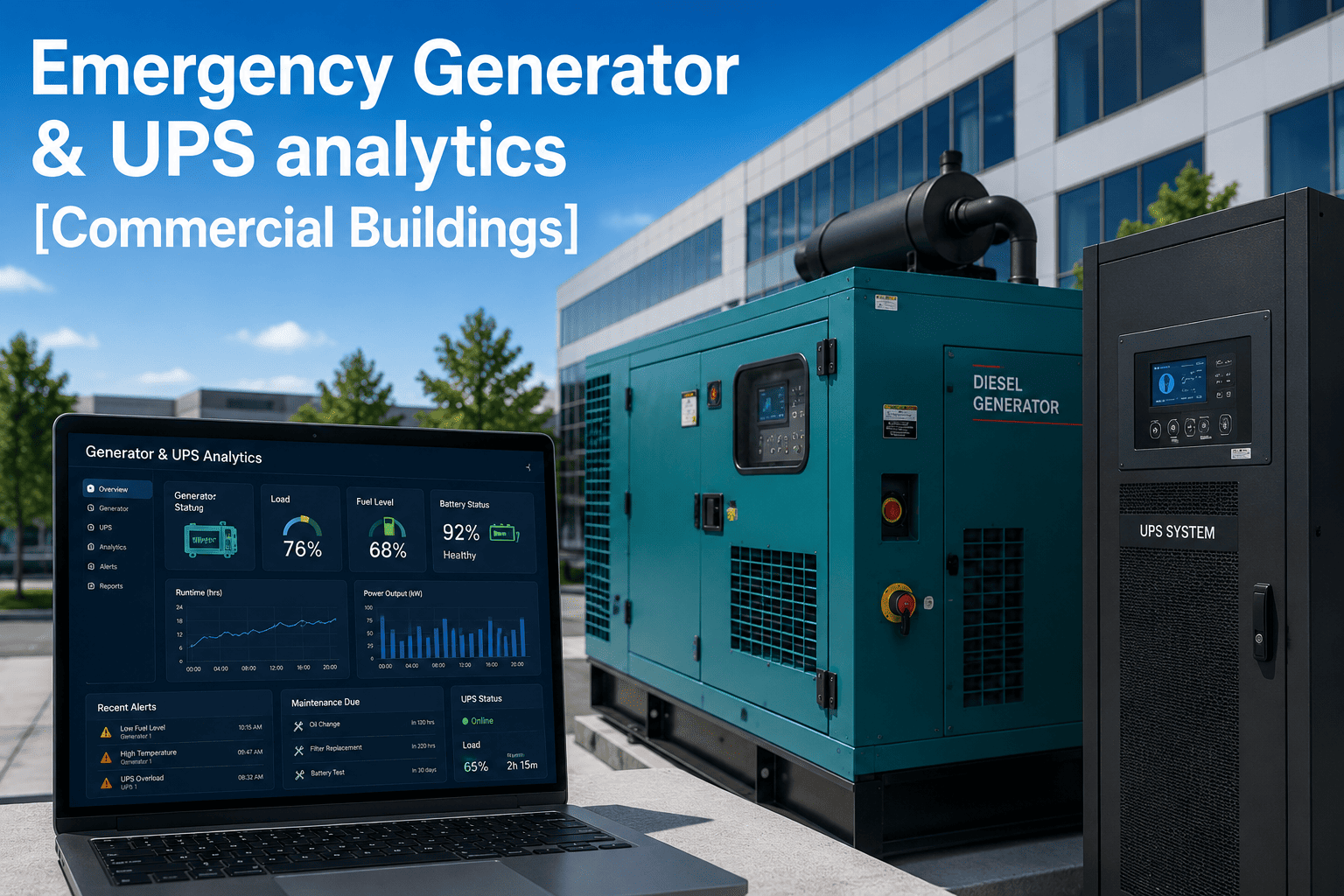
Generator and Backup Power Maintenance Checklist: Load Testing, ATS Inspection and Fuel Management for FM Teams

By Jhon Polus on March 24, 2026

generator-backup-power-maintenance-facility-resilience

Battery failure accounts for the largest share of generator start failures in commercial facilities, yet most FM teams only inspect batteries during scheduled annual service. NFPA 110 Chapter 8 mandates weekly visual inspections and monthly 30-minute load tests at a minimum of 30% of nameplate kilowatt rating for all Level 1 and Level 2 emergency power systems. The gap between what the standard requires and what facilities actually document is the gap that regulators, insurers, and accreditation bodies close during an audit. This checklist covers the complete preventive maintenance cycle for commercial generator sets and automatic transfer switches: weekly visual checks, monthly load tests, semi-annual fluid analysis, annual ATS functional tests, and fuel management records. Every section maps directly to NFPA 110 Chapter 8 requirements with the documentation standard each item must meet. Book a demo to see Oxmaint's generator PM module with NFPA 110 compliance scheduling configured for your facility's EPSS level and class.

NFPA 110 Compliance Starts With Documented, Consistent PM Schedules

Oxmaint auto-generates generator and ATS work orders on weekly, monthly, semi-annual, and annual cycles. Every inspection result is timestamped, technician-attributed, and stored as an audit-ready record against your EPSS asset register.

30 min
Minimum monthly load test duration required under NFPA 110 at 30% of nameplate kW rating
10 sec
Maximum transfer time requirement for Level 1 EPSS systems under NFPA 110 Type 10 classification
133%
Minimum fuel tank capacity required by NFPA 110 relative to the system operating class requirement
36 mo
Interval for full-duration load bank test on Level 1 systems per NFPA 110 Section 8.4.2 requirements
How to Use This Checklist
1Complete each inspection cycle section in sequence. Record actual measured values, not pass/fail checkmarks only, for all items with defined acceptance thresholds.
2Photograph every flagged item with a clear reference to the generator set ID and inspection date before closing the work order or moving to the next item.
3Record inspector name, date, generator set designation, runtime hours, and utility power status as header data before starting any inspection section.
4Retain all completed records and test reports per NFPA 110 Section 8.3.2 requirements and make available to the Authority Having Jurisdiction on request.
Severity Classification
CriticalImmediate corrective action required before next load event
ActionSchedule repair within 30 days or before next compliance test
MonitorLog condition, increase inspection frequency, escalate if trend worsens
PassCondition within acceptance parameters, continue current PM programme
Cycle 1
Weekly Visual Inspection
NFPA 110 Sec 8.4.1 All Level 1 and Level 2 Systems
Check engine oil level using dipstick with generator in shutdown state. Acceptance: oil between add and full marks on dipstick. Record actual level. Top up with manufacturer-specified grade if below the add mark on the dipstick scale.Action
Inspect coolant level in overflow reservoir and radiator filler neck if accessible. Note any visible oil contamination in coolant, which indicates head gasket failure risk and requires investigation before the next scheduled load test event.Critical
Inspect all visible fluid lines and connections for leaks. Check oil drain area, coolant hose connections, and fuel supply line fittings. Photograph and log any wet spots or staining on the generator base frame immediately for work order creation.Critical
Check engine block heater operation by verifying coolant temperature at control panel meets the manufacturer set point range. Typical acceptance: coolant temperature between 32 and 43 degrees C for diesel systems in standby configuration.Action
Inspect air filter indicator or service light status. Check air cleaner housing for physical damage or evidence of water ingestion if the generator is in an outdoor enclosure subject to weather exposure throughout the inspection period.Action
Check battery charger status light or control panel display confirms charger is active and in float or absorption mode. A charger showing fault or offline status is the leading cause of generator start failures under real emergency conditions at commercial facilities.Critical
Inspect battery terminals and cable connections for corrosion, looseness, or sulfation buildup. White or green crystalline deposits on terminals indicate charging circuit inefficiency. Record terminal condition as clean, slight corrosion, or heavy corrosion requiring immediate service.Action
Record battery float voltage from control panel display or with a digital multimeter at battery terminals. Acceptance: 13.2 to 13.8 V for 12V systems, 26.4 to 27.6 V for 24V systems. Voltage outside this range warrants investigation of charger output and battery internal condition.Action
Read and record day tank or base tank fuel level from gauge or control panel indicator. Acceptance: tank level above the low-fuel alarm setpoint defined for your NFPA 110 class. Compare to prior week reading for evidence of unexpected consumption between inspections.Critical
Verify control panel is in AUTO mode and no active fault alarms are present. Record any alarm codes displayed and investigate root cause before the next scheduled test. A generator left in manual mode after a test is a compliance failure point at every AHJ inspection.Critical
Inspect generator enclosure for pest ingress, water pooling, blocked ventilation louvers, or evidence of unauthorized access. Blocked louvers reduce cooling airflow during load test and can cause thermal protection trips under sustained operation at high load levels.Monitor
Cycle 2
Monthly Load Test and Operational Inspection
NFPA 110 Sec 8.4.2 Minimum 30 Min at 30% kW
Confirm all weekly inspection items were completed and cleared within the current month before initiating the monthly load test. Do not conduct the monthly test if a Critical item from any weekly inspection in the current period is unresolved and undocumented.Critical
Notify building occupants and facility operations team of planned test time and expected utility transfer duration. Confirm no critical clinical, manufacturing, or data center operations are scheduled requiring uninterrupted utility power during the planned test window.Action
Start generator and verify it reaches rated voltage and frequency within manufacturer specifications before ATS transfers load. Record actual voltage, frequency, and start time in seconds from initiation signal to reaching rated output on the control panel display.Critical
Transfer load to generator via ATS and record actual kW output at transfer. Minimum acceptance per NFPA 110: load at or above 30% of nameplate kW rating. Record actual kW, kVA, power factor, voltage, and frequency at 5-minute intervals during the full 30-minute test period.Critical
Monitor exhaust output for excessive black smoke throughout the test period. Persistent black smoke indicates incomplete combustion from low load conditions. If available building load does not achieve 30% nameplate, supplement with a portable load bank to meet the NFPA 110 minimum threshold requirement.Action
Check engine coolant temperature, oil pressure, and battery charge current readings on control panel at 10-minute intervals during the test period. Record all readings. Any parameter outside the normal operating band warrants investigation before the next test event is conducted.Action
Retransfer load to utility supply via ATS and record actual retransfer time. Verify ATS returns to normal position and generator completes cool-down period before shutdown. Record cool-down duration and confirm generator returns to AUTO mode after shutdown is complete.Critical
Inspect exhaust system for leaks, unusual discolouration of exhaust manifold or flexible sections, or evidence of condensation accumulation in low sections of exhaust piping following generator shutdown. Photograph all findings and create work orders for any deficiencies.Monitor
Record total test runtime hours to generator runtime log. Compare cumulative runtime hours to oil change interval specified by the manufacturer and initiate oil change work order if due within the next scheduled monthly test window or within 30 calendar days.Monitor
Cycle 4
Semi-Annual and Annual Engine Service
NFPA 110 Sec 8.3 Load Bank Test - 36 Month
Change engine oil and replace oil filter at the interval specified by the manufacturer based on runtime hours or calendar months, whichever occurs first. Send oil sample for spectrometric analysis at each change to track wear metal trends indicating internal component degradation over time.Action
Test coolant chemistry using test strips or a laboratory coolant analysis kit. Check freeze point, pH, and inhibitor concentration. Change coolant per manufacturer specification, typically every 2 years for conventional coolant or every 5 years for extended-life OAT coolant formulations.Action
Inspect all coolant hoses and clamps for hardening, cracking, soft spots, or swelling at connection points. Squeeze all hoses by hand to detect internal collapse or delamination not visible on the exterior surface. Replace any hose that does not return to round shape immediately after squeezing.Action
Inspect drive belts for cracking, glazing, fraying, or uneven wear. Check belt tension against manufacturer specification. Replace belts showing any surface cracking even if tension is within specification, as cracking indicates thermal fatigue that accelerates under sustained load conditions.Action
Replace air filters and inspect air intake ducting for blockage, physical damage, or evidence of moisture ingestion. Record the air filter service interval as a baseline for trending consumption rate, which increases substantially in high-dust installation environments throughout the year.Action
Inspect alternator windings and connection terminations for moisture contamination, rodent damage, or insulation degradation. Test insulation resistance to earth using a 500V megohmmeter on the stator windings. Acceptance: reading above 1 megohm after 60 seconds of measurement.Critical
Verify voltage regulator output voltage setting against nameplate. Test voltage regulation under load by recording output voltage from no load to full load during the annual load bank test. Acceptance: voltage regulation within plus or minus 5% of nominal from no load to full load.Action
Torque all main power output connection bolts and lugs to manufacturer-specified values. Loose connections at output terminals are the second most common cause of voltage drop complaints after load transfer to emergency supply in commercial facility environments.Critical
Conduct cranking amp capacity test using a dedicated battery load tester. Compare measured cold cranking amp output against battery nameplate CCA rating. Replace any battery measuring below 80% of rated CCA regardless of age or visual condition before it enters its third year of standby service.Critical
Replace starting batteries at the interval specified by the manufacturer or at a maximum of every 2 to 3 years for flooded lead-acid batteries in standby service. Record the date of manufacture printed on the battery label and the date of installation in the generator asset record.Action
Cycle 5
Fuel System and Storage Management
NFPA 110 Sec 8.3.8 ASTM Annual Fuel Quality Test
Submit diesel fuel sample for annual laboratory analysis per NFPA 110 Section 8.3.8 requirements. Tests must include microbial contamination count, water content, sediment level, and cetane rating. Reject fuel testing positive for microbial growth or with water content above 0.05% by volume.Critical
Inspect fuel tank exterior for corrosion, physical damage, or evidence of leakage at seams, fittings, and vent lines. Inspect secondary containment or tank containment pan for accumulated water or fuel. Record tank level at inspection and compare to prior inspection for unauthorized consumption.Critical
Verify fuel level meets or exceeds the NFPA 110 minimum requirement of 133% of fuel consumption for the system operating class duration. Document the calculation: class hours multiplied by fuel consumption rate at 100% load, multiplied by 1.33, compared against current tank volume in gallons.Critical
Test fuel polishing or fuel conditioning system operation if installed. Verify polishing pump is operational, filter condition indicators are within service range, and water separator bowl is drained and clear. Record polished volume accumulated since the last service inspection date.Action
Inspect day tank level control system by verifying float switch or level sensor activates day tank fill pump at the correct level setpoint. Test alarm function at both low fuel and high fuel setpoints from the day tank to confirm control panel annunciation is functioning correctly.Action
Verify fuel vent lines terminate outside the building per NFPA 110 requirements and are free from obstruction. Check that vent line screens or caps are intact and that no vent line penetration into the building has been added since the last inspection that would violate NFPA 110 Section 7.9.Action
Inspect fuel supply piping from tank to engine for evidence of leakage at all unions, flexible connections, and manual isolation valves. Operate manual isolation valves through full travel to confirm they are not seized. Record the date of last operation for each manual isolation valve.Monitor
Inspection Sign-Off and Header Record
Inspector Name

Inspection Date

Generator Set Designation

Runtime Hours at Inspection

Utility Power Status at Start

Supervisor Sign-Off

Critical and Action Items Summary


System Readiness Decision

Oxmaint digitises this entire checklist. Auto-scheduled work orders for weekly, monthly, semi-annual, and annual cycles. Every inspection result timestamped and linked to your generator asset record. NFPA 110 compliance documentation retrievable in under 60 seconds from the audit dashboard. Book a demo to see the generator PM module configured for your EPSS level and class.

How Oxmaint Manages Your Generator PM Programme

Paper-based generator inspection records cannot be trended, searched, or compared against prior inspection cycles without manual effort that takes hours. Oxmaint digitises every checklist section above into structured inspection forms with automatic work order scheduling, photo capture, and compliance record generation linked to each generator asset record.

SCH
Auto-Scheduled PM Work Orders
Weekly visual, monthly load test, semi-annual service, and annual ATS test work orders are generated automatically on schedule. Overdue work orders escalate to supervisor level. PM compliance rate is tracked in real time on the facility dashboard.
LOG
Load Test Data Recording
Monthly load test fields capture kW output, voltage, frequency, power factor, coolant temperature, and oil pressure at each recording interval. Test records are formatted as NFPA 110-compliant reports and stored against the generator asset for AHJ review on demand.
ATS
ATS Transfer Time Tracking
ATS test results capture transfer time in seconds and compare against the Type 10 or Type 60 threshold for your system classification. Transfer time trending over 12 to 24 months identifies ATS mechanical degradation before the next compliance inspection window.
FUL
Fuel Level and Quality Records
Weekly fuel level readings, annual fuel analysis results, and polishing system service records are all stored in the generator asset record. Fuel consumption trend analysis identifies abnormal consumption indicating leaks or unauthorized use between formal inspections.
AUD
Audit-Ready Compliance Records
Every inspection session generates a timestamped, technician-attributed record that cannot be modified after sign-off. NFPA 110 documentation packages for AHJ, accreditation, and insurance audit are exportable in under 60 seconds from the Oxmaint compliance dashboard.
CAP
Battery and Component CapEx Planning
Battery installation dates, CCA test results, and manufacturer replacement intervals are tracked per generator asset. Oxmaint flags batteries approaching end-of-life in the CapEx forecast 90 days before replacement is due, enabling budget allocation before emergency failure occurs.

Frequently Asked Questions

QWhat is the minimum monthly test requirement for a Level 1 generator under NFPA 110?
Level 1 generators must be tested monthly under load for a minimum of 30 minutes at a minimum of 30% of nameplate kW rating. If connected building load is insufficient to reach 30%, a load bank must supplement to meet the threshold. Sign up free to configure your monthly test schedule, or book a demo to see the load test recording module.
QHow often must an ATS be fully tested under NFPA 110 for a Level 1 facility?
NFPA 110 requires automatic transfer switches to be functionally tested at least annually, including verification of transfer time, retransfer time, and alarm outputs. Level 1 systems must also undergo a full-duration load bank test every 36 months. Book a demo to see ATS inspection scheduling, or start a free trial to configure your ATS PM cycle today.
QWhat fuel storage volume does NFPA 110 require for an emergency generator?
NFPA 110 Section 5.5.3 requires fuel tank capacity of at least 133% of the fuel volume needed to run the generator for the full duration of its operating class. The low-fuel alarm must be set at 100% of the class duration volume. Sign up free to track fuel levels as a PM data point, or book a demo to see the fuel management records module.
QHow long must generator maintenance records be retained per NFPA 110?
NFPA 110 Chapter 8 requires that maintenance and test records be retained and made available to the AHJ on request without specifying a minimum retention period. Most AHJs and accreditation bodies require a minimum of 3 years of records to be accessible for review. Book a demo to see Oxmaint's audit record export function, or start a free trial and begin building a compliant record from day one.

Replace Paper Generator Logs With Live NFPA 110 Compliance Records

Oxmaint auto-schedules your generator, ATS, and fuel system PM work orders, records every inspection result with photo documentation, and generates NFPA 110 compliance reports on demand. No manual compilation. No missing records. No compliance surprises at audit time.
Share This Story, Choose Your Platform!