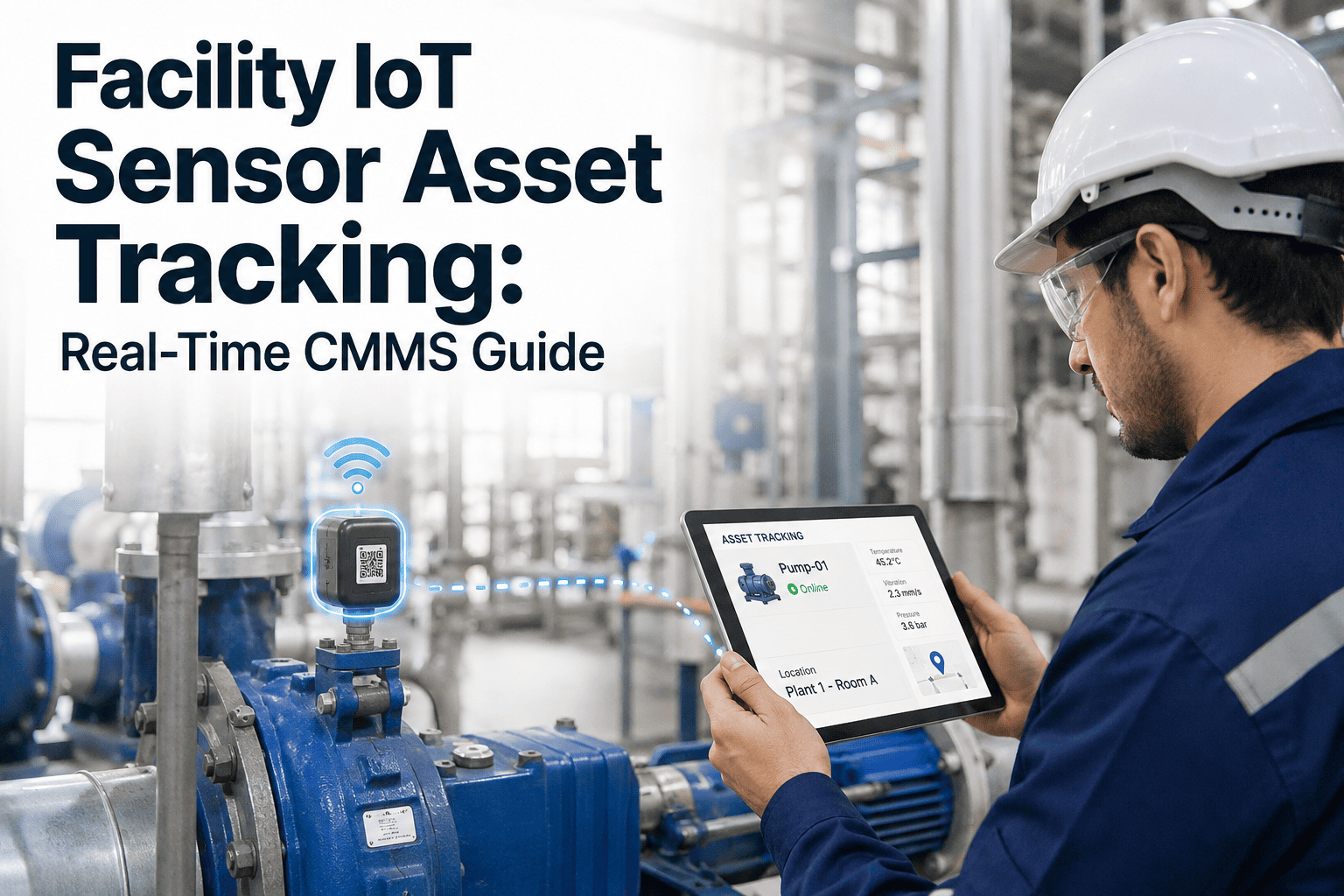
Facility IoT sensor asset tracking turns every pump, motor, air handler, and electrical panel into a self-reporting node — continuously streaming temperature, vibration, run-status, and amperage data into your CMMS so failures are flagged before they cause downtime. For most plants, the first 90 days of deployment cut unplanned downtime by 20–40% and shrink emergency work orders by roughly a third, because technicians are dispatched on condition triggers instead of calendar guesses. This guide walks through sensor selection, CMMS integration architecture, condition-based work-order automation, and the 2026 ROI math that justifies the rollout. If you want to skip ahead and see live data flowing into a real work queue, you can Start Free Trial and connect your first ten assets this week.
What if 100% of your critical assets reported their health — before they failed?
Wireless IoT sensors stream temperature, vibration, and run-status into your CMMS every 60 seconds, automatically generating work orders the moment a threshold trips. No clipboard rounds, no surprise failures, no overtime scrambles.
Why Manual Facility Asset Tracking Is Quietly Bleeding Your Maintenance Budget
Unplanned downtime costs industrial manufacturers an average of $260,000 per hour, and Deloitte estimates the global figure exceeds $50 billion annually. The root cause is rarely the asset itself — it's the gap between when a defect begins and when someone writes the work order.
A single bearing failure on a 75 HP motor can lock a production line for 6–14 hours while parts ship.
Arizona State reliability research shows calendar-based PMs catch fewer than 18% of failures before they occur.
A 12-technician team burns 2,184 productive hours a year — roughly $109K in loaded labor — on rounding.
By the time a tech hears a bearing whine or smells overheated insulation, the asset is already in failure mode. IoT sensors catch the same defect 30–90 days earlier — when it still costs $40 to fix instead of $4,000.
A 180-Asset Plant Spending $42K/Year On PMs — What IoT Tracking Actually Changes
Consider a mid-size food processing facility running 180 tracked assets — mixers, conveyors, chillers, AHUs, and packaging motors. Their current preventive maintenance program costs $42,000/year in labor and parts, yet they still logged 27 unplanned failures last year averaging 4.2 hours each. Here's what happens when wireless sensors feed that same asset register in real time.
That's a 13.6× return in the first 12 months — and the sensor hardware is a one-time cost, so Year 2 savings climb past $315,000. The payback period lands between 26 and 33 days for a facility of this size.
90-Day Rollout: From Sensor Unboxing To Condition-Based Work Orders
A properly scoped IoT-to-CMMS deployment follows a disciplined 12-week path. Skip the asset criticality ranking and you'll overspend on sensors for non-critical fans while missing the 200 HP compressor that actually drives downtime. Here's the sequence that consistently delivers a sub-90-day payback.
Asset Criticality & Sensor Selection
Rank assets by downtime cost × failure frequency using ISO 55000 criticality logic. Tag the top 30% as Tier-1 candidates for vibration + temperature sensors; the next 40% get run-status only. Spec sensor battery life (typically 3–5 years for LoRaWAN) and confirm IP67 enclosure ratings for washdown zones.
Gateway Install & CMMS Integration
Mount LoRaWAN or Wi-Fi gateways to cover the facility floor — one gateway typically covers 50,000–100,000 sq ft line-of-sight. Pair sensors to assets in the CMMS asset register via barcode or QR. Configure the API bridge so telemetry flows into each asset's history log every 60 seconds.
Threshold Tuning & Work-Order Automation
Run sensors in "monitor-only" mode for 14 days to establish baselines, then set condition triggers: vibration RMS above 0.45 in/s, bearing temperature 15°F above ambient, or runtime exceeding 720 hours since last PM. Auto-generate work orders assigned to the right technician with parts pre-loaded.
Which Sensor Type Belongs On Which Asset Class
The most common deployment mistake is over-sensing low-criticality assets and under-sensing the ones that actually drive downtime. Match sensor type to failure mode — not to what's cheapest or easiest to install. The matrix below reflects typical industrial facility pairings and the condition triggers that fire work orders.
| Asset Class | Primary Sensor | Failure Mode Detected | Trigger Threshold | CMMS Action |
|---|---|---|---|---|
| Centrifugal pumps (50+ HP) | Vibration + temp | Bearing wear, cavitation | RMS > 0.45 in/s | Auto WO — inspect bearings |
| HVAC AHUs & fans | Run-status + temp | Motor burnout, belt slip | Runtime > 720 hrs | Auto WO — belt & bearing PM |
| Electrical panels & switchgear | Wireless thermocouple | Hot spots, loose connections | ΔT > 15°F above ambient | Critical WO — electrician dispatch |
| Compressed air systems | Pressure + vibration | Valve failure, seal leak | Pressure drop > 8% | Auto WO — leak audit |
| Process chillers | Vibration + amperage | Compressor imbalance | Amp draw +12% above baseline | Auto WO — mechanical inspect |
| Conveyor drive motors | Vibration + temp | Coupling misalignment | RMS > 0.32 in/s (1× peak) | Auto WO — laser alignment |
Before IoT vs. After IoT: The Maintenance Operation Shift
The transition from time-based to condition-based maintenance isn't just a tool change — it restructures how the entire maintenance team spends its day. Reactive firefighting drops, planned precision work rises, and the CMMS becomes the live operational nervous system instead of a compliance archive.
- Technicians spend 3.5 hrs/week on clipboard rounds — data often logged retroactively.
- PMs fire on calendar intervals regardless of actual asset condition — 40% are premature.
- Failures are discovered by operators or after damage has already cascaded downstream.
- Emergency work orders make up 28–35% of weekly workload, driving overtime and parts expediting.
- CMMS is a record-keeping tool; asset history is incomplete and reactive.
- Sensors auto-log condition data every 60 seconds — zero manual data entry.
- PMs fire on actual runtime hours and condition thresholds — waste cut by 30–45%.
- Defects are flagged 30–90 days before functional failure, with severity trending visible.
- Emergency work orders drop below 10% of weekly load; overtime falls by ~22%.
- CMMS becomes the live operational dashboard, auto-generating and prioritizing work.
Watch Real-Time Sensor Data Generate Work Orders In Your CMMS
Connect your first ten assets in under an hour. See vibration, temperature, and run-status flow into a live work queue — no spreadsheet imports, no IT ticket required.
Facility IoT Sensor Tracking & CMMS Integration — Answered
How long do wireless IoT sensors last before the battery dies?
Most LoRaWAN vibration and temperature sensors designed for facility asset tracking run 3–5 years on a single coin-cell or AA lithium pack, transmitting every 60 seconds. Run-status sensors with wired magnetic pickups can last 7–10 years. The CMMS platform tracks battery voltage and auto-generates a replacement work order when it drops below 15%, so you never lose coverage unexpectedly.
Do I need to replace my existing CMMS to use IoT sensor data?
No. Modern IoT-to-CMMS integration uses REST APIs or MQTT webhooks to push sensor telemetry into your existing asset register. If your current CMMS lacks an open API, you can Book a Demo to see how the platform ingests sensor data natively and auto-generates work orders without middleware or custom code.
What's the typical cost per asset to add IoT tracking?
Hardware runs $35–$120 per sensor depending on type (run-status is cheapest; high-frequency vibration with FFT output is priciest). Platform licensing adds $4–$8 per asset per month. For a 180-asset facility, total Year-1 cost lands around $21,600 — which is why the payback period is under 35 days for most mid-size plants when downtime avoidance is factored in.
Can IoT sensors work in harsh or washdown environments?
Yes. Look for sensors rated IP67 or IP68 for dust and water ingress, and confirm the operating temperature range covers your environment (-40°F to +185°F is standard). Food processing and pharmaceutical facilities routinely deploy stainless-steel-enclosed vibration sensors rated for IP69K washdown. Battery access panels use sealed O-ring gaskets to maintain rating during cell swaps.
How quickly will I see a return on investment after deployment?
Most facilities catch their first prevented failure within 14 days of going live — typically a bearing defect or overheating coupling that would have caused 4–8 hours of unplanned downtime. Full payback (where cumulative downtime savings exceed total sensor and platform cost) averages 26–33 days for plants with 100+ critical assets. You can validate the math on your own asset register when you Start Free Trial and connect a pilot group of sensors.
Turn Every Asset Into A Self-Reporting Node In Under An Hour
Connect wireless sensors, stream live condition data into your CMMS, and let work orders generate themselves. Your first 90 days will pay for the entire year.
Free 14-day trial · No credit card