Facility Maintenance Compliance Tracking System Guide
By Lewis Abbott on May 8, 2026
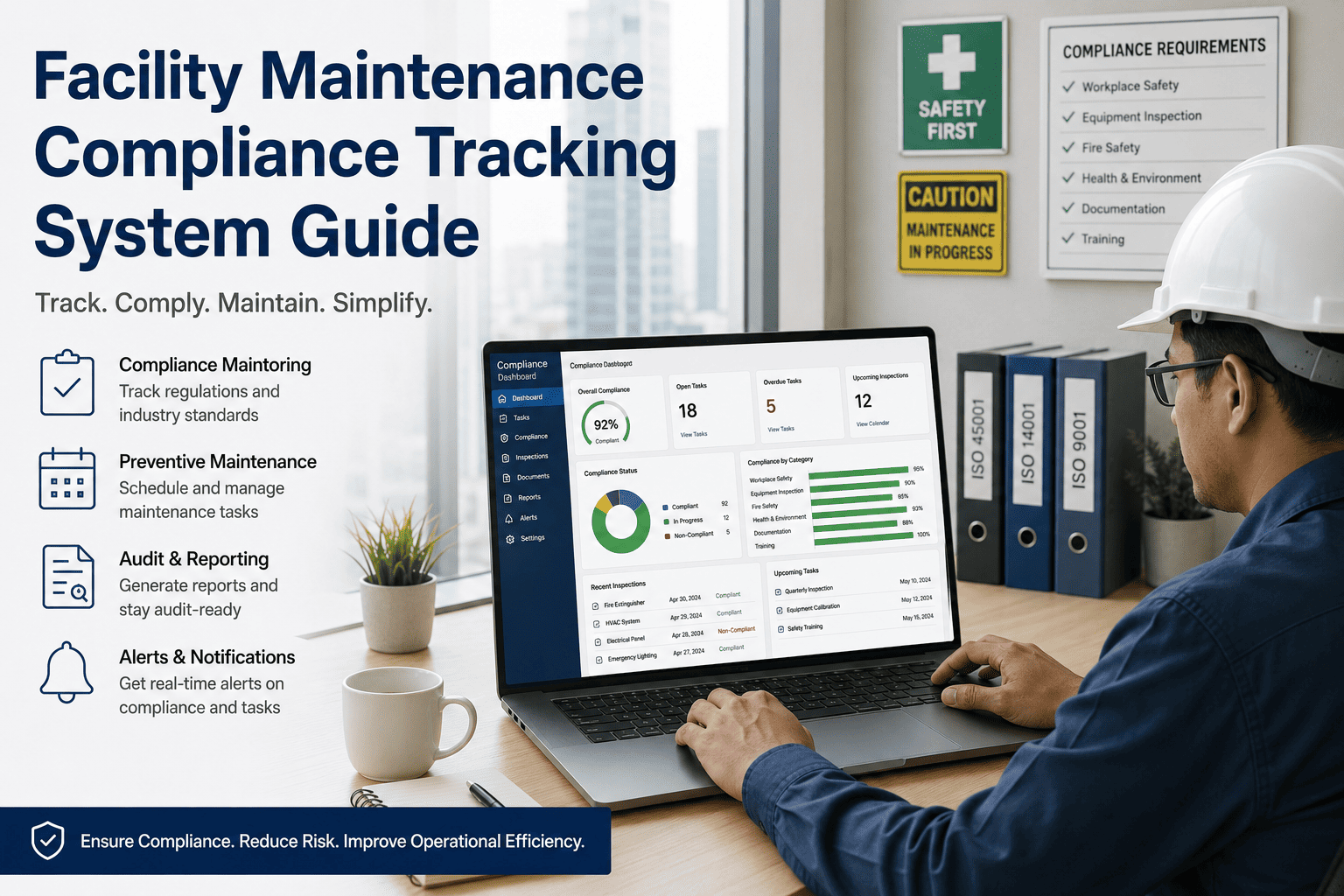
Facility compliance failure is rarely caused by ignorance of the rules — it is caused by the absence of a system that ensures the rules are followed, documented, and verifiable on demand. A building with 200 assets, 14 active regulatory obligations, 6 inspection frequencies, and a team of 12 technicians generates compliance obligations every single day. When those obligations are tracked in spreadsheets, shared drives, or the memory of a single experienced FM manager, the outcome is predictable: missed inspection windows, undocumented corrective actions, audit surprises, and legal exposure that no amount of reactive catch-up can fully resolve. A digital facility maintenance compliance tracking system eliminates this fragility by converting regulatory obligations into scheduled work, capturing evidence automatically as maintenance is performed, and generating audit-ready documentation without any additional administrative effort from the FM team. Facilities that transition from manual to digital compliance tracking reduce audit preparation time by an average of 74% and cut compliance-related incidents by 58% within 18 months. Start a free OxMaint trial to build your compliance tracking system today, or book a demo with our compliance specialists.
The Compliance Problem
Why Manual Compliance Tracking Fails Facility Teams
01
No Single Source of Truth
Compliance obligations spread across spreadsheets, email threads, binder systems, and individual knowledge create an impossible reconciliation problem at audit time. There is no way to confirm that every obligation has been met without manually assembling records from multiple disconnected sources.
02
Corrective Actions Left Open
Inspection findings generate corrective action requirements — and without a tracked workflow, corrective actions routinely fall through the cracks. An open corrective action at the time of a regulatory inspection is treated as an unresolved compliance failure, regardless of when the finding was made.
03
Evidence Not Captured at Point of Work
Technicians complete inspections but rarely document them with the specificity regulators require — no photographs, no measured readings, no technician signature, no timestamp. Evidence assembled after the fact is legally weak and often challenged in enforcement proceedings.
04
Inspection Frequency Drift
Monthly inspections slip to every six weeks, quarterly inspections become semi-annual, and annual inspections are performed 14 months apart. Frequency drift is invisible in a manual system until the audit exposes it. In a digital system, missed inspections are flagged automatically before they become violations.
System Architecture
Five Core Components of a Digital Compliance Tracking System
A compliance tracking system is not a single tool — it is a structured stack of five interconnected capabilities. Each one is necessary. Any gap in the stack creates a vulnerability in the compliance program.
1
Regulatory Obligation Register
A centralised register of every compliance obligation applicable to the facility — by regulation, asset, frequency, responsible person, and consequence of non-compliance. This is the master list that drives everything else in the system. Without it, compliance tracking is reactive by definition.
Foundation Layer
2
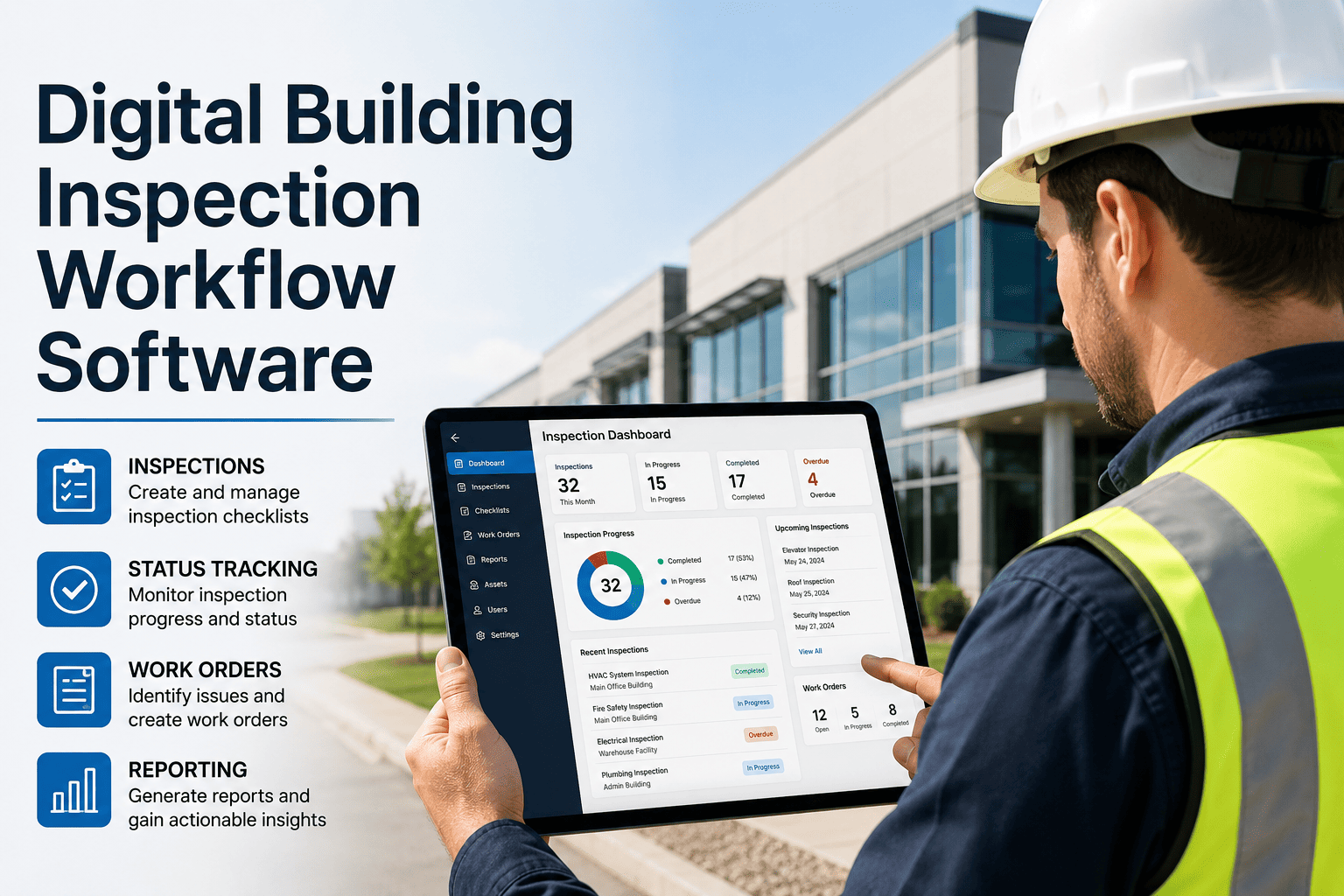
Automated Inspection Scheduling
Every obligation in the register is converted into a scheduled inspection task with the correct frequency, assigned technician, and mobile-ready checklist. The system generates work orders automatically and escalates overdue tasks before they breach compliance windows.
Schedule Engine
3
Evidence Capture at Point of Work
Technicians complete inspections on a mobile app — recording measured values, capturing photographs, adding technician signatures and timestamps. Evidence is attached to the work order in real time, not assembled retrospectively. Every compliance event produces its own documentation automatically.
Evidence Engine
4
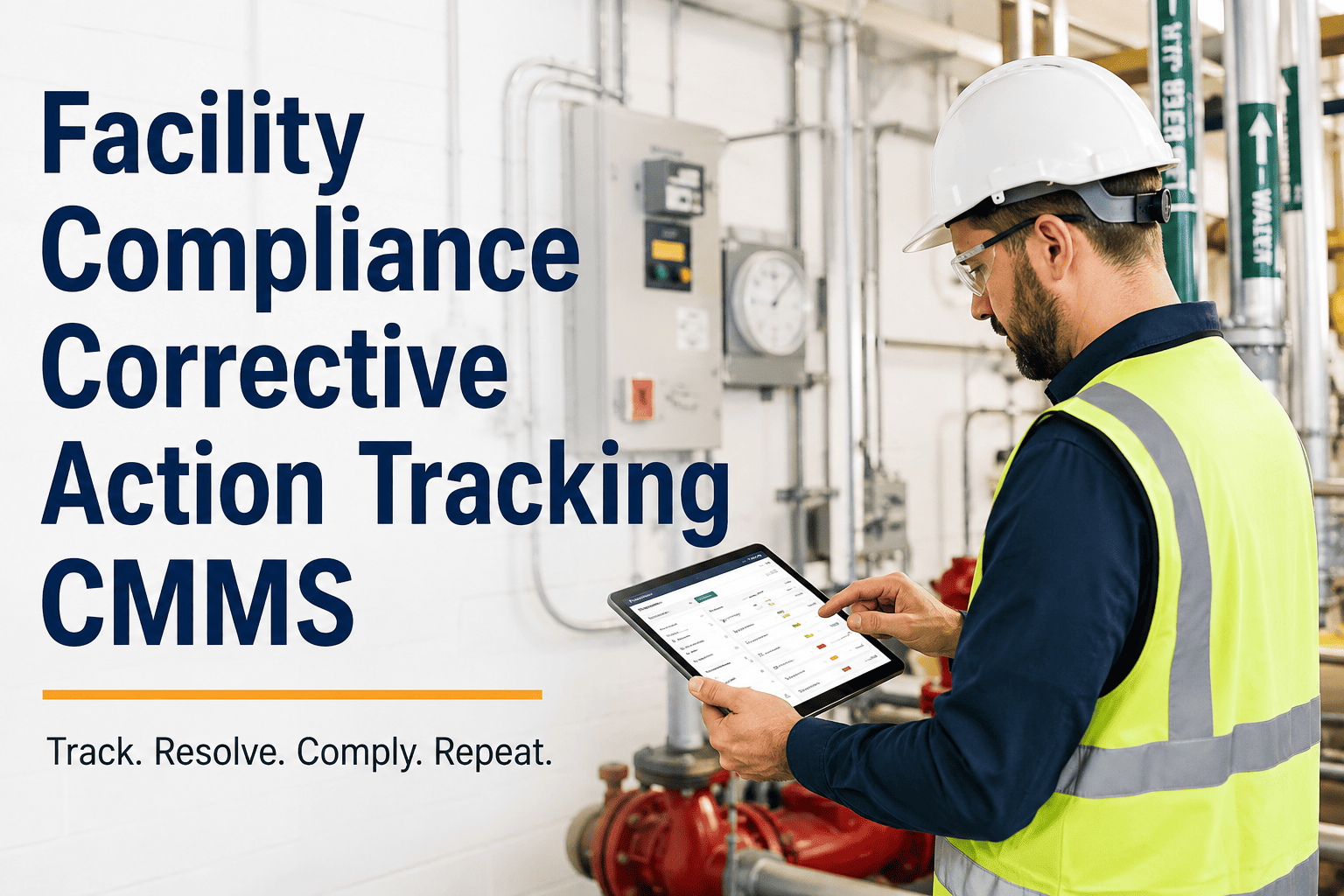
Corrective Action Workflow
Inspection findings automatically generate corrective action work orders with assigned owners, due dates, and priority levels. The system tracks every corrective action from finding to closure — with evidence of the remedy captured at completion. No finding can be lost in the workflow.
Action Tracker
5
Audit-Ready Report Generation
Compliance reports are generated on demand — covering inspection completion rates by regulation, open corrective actions by age, evidence records by asset, and compliance calendar adherence. Reports are formatted for regulator submission, internal audit, and board-level compliance dashboards.
Reporting Layer
Regulatory Coverage
Compliance Obligations by Facility Type — What Your System Must Cover
Different facility types carry materially different regulatory burdens. The matrix below maps the primary compliance obligations by facility category and the inspection evidence required for each. Your compliance tracking system must handle every row applicable to your portfolio.
Compliance Area
Regulation / Standard
Facility Types Affected
Inspection Frequency
Evidence Required
Fire Safety Systems
NFPA 25 / Local Fire Code
All commercial facilities
Monthly — Quarterly — Annual
Test results, flow readings, inspection forms
Electrical Safety
NFPA 70E / NETA MTS
All facilities with switchgear
Annual thermography + NETA cycle
IR images, test data, technician cert numbers
Lifting Equipment (LOLER)
LOLER / ASME B30
All with lifts, hoists, cranes
6-monthly thorough examination
Examination report, certificate, defect record
Pressure Systems
PSSR / ASME VIII
Boilers, pressure vessels, steam
Per written scheme — typically annual
Inspection certificate, operating limits, repairs
Water Hygiene / Legionella
ASHRAE 188 / HSG274 / L8
All with cooling towers / TMVs
Monthly — Quarterly Legionella test
Water test results, temperature logs, WMP records
Refrigerant Management
EPA 608 / F-Gas / AIM Act
All with HVAC / refrigeration
Annual minimum; quarterly for large systems
Leak test results, top-up log, repair records
Lockout / Tagout
OSHA 29 CFR 1910.147
All with energy-isolatable equipment
Annual program review + per-work verification
LOTO procedures, training records, audit log
Confined Space Entry
OSHA 29 CFR 1910.146
All with permit-required spaces
Per entry — permit-based
Entry permits, atmospheric test log, rescue plan
Healthcare Facilities
Joint Commission / CMS / NFPA 99
Hospitals, clinics, care homes
Per EC management plans — monthly to annual
EC rounds, interim life safety measures, EOC reports
Digital Audit Trail
What a Complete Digital Audit Trail Looks Like
The legal and regulatory value of a digital compliance system depends entirely on the integrity of its audit trail. A complete audit trail for any single compliance event must contain seven specific elements — all timestamped, all linked to the asset and the work order, and all immutable after completion.
01
Scheduled Obligation
Regulation cited, asset identified, due date set, assigned technician named — all captured before the work begins
02
Work Order Dispatched
Timestamp of dispatch, technician accepted confirmation, mobile app delivery record — proving the task was actively assigned
03
Inspection Completed
Checklist items completed, measured values recorded, pass/fail status per item — with GPS location and completion timestamp
04
Photographic Evidence
Timestamped photographs attached to the work order — date-stamped, GPS-tagged, and linked permanently to the asset record
05
Technician Signature
Digital signature captured on device — with technician name, certification number (where required), and signature timestamp
06
Findings and Corrective Actions
Any non-conformance recorded as a finding — automatically generating a corrective action work order with due date and assigned owner
07
Corrective Action Closed
Remedy documented, closure evidence attached, closure verified by supervisor — completing the loop from finding to resolution
Build a Compliance System Your Auditors Will Trust
OxMaint's Compliance Tracking module gives facility teams a complete digital audit trail — from scheduled obligation to closed corrective action — across every regulatory requirement in their portfolio. Stop preparing for audits. Start producing audit evidence automatically as part of normal maintenance operations.
Up from 52% with manual tracking — tracked workflow accountability
3 yrs
Audit-ready evidence history on demand
Every compliance event documented and retrievable instantly
Expert Review
What Compliance and Facilities Management Specialists Say
The shift from manual to digital compliance tracking is not a technology upgrade — it is a risk management decision. Every day a facility operates without a documented audit trail for its regulatory obligations is a day where the FM manager and the organisation are personally exposed. I have seen regulatory enforcement actions where the underlying work was done correctly but could not be proven because the records did not exist. A CMMS that generates documentation automatically changes that risk profile entirely.
AL
Andrew Lim
Facilities Compliance Director, Healthcare and Higher Education Estates
The corrective action tracking element is what separates a good compliance system from a basic inspection scheduling tool. Finding a problem and documenting it is easy. Ensuring it is assigned, tracked, escalated when overdue, and closed with evidence — that is the hard part, and it is the part that auditors look at most carefully. The facilities that pass regulatory inspections consistently are the ones with closed-loop corrective action workflows, not just completed inspection records.
SB
Sarah Blackwell
Senior FM Consultant, Regulatory Compliance and Safety Management
Frequently Asked Questions
Facility Compliance Tracking — Common Questions
From a regulatory enforcement perspective, digital records are generally treated as equivalent to paper records provided they are accurate, unaltered, and retrievable on demand. The advantage of a purpose-built digital audit trail is that it is inherently tamper-evident — each entry is timestamped and linked to a specific user, making fabrication or backdating detectable. Paper records can be assembled after the fact with no reliable indication of when they were created. For enforcement proceedings, a digital audit trail with GPS-tagged photos, technician signatures, and timestamp sequences is substantially more defensible than a paper binder assembled before an inspection. OxMaint's compliance records include immutable timestamps and user logs for every entry.
Start with a compliance gap assessment — a structured review of the facility against the regulations applicable to your building type, jurisdiction, and occupancy. The assessment should cover fire, electrical, mechanical, water, health and safety, environmental, and equipment-specific regulations. For most commercial facilities in the US, the primary framework comes from OSHA, NFPA, EPA, and local authority codes. For UK facilities, the HSE framework and associated Approved Codes of Practice define the primary obligations. OxMaint includes pre-built compliance obligation libraries for the most common facility types, which can be used as a starting framework and customised for your specific portfolio. Book a session to walk through the compliance library configuration for your facility type.
A regulatorily compliant corrective action workflow must capture four things for every finding: the finding description and date discovered, the assigned owner and due date for resolution, the remedy applied and the date it was completed, and evidence that the remedy was effective — typically a re-inspection or verification test result. Some regulations, including NFPA 25 for fire systems and EPA 608 for refrigerant, specify maximum timelines for corrective action completion that your system must track and escalate against. An open corrective action past its due date is treated by most regulatory bodies as an unresolved defect — regardless of when the underlying work was performed. OxMaint's corrective action module tracks every finding through to verified closure with automated escalation at configurable deadlines.
Yes — a well-designed CMMS allows each building in a portfolio to carry its own compliance obligation register, inspection schedule, and corrective action queue, while the portfolio layer provides aggregated compliance dashboards showing overdue items, completion rates, and open findings across every site. This is essential for property companies, estate managers, and FM contractors managing facilities across different sectors or jurisdictions, where each building may carry a materially different set of regulatory obligations. The key design requirement is that the system supports building-level obligation libraries while providing portfolio-level visibility — not a single global template forced onto every site. Book a walkthrough to see OxMaint's multi-site compliance configuration.
Build a Compliance System Your Auditors Will Trust


.jpeg)