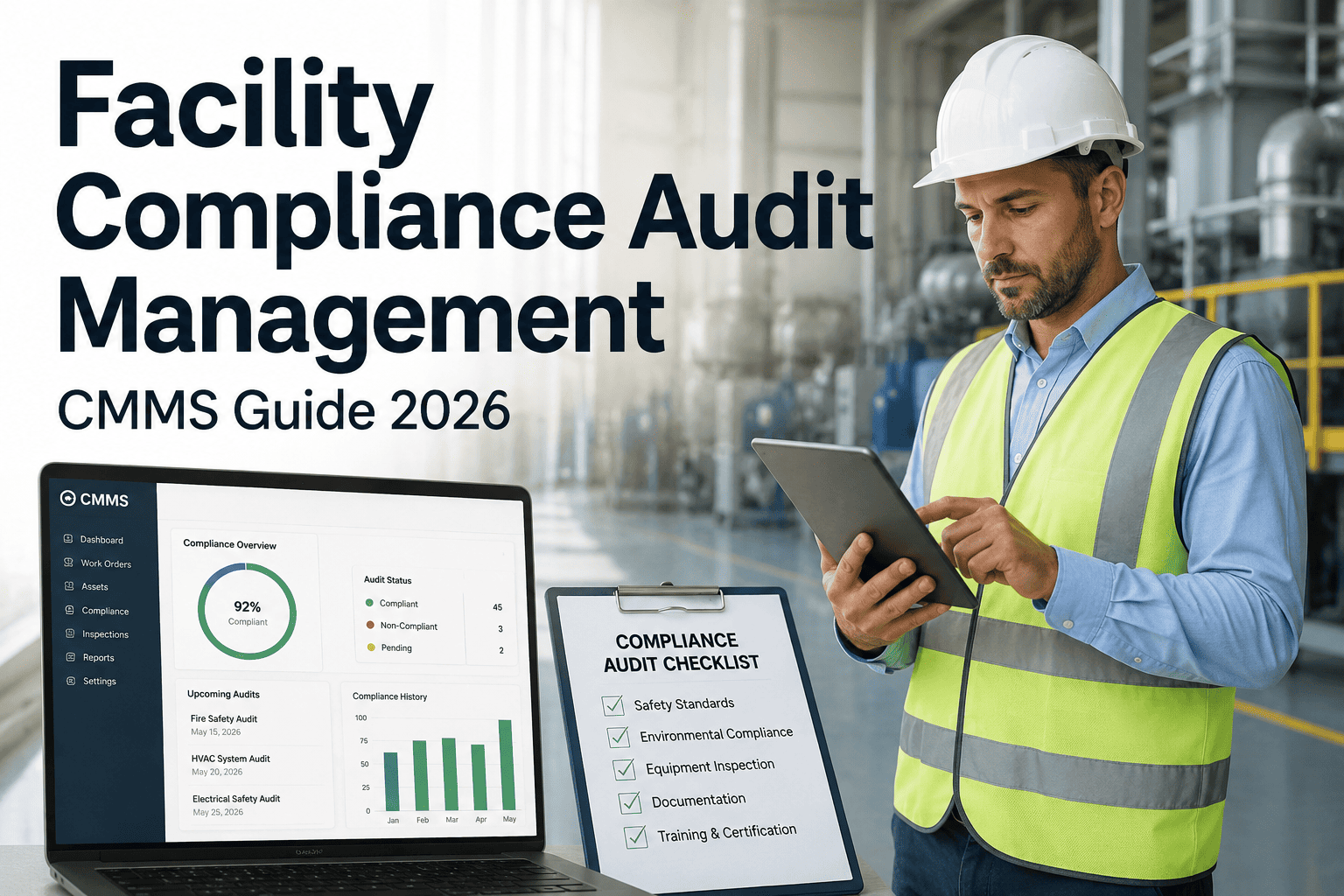
Facility managers entering 2026 are not facing new problems — they are facing old problems that have compounded into a structural crisis. 75% of facility managers cite budget constraints as their primary challenge, while 40% absorbed budget cuts between 2024 and 2025. The average industrial fixed asset is now 24 years old — the oldest average in nearly 70 years. Skilled technicians are retiring at a rate that training pipelines cannot replace. Compliance frameworks have evolved from project milestones into continuous operational requirements. And the tools most teams are using — spreadsheets, paper work orders, disconnected systems — were never built for this level of complexity. This guide covers the 10 biggest facility management challenges in 2026, what each one actually costs, and exactly how OxMaint's integrated CMMS platform eliminates them. If you want to skip the reading and see solutions in action, start your free OxMaint trial or book a live demo today.
75%
Of FM teams cite budget constraints as their primary challenge in 2025–2026
24 yrs
Average age of industrial fixed assets — oldest in nearly 70 years
30%
Skills gap emerging as experienced technicians retire faster than replacements arrive
81 min
Mean time to repair — up from 49 minutes, driven by skills gaps and supply chain delays
OxMaint Integrated CMMS Platform
Every FM Challenge Below Has a Proven Fix Inside OxMaint.
Asset lifecycle tracking, preventive maintenance scheduling, compliance documentation, CapEx forecasting, and portfolio reporting — all connected in one platform. Deploy in days, not months.
The 10 Biggest Facility Management Challenges in 2026
These are not abstract industry trends. Each challenge below is a measurable operational and financial problem with a direct cost, a root cause, and a concrete fix. Read them in order or jump to the ones hurting your team most right now.
Years of budget cuts have built a maintenance debt that compounds annually. Rooftop HVAC units past service life, electrical panels with outdated components, elevators with overdue inspections — these are active liabilities, not hypothetical risks. The average industrial asset is now 24 years old. Every month of deferral increases failure probability and repair cost.
How OxMaint Fixes It
Full asset registry with condition scores, failure probability ranking, and regulatory deadlines. Teams work from a prioritized backlog driven by data — not guesswork. Rolling 5–10 year CapEx forecasts show exactly when replacement is more economical than repair.
$271B
Estimated annual deferred maintenance cost across US commercial buildings
40% of the maintenance workforce is set to retire by 2030. Experienced HVAC technicians, electricians, and building engineers are leaving faster than replacements arrive. Conservative estimates project a 30% skills gap in the near term. Mean time to repair has already risen from 49 to 81 minutes as a direct consequence.
How OxMaint Fixes It
Mobile work orders with embedded step-by-step checklists, photo documentation, and built-in knowledge bases. A second-year technician performs at the level of a ten-year veteran when the system guides every task. Institutional knowledge is captured in the platform — not lost when the expert retires.
40%
Of maintenance workforce retiring by 2030 — knowledge gap follows immediately
40% of FM teams experienced budget reductions between 2024 and 2025. In 2026, the focus has shifted from how much is spent to how intelligently it is allocated. FM teams are now expected to justify every maintenance dollar with measurable outcomes — cost avoidance, asset life extension, risk reduction. Teams without data cannot make this case.
How OxMaint Fixes It
Automated maintenance cost tracking per asset, portfolio-level reporting, and investor-grade CapEx forecasting. Present data-backed budget justifications to leadership — not estimates based on asset age alone. Every dollar spent is linked to a specific asset record and outcome.
45%
Of maintenance leaders cite lack of resources as their primary obstacle in 2026
The Fire Safety Act, Building Safety Act, OSHA, EPA, ADA, and industry-specific standards are all active compliance obligations simultaneously. For multi-site portfolios, overlapping jurisdictions create documentation requirements that manual systems cannot reliably satisfy. Enforcement has moved from transition to embedded accountability — non-compliance is now immediately penalizable.
How OxMaint Fixes It
Audit-ready documentation generated automatically from daily operations. Digital inspection checklists with timestamped, person-attributed records. Compliance status visible across every property in the portfolio from a single dashboard. Retrieve any record in under 60 seconds — not hours of manual assembly.
3.4x
More regulatory citations issued to facilities without documented inspection and corrective action trails
The average facility experiences 25 unplanned downtime incidents per month — adding up to 326 hours of lost production per year. Emergency repairs cost 4.8x more than planned maintenance. Best-in-class facilities maintain below 20% reactive work. Most facilities start above 60%. Every unplanned breakdown is evidence that preventive maintenance is not working.
How OxMaint Fixes It
Preventive maintenance scheduling tied to asset records — triggered by calendar, usage cycles, or sensor data. PM completion rates tracked automatically. When compliance dips, the system flags it before breakdowns occur. Reactive-to-planned ratio visible on the live dashboard at all times.
4.8x
Cost of emergency repairs vs. planned maintenance — the reactive premium every FM team absorbs
37% of FM teams have asset registers that are less than 50% accurate. 6% have no asset register at all. Without accurate condition data, every maintenance decision is a guess — and CapEx decisions are based on asset age rather than actual condition. Teams routinely over-invest in assets they should replace and under-invest in assets approaching critical failure.
How OxMaint Fixes It
Full asset registry with condition scoring, maintenance history, and remaining useful life estimates. Asset hierarchy from Portfolio down to Component. Condition-based replacement decisions replace age-based guesswork. Every repair and inspection links to the specific asset record automatically.
37%
Of FM teams have asset registers less than 50% accurate — CapEx decisions built on bad data
Building performance standards in major cities now mandate measurable emissions reductions with escalating fines for non-compliance. At the same time, energy costs remain volatile and ESG reporting requirements from enterprise clients and investors are becoming mandatory. Facility managers must reduce consumption, prove compliance, and maintain occupant comfort simultaneously.
How OxMaint Fixes It
Track every energy-related asset — chillers, boilers, lighting systems, BMS integrations — and link maintenance activity directly to performance outcomes. When a chiller's efficiency drops because a PM was missed, the platform flags it immediately. Maintenance actions tied to energy performance reporting.
8%
Chiller efficiency loss from a single missed condenser coil PM — compounded across the portfolio
Most FM teams still rely on spreadsheets, paper work orders, email threads, and disconnected tools that cannot share data. 20% of facility managers cite system integration as their primary barrier to digital adoption. Without centralized data, portfolio-level reporting is impossible, AI initiatives have no reliable foundation, and leadership cannot get the visibility they need to make capital decisions.
How OxMaint Fixes It
Single platform connecting asset registry, preventive maintenance, work order management, compliance documentation, and CapEx forecasting. IoT and SCADA integration for real-time data. Portfolio-level dashboards give leadership visibility across every property from one login.
20%
Of FMs cite system integration as their primary barrier to digital adoption in 2026
Leadership expects clearer visibility into asset performance, utilization, and operating costs — and reporting expectations from finance and the C-suite continue to increase. FM teams that cannot demonstrate data-backed CapEx justifications lose budget to departments that can. Without asset condition data, capital planning is based on age estimates and historical spend patterns that routinely produce the wrong decisions.
How OxMaint Fixes It
Rolling 5–10 year CapEx forecasting models built from actual asset condition data — not age-based guesses. Investor-grade portfolio reporting that stands up to ownership group and finance committee scrutiny. Every replacement recommendation is backed by condition score, maintenance cost trend, and failure probability.
5–10yr
Rolling CapEx forecast horizon OxMaint generates from actual asset condition data
Two-thirds of maintenance teams say they will adopt AI by end of 2026 — but adoption is stalling at many facilities due to cost, skills gaps, and resistance from experienced staff who have built effective processes around legacy systems. The platforms that fail are the ones that require IT projects, heavy implementation, and months of training. The ones that succeed deploy in days and fit existing workflows.
How OxMaint Fixes It
No heavy implementation fees. No long onboarding. Mobile-first design that field teams learn in hours, not weeks. Cloud-based deployment with no server infrastructure required. Most facility teams are operational within one to two weeks — full platform, all properties, all users.
67%
Of maintenance teams plan AI adoption by end of 2026 — but most are stalling on implementation
Before vs. After: Manual FM Operations vs. OxMaint
The gap between where most facilities are today and where OxMaint takes them is measurable in hours saved, costs avoided, and risks eliminated. Here is what the shift looks like across the functions that matter most.
OxMaint solves all 10 challenges in a single integrated platform
Asset lifecycle tracking, preventive maintenance, work order management, compliance documentation, and CapEx forecasting — connected, cloud-based, and mobile-first. No heavy implementation. No IT project.
ROI of Fixing These Challenges with OxMaint
25–40%
Maintenance Cost Reduction
Shifting from reactive to preventive maintenance delivers 25–40% lower total maintenance spend. Every emergency job avoided is a 4.8x cost premium eliminated from the budget.
45%
Less Unplanned Downtime
Preventive scheduling and condition-based maintenance reduce unplanned downtime by up to 45% — eliminating the 326 hours of annual downtime the average facility currently absorbs.
11%
Asset Lifespan Extension
Consistent OEM-aligned maintenance schedules extend asset useful life by up to 11% — deferring replacement costs and maximizing return on existing capital investment.
1–2 wks
Deployment Timeline
Most facility teams are fully operational on OxMaint within one to two weeks. Asset import, PM configuration, and team onboarding happen in parallel — no IT project, no long implementation.
Frequently Asked Questions
What is the single biggest facility management challenge in 2026?
According to the SFG20 State of Facilities Management Report 2025, budget constraints are the number-one challenge — cited by 75% of FM teams. But budget pressure does not exist in isolation: it intensifies every other challenge on this list. Aging assets require capital that budgets cannot support. Skills gaps require investment in training that tightening budgets cut first. Compliance requires documentation infrastructure that under-resourced teams struggle to maintain. The solution is not more budget — it is spending what you have more intelligently, which requires accurate asset data, predictive maintenance, and real-time portfolio visibility. Sign up for OxMaint free or book a demo to see how the platform stretches limited FM budgets further.
How does a CMMS actually solve the FM skills gap?
The skills gap manifests operationally as longer mean time to repair (now 81 minutes, up from 49), more missed PM intervals, and institutional knowledge walking out the door with retiring technicians. A CMMS like OxMaint addresses all three vectors simultaneously. Mobile work orders with embedded step-by-step instructions allow junior technicians to perform complex tasks that previously required senior expertise. Built-in knowledge bases capture the procedures, notes, and troubleshooting logic that experienced staff carry in their heads — making that knowledge accessible to every team member. And PM schedules that auto-trigger and auto-assign ensure that even a lean team misses nothing. The result is more output from fewer people, with consistent quality regardless of individual experience level. Book a demo to see OxMaint's mobile technician experience in action, or start free today.
How quickly can a facility team deploy OxMaint and see results?
Most facility teams are fully operational on OxMaint within one to two weeks. Asset data import, PM schedule configuration, and user onboarding happen in parallel — not sequentially. Because OxMaint is cloud-based and mobile-first, there is no server infrastructure to install, no IT department project, and no hardware procurement required. Your team accesses everything through web browsers and mobile apps on day one. Results are typically visible within the first month: PM completion rates improve immediately when work orders auto-generate and auto-assign. Reactive-to-planned ratio begins shifting within 60–90 days as the PM schedule builds its rhythm. Compliance documentation is audit-ready from the moment your first digital inspection is completed. Start your free trial today or book a demo to walk through a deployment plan for your specific facility size and type.
Can OxMaint handle multi-site facility portfolios, and how does it address compliance across jurisdictions?
OxMaint is built as a multi-site platform from the ground up — meaning a single deployment covers your entire facility portfolio from one dashboard, with site-specific configuration at each location. For compliance, each site can have its own inspection checklists, regulatory documentation templates, and audit schedules aligned to its specific jurisdiction — OSHA in the USA, Building Safety Act and Fire Safety Act requirements in the UK, emissions standards in the UAE, and industrial safety regulations in Germany. The underlying asset hierarchy (Portfolio > Property > System > Asset > Component) means records are always traceable to the correct property and regulatory framework. Corporate operations gets portfolio-wide compliance status in real time. Regulators and auditors get precise, timestamped records retrievable in under 60 seconds. Book a demo to see multi-site configuration and cross-property compliance dashboards running live, or sign up free to start building your property hierarchy today.
OxMaint Integrated FM Platform
Every Challenge on This Page Has a Fix Inside OxMaint. Start Solving Them Today.
Asset lifecycle tracking, preventive maintenance scheduling, compliance documentation, CapEx forecasting, and portfolio reporting — all connected in one platform built for the facility management challenges that define 2026.
25–40%
Maintenance Cost Reduction
45%
Less Downtime
11%
Longer Asset Life
1–2 wks
To Deploy