Commercial buildings are losing experienced HVAC, electrical, and controls technicians faster than the labor market can replace them. Many facility teams now compete for the same small pool of qualified candidates and still end up with open positions for months. A registered apprenticeship is one of the few approaches that builds skilled people instead of bidding for them. It pairs paid on-the-job learning with structured classroom instruction under a nationally recognized standard. See how a maintenance system supports it.
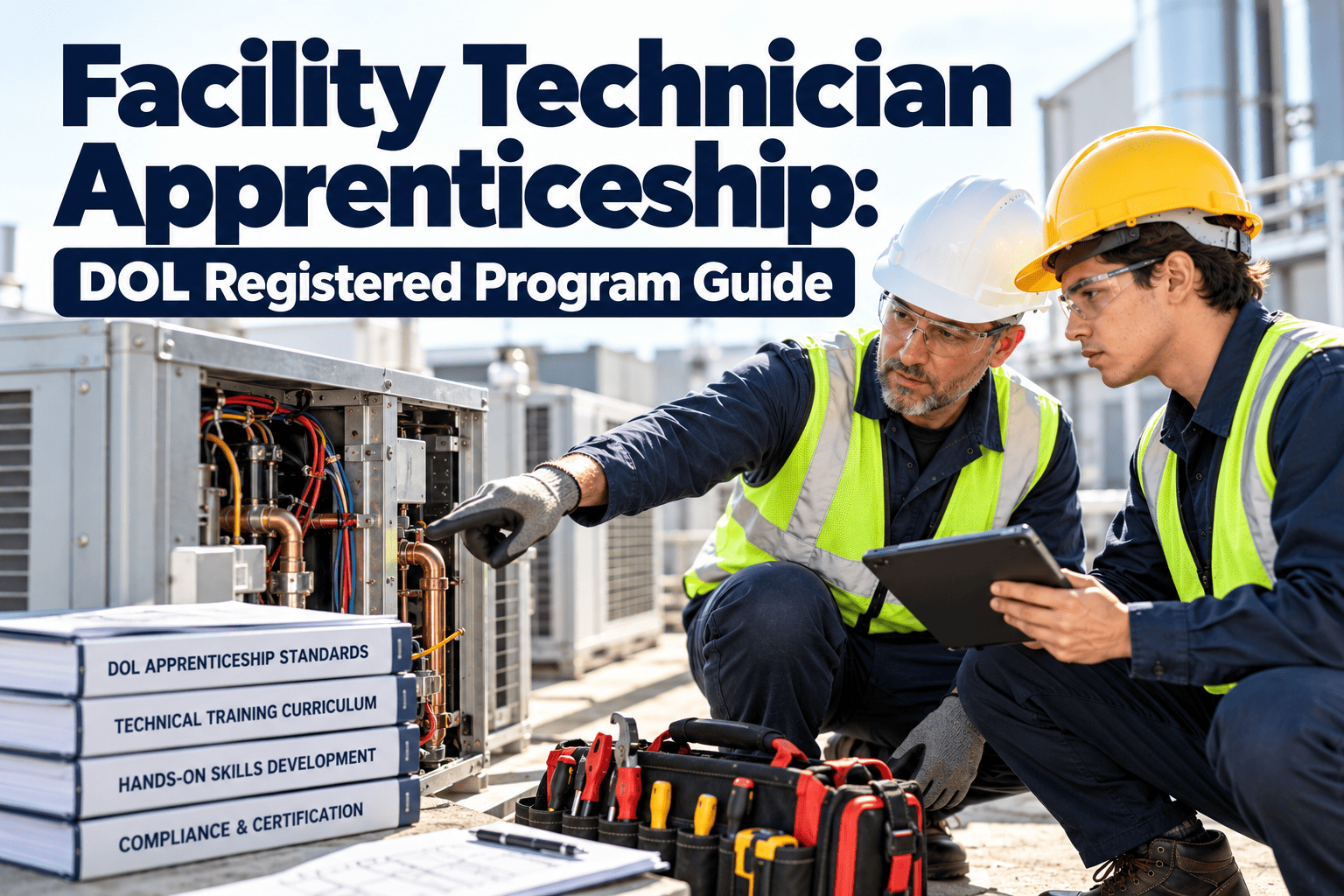
Facility Technician Apprenticeship: A Practical Guide to DOL Registered Programs
Build your own commercial HVAC and facility technicians through an earn-while-you-learn model, and track every competency inside the same system that runs your work orders.
The Hiring Problem Facility Teams Keep Repeating
Buying Skills on the Open Market
- Postings stay open for months while PM tasks slip.
- Experienced hires expect premium pay and leave for better offers.
- New hires arrive with habits that do not match your equipment or standards.
- Knowledge stays with individuals instead of with the team.
Building Skills Through Apprenticeship
- You recruit for aptitude and attitude, then train to your own buildings.
- Wages rise in steps as skills are proven, which supports retention.
- Training follows a written standard instead of informal shadowing.
- Every task completed becomes a documented record.
The Aging Workforce Gap
Many senior building technicians are approaching retirement. When they leave, the knowledge of how a chiller plant behaves in August leaves with them. Apprenticeship gives that knowledge a structured path to the next generation before it is lost.
What a DOL Registered Apprenticeship Actually Is
- A program registered with the U.S. Department of Labor or a State Apprenticeship Agency, listed through Apprenticeship.gov.
- Paid employment from day one, with progressive wage increases.
- Structured on-the-job learning supervised by a qualified mentor.
- Related technical instruction delivered in a classroom, online, or through a training partner.
- A nationally recognized credential on completion.
Time-Based, Competency-Based, or Hybrid
Progress is measured in hours worked. Common benchmarks are around 2,000 hours of on-the-job learning per year, though your sponsor sets the final standard.
Progress is measured by demonstrated skills. Faster learners can advance sooner once a mentor signs off.
Combines minimum hour ranges with competency checkpoints. Many facility employers prefer this for its balance of structure and flexibility.
How Learning Time Is Split Across the Program
Your sponsor and instruction provider set the exact hours, so treat these splits as a planning guide and confirm them against your registered standards.
Skills Typically Covered in Facility Tracks
- Commercial HVAC fundamentals, refrigeration cycles, and airflow.
- Building automation basics and sequence of operations.
- Electrical safety, lockout and tagout, and arc flash awareness.
- Plumbing, boilers, and hydronic systems.
- Preventive maintenance routines and inspection techniques.
- Documentation, work order discipline, and customer communication.
A Year-by-Year Progression for a Facility Apprentice
Train Technicians the Way Your Buildings Actually Run
Use work orders, asset records, and inspection history as the training ground for every apprentice.
What Federal and State Rules Require Before You Register
Programs must meet the apprenticeship standards in 29 CFR 29.5, and each state can add its own rules. Read both before you write your plan.
Core Elements Every Registered Program Includes
- A written apprenticeship agreement between the apprentice and the sponsor.
- Supervised on-the-job learning, with at least 2,000 hours for a time-based term. Competency-based and hybrid models must still include on-the-job learning and proven competency.
- Organized related technical instruction, commonly set at 144 hours for each year. Maryland and Minnesota, for example, write that figure in as a minimum.
- A progressive wage schedule, often expressed as a percentage of the journeyworker rate.
- Qualified on-the-job supervision, with an apprentice-to-journeyworker ratio set by the state or the program.
- Progress records, including a transcript of related instruction and on-the-job learning.
State Add-Ons to Check
Some states add requirements on top of the federal baseline. Minnesota, for instance, requires at least 50 hours of related safety instruction over the term. Confirm the rules with your state apprenticeship agency before you finalize hours.
Choosing a Sponsor Model
You register and run your own program. Best for larger portfolios with several journeyworkers able to mentor.
Several employers share one program and one instruction provider, which spreads the administrative load.
An association, college, or training body holds the registration and handles reporting while you supply the work site.
Where Facility Apprentices Come From and How to Screen Them
Strong Talent Sources
- Recognized pre-apprenticeship programs that teach job-readiness and basic technical skills and link to a registered sponsor.
- High school and career technical education programs.
- Current custodial, grounds, and security staff who want a trade career.
- Military veterans with mechanical or electrical experience.
What to Screen For
- Reliability and willingness to work in mechanical rooms and on rooftops.
- Basic math and the ability to read a gauge or schematic.
- Curiosity about how systems work.
- Comfort with a mobile device for logging work.
Skills can be taught. Attendance, honesty, and the habit of asking questions are much harder to add later.
Understanding Apprenticeship Costs Without Guessing
Costs vary by region, trade, and sponsor model, so build your own estimate from real line items rather than a generic number.
| Cost Area | What It Includes | Ways Employers Offset It |
|---|---|---|
| Apprentice wages | Starting wage plus scheduled step increases | Productive work from apprentices offsets part of the cost |
| Related instruction | Tuition, materials, and paid or unpaid class time | State grants, workforce boards, and community college partnerships |
| Mentor time | Supervision hours taken from journeyworkers | Plan mentor capacity into scheduling |
| Tools and PPE | Hand tools, meters, and safety equipment | Shared tool crib or tool allowance |
| Administration | Registration, reporting, and record keeping | Intermediary sponsors or group programs |
Ask your state apprenticeship agency which incentives apply to your trade, since availability and amounts change from year to year.
Funding Sources Worth Checking
- State apprenticeship grants and tax credits, which differ by state.
- Workforce Innovation and Opportunity Act funding through local workforce boards.
- Veterans education benefits for eligible apprentices.
- Industry associations and union training funds.
The Mentor Is the Program
What Strong Mentors Do
- Explain why a step matters, not only how to do it.
- Let the apprentice attempt tasks before stepping in.
- Sign off competencies honestly and on time.
- Model documentation habits.
What Weak Programs Do
- Use apprentices as extra hands without teaching.
- Assign mentors with no scheduled time to coach.
- Skip sign-offs until the end of the year.
- Leave progress records on paper in a drawer.
Protecting Mentor Capacity
A mentor who is also the most overloaded technician cannot teach well. Schedule coaching blocks into the weekly plan so apprentice training is treated as real work, not an extra.
Mentor Ratios and Scheduling
- Many states set a ratio of apprentices to journeyworkers, so confirm yours before planning cohort size.
- Pair each apprentice with one lead mentor and one backup so training continues during leave.
- Block coaching time on the weekly schedule and protect it from emergency reassignment where possible.
Turning Daily Maintenance Into Documented Training
Capabilities That Support an Apprenticeship Program
- Preventive maintenance templates that give apprentices repeatable, standardized tasks.
- Asset records with equipment history so learners see how real assets have failed before.
- Mobile work orders for photos, notes, and checklists captured at the equipment.
- Scheduling that pairs apprentices with mentors and avoids overloading either.
- Reporting on completed tasks by technician, which supports competency evidence.
Oxmaint does not replace your sponsor's official records, but it gives you a clean, timestamped trail of the work each apprentice has performed.
What to Track to Know the Program Is Working
Set your own baselines before launching. Published national figures are useful context, but your own cohort data is what proves the return.
Steps to Start a Registered Program
- Visit Apprenticeship.gov and contact your state apprenticeship office or an intermediary sponsor.
- Choose an occupation framework such as commercial HVAC or facility maintenance technician.
- Write the work process schedule that lists skills and target hours.
- Select a related instruction provider, such as a community college or training partner.
- Name and train mentors, and block their coaching time.
- Set wage steps tied to competency milestones.
- Recruit from schools, veterans groups, and current employees seeking a career path.
- Configure your maintenance system to record apprentice work and mentor sign-offs.
What Evidence Looks Like at Each Stage
| Skill Area | Year 1 Evidence | Year 2 Evidence | Year 3 Evidence |
|---|---|---|---|
| HVAC service | Filter, belt, and coil PM tasks completed with photos | Fault diagnosis on rooftop units and VAV boxes | Compressor, motor, and economizer repairs signed off |
| Electrical safety | Lockout and tagout walkthrough with a mentor | Supervised de-energizing and verification | Leads isolation for routine jobs |
| Controls | Reads trend screens and setpoints | Checks sensors and actuators | Adjusts sequences under review |
| Hydronics and plumbing | Valve identification and basic leak response | Pump and strainer service | Boiler and chiller plant rounds |
| Documentation | Completes checklists accurately | Writes clear failure notes | Reviews work orders for newer apprentices |
Review the map with each apprentice every quarter so gaps are visible early and training can be adjusted.
Wage Steps Tied to Proof
Why Facility Apprenticeships Stall and How to Prevent It
| Problem | Typical Cause | Practical Fix |
|---|---|---|
| Apprentices stuck on filter changes | No rotation plan across systems | Schedule task rotation by quarter |
| Mentor burnout | Coaching added on top of a full workload | Reduce the mentor's own task load during coaching blocks |
| Missing hours | Time and tasks logged inconsistently | Log work through work orders, reviewed weekly |
| Early dropouts | Unclear path and pay progression | Share the wage schedule and milestones on day one |
| Classroom gap | Instruction disconnected from daily work | Match lessons to the equipment apprentices touch that month |
Keeping Apprentices Safe and Records Audit-Ready
- Attach lockout and tagout steps to every task that involves stored energy.
- Require a mentor verification step before an apprentice works on live electrical or pressurized equipment.
- Store training sign-offs, inspection results, and corrective actions against the asset they relate to.
- Keep records long enough to satisfy your sponsor, state agency, and insurer.
- Review incidents and near-misses with the whole cohort, not only the person involved.
First 120 Days After You Register
Facility Apprenticeship Questions
Most commercial HVAC and facility programs run about three to five years depending on the sponsor's standard. Competency-based models may finish sooner.
Yes. Group or intermediary sponsors handle paperwork and instruction for smaller employers. Book a demo to see how training work can be tracked.
Yes. They are paid employees, with wages that rise as skills are demonstrated and hours are completed.
Record completed work orders, checklists, and mentor sign-offs in a CMMS. Sign up to set up technician-level reporting.
Rates differ widely by program and employer, so track your own cohorts from the first intake and review them yearly.
Give Every Apprentice a Clear Path and Every Mentor a Clear Record
Run work orders, inspections, and training evidence from one maintenance platform built for facility teams.