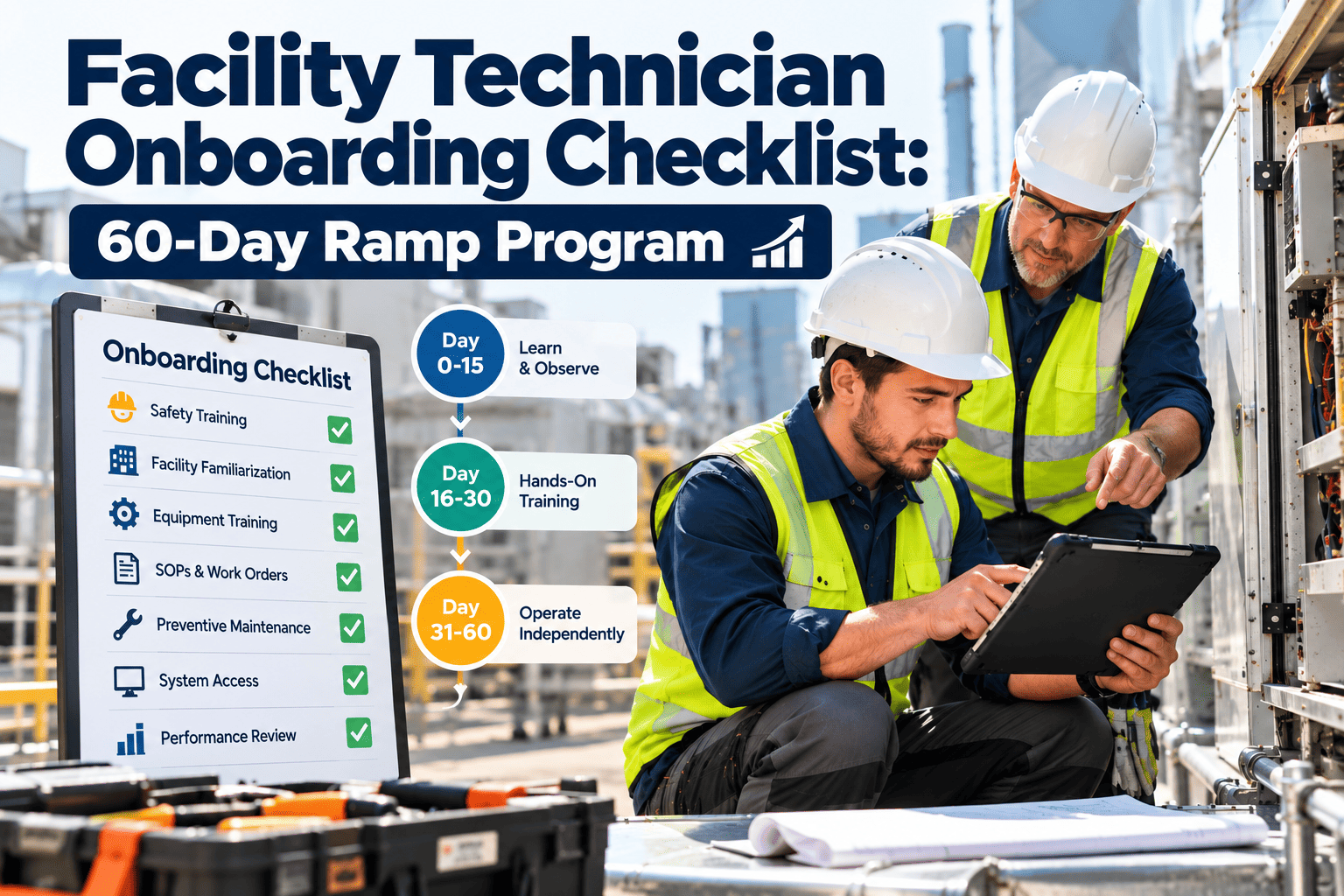
A new facility technician can walk onto a site with solid trade skills and still struggle for months, because every building has its own equipment, lockout points, vendors, and unwritten rules. With skilled labor hard to hire and harder to keep, a loose "shadow someone for a week" start costs more than it seems: slower work orders, repeat callbacks, and early resignations. This 60-day checklist gives managers and mentors a structured path from Day 1 to independent work orders, and shows how mobile work orders and inspections in Oxmaint can support training and sign-offs.
Facility Technician Onboarding Checklist: 60-Day Ramp Program
Five stages, clear sign-offs, and a mentor at every step, so new HVAC, electrical, and general facility technicians reach independent work orders safely.
Why a Structured Ramp Beats Informal Onboarding
Good onboarding practice, such as that promoted by SHRM, stresses preparation before day one, clear role expectations, manager involvement, and regular check-ins. For technical roles, add safety sign-offs and equipment-specific training.
Informal Start
- Tools and access arrive late
- Training depends on who is free
- Safety topics are covered unevenly
- No clear point when the person works alone
Structured 60-Day Ramp
- Everything ready before the first shift
- A named mentor and weekly goals
- Safety and competency sign-offs recorded
- A defined gate to independent work
Stage 1: Before Day 1 (Preboarding)
- Send a welcome message and first-day plan. Include start time, parking, dress code, who to ask for, and the day's agenda. Done when the hire confirms receipt. Owner: Manager
- Complete paperwork in advance. Tax, payroll, emergency contact, and policy acknowledgements. Done when nothing needs signing on Day 1. Owner: HR
- Order uniform, PPE, and tools. Safety boots, gloves, eye protection, hearing protection, and a starter tool set. Done when everything is on site and sized. Owner: Supervisor
- Request system access. CMMS account, email, building access card, and keys. Done when logins work on a test device. Owner: IT
- Assign a mentor. Choose an experienced technician with time and patience, and adjust their workload. Done when the mentor accepts in writing. Owner: Manager
- Prepare the 60-day plan. Print this checklist with dates and check-in meetings. Done when the plan is in the hire's folder. Owner: Manager
Stage 2: Day 1 and Week 1 (Orient and Shadow)
- Welcome and introductions. Meet the team, building staff, and key contacts. Done when the hire can name their reporting line. Owner: Manager
- Site tour. Cover mechanical rooms, electrical rooms, roof access, shutoffs, fire panels, and tenant areas. Done when the hire can find the main shutoffs unassisted. Owner: Mentor
- Safety orientation. Cover hazards, incident reporting, emergency procedures, and stop-work authority. Done when the hire signs an acknowledgement. Owner: Safety lead
- Lockout and tagout introduction. Review the site's energy control procedures consistent with OSHA 1910.147. Done when the hire can explain each step. Owner: Safety lead
- Credential check. Verify required licences, such as EPA Section 608 for refrigerant work, before assigning related tasks. Done when copies are on file. Owner: HR
- CMMS walkthrough. Show how to view assigned work orders, add notes, log time and parts, and attach photos. Done when the hire closes a practice work order. Owner: Mentor
- Shadow routine rounds. Ride along on daily inspections and PM tasks. Done when the hire summarises three assets and their checks. Owner: Mentor
- Day 5 check-in. Ask what was clear, what was confusing, and what tools are missing. Done when actions are logged. Owner: Manager
Competency Levels Used Throughout the Program
| Level | Meaning | Supervision |
|---|---|---|
| 0 Not started | Not yet introduced to the task | Not allowed to perform |
| 1 Observed | Has watched the task done correctly | Mentor performs |
| 2 Assisted | Performs with the mentor present | Direct supervision |
| 3 Independent | Performs correctly and safely alone | Spot checks only |
| 4 Can teach | Can explain and coach others | None |
Give New Technicians a Clear Digital Starting Point
Oxmaint puts work orders, inspections, asset history, and checklists in one mobile workflow that new hires can follow from the first shift.
Stage 3: Weeks 2 and 3 (Assisted Tasks)
- Learn the top ten equipment types. Cover air handlers, rooftop units, boilers, chillers, pumps, panels, lighting, plumbing fixtures, doors, and fire systems. Done when the hire explains basic operation of each. Owner: Mentor
- Perform assisted preventive maintenance. Filters, belts, lubrication, and inspections with the mentor present. Done when five PMs are completed at level 2. Owner: Mentor
- Practise lockout and tagout under supervision. Apply and remove locks on real equipment. Done when the supervisor signs a demonstration. Owner: Safety lead
- Complete electrical safety training. Cover NFPA 70E concepts and the limits of unqualified work. Done when the course record is filed. Owner: Safety lead
- Learn work order standards. Write clear problem, cause, and fix notes and record time and parts. Done when three work orders pass review. Owner: Supervisor
- Meet vendors and contractors. Understand who services which systems and how access is arranged. Done when the hire holds a contact list. Owner: Manager
- Day 14 check-in. Review progress, confidence, and any safety concern. Done when notes are saved. Owner: Manager
Stage 4: Weeks 4 and 5 (Own Routine Work)
- Take a defined route of routine work. Assign a set of low-risk PMs and rounds. Done when the hire completes the route two weeks in a row. Owner: Supervisor
- Troubleshoot with a method. Practise symptom, check, isolate, and fix with the mentor questioning but not leading. Done when two faults are resolved. Owner: Mentor
- Respond to tenant requests. Practise communication, expectations, and safe entry rules. Done when feedback from a tenant contact is positive. Owner: Supervisor
- Participate in an after-hours or on-call briefing. Understand the escalation path before any on-call duty. Done when the hire explains it back. Owner: Manager
- Handle parts and inventory. Request, issue, and return parts correctly. Done when stock records match physical counts. Owner: Storeroom lead
- Learn site-specific hazards. Include roof edges, confined spaces, chemicals, and high-voltage areas. Done when a documented walkthrough is complete. Owner: Safety lead
- Day 30 review. Hold a formal conversation about skills, goals, and fit. Done when both sides sign the review. Owner: Manager
Stage 5: Weeks 6 to 8 (Independent Sign-Off)
- Complete work orders independently. Select a set of corrective tasks suited to the hire's trade. Done when at least ten pass supervisor review. Owner: Supervisor
- Demonstrate lockout and tagout alone. Perform a full procedure while observed. Done when the observer signs without corrections. Owner: Safety lead
- Complete a practical assessment. Cover diagnosis, repair, and documentation on a real or staged fault. Done when scored at level 3 or higher. Owner: Mentor
- Review quality and callbacks. Check repeat visits and rework. Done when no unresolved quality issues remain. Owner: Supervisor
- Collect hire feedback. Ask about training clarity, mentor support, tools, and workload. Done when feedback is recorded for program improvement. Owner: HR
- Day 60 sign-off meeting. Agree the next 90-day development goals and any certifications to pursue. Done when the hire moves to independent status. Owner: Manager
Check-In Schedule
| When | Who Attends | Key Questions |
|---|---|---|
| Day 5 | Manager and hire | Do you have what you need? What is unclear? |
| Day 14 | Manager, mentor, hire | Is the pace right? Any safety concerns? |
| Day 30 | Manager and hire | Which skills are strong, and which need more support? |
| Day 45 | Mentor and hire | Which tasks feel ready for independence? |
| Day 60 | Manager, mentor, hire | Is the hire ready for independent work orders? |
Mentor Checklist
- Explain why, not just how. Share the reasoning behind each procedure. Done when the hire can repeat it in their own words.
- Let the hire attempt tasks first. Step in only for safety or damage risk. Done when the hire completes tasks with coaching.
- Record observations weekly. Note strengths, gaps, and safety behaviour. Done when notes are shared with the manager.
- Protect mentoring time. Reduce the mentor's own workload during the program. Done when the manager confirms the adjustment.
Metrics to Track the Program
- Time to independent work orders: days from start to sign-off
- Checklist completion rate: items signed by their due date
- Callback rate for new hires: repeat visits compared with experienced staff
- Safety observations: near misses and corrective coaching during the first 60 days
- 90-day retention: share of new hires still employed after three months
Frequently Asked Questions
Can experienced technicians skip parts of the program?
Yes, shorten trade basics but keep site safety, lockout, and system walkthroughs.
Who should be the mentor?
Pick a skilled technician who explains well and has protected time to coach.
What if a hire is not ready at Day 60?
Extend the plan with specific goals and a new review date rather than rushing sign-off.
How can software support onboarding?
It gives clear tasks, history, and checklists. Try Oxmaint for mobile work orders and inspections.
Can Oxmaint record training sign-offs?
Work order and inspection history helps support reviews. Book a demo to discuss your process.
Build a Faster, Safer Path to Independent Technicians
Combine this ramp program with Oxmaint work orders, inspections, and reporting to keep every new hire on track.