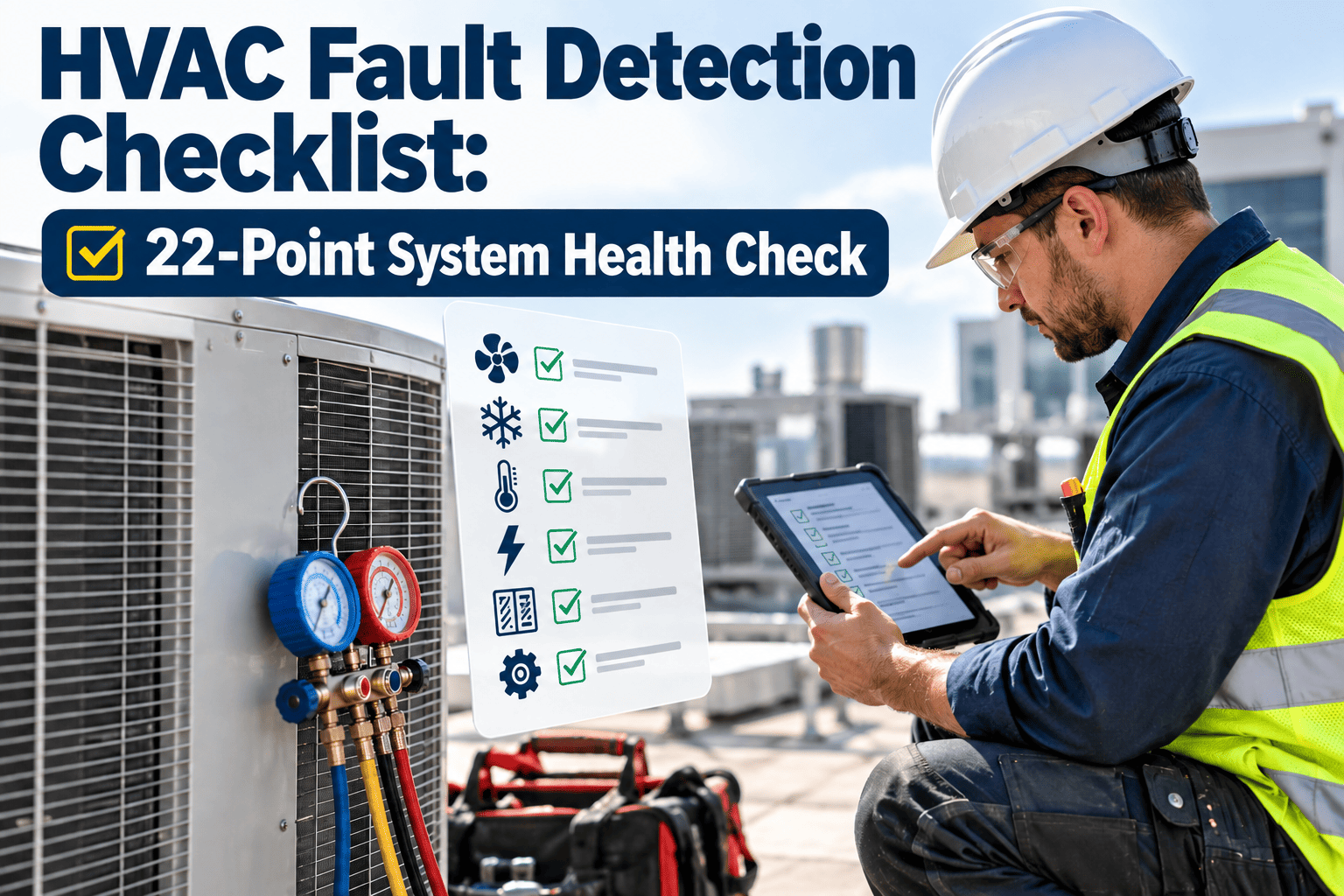
Most commercial HVAC faults never trigger an alarm. A stuck economizer damper, a drifting supply air sensor, or a VAV box reheating air that the chiller just cooled can run for months while occupants adjust their thermostats and the energy bill quietly climbs. This 22-point checklist walks facility teams through economizers, VAV terminals, chillers, boilers, and control loops, using the fault categories commonly described in PNNL fault detection and diagnostics research. Each check points to a symptom, a likely cause, and a next action, and teams that log findings in an HVAC maintenance platform can turn every confirmed fault into a tracked work order.
HVAC Fault Detection Checklist: 22-Point System Health Check
Catch soft faults before they become alarms. Work through five systems in order, tick each point as you verify it, and send confirmed faults straight into maintenance.
A fault at any link in this chain shows up downstream as comfort complaints or wasted energy. The checklist follows the same chain.
Why Soft Faults Cost More Than Breakdowns
A broken compressor gets fixed because everyone notices. A soft fault keeps the building running, so nobody owns it.
Hard fault
- Equipment stops or trips an alarm
- Occupants complain within hours
- Work order created automatically
- Fixed quickly because it is visible
Soft fault
- Equipment runs but performs poorly
- Comfort drifts, energy use rises
- No alarm, so no work order
- Persists until someone checks trends
Where the checklist looks
- Control faults: wrong setpoints, overridden schedules, and loops that hunt.
- Sensor faults: readings that drift or stick, which fool every sequence that relies on them.
- Actuator faults: dampers and valves that leak, stick, or do not follow commands.
- Performance faults: fouling, low delta-T, and short cycling that waste energy without stopping the plant.
How to Use This Checklist
- 1
Pull trends first. Export 7 to 14 days of BMS trend data for the system you are checking, including outdoor air temperature, supply air temperature, and valve or damper positions.
- 2
Check each point. Compare the reading or behaviour with the expected value. Tick the box only when you have verified it.
- 3
Rate the finding. Mark each fault as safety or comfort critical, energy waste, or housekeeping so repair order follows consequence.
- 4
Create the work order. Record the asset, the symptom, the evidence, and the suspected cause so the technician starts with a diagnosis, not a complaint.
- 5
Verify the fix. Repeat the trend check after repair and close the work order only when the data confirms normal behaviour.
Zone 1: Economizer and Air Handler (Points 1 to 5)
Economizers are a leading source of hidden waste because they depend on sensors, dampers, and logic all working together. Verify each link.
Turn Every Confirmed Fault Into a Work Order
Findings written on a clipboard rarely get fixed. Log each fault against the asset with its evidence so the repair is scheduled, tracked, and verified.
Zone 2: VAV Terminal Units (Points 6 to 10)
One bad VAV box affects a single zone, but a floor of them wastes energy and generates complaints. Sample the worst zones first.
Zone 3: Chilled Water and Chiller Plant (Points 11 to 14)
Chiller plants hold the largest energy loads. Small efficiency losses here are expensive, so watch the trends, not just alarms.
Zone 4: Boilers and Hot Water (Points 15 to 18)
Boiler faults waste fuel and shorten equipment life. Most show up in temperatures long before a lockout.
Zone 5: Control Loops and Scheduling (Points 19 to 22)
The control layer decides how equipment behaves. Faults here affect every system downstream.
Symptom-to-Cause Quick Reference
Use this table when a complaint arrives and you need to know which checkpoint to open first.
| Symptom | Likely cause | Start with points |
|---|---|---|
| Cooling energy high in mild weather | Economizer not enabling or damper leaking | 01, 02, 03 |
| Zone too warm, others fine | VAV damper, airflow sensor, or zone sensor | 06, 07, 10 |
| Heating and cooling both running | Leaking reheat valve or high supply setpoint | 08, 09, 15 |
| Chiller kW per ton rising | Fouling or low delta-T | 12, 13 |
| Boiler cycling constantly | Oversizing, differential, or sensor location | 16, 17 |
| Valves or dampers constantly moving | Poor loop tuning | 19 |
| Equipment running after hours | Schedule or override error | 20, 21 |
From Finding to Fix: The Triage Path
Suggested ranking
- Safety or code: ventilation shortfalls, combustion problems, and failed safeties go first.
- Comfort or critical space: labs, server rooms, and patient areas follow.
- Energy waste: schedule these by estimated waste, largest first.
- Housekeeping: overrides and trend gaps can be batched.
Data and Tools to Have Ready
A fault check goes faster when the evidence is on hand. Collect these before you start so each point can be confirmed in one visit.
Common Mistakes When Running a Fault Check
| Mistake | Why it hurts | Better approach |
|---|---|---|
| Trusting a single sensor | A drifting probe makes a healthy system look faulty, or hides a real fault | Cross-check with a handheld or a second sensor before acting |
| Checking on a mild day only | Economizer and reheat faults appear only at extremes | Review trends across hot, cold, and shoulder days |
| Fixing the symptom | Resetting a setpoint hides a failed actuator | Record the cause and verify with trend data after repair |
| Leaving overrides in place | Manual commands defeat the sequence you are testing | List and clear overrides before starting |
| No follow-up check | Faults return and nobody notices | Repeat the point after a week and close the order on evidence |
How Often to Run Each Check
| Cadence | What to check | Points |
|---|---|---|
| Weekly | Overrides, schedules, alarm and trend health | 20, 21, 22 |
| Monthly | Economizer, VAV samples, boiler temperatures, loop behaviour | 01 to 10, 15 to 17, 19 |
| Quarterly | Chiller approach, delta-T, staging, sensor cross-checks | 11 to 14, 05 |
| Seasonal or annual | Combustion test, sensor calibration, setpoint review | 18, 01, 09 |
Adjust the cadence to building size, equipment age, and how critical the space is. These are starting points, not requirements.
How Oxmaint Fits Into the Workflow
- Inspections: load this checklist as a mobile inspection so each point is recorded with notes and photos.
- Work orders: convert a failed point into a corrective work order against the exact asset.
- Preventive maintenance: schedule sensor calibration, coil cleaning, and combustion tests on a fixed cadence.
- Asset records: keep fault history by AHU, VAV, chiller, or boiler to spot repeat offenders.
- Reports: track open faults, repeat faults, and time to close across the portfolio.
Metrics That Show the Program Is Working
HVAC Fault Detection FAQs
What is HVAC fault detection and diagnostics?
It is the process of finding equipment and control faults from operating data, then identifying their likely cause. It can be manual, as in this checklist, or automated.
Do I need automated software to use this checklist?
No. Trend data from a BMS is enough to start, and you can log findings and work orders in a maintenance platform.
How many points should I check at once?
Work one zone at a time. Five to ten points per visit keeps the check thorough and the follow-up manageable.
Which faults waste the most energy?
Simultaneous heating and cooling, failed economizers, and bad schedules are common culprits. Rank by measured waste in your own building.
Can we review our results with someone?
Yes. You can book a short demo to see how checklist findings turn into tracked work.
Find the Fault Before the Alarm Does
Run the 22 points, log what you find, and keep every fix on record. Your next comfort complaint should already have a diagnosis attached.