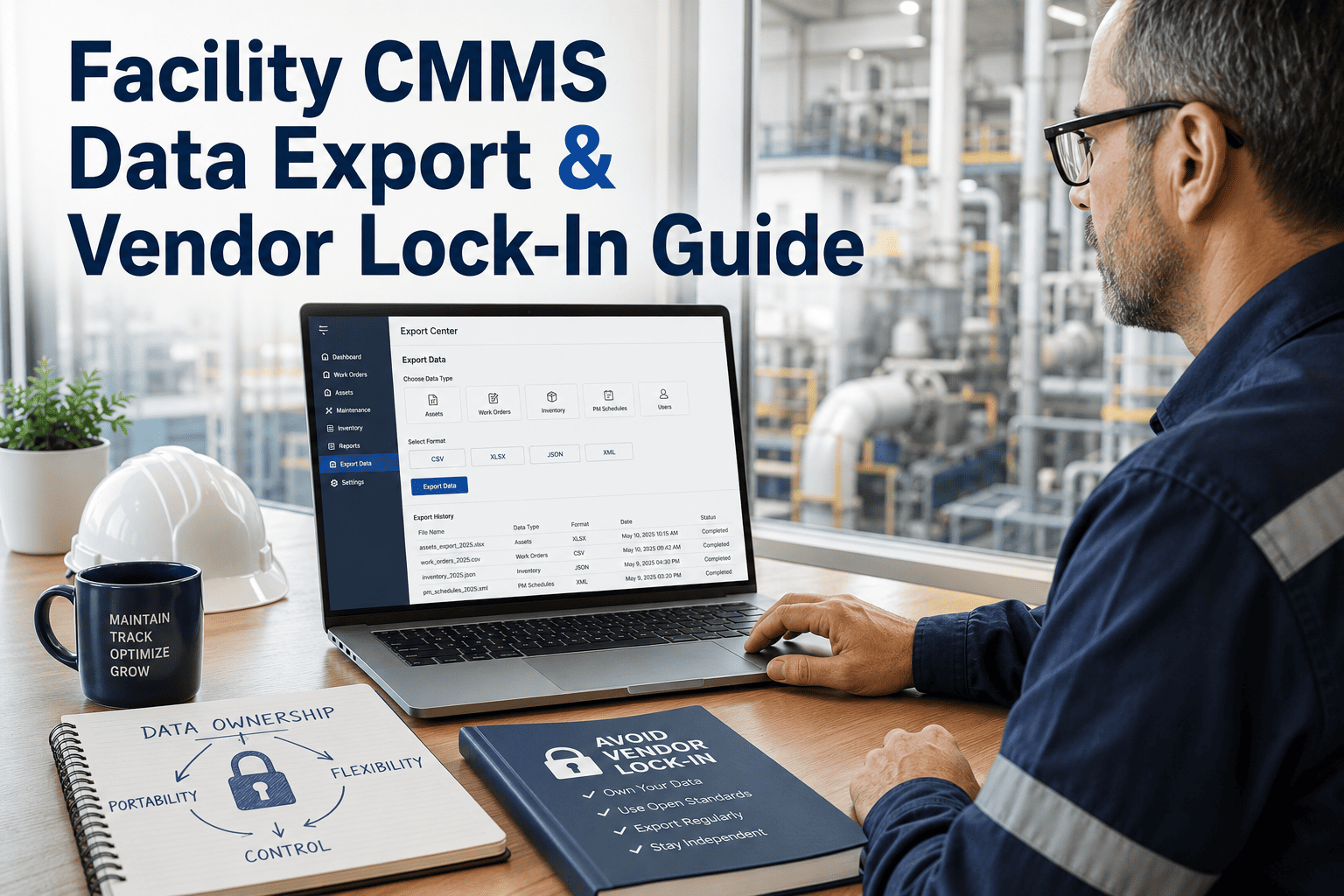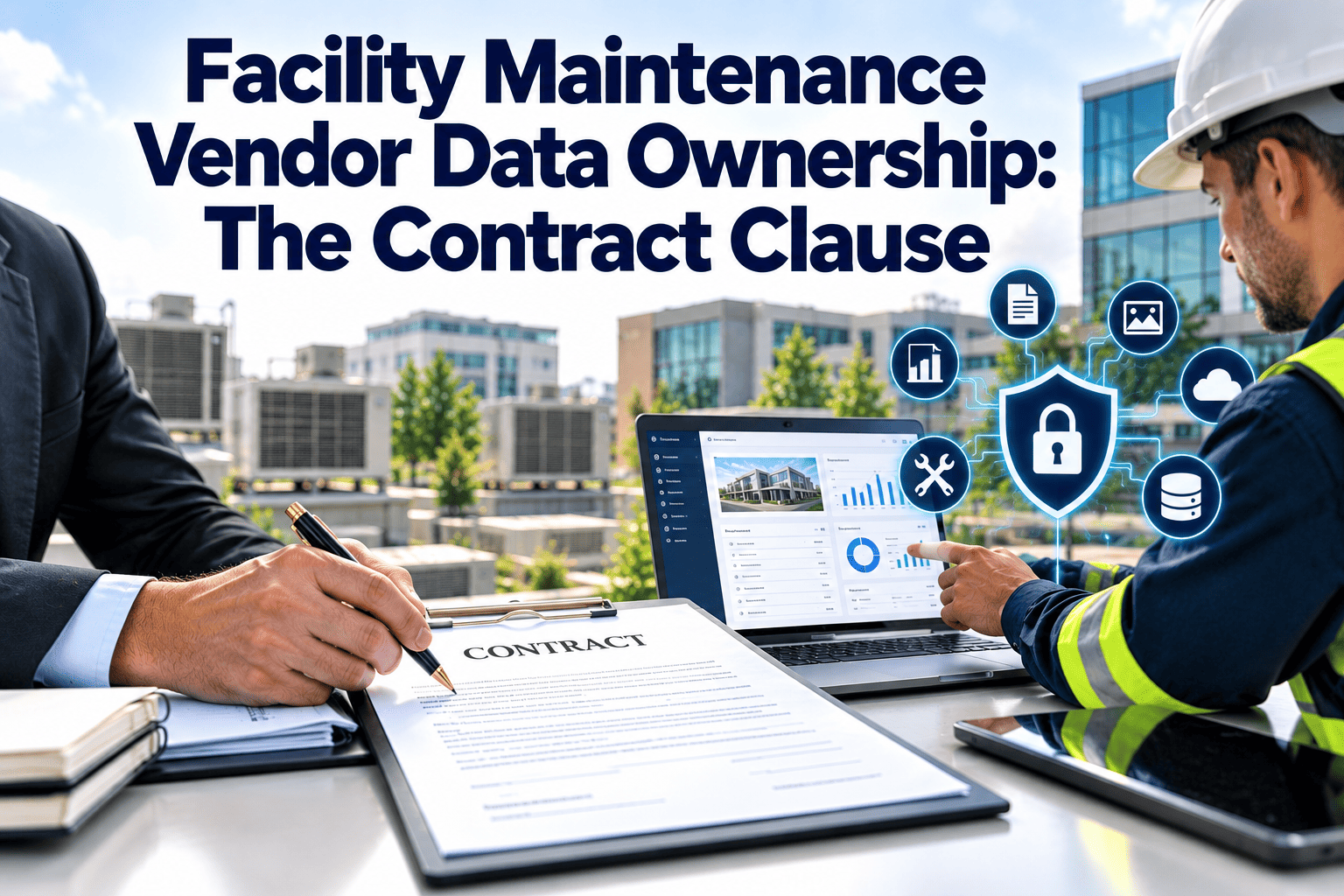
When a facility services contract ends, the building rarely walks away with its own history. Work order records, asset condition notes, inspection photos, and compliance evidence often sit inside a vendor’s system, and the agreement says little about who owns them. That gap is invisible at onboarding and expensive at renewal, because switching providers means rebuilding the asset record from zero. A precise data ownership clause closes the gap early, and Oxmaint maintenance management software gives your team a record that stays with the building.
Facility Maintenance Vendor Data Ownership: The Contract Clause
Vendor-held maintenance data turns every renewal into a hostage negotiation. See which records to claim, which clause language protects them, and how to keep a vendor-independent history from the first day of service.
Contract silent on data
- Work history lives in the vendor’s tool
- Exports are optional and priced per request
- Asset records restart after a vendor change
- Audit evidence depends on vendor goodwill
Contract with a data clause
- Owner holds every record from day one
- Exports are scheduled, free, and open format
- Asset history transfers intact at exit
- Audit evidence is retrievable on demand
Why vendor data ownership surfaces at the worst possible moment
Most facility service contracts are written around scope, response times, and price. Data is treated as a by-product of the work, so it is governed by default software settings instead of negotiated terms.
Procurement
Onboarding
Operation
Renewal or exit
What lock-in looks like in practice
- Replacement bids are priced higher because the new provider must re-survey every asset before quoting a maintenance plan.
- Recurring failure patterns disappear, so the same defects are rediscovered after every transition.
- Warranty claims and lifecycle decisions rely on memory instead of recorded service history.
- Compliance teams cannot show continuous inspection evidence across a vendor change.
- Finance cannot reconcile invoices to completed work because the source records sit elsewhere.
The data categories a facility contract should name explicitly
“All data” is too vague to enforce. List each category, state who owns it, and define the format and timing for return. The table is a starting point to adapt with your legal team.
| Data category | What it contains | Recommended position | Return format |
|---|---|---|---|
| Work order history | Requests, assignments, labor, parts, completion notes, timestamps | Owner owns all records | Structured export such as CSV |
| Asset register | Equipment IDs, locations, nameplate data, condition, criticality | Owner owns, including vendor-added fields | Structured export with IDs preserved |
| Inspection records | Checklists, readings, findings, photos, signatures | Owner owns originals and attachments | Records plus original image files |
| Compliance evidence | Certificates, test results, permits, regulatory logs | Owner owns, retained for the required period | Readable documents with metadata |
| Sensor and BMS feeds | Trend logs, alarms, setpoint changes | Owner owns raw data | Time-series export |
| Vendor methods and tools | Proprietary software, templates, internal pricing models | Vendor retains; owner receives outputs | Not applicable |
A note on the vendor’s legitimate interests
- Vendors can keep their software, methods, and internal cost data.
- Owners keep the facts about their own buildings and equipment.
- Separating the two clearly makes the clause far easier to accept at the negotiating table.
Which data losses hurt most, and which can be rebuilt
Not every record carries the same risk. Rank each category by how hard it is to recreate and how much it affects compliance or capital decisions.
Hard to rebuild, high impact
Hard to rebuild, moderate impact
Easy to rebuild, high impact
Easy to rebuild, low impact
Keep your maintenance history in a system you control
Six provisions that make a data ownership clause enforceable
The sample wording is illustrative only. Have counsel adapt it to your jurisdiction, contract structure, and applicable privacy and records-retention rules.
Ownership declaration
Definition of facility data
Access and export rights
Return and transition
Use restrictions and security
Deletion and certification
Where standard clauses often fall short
Facility contracts rarely involve a single vendor using a single tool. These situations deserve their own wording.
- Subcontractors
- Require the primary vendor to flow data obligations down to every subcontractor that touches your assets, so records created by a specialist trade are not trapped in a separate system.
- Vendor-owned platforms
- If the vendor insists on using its own software, require continuous read access and scheduled exports, not a one-time dump at termination.
- Personal data
- Technician names, tenant contacts, and access logs can be personal data. Address privacy obligations and processing limits alongside ownership.
- Building systems data
- BMS trends, meter readings, and sensor logs belong in the clause too, with a clear statement on who may analyze or reuse them.
- Benchmarking rights
- If the vendor wants to use anonymized data for benchmarking, define what is anonymized, who approves it, and whether the right can be withdrawn.
Vendor-owned records versus owner-owned records at renewal
Vendor-owned approach
- Renewal talks start with the vendor holding the only full history
- Bids from competitors carry a re-survey premium
- Reports arrive as summaries, not source records
- Audit requests wait on vendor availability
- Exit planning begins after notice is served
Owner-owned approach
- Renewal talks use your own performance and failure data
- Competing bids rely on a ready asset register
- Source records are available at any time
- Audit evidence is pulled directly by your team
- Exit planning is a routine export, not a rescue
Negotiation checklist for facility service data terms
Use these checks during contract review, whether you are renewing an incumbent or onboarding a new provider.
A 90-day data transition sequence for vendor changes
A clause matters only if it can be executed. Rehearse the handover so that return rights translate into a working asset record for the incoming provider.
Request and inventory
Receive and validate
Reconcile and brief
Certify and close
How a CMMS keeps the record independent of any vendor
The strongest protection is operational. If vendor technicians log work in a system you administer, the history is yours by design, and the clause becomes a backstop rather than a rescue plan.
Oxmaint capabilities that support data ownership
- Asset management that holds equipment records and service history in one register.
- Work orders and preventive maintenance schedules that vendors execute inside your account.
- Mobile inspections with checklists, photos, and sign-offs that stay linked to each asset.
- Reporting and dashboards for response, completion, and repeat-failure review.
- Inventory tracking so parts usage remains part of the permanent record.
Data health indicators worth tracking each quarter
Ownership language is only as good as the records behind it. Track these indicators to confirm that vendor activity is landing in your system.
- Work orders logged in owner system
- Compare vendor invoices to recorded work orders. Gaps show activity happening outside your record.
- Asset records with complete fields
- Check location, criticality, and maintenance plan. Incomplete records weaken both audits and bids.
- Inspections with attached evidence
- Measure how many inspections include readings or photos rather than a bare pass mark.
- Export test result
- Run a trial export each quarter and confirm record counts and attachments match.
Facility vendor data ownership FAQ
Who owns maintenance data created by a facility vendor?
It depends on the contract. Without explicit language, ownership is often unclear, so state that the owner holds all facility data created during service.
Can a vendor keep its own software and methods?
Yes. Vendors typically retain proprietary tools while the owner retains the records those tools produce about its buildings and equipment.
What export format should the clause require?
A documented, non-proprietary format that preserves identifiers and attachments. Book a demo to see how structured exports work.
Is a data clause enough without owning the system?
A clause helps, but enforcement is easier when vendors work in a system you administer. You can start with your own CMMS.
How long should regulated records be retained?
Retention periods vary by jurisdiction and record type. Confirm requirements with counsel and write them into the clause.
Questions to put to every bidder about data
The cheapest moment to secure data rights is before award, when competing bidders want the work. Add these questions to the request for proposal and score the answers.
- Where will our records be stored?
- Ask which system holds work orders, assets, and inspections, who administers it, and whether your team gets direct access.
- What export formats do you support?
- Request a sample export from a live account. A vendor that cannot produce one before award is unlikely to produce one at exit.
- How are attachments handled?
- Photos, certificates, and signed forms are often the most valuable records. Confirm they are exported with the data, not left behind.
- What happens to our data on termination?
- Ask for the written return process, timeline, and deletion steps, and compare them across bidders.
- Who else can see our data?
- Clarify use for benchmarking, product improvement, or sharing with partners, and require consent for anything beyond service delivery.
Keeping the clause alive after signature
A clause that is signed and filed does not protect anyone. Assign an owner and schedule the checks that prove it still works.