Few conversations between facilities and finance get as heated as the one about whether a job is capital or expense. A new compressor, a recoated roof or a rewired panel can be argued either way, and the answer changes tax treatment, capital plans, reported operating cost and even how a facility manager's performance looks. A clear policy, applied the same way to every line, ends most of the arguing. This guide sets out the tests, the decision flow and the twenty most-argued FM line items, and shows how a maintenance management system can carry the evidence finance needs. It is general information, so confirm treatment with your accountant.
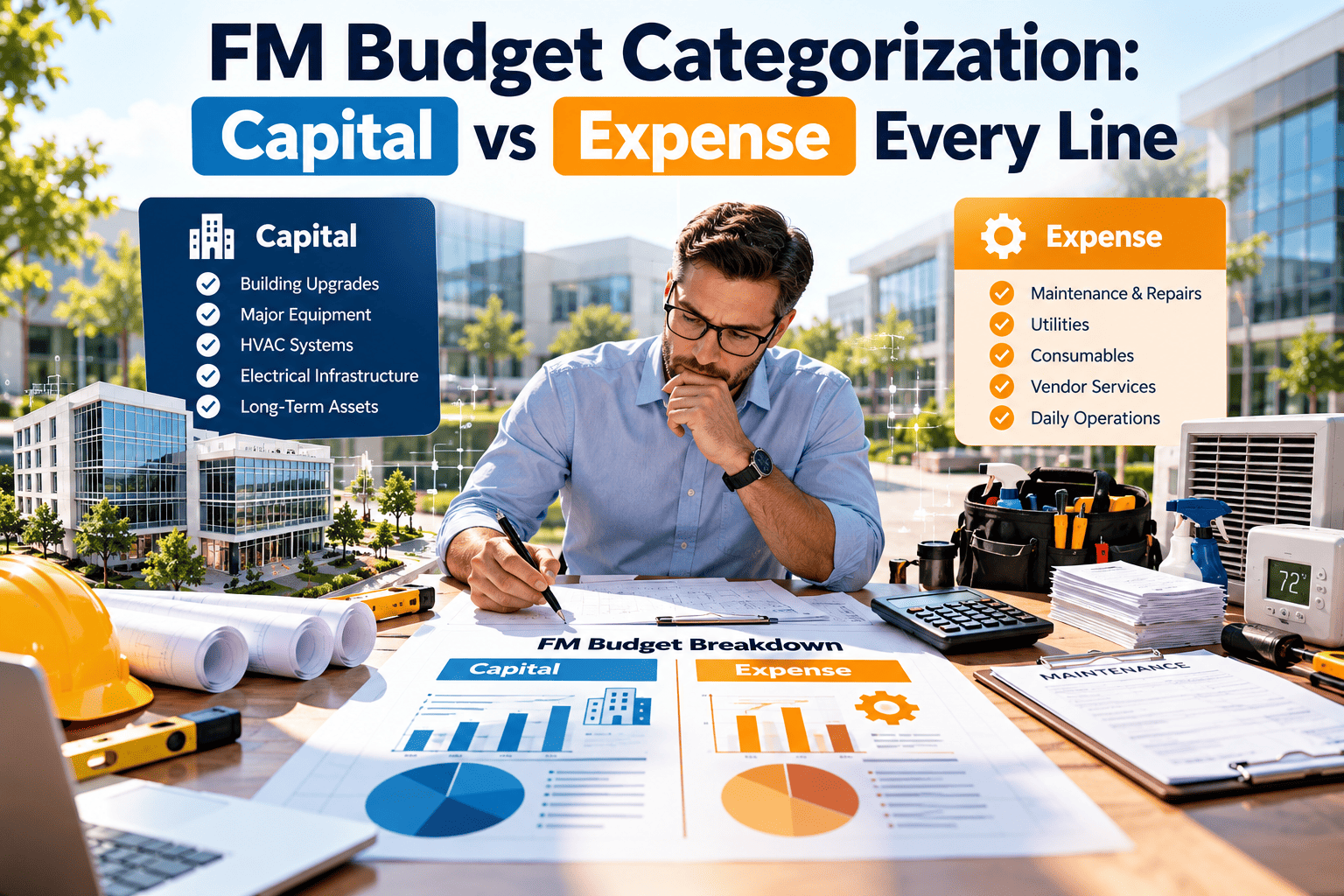
FM Budget Categorization: Capital vs Expense Every Line
Classification is a judgement made once, written down and applied consistently. Oxmaint records the scope, cost and evidence on each work order so the decision can be reviewed instead of rebuilt at year end.
Why the Classification Matters
The same invoice can land in very different places. Four outcomes depend on getting the call right.
The Core Tests: Maintenance or Betterment
Most frameworks share a simple idea. Work that keeps an asset in ordinary operating condition is an expense. Work that improves it beyond its original state is capital.
- Restores the asset to its previous operating condition
- Recurs regularly as part of normal servicing
- Replaces a minor part without extending total life
- Does not change capacity, quality or use
- Falls below the capitalisation threshold
- Extends the useful life beyond the original estimate
- Increases capacity, output or efficiency
- Replaces a significant component or the whole asset
- Adapts the asset to a new or different use
- Exceeds the threshold and forms a distinct unit
A Decision Flow You Can Apply to Any Line
Run each job through the same steps in the same order. The consistency matters more than any single answer.
Policy Building Blocks
A written policy removes most of the debate. Decide each element once, record it, and review it periodically with finance.
| Policy element | Question it answers | Options to decide |
|---|---|---|
| Capitalisation threshold | How large must a job be to qualify? | A single amount, or tiers by asset class |
| Unit of account | Is the item judged alone or as part of a project? | Per component, per asset, or per project |
| Minimum useful life | How long must the benefit last? | For example, longer than one financial year |
| Component approach | Are major parts depreciated separately? | Yes for roofs, plant and lifts, or whole asset only |
| Soft costs | Which design and management costs can be added? | Directly attributable only, or none |
| Disposal of replaced parts | How is the old component treated? | Write off the remaining book value |
| Approval path | Who signs off classification? | Facility lead, finance reviewer, or both above a limit |
Give Finance the Evidence Behind Every Capital Decision
Record scope, cost and approval on each Oxmaint work order, so classification is clear, consistent and ready for review.
The 20 Most-Argued FM Line Items
The table shows the usual starting treatment and the fact that tends to flip it. Your own policy, accounting framework and tax rules take precedence, so treat this as a discussion aid.
| # | Line item | Usual starting point | What can flip it |
|---|---|---|---|
| 1 | Roof leak patching | Expense | Large section replaced, extending roof life |
| 2 | Full roof replacement | Capital | Only a minor like-for-like repair is done |
| 3 | Roof coating or recoat | Judgement | Expense if routine upkeep, capital if it clearly extends life |
| 4 | Replacing a failed fan motor | Expense | Capital if above threshold and treated as a distinct component |
| 5 | Chiller compressor replacement | Judgement | Capital if it extends life or restores major capacity |
| 6 | Whole chiller or boiler replacement | Capital | Expense only if below threshold |
| 7 | Boiler tube or coil repair | Expense | Capital if a major overhaul extends useful life |
| 8 | Elevator repairs and callouts | Expense | Modernisation of drives or controls is typically capital |
| 9 | Interior repainting | Expense | Capital if part of a larger refurbishment project |
| 10 | Carpet or flooring replacement | Judgement | Patching is expense; full area replacement can be capital |
| 11 | Parking lot seal coating | Expense | Resurfacing or reconstruction is generally capital |
| 12 | LED lighting retrofit | Capital | Individual lamp or driver swaps are expense |
| 13 | Building controls upgrade | Capital | Licence renewals and support are typically expense |
| 14 | Fire alarm panel replacement | Capital | Replacing single devices is expense |
| 15 | Window or glazing replacement | Capital | Single pane or seal repair is expense |
| 16 | Plumbing repiping | Capital | Single leak repair is expense |
| 17 | Generator major overhaul | Judgement | Capital if it extends life beyond original estimate |
| 18 | Pump replacement | Judgement | Threshold and unit of account decide the outcome |
| 19 | Emergency repair after damage | Judgement | Restoring original condition is expense; improvement is capital, and insurance recovery affects the net |
| 20 | Planned maintenance contracts and inspections | Expense | Rarely flips, unless bundled into a capital project scope |
The Grey Areas That Cause Most Disputes
Clear items rarely cause arguments. These five situations do, so decide them in policy.
Repairs Bundled Into a Larger Project
Work that would be an expense alone may be capital when it is a necessary part of a larger betterment. Define whether the project or the individual task is the unit.
Component Replacement
Replacing a major part of a larger asset can be capital, with the replaced part written off. This needs component records in the asset register.
Soft and Indirect Costs
Design fees, project management, permits and commissioning may be capitalisable when directly attributable. General overhead usually is not.
Leased Premises
Landlord and tenant responsibilities differ. Check the lease before deciding who carries the cost and how it is classified.
Emergency Work
Urgency does not change the nature of the work. Classify by what was done, and record insurance recoveries separately.
What to Record on the Work Order
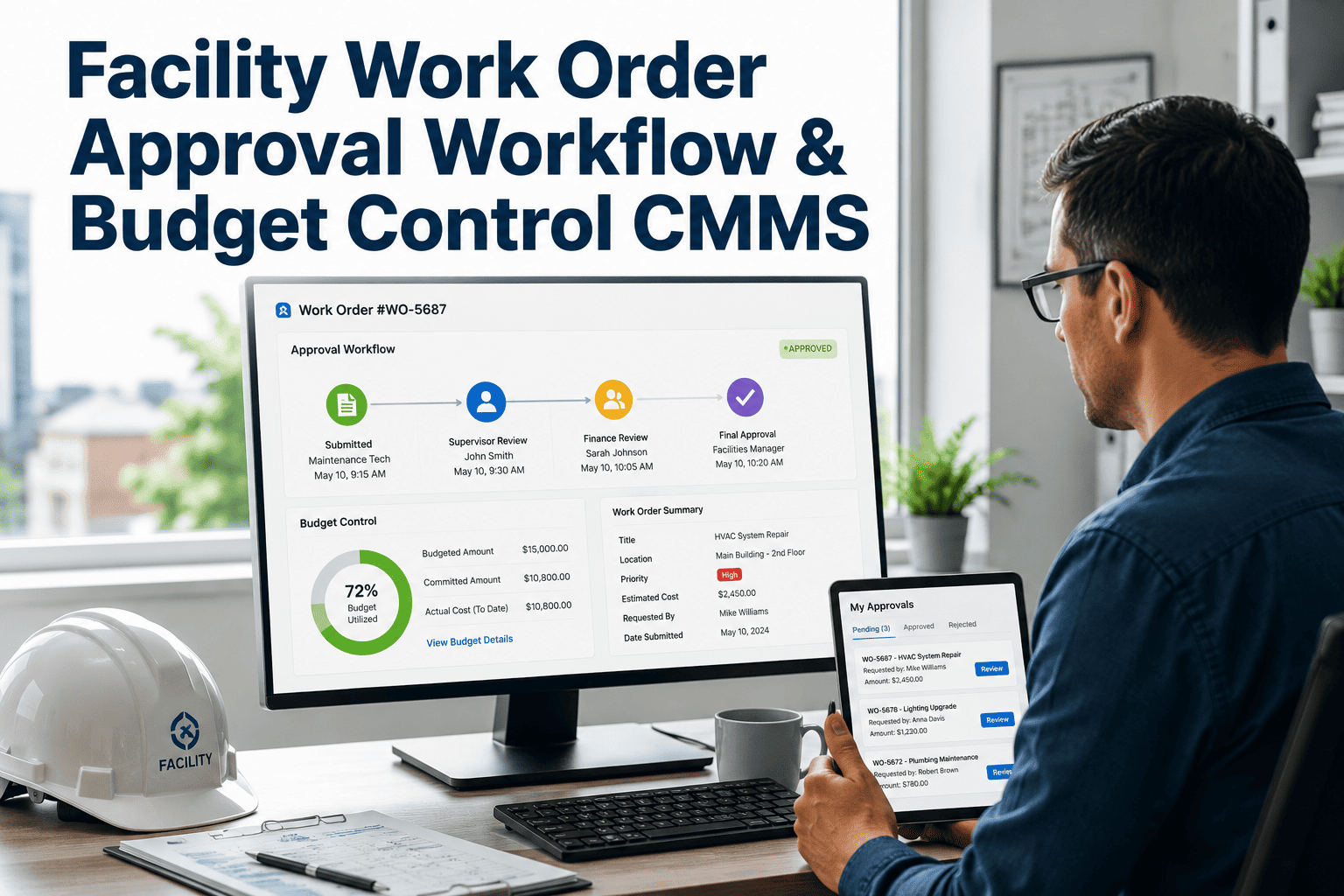
Good records let a reviewer reach the same answer without calling the technician. Capture these fields on every job likely to be questioned.
A Classification Workflow Between Facilities and Finance
Agree who does what, so disputes are resolved by process rather than by seniority.
- Describe scope and evidence
- Propose classification
- Attach quotes and photos
- Check against written policy
- Confirm threshold and unit
- Approve or return with reasons
- Post to capital or operating ledger
- Update asset register
- Retire replaced components
Auditing Your Own Classification
Run a short quarterly review to catch drift. Sample a mix of jobs from both sides of the line.
| Check | What to look for | Likely fix |
|---|---|---|
| Large expense jobs | Work that extended life or added capacity | Reclassify and update the register |
| Small capital items | Items below threshold posted to capital | Move to expense and tighten approval |
| Split invoices | One job divided to stay below the threshold | Combine and apply unit of account rule |
| Missing evidence | Capital items without scope or photos | Add documentation before posting |
| Unretired components | Replaced parts still on the register | Write off and remove from schedule |
Setting the Threshold: Low or High?
There is no universal number. The right threshold balances audit effort against the risk of misstating cost, and should be agreed with finance and your auditors.
- More items on the asset register and depreciation schedule
- Better visibility of lifecycle cost
- Higher administrative effort for small items
- Smaller operating budget swings from replacement years
- Fewer register entries and simpler audits
- More spend flows through the operating budget
- Risk that meaningful renewals are expensed
- Larger year-to-year swings when big jobs fall in one year
Special Cases Worth Deciding in Advance
Several recurring situations do not fit neatly into the repair versus betterment test. Write a rule for each so decisions are not made fresh every time.
| Situation | Why it is awkward | Questions to settle in policy |
|---|---|---|
| Energy efficiency retrofits | Improves performance but often replaces working equipment | Is the efficiency gain a betterment, and is the removed asset written off? |
| Tenant improvements | Benefit and ownership may differ between landlord and tenant | Who owns the asset, and over what period is it recognised? |
| Software and system licences | Subscriptions look like expense, implementations look like capital | Which costs are ongoing service, and which are one-off implementation? |
| Warranty-covered repairs | Cost may be recovered or never incurred | How are recoveries recorded against the original cost? |
| Condition-based programmes | Spreads many small repairs across assets | Is the programme a project, or a series of expenses? |
| Deferred maintenance catch-up | Work restores condition rather than improving it | Is a backlog clearance an expense, even when the sum is large? |
Common Classification Mistakes
- Classifying by urgency rather than by the nature of the work
- Letting each site apply its own threshold
- Expensing large renewals to protect the capital budget
- Capitalising routine work to flatter operating cost
- Not retiring replaced components from the register
- Classify by scope, using the same written tests
- Apply one policy across the portfolio
- Report large renewals through the capital plan
- Keep routine work in the operating line, even if tedious
- Update the register in the same step as posting
Policy Review Checklist
Review the policy once a year, and any time accounting standards, tax rules or the portfolio change.
- Confirm the threshold and unit of account still match the size of your typical jobs.
- Check that useful life estimates reflect actual asset history, not only default tables.
- Test a sample of recent work orders against the written tests, and note where reviewers disagreed.
- Ask whether any new asset classes, such as batteries, solar or EV charging, need their own rules.
- Confirm the approval path still suits the volume and value of work.
- Record every change with a date and reason, so prior-year comparisons stay understandable.
Share the updated policy with every vendor and technician who raises or closes work orders, since the quality of classification starts with the quality of the job description. A vague note such as "repaired unit" gives finance nothing to test, while a clear scope narrative makes the decision quick and defensible.
How Oxmaint Supports Capital and Expense Tracking
Oxmaint is maintenance management software, not an accounting system. It captures the operational evidence that finance relies on to classify and post.
Frequently Asked Questions
End the Capital Versus Expense Argument With Evidence
Standardise scope, cost and approval on every work order, and let finance classify from a clear record in Oxmaint.