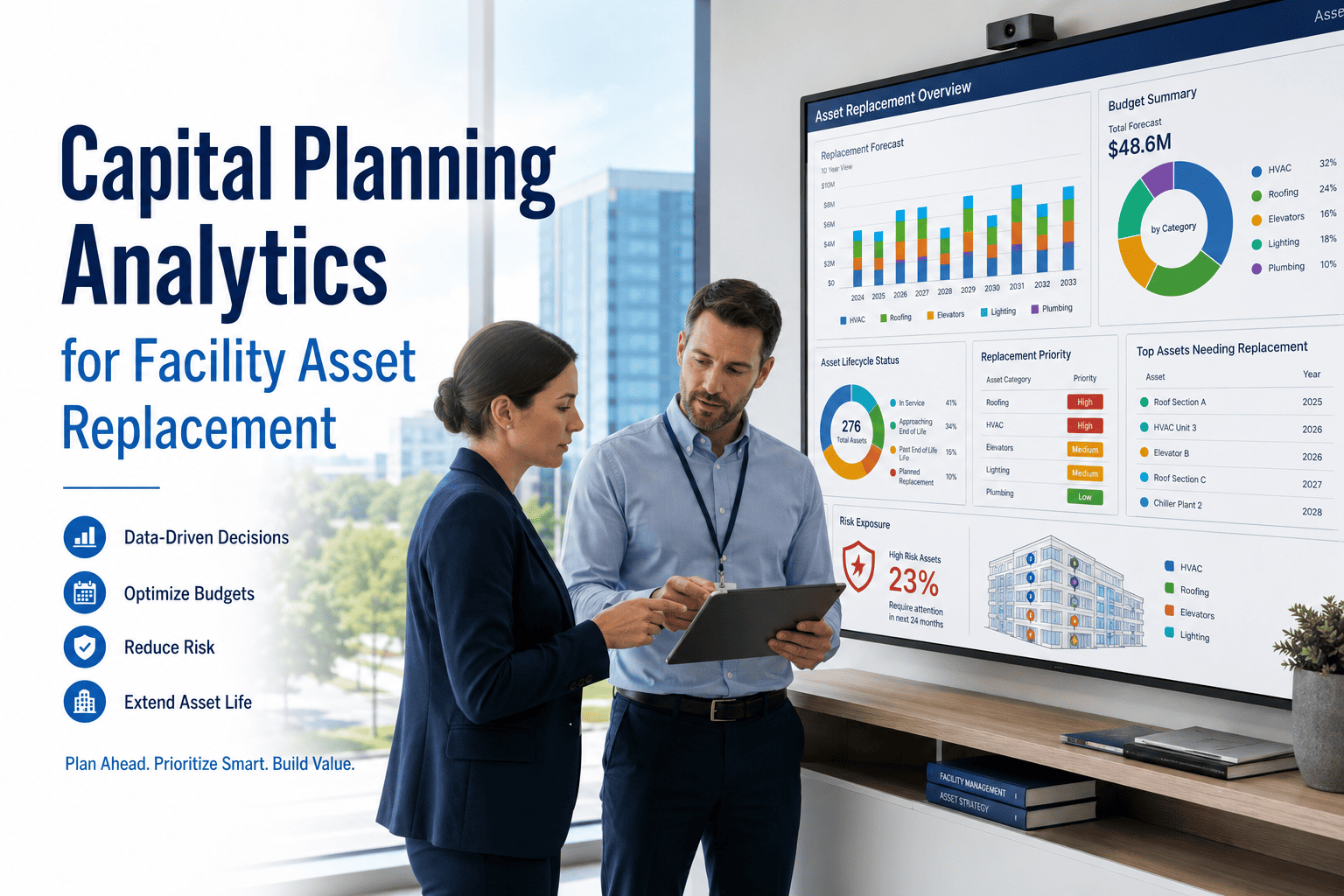
Facilities leaders entering 2026 face a convergence of pressures that makes guesswork budgeting unacceptable: rising labor costs, deferred capital exposure from pre-2024 deferrals, aging building systems reaching end-of-life simultaneously, and expanding compliance demands — all colliding in the same fiscal year. The organizations that consistently outperform are not those with larger budgets. They are the ones that align spending to actual asset condition, build rolling 5-year CapEx forecasts from real data, and give their CFO the investor-grade reporting required to approve capital projects with confidence. This guide delivers the complete framework — OpEx versus CapEx classification, deferred maintenance cost calculation, 5-year CapEx forecasting methodology, and ROI justification templates that translate maintenance data into financial decisions. Sign up for Oxmaint free and start building your FM budget on asset condition data today, or book a demo to see the CapEx forecasting dashboard live.
$84B
California's accumulated deferred maintenance backlog alone — the national commercial FM deferred maintenance crisis is measured in the trillions
4.8x
Emergency repair cost premium versus planned preventive maintenance — the core financial case for proactive FM budgeting
40–65%
CapEx budget variance for FM teams without asset condition data — versus under 15% for data-driven planners
5–7%
Annual inflation escalator required on all multi-year CapEx plans in 2026 — quotes from 2023 are no longer valid budget inputs
Oxmaint · Analytics Dashboard · FM Core & Strategy
Your CFO Needs Data, Not Estimates. Oxmaint Turns Asset Condition Into CapEx Forecasts That Win Board Approval.
Rolling 5–10 year CapEx forecasting. Remaining Useful Life calculations per asset. OpEx versus CapEx classification support. Deferred maintenance cost tracking. Investor-grade reporting built from live maintenance data — not spreadsheets assembled at budget season.
Under 15%CapEx variance with data
5–10 yrRolling CapEx forecasts
40%Maintenance cost reduction
DaysTo deploy Oxmaint
The Foundation
OpEx vs. CapEx in Facility Management — The Classification Decision That Determines Your Budget Access
The most consequential financial skill for any FM leader is knowing which side of the CapEx/OpEx line an expense falls on — because it determines which budget pool it draws from, how it is approved, and how it is reported to ownership. Getting it wrong means either losing access to capital budget funds or misclassifying investments that should be capitalized.
OpEx — Operating Expenditure
Day-to-day costs that keep a facility running. Fully expensed in the year incurred. Managed through the operating budget, not capital allocation. Predictable and recurring.
Typical OpEx Items
Routine preventive maintenance and inspections
Minor repairs under capitalization threshold
Utilities, janitorial, and general facility operations
Emergency repairs that restore but do not improve
Consumables and MRO supplies
Annual service contracts and vendor retainers
Tax treatment: Fully deductible in the year incurred
CapEx — Capital Expenditure
Long-term investments that acquire, upgrade, or extend the useful life of a physical asset beyond one year. Capitalized on the balance sheet and depreciated over the asset's service life.
Typical CapEx Items
HVAC system replacement (15–20 year asset life)
Roof replacement or major structural overhaul
Elevator modernization and safety upgrades
Building automation and energy management systems
Major renovations that extend asset useful life
New equipment acquisition above capitalization threshold
BAR Test: Betterment / Adaptation / Restoration to qualify
The BAR Test — How Finance Classifies Your Capital Requests
BBetterment — Does it improve the asset's efficiency, capacity, or performance beyond its original design? HVAC replacement with higher SEER rating qualifies.
AAdaptation — Does it adapt the asset to a new or different use? Converting office space to lab facilities qualifies.
RRestoration — Does it restore a major component to like-new condition, extending useful life significantly? Full roof tear-off and replacement qualifies.
Deferred Maintenance
The Deferred Maintenance Crisis in 2026 — How to Calculate Your Organization's Hidden Liability
Deferred maintenance is not a line item that disappears when it is skipped. It compounds. Every year a capital project is deferred, its cost grows — from inflation, from accelerated deterioration of adjacent systems, and from the emergency repair premium when deferral ends in failure rather than planned replacement. Research shows the annual cost of deferred maintenance grows at 1.3–1.5x per year it remains unaddressed.
01
Inflation Escalation
Add 5–7% annually to every deferred CapEx project cost. A roof replacement quoted at $400,000 in 2023 now costs $447,000–$463,000 in 2026. Multi-year deferrals create a compounding shortfall that destroys budget accuracy at year-start planning.
02
Cascade Damage Multiplier
Deferred roof replacement allows water infiltration that damages insulation, decking, and interior finishes — turning a $400,000 roof project into a $620,000 combined restoration. Deferred HVAC replacement accelerates electrical and ductwork deterioration in adjacent systems.
03
Emergency Premium on Failure
When deferred maintenance results in system failure, the repair cost carries the 4.8x emergency premium — overtime labor, expedited parts, temporary systems, and business disruption costs that a planned replacement eliminates entirely. Deferral rarely saves money. It transfers cost to a worse scenario.
04
Compliance Liability Accumulation
Deferred life safety and code compliance upgrades accumulate regulatory risk that creates liability exposure. OSHA violations, building code deficiency notices, and insurance exclusions resulting from known-but-deferred maintenance create financial exposure that far exceeds the project cost that was deferred.
05
Asset Value Deterioration
Deferred maintenance reduces portfolio asset value. Lenders, investors, and buyers assess deferred maintenance backlogs as direct reductions to property valuation. Organizations with structured CapEx programmes and documented maintenance histories consistently achieve higher asset valuations at disposition or refinancing.
06
Budget Collision Risk
Capital exposure rising from deferred replacements pre-2024 increases the probability that multiple high-ticket events land in the same fiscal year. Without rolling CapEx forecasts, facilities teams discover in Q3 that they need $2.1M in capital they have not budgeted — creating financial emergencies that a 5-year plan would have distributed across multiple years.
The 5-Year CapEx Framework
How to Build a CFO-Ready 5-Year Facility CapEx Plan — Step by Step
A CFO-ready CapEx plan is not a wishlist. It is a data-driven investment roadmap that connects asset condition to replacement timelines, costs, and financial impact — and answers the finance team's questions before they are asked.
01
Complete Asset Inventory and Condition Assessment
Document every major building system with its installation date, manufacturer design life, current condition score (1–5), and last major service event. Systems approaching end of design life with condition scores below 3 are your immediate CapEx risk. Oxmaint's asset registry captures this data at the portfolio, property, system, asset, and component level — creating the foundation that rolling CapEx forecasts are built on. Without this baseline, CapEx planning is educated guessing. With it, you have a defensible capital case.
Asset registry build
Condition scoring 1–5
Design life tracking
Last service date
02
Calculate Remaining Useful Life Per Asset
Remaining Useful Life (RUL) is the primary input to any CapEx forecast. It is calculated as: Design Life — Age — Condition Adjustment Factor. A 20-year HVAC unit installed 14 years ago with a condition score of 2 has a RUL of approximately 2–3 years, not 6. Apply the condition adjustment factor (typically 0.5–0.8 for assets in below-average condition) to all assets with condition scores below 3. Oxmaint's analytics dashboard calculates RUL automatically from asset records and condition scores — updating dynamically as maintenance history accumulates and condition assessments are recorded.
RUL auto-calculated
Condition adjustment
Dynamic updates
Per-asset forecasting
03
Build the 5-Year Replacement Schedule with Cost Estimates
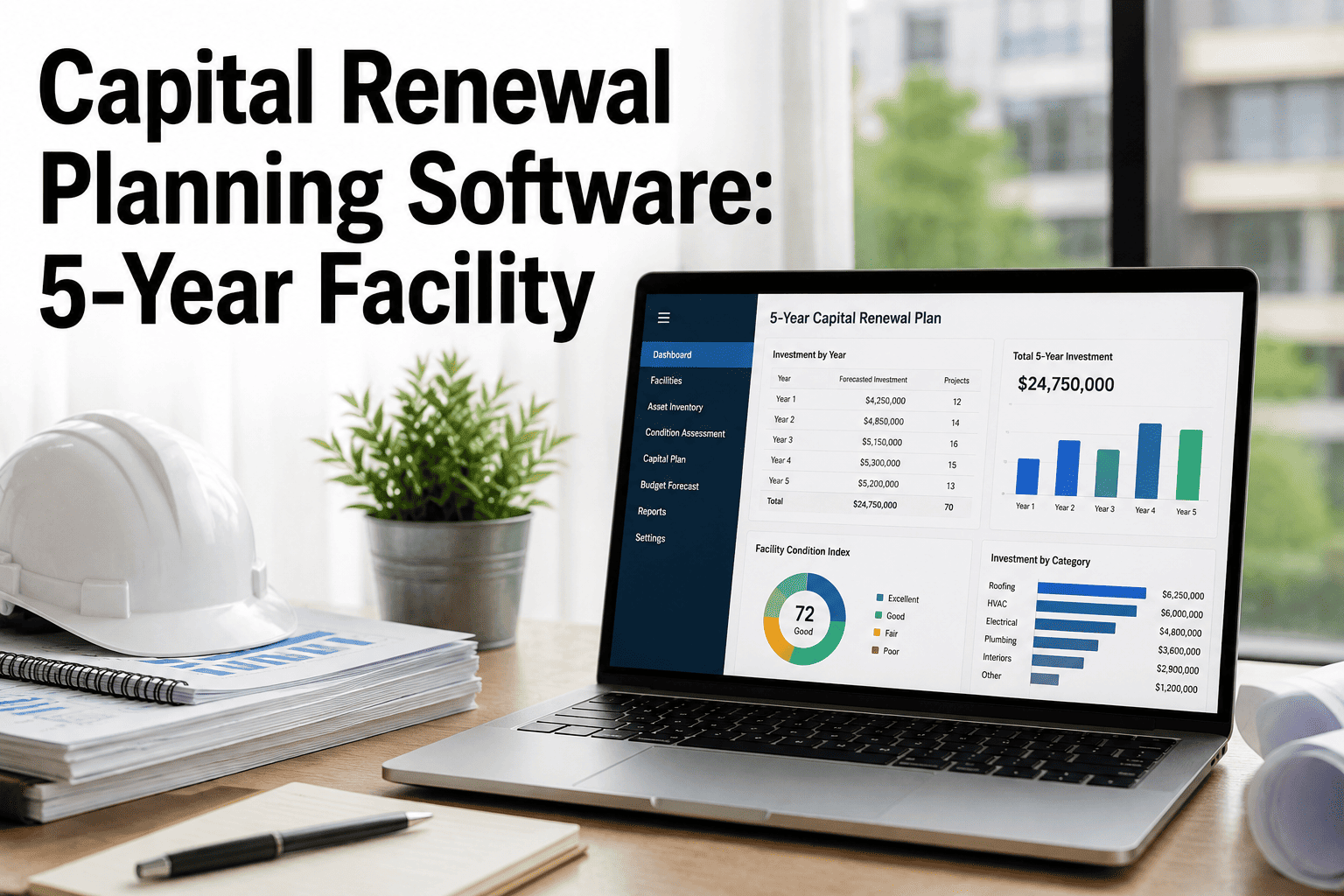
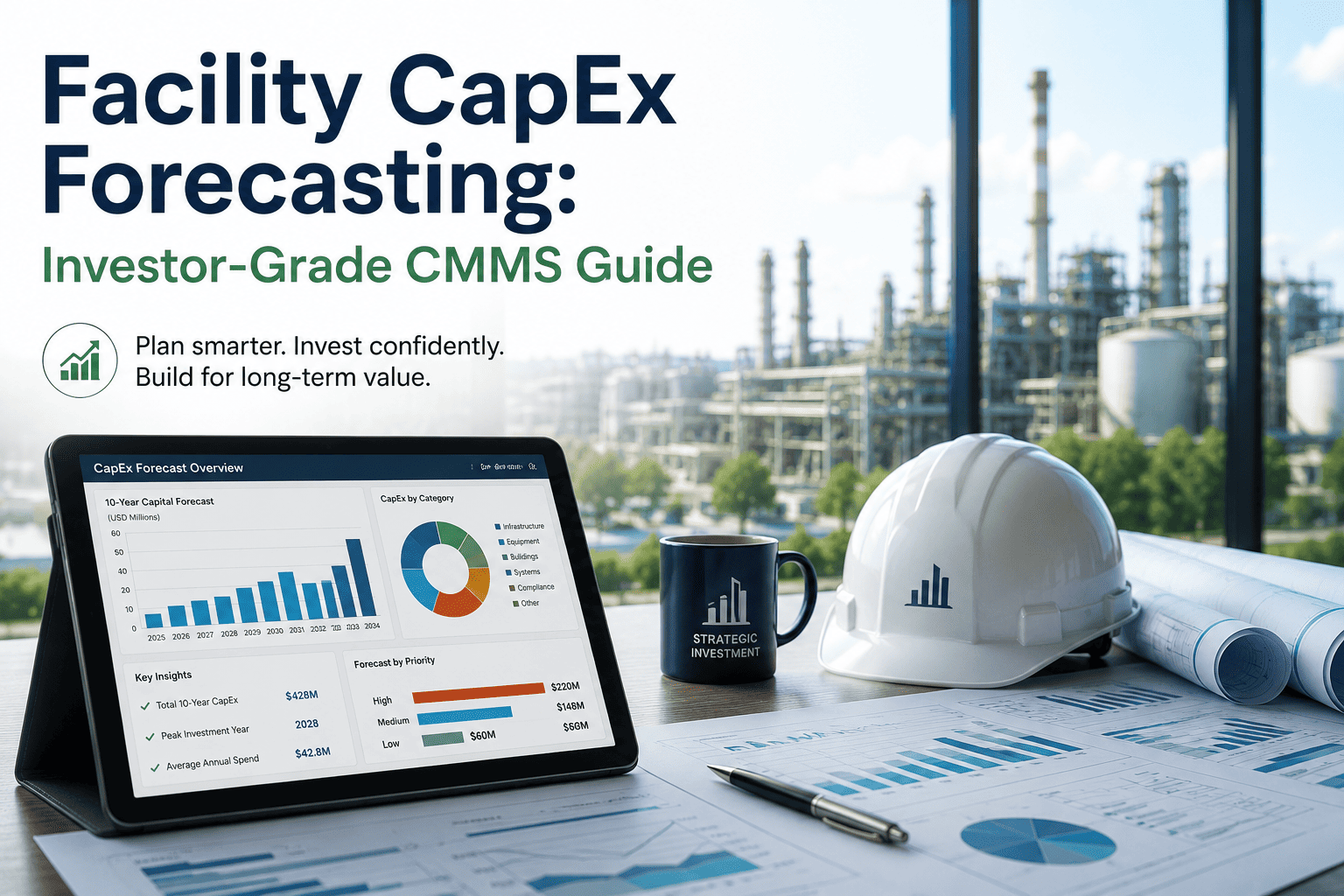
Map every asset with RUL under 6 years to a replacement year, with replacement cost estimates escalated at 5–7% annually from current quotes. Apply a 10–15% contingency buffer to each project for unforeseen conditions discovered during replacement. Group projects by building system to identify years where multiple system replacements coincide — these are budget collision risks that need either accelerated funding or deliberate sequencing across adjacent years. Oxmaint's CapEx forecasting module generates this schedule automatically from asset records, surfacing year-by-year capital requirements across your entire portfolio.
5–7% inflation escalation
10–15% contingency
Collision year detection
Portfolio-level view
04
Build the ROI Justification for Each Capital Project
Every capital request needs a financial case that speaks to CFO priorities — not just the replacement cost, but the cost of not replacing. The justification should include: current annual maintenance cost on the aging asset, cost trajectory if deferred (escalation plus cascade damage multiplier), replacement cost, post-replacement annual OpEx reduction, payback period, and net 10-year financial impact. For energy-efficiency projects, include energy savings at current utility rates. Oxmaint's total cost of ownership reports pull this data from work order history, providing the maintenance cost evidence that turns a budget request into an investment proposal.
TCO calculation
Payback period
Deferral cost quantified
10-year net impact
05
Establish Reserve Funding and Annual Contribution Rates
For every major asset class, establish an annual reserve contribution that accumulates toward future replacement — reducing the capital shock of large replacement events. The standard approach is to divide total replacement cost by design life and contribute that amount annually to a reserve fund. This transforms CapEx events from budget surprises into planned financial provisions. For a $480,000 chiller with a 24-year design life, the annual reserve contribution is $20,000 — a predictable OpEx line that avoids a $480,000+ emergency appropriation when the unit fails in year 22 without a reserve in place.
Annual reserve formula
Design life basis
Smooth capital timing
CFO-predictable
Before vs. After
FM Budgeting Without Data vs. Oxmaint Data-Driven Capital Planning
Asset Lifecycle Reference
Facility Asset Lifecycle Reference — Design Lives and CapEx Planning Horizons
Every 5-year CapEx plan starts with accurate design life assumptions. These industry-standard lifecycle benchmarks — used by facility assessors, lenders, and insurance underwriters — form the basis of Remaining Useful Life calculations in Oxmaint's analytics dashboard.
HVAC Systems
15–20 years
$18,000–$75,000 per unit
Highest emergency cost risk if deferred. Cascade damage to electrical and ductwork. Annual reserve: replacement cost ÷ 18.
Roofing Systems
20–30 years
$8–$25 per sq ft
Water infiltration from deferral multiplies total project cost by 1.5–2.2x. Section 179 immediate expensing may qualify.
Elevator Systems
25–35 years
$100,000–$300,000 per cab
Mandatory inspection cycles. Modernization components (controls, hydraulics) have shorter lifecycles than the cab structure itself.
Electrical Distribution
30–40 years
$50,000–$400,000+
Switchgear and panel replacement is a major CapEx event. Insurance carriers scrutinize age and condition at renewal.
Plumbing Systems
40–70 years (varies by material)
$4–$20 per sq ft full repiping
Cast iron drain systems in buildings 40+ years commonly show deterioration. Water heaters: 10–15 yr. Boilers: 20–35 yr.
Flooring and Finishes
8–15 years (traffic-dependent)
$3–$15 per sq ft
Short lifecycle requires frequent CapEx budget inclusion. High-traffic commercial spaces depreciate fastest and require condition-based assessment annually.
Building Envelope
30–50 years
Highly variable by scope
Caulking and sealants: 5–10 yr (OpEx). Windows: 20–30 yr (CapEx). Facade cladding: 30–50 yr. Phased approach common for large portfolios.
BAS / Building Automation
15–25 years
$2.50–$7.00 per sq ft
Legacy systems lose parts availability in year 15+. Modernization qualifies as CapEx Betterment when it improves energy efficiency or control capability.
Oxmaint · Analytics Dashboard
Oxmaint Calculates RUL, Forecasts CapEx, and Builds the CFO Report — Automatically From Your Asset Data.
Stop assembling CapEx budgets from spreadsheets at year-end. Oxmaint's analytics dashboard gives you rolling 5–10 year CapEx forecasts, reserve fund calculations, total cost of ownership by asset class, and investor-grade portfolio reporting — updated continuously as maintenance data accumulates. Free to start. No implementation fees.
ROI and Results
What Data-Driven FM Budgeting Delivers — Quantified Outcomes
Under 15%
CapEx Budget Variance
Versus 40–65% variance for FM teams without asset condition data. Rolling RUL-based forecasts aligned to actual condition eliminate the surprise replacements that blow annual capital budgets.
40%
Maintenance Cost Reduction
McKinsey benchmark: condition-based maintenance reduces total maintenance spend by up to 40% versus reactive operations. Emergency repair premium eliminated by planned intervention aligned to asset condition data.
$2.4M
Average Annual Savings
Average annual maintenance savings per large commercial portfolio from emergency repair reduction and planned capital efficiency — documented across Oxmaint deployments in multi-site facility management operations.
3.2x
Return on CMMS Investment
ROI achieved within 18 months across Oxmaint commercial facility deployments — from reduced emergency spend, deferred maintenance cost avoidance, and CapEx timing optimization across the asset portfolio.
5–10 yr
Rolling CapEx Forecasts
Oxmaint's analytics dashboard generates rolling 5–10 year CapEx forecasts updated continuously from live asset condition data. Capital plans that were previously assembled once annually now update dynamically as assets are serviced and assessed.
68%
Unplanned Failure Reduction
Reduction in unplanned asset failure events within 18 months of Oxmaint deployment — the primary driver of emergency CapEx events that destroy annual FM budget accuracy and force unplanned capital appropriations.
Frequently Asked Questions
FM Budgeting and Capital Planning — What CFOs and Facility Leaders Ask First
How do I calculate Remaining Useful Life for facility assets, and why does condition matter more than age?
Remaining Useful Life is calculated by adjusting an asset's design life for both its current age and its current condition — not age alone. The formula is: RUL = (Design Life × Condition Factor) — Age. For an asset in average condition (factor: 1.0), RUL equals design life minus age. For an asset in poor condition (factor 0.6–0.8), RUL is significantly shorter than the age-based calculation. This matters because an 18-year-old HVAC unit in excellent condition may have 4–6 more years of useful life, while a 14-year-old unit in poor condition (failed prior to adequate PM) may have 1–2 years. Using age alone systematically misstates CapEx timing — either over-replacing healthy assets or under-budgeting for deteriorated ones. Oxmaint's analytics dashboard calculates RUL automatically from condition scores entered during inspections and work order completions. As maintenance history accumulates, RUL calculations become more accurate.
Sign up free to start building RUL-based CapEx forecasts, or
book a demo to see the forecasting dashboard live.
What is the right format for presenting a CapEx request to a CFO — and what financial metrics do finance teams require?
A CFO-ready capital request answers five financial questions before the finance team asks them. First: what is the current annual maintenance cost on this aging asset, and what is its trajectory over the next 3 years without replacement? Second: what does deferral cost in inflation escalation, cascade damage risk, and emergency replacement premium? Third: what is the total replacement cost including contingency, and which fiscal year does it fall in? Fourth: what is the post-replacement OpEx reduction, and what is the payback period? Fifth: what is the net 10-year financial impact of replacing now versus deferring 2–3 years? Finance teams approve CapEx when the cost of inaction is quantified alongside the cost of action. The request fails when it only presents the replacement cost without the deferral cost analysis. Oxmaint's total cost of ownership reports pull maintenance cost history, work order frequency, and parts spend per asset — providing the evidence base for all five questions in a single dashboard export.
Book a demo to see a capital request built from Oxmaint data, or
sign up free to start collecting the asset data your next capital request needs.
How does Oxmaint's analytics dashboard support FM budgeting — and what outputs does it generate for finance teams?
Oxmaint's analytics dashboard serves as the financial intelligence layer of facility management — converting maintenance operational data into the budget and capital planning outputs that finance teams require. For OpEx budgeting, the dashboard generates maintenance cost trending by asset class, work order cost distribution (planned versus emergency), parts spend by system, and budget variance analysis against prior periods. For CapEx planning, it generates rolling 5–10 year capital forecasts by asset class and property, RUL calculations per asset, reserve fund contribution requirements, and total cost of ownership by asset for refurbish-versus-replace analysis. For board-level reporting, it produces portfolio-level summaries showing deferred maintenance backlog, capital investment pipeline, and maintenance performance KPIs formatted for investor and ownership group review — without requiring the FM team to manually assemble reports from multiple data sources. The dashboard updates continuously as work orders are completed and condition assessments are recorded, making the capital plan a living document rather than an annual exercise.
Sign up free to access the analytics dashboard, or
book a demo to see portfolio-level CapEx reporting with your facility data.
What is the difference between an FM reserve fund and a CapEx budget — and how should both be structured?
A reserve fund is a proactive financial provision built annually to fund future CapEx events — it accumulates over the asset's life so the capital is available when replacement is needed. A CapEx budget is the annual allocation of capital funds for projects being executed in the current fiscal year. The two work together: reserve contributions in the operating budget (OpEx line item) accumulate toward future CapEx events, reducing the capital shock when major replacements arrive. The reserve contribution formula is: Annual Contribution = Replacement Cost ÷ Remaining Design Life. For a $480,000 chiller with 24 remaining design years: annual reserve contribution = $20,000. For organizations that cannot immediately establish reserves for all asset classes, prioritize by consequence-of-failure: HVAC, elevators, and fire life safety systems first, then roofing and electrical. Oxmaint's asset registry and CapEx forecasting module calculates recommended reserve contributions per asset class and tracks actual reserve accumulation against the target — providing the reserve fund reconciliation that auditors, lenders, and investors require in multi-site commercial portfolios.
Sign up free to configure reserve tracking for your portfolio, or
book a demo to see reserve fund management in action.
How should FM teams approach budgeting for 2026 given rising labor costs, inflation, and deferred capital from pre-2024 deferrals?
The 2026 FM budget environment has three specific pressures that require explicit responses in the planning process. First, inflation escalation: quotes from 2023 are no longer valid inputs for 2026 budget construction. Apply 5–7% annually per year elapsed since your last market price check. A project quoted in 2023 at $350,000 requires a 2026 budget line of $404,000–$429,000 before contingency. Second, deferred capital collision: capital exposure from pre-2024 deferrals is now maturing simultaneously. Facilities teams need to explicitly identify which deferred projects are landing in 2026 and whether they can be sequenced or require simultaneous funding. Oxmaint's deferred maintenance tracking and CapEx calendar surfaces this collision risk before the fiscal year opens. Third, reactive spend normalization: teams entering 2026 with high emergency repair spend need to rebalance toward preventive maintenance as the primary lever for OpEx cost control. The industry benchmark is that $1 spent on preventive maintenance prevents $4.80 in emergency repair spend — making PM expansion the highest-ROI investment in any 2026 FM budget.
Book a demo to build your 2026 FM budget framework in Oxmaint, or
sign up free and start with the asset inventory that every FM budget should begin from.
Oxmaint · FM Budgeting and Capital Planning
Your Next Capital Budget Presentation Needs Asset Condition Data Behind Every Number. Oxmaint Builds That Foundation — Free to Start.
Rolling 5–10 year CapEx forecasts. RUL calculations per asset. Total cost of ownership by system. Reserve fund contribution models. Deferred maintenance backlog quantification. Board-level portfolio reporting. All built automatically from live maintenance data — not assembled manually at budget season. Deploy in days. No implementation fees. No IT project required.