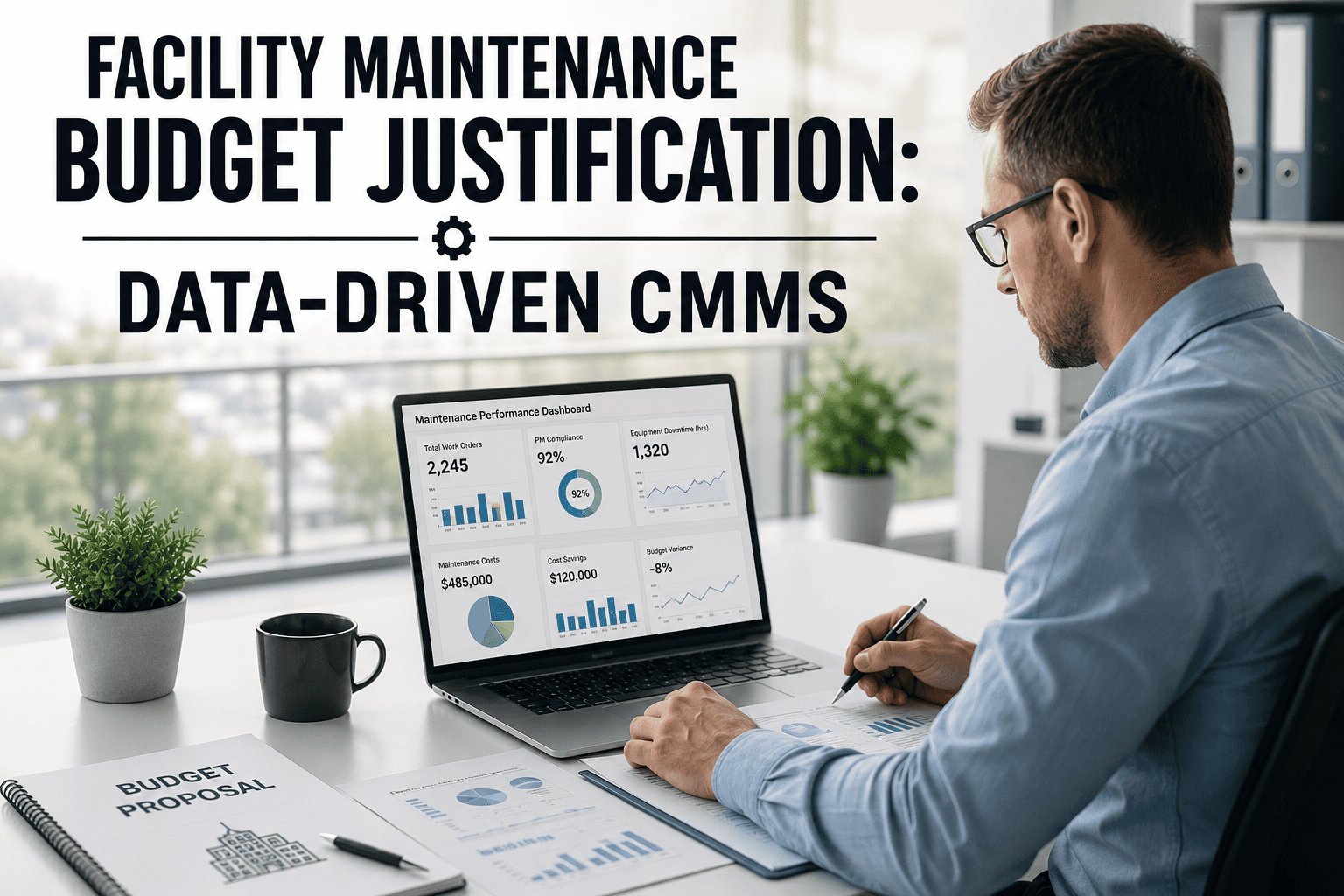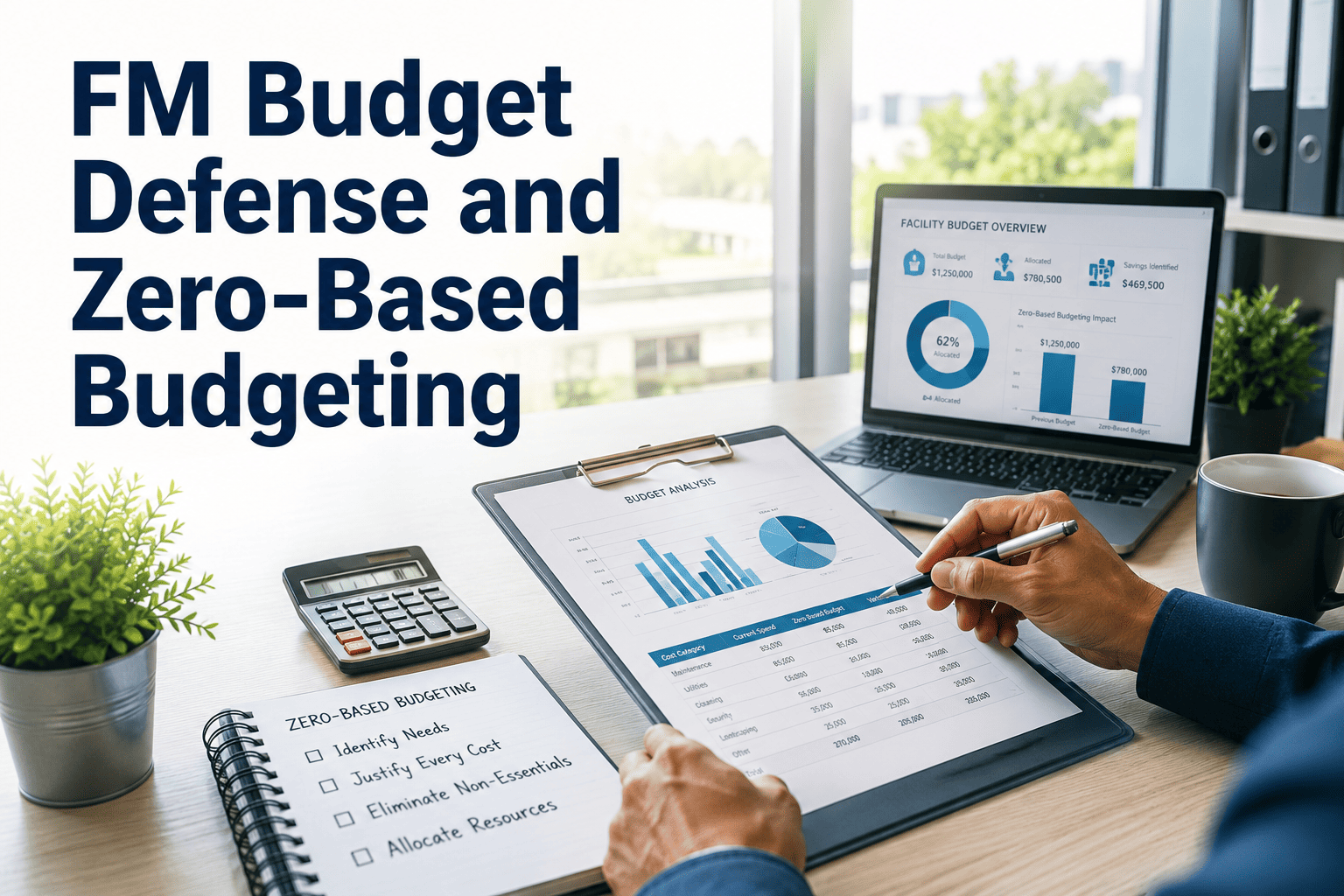
Zero-based budgeting for facility management means justifying every dollar from scratch rather than rolling over last year's spend — and it is rapidly becoming the standard for FM budget defense under aggressive finance scrutiny. When every line item gets questioned, facility leaders can no longer rely on historical precedent to protect maintenance funding. By tying asset condition, failure risk and compliance exposure directly to financial outcomes, you build a facility budget justification that survives the boardroom. OxMaint gives you the maintenance analytics and asset-level cost tracking needed to prove ROI in real time — Start Free Trial and see how your data transforms into defensible budget narratives.
FM BUDGET DEFENSE
Can you defend every dollar of your facility maintenance budget from zero?
When finance starts from scratch, last year's numbers no longer protect you. Zero-based budgeting demands that every FM expenditure be justified by asset risk, compliance exposure and measurable ROI — not historical precedent.
THE SHIFT
Why zero-based budgeting has arrived in facility management
Corporate finance teams are under pressure to eliminate stranded spend, and facility management budgets — often the third-largest operating expense after payroll and real estate — are an obvious target. Rolling over last year's FM budget with a 3% adjustment is no longer accepted practice.
In a zero-based FM budget, you do not start with last year's $1.2M maintenance allocation. You start at zero, build up the minimum required spend for regulatory compliance (OSHA, NFPA, EPA), add preventive maintenance for critical assets, and justify each discretionary dollar — spare parts inventory, contractor spend, predictive sensors — against the cost of failure it prevents. The organizations that win this argument use data from a CMMS to prove that deferred maintenance today creates 3–5× the replacement cost downstream.
HOW TO JUSTIFY
How to build an FM budget justification that survives finance scrutiny
Facility budget defense fails when it relies on qualitative arguments like "we've always done it this way." Finance accepts quantitative justification: cost-to-serve per asset, downtime cost per hour, and risk-weighted maintenance spend.
Risk-Adjusted Maintenance ROI
ROI = (Cost of Avoided Failure − Maintenance Spend) ÷ Maintenance Spend
If an HVAC failure costs $18,000/hour in production loss and a $4,200/year PM program reduces failure probability by 65%, the ROI is defensible at 2.8× — a number finance cannot cut.
Deferred Maintenance Multiplier
Future Repair Cost = Current Repair Cost × (1 + 0.07 × Years Deferred)
Based on FASB-aligned facility degradation models, every year a $10K repair is deferred compounds to $17K within a decade. Use this to defend proactive spend against deferral pressure.
Asset register audit
Catalog every asset, condition score, criticality tier and current maintenance cost. OxMaint imports existing spreadsheets in under 48 hours.
Failure-cost mapping
Calculate downtime cost per asset hour and pair it with failure probability. Rank assets by financial risk exposure, not just age.
Zero-based rebuild
Rebuild the budget from compliance floor upward. Justify each PM task, spare-parts holding and contractor contract against the failure it prevents.
Finance review
Present line-item ROI with OxMaint analytics dashboards. Show real-time work-order cost data so finance trusts the numbers, not a static slide.
BUDGET STRUCTURE
FM zero-based budget: what to include and what to cut
A defensible facility management budgeting process separates mandatory spend from discretionary spend — and proves why each bucket matters. The table below maps the six budget categories finance most often challenges and the justification framework that protects each one.
| Budget Category | Avg % of FM Budget | Finance Challenge | Zero-Based Justification |
|---|---|---|---|
| Preventive Maintenance Labor | 28% | "Can we reduce PM frequency?" | Asset-criticality tier + failure-cost model proving PM is 3–5× cheaper than reactive repair |
| Spare Parts Inventory | 19% | "Why hold $200K in parts?" | Criticality-ranked min/max levels tied to supplier lead time and downtime cost per hour |
| Compliance & Statutory | 14% | "Is all of this necessary?" | Regulatory mandate mapping (NFPA, OSHA, FMCSA, EPA) with penalty-cost exposure per line |
| Contractor & Vendor Spend | 17% | "Can in-house cover this?" | Skills-gap analysis showing where contractor specialization prevents $50K+ specialist failures |
| Predictive / Condition Monitoring | 9% | "Is the sensor ROI proven?" | Vibration/IR data showing early-failure detection avoided $X in unplanned downtime last quarter |
| Emergency / Reactive Reserve | 13% | "Why reserve for failures we prevent?" | Historical MTBF data showing residual failure rate even with strong PM — cutting this risks safety |
WORKED EXAMPLE
Real scenario: a 180-asset plant defending $42K in PM spend
Consider a mid-sized manufacturing facility with 180 tracked assets and a $42,000/year preventive maintenance budget. Finance proposed cutting PM frequency by 40% to save $16,800 annually. Here is how the FM team defended the full budget.
Baseline the risk
OxMaint analytics showed 34 of the 180 assets were Tier-1 critical — a failure on any one halted production at $4,200/hour. The PM program covered all 34 with biweekly inspections costing $11,400/year.
Model the cut
Reducing PM frequency by 40% would extend intervals from 14 to 23 days. Historical work-order data showed failures clustered at 18–21 day intervals on three high-speed compressors — the cut virtually guaranteed a failure.
Quantify the exposure
A single compressor failure averaged 9.5 hours of downtime at $4,200/hr = $39,900 per event — more than double the proposed savings. Probability of one failure per quarter rose from 8% to 47%.
Present and win
The FM leader presented OxMaint's risk-weighted ROI dashboard. Finance restored the full $42K and approved an additional $8,000 for predictive vibration sensors on the three highest-risk compressors.
SOLUTION
How OxMaint strengthens your FM budget defense
OxMaint is an AI-powered CMMS and EAM platform that turns maintenance execution data into the financial evidence finance demands. Every work order, asset record and failure history becomes a line item in your budget justification.
Asset-level cost tracking
Every work order captures labor hours, parts cost and contractor spend against the specific asset. Export per-asset TCO in one click for zero-based budget line items.
Outcome: Replace "estimated $42K" with exact, auditable spend per asset.
Predictive failure analytics
AI models analyze vibration, temperature and run-time data to flag assets approaching failure before it happens — letting you shift spend from reactive to predictive.
Outcome: Cut unplanned downtime 30–50% and justify sensor spend with data.
Compliance & audit readiness
Automated logs of every inspection, PM completion and corrective action create an audit trail that satisfies OSHA, NFPA, FMCSA and ISO 55000 requirements without manual documentation.
Outcome: Prove mandatory spend is truly mandatory — and avoid $15K+ penalties.
Maintenance ROI dashboards
Live dashboards show cost of avoided failures, PM-to-reactive ratio and MTBF trends — the exact metrics finance uses to evaluate whether your budget is delivering returns.
Outcome: Walk into budget review with real-time proof, not last quarter's slide.
See OxMaint on your assets — book a 30-minute demo
Watch your work-order data transform into a defensible, zero-based FM budget narrative in real time. Bring your toughest budget question.
FAQ
FM budget defense and zero-based budgeting: common questions
What is zero-based budgeting in facility management?
Zero-based budgeting in FM means rebuilding the maintenance budget from zero each cycle rather than carrying over prior-year spend. Every line item — PM labor, parts, contractor costs, compliance inspections — must be justified against asset criticality, failure risk and regulatory requirement. The approach typically reduces FM spend 15–30% while protecting the maintenance activities that prevent costly failures. OxMaint's asset-level cost tracking provides the data foundation for this justification — Start Free Trial to see your numbers.
How do I defend my facility maintenance budget against cuts?
The strongest facility budget defense pairs each line item with the cost of not funding it. Calculate downtime cost per asset hour, map PM tasks to the failures they prevent, and show the deferred-maintenance multiplier — every year a repair is deferred compounds the future cost by roughly 7%. Presenting real-time work-order data from a CMMS like OxMaint makes the case auditable rather than theoretical, which finance teams treat with far more credibility than spreadsheet estimates.
What is the difference between incremental and zero-based FM budgeting?
Incremental budgeting takes last year's FM spend and adjusts it by a percentage — typically 2–5% up or down. Zero-based budgeting starts from $0 and requires every expense to be rebuilt and justified from scratch. Incremental is faster but preserves inefficiencies; zero-based is more rigorous and typically uncovers 15–30% in stranded spend, but it requires granular asset and work-order data to execute well.
How much time does it take to build a zero-based FM budget?
For a facility with 100–250 assets, a first-time zero-based budget typically takes 6–10 weeks: 2 weeks for asset register audit, 2–3 weeks for failure-cost mapping, 2 weeks for budget rebuild and 1–2 weeks for finance review. Organizations using a CMMS with existing work-order history can compress this to 3–4 weeks because the asset and cost data is already structured. Manual spreadsheet environments may take a full quarter.
Can zero-based budgeting reduce preventive maintenance too aggressively?
Yes — this is the biggest risk. If zero-based reviews cut PM frequency without modeling failure probability, the "savings" convert to higher reactive repair and downtime costs within 6–12 months. The safeguard is pairing each proposed PM cut with a failure-cost model: if reducing inspections from biweekly to monthly raises failure probability above the cost of a single downtime event, the cut should be rejected. Book a demo at calendly.com/oxmaintapp/30min to see how OxMaint automates this risk calculation.
Turn maintenance data into budget approval
Join the FM leaders using OxMaint to justify every dollar with real asset data, predictive analytics and ROI dashboards finance can't argue with.
Free 14-day trial · No credit card