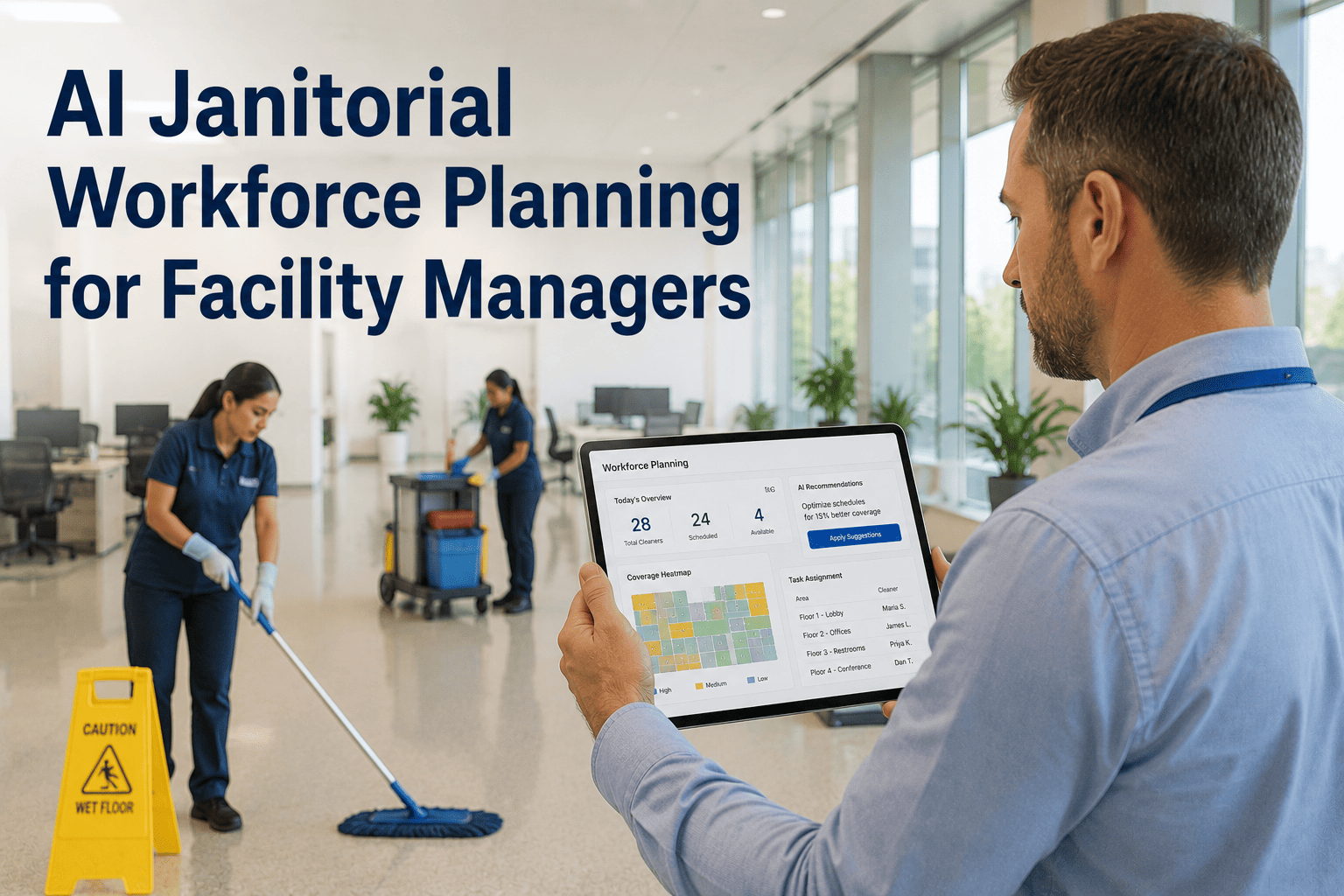
FM contract transition and mobilisation is the single highest-risk phase in any facility management lifecycle — the moment when service continuity either holds or breaks. Research from leading FM consultancies shows that poorly executed mobilisation can disrupt service delivery for 6–12 months and inflate lifecycle costs by 15–25%, with the client paying for that failure long after the ink is dry. A disciplined FM transition plan covers transition planning, structured knowledge transfer, service continuity protocols, and a mobilisation approach designed to protect uptime from day one. The right CMMS platform makes that handover auditable, repeatable, and fast — which is why teams tackling facility contract transition turn to OxMaint to digitise asset registers, work-order histories, and SLAs before the new provider ever sets foot on site. You can Start Free Trial today or read on for the complete mobilisation playbook.
Can your facility survive a 90-day service gap?
When an FM provider changeover goes wrong, the fallout isn't measured in days — it's measured in slipped SLAs, missed compliance audits, and assets that quietly fail because no one inherited the maintenance history. A structured facility contract mobilisation plan eliminates the blind handover and keeps service continuity intact from the first hour of Day 1.
Why FM contract transitions fail — and what it costs you
Most facility management transition failures share the same root causes: incomplete asset data, lost work-order histories, undocumented SLAs, and no single source of truth for the incoming provider.
A 420,000 sq ft corporate campus switched FM providers without a digitised asset register or work-order history export. The new team inherited 1,800 assets on paper — but no failure codes, no PM schedules, and no spare-parts min/max levels. Within four months, two rooftop units failed simultaneously, AHU filter changes slipped past their intervals, and the client's helpdesk ticket backlog hit 340 open items. The recovery cost: $180K in emergency vendor calls and a renegotiated SLA penalty clause. A structured FM transition plan with OxMaint would have migrated every asset, PM schedule, and spare in under two weeks.
FM transition plan: a phased mobilisation timeline
A successful facility contract mobilisation follows a structured sequence — each phase gates the next, so nothing is left to assumption on go-live day.
Discovery & data audit
Extract the incumbent's asset register, work-order history (minimum 24 months), SLA documentation, compliance certificates, and spare-parts inventory. Validate completeness — a 10% data loss rate here compounds to 40% by go-live. Load everything into OxMaint as the single source of truth before mobilisation begins.
Transition planning & knowledge transfer
Map every asset to a PM schedule, assign priority tiers, and build the facilities mobilisation plan. Conduct structured knowledge-transfer sessions with outgoing technicians — capture failure codes, known quirks, and seasonal patterns. Digitise all paper-based checklists into OxMaint's mobile work-order module.
System setup & SLA configuration
Configure SLA timers, escalation rules, and compliance workflows in OxMaint. Set spare-parts min/max thresholds, build vendor records, and import historical failure data so predictive maintenance algorithms have a baseline. Run parallel operations for two weeks — old system and new — to verify nothing is lost.
Go-live & service continuity
Cut over to the new provider with full visibility. OxMaint's dashboard shows every open work order, every SLA at risk, and every asset due for PM in real time. The first 30 days post-go-live are critical — daily mobilisation stand-ups review SLA performance, ticket backlog, and any compliance gaps flagged by automated alerts.
Facility service transition: protecting SLAs through the handover
Service continuity is the single most fragile element of any FM provider changeover. The fix is a structured protocol that makes the invisible visible — every asset, every PM, every compliance deadline — from the first minute of Day 1.
Pre-mobilisation continuity checks
- Full asset register exported, validated, and loaded into CMMS with GPS/location data
- 24 months of work-order history migrated with failure codes and resolution times
- All active PM schedules mapped to assets with next-due dates calculated
- Compliance certificates (HVAC, fire, electrical, elevators) catalogued with expiry alerts
- Spare-parts inventory counted, min/max levels set, critical spares flagged
Go-live continuity protocols
- Dual-running helpdesk for 14 days — old and new systems both logging tickets
- Daily SLA performance review for first 30 days with automated red/amber/green dashboards
- On-site shadow days: incoming technicians paired with outgoing team for knowledge transfer
- Escalation matrix configured in OxMaint — auto-notify account manager at 80% SLA breach
- Post-go-live audit at Day 30, Day 60, Day 90 — documented and signed off by both parties
| Continuity risk | Without a plan | With OxMaint mobilisation |
|---|---|---|
| PM schedule gaps during handover | 30–60 days of missed PMs; asset failures spike | Zero-gap: PM schedules migrate with next-due dates intact |
| Lost work-order history | New team starts blind; recurring issues undiagnosed | Full 24-month history with failure codes for pattern analysis |
| SLA breach during transition | Average 22% breach rate in first 90 days | Real-time SLA tracking with auto-escalation at 80% threshold |
| Compliance documentation gaps | Audit failures; regulatory exposure; rework costs | Digital compliance register with automated expiry alerts |
| Spare-parts stockouts | Critical spares unavailable; extended downtime | Min/max thresholds auto-trigger replenishment work orders |
How to structure FM contract handover knowledge transfer
Knowledge transfer isn't a meeting — it's a data migration. The most valuable information lives in work-order histories, failure codes, and technician notes, not in a PowerPoint deck.
Extract the implicit knowledge
Every work order tells a story: which assets fail, how often, what fixed them, and how long it took. Pull 24 months of history from the incumbent's system — or from paper logs if that's all that exists — and load it into OxMaint. The platform's analytics engine surfaces recurring failure patterns the new team needs to know on Day 1.
Map assets to criticality tiers
Not every asset matters equally. Tier assets A/B/C based on operational impact, regulatory requirement, and historical failure frequency. OxMaint's asset register supports custom criticality fields — so PM frequencies, spare-parts buffers, and SLA response times automatically align to the tier. An A-tier chiller gets a 4-hour response; a C-tier office fan gets a 72-hour window.
Codify failure codes and resolution patterns
Standardised failure codes are the bridge between the old team's experience and the new team's effectiveness. Map the incumbent's free-text resolution notes to a structured failure-code taxonomy in OxMaint. When a rooftop unit trips on high-pressure fault in August, the new technician sees the last five occurrences, the fix that worked, and the parts required — before they reach the roof.
Run shadow operations for 14 days
No amount of documentation replaces watching a seasoned technician work. Schedule 14 days of shadow operations where incoming staff accompany outgoing staff on PMs and reactive calls. Every observation gets logged as a note in OxMaint against the relevant asset — building a living knowledge base that survives personnel changes long after mobilisation ends.
OxMaint: the CMMS purpose-built for FM contract mobilisation
OxMaint turns the riskiest 90 days of an FM contract into a controlled, auditable, data-driven process. Four capabilities directly address the failure points that derail most transitions.
One-click asset register migration
Import thousands of assets, locations, and hierarchies from CSV, Excel, or legacy CMMS exports. OxMaint validates data integrity, flags duplicates, and auto-generates QR code labels for every asset — so the new team can scan-and-verify on Day 1 instead of searching through spreadsheets.
PM schedule continuity engine
Every preventive maintenance schedule migrates with its full history — last completed date, next due date, parts consumed, and time logged. OxMaint automatically recalculates next-due dates based on the transition timeline so no PM falls through the gap between providers.
SLA tracking with auto-escalation
Configure SLA timers per contract section, per asset tier, per priority level. OxMaint tracks every work order against its SLA in real time and auto-escalates at 80% threshold — notifying the account manager before a breach occurs, not after. The dashboard gives the client and provider a shared, transparent view of performance.
Predictive analytics from Day 1
OxMaint's AI engine analyses the migrated 24-month work-order history to identify failure patterns, seasonal trends, and assets at risk. The new provider inherits not just data — but predictive insight. Get failure probability scores and recommended interventions before the first PM is even scheduled.
The mobilisation ROI formula
If you're evaluating whether to invest in a CMMS-driven mobilisation versus a manual handover, here's the calculation that makes the decision obvious.
A portfolio of 1,200 assets transitions without a structured mobilisation plan. Over 12 months: 45 missed PMs convert to reactive calls at $1,200 premium each ($54,000). 18 SLA breaches trigger penalty clauses at $850 each ($15,300). 60 hours of compliance rework at $95/hr ($5,700). 14 hours of extended downtime across two critical failures at $4,200/hr ($58,800). Total annual transition loss: $133,800. The OxMaint subscription, mobilisation support, and training for the same portfolio: under $24,000/year. Net savings: $109,800 — a 5.6x return in year one alone.
| Mobilisation approach | Time to full service | SLA breach rate (90 days) | 12-month cost impact |
|---|---|---|---|
| Manual / spreadsheet handover | 6–12 months | 18–25% | +$95K to +$180K |
| Partial CMMS (basic work orders) | 3–5 months | 8–14% | +$40K to +$85K |
| OxMaint full mobilisation | 4–8 weeks | Under 3% | Net savings of $80K–$110K |
See OxMaint run your mobilisation — book a 30-minute demo
Watch how a 1,200-asset portfolio migrates in days, not months. We'll show you the exact workflow your team will use on Day 1.
FM contract transition & mobilisation: your questions answered
How long should an FM contract transition take?
A well-planned FM contract mobilisation takes 8–12 weeks from contract signature to full go-live, with parallel operations running for the final two weeks. Complex portfolios with 2,000+ assets or multi-site footprints may extend to 16 weeks. The critical factor isn't portfolio size — it's data readiness. Teams using OxMaint typically compress the timeline to 4–8 weeks because asset registers, PM schedules, and work-order histories migrate in days rather than weeks. Book a demo to see the migration workflow on your own data.
What is a facilities mobilisation plan and who owns it?
A facilities mobilisation plan is the structured document — or better, the live CMMS configuration — that defines every task, milestone, and accountability during the transition from one FM provider to another. It covers data extraction, asset validation, PM schedule migration, SLA configuration, spare-parts setup, knowledge transfer, and go-live protocols. Ownership sits jointly with the client's facilities lead and the incoming provider's mobilisation manager, with OxMaint serving as the shared platform both parties work from.
How do you ensure service continuity during FM provider changeover?
Service continuity survives a changeover when three things are in place: a complete digital asset register with 24 months of work-order history, pre-configured PM schedules with next-due dates that survive the transition gap, and real-time SLA tracking with auto-escalation. Dual-running the helpdesk for 14 days and conducting shadow operations between outgoing and incoming technicians catches the tacit knowledge that no document captures. OxMaint automates all three layers.
What data should be transferred during FM contract handover?
The minimum data set for a compliant handover includes: the full asset register with location hierarchies, 24 months of work-order history with failure codes and resolution notes, all active PM schedules with last-completed and next-due dates, spare-parts inventory with current stock levels and min/max thresholds, compliance certificates with expiry dates, SLA documentation, and vendor/supplier records. OxMaint accepts all of this via structured import — CSV, Excel, or API — and validates integrity during migration. Start your free trial to test the import on your data.
What happens to preventive maintenance schedules during the transition?
PM schedules are the most commonly lost element in a manual handover — and the most expensive when missed. In OxMaint, every PM schedule migrates with its full history, frequency logic, parts list, and next-due date. The platform automatically recalculates next-due dates based on the transition timeline, so if a quarterly PM was due during the changeover window, it appears in the new team's dashboard on Day 1. No PM falls through the gap — which is why teams using OxMaint see 30–50% fewer unplanned failures in the first 90 days.
Make your next FM contract transition the smoothest one yet
Join the maintenance teams using OxMaint to mobilise contracts in weeks, protect service continuity, and cut unplanned downtime by up to 50%.
Free 14-day trial · No credit card