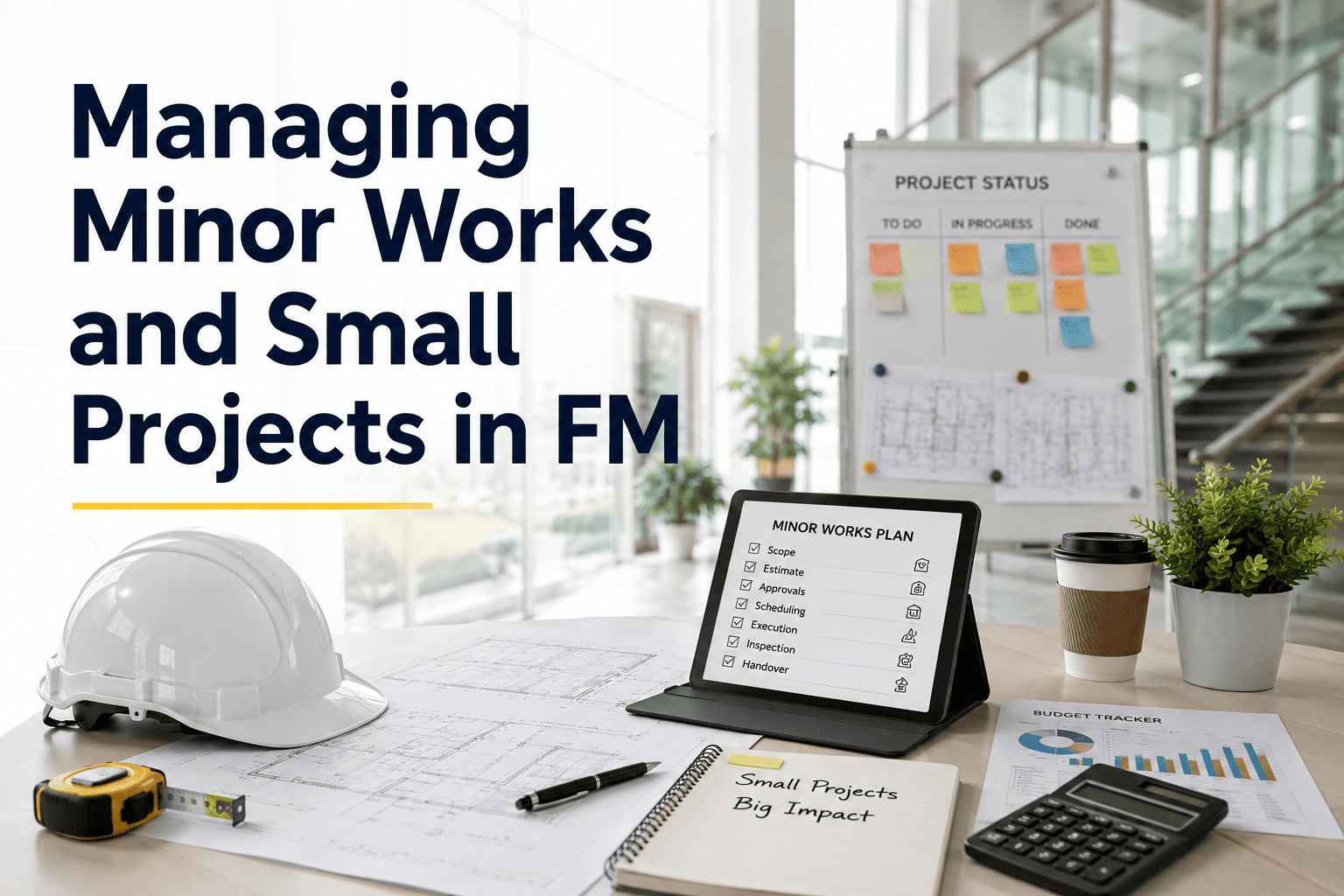
Every facility team runs three kinds of work at once — reactive breakdowns, capital projects, and the churn of small jobs in between: a relocated partition wall, a new signage run, a storeroom fit-out, a parking lot restripe. That third category, minor works, rarely gets a home. It is too big for a routine work order and too small to justify a capital project charter, so it drifts between departments, gets tracked in email threads, and quietly consumes far more coordinator time than its dollar value would suggest. This guide covers how facility teams mobilise minor works and small projects without letting them disrupt core service delivery, and how a CMMS-backed intake process turns that churn into a managed, visible pipeline.
Project Management
FM Operations
Small Works
Three Categories of FM Work — Only One Is Usually Unmanaged
BAU Maintenance
Recurring PMs and reactive repairs. Scheduled and tracked directly in the CMMS.
Minor Works
One-off jobs under a defined budget threshold. Usually tracked nowhere consistent.
Capital Projects
Formal charters, contractors, procurement sign-off. Owned by project management.
Minor works sit in the gap — no formal PM process, but too frequent for ad hoc handling
Why It Gets Lost
The Cost of an Unmanaged Middle Ground
No single intake point
Requests arrive by email, hallway conversation, and phone call, so nothing is prioritized against anything else.
No visibility for requesters
Without status tracking, stakeholders chase coordinators directly, which is the single biggest time drain on a small FM team.
No cost accountability
Small jobs are absorbed into general maintenance budgets, so nobody can see what minor works actually cost the portfolio each year.
No consistent contractor process
Every job gets sourced fresh instead of drawing from a qualified, rate-agreed vendor pool built for repeat small works.
Give Minor Works a Real Intake Process
Oxmaint routes every small project request through one intake form, tracks it against budget and priority, and gives requesters visibility without a single status-check phone call.
The Workflow
A Six-Step Process for Mobilising Small Projects
01
Single intake
One form for every request, regardless of department, capturing scope, budget estimate, and requested timeline.
02
Triage against threshold
Confirm the request actually qualifies as minor works rather than a routine work order or a capital-scale project.
03
Prioritize
Score against urgency and operational impact so the queue reflects real priority, not who asked loudest.
04
Scope and quote
Pull from a pre-qualified small-works contractor pool with agreed rates instead of sourcing a new bid every time.
05
Schedule around operations
Sequence execution so small works never collide with peak occupancy, production hours, or a concurrent capital project.
06
Close and report
Log final cost against the original estimate so annual minor works spend becomes a reportable, budgetable number.
Prioritization
Scoring Requests: Impact vs. Urgency
| Quadrant | Impact | Urgency | Handling |
|---|---|---|---|
| Do now | High | High | Scheduled within the current cycle, ahead of the standing queue |
| Plan next | High | Low | Batched into the next quarterly minor works window |
| Fit in | Low | High | Assigned to the next available contractor slot |
| Backlog | Low | Low | Held in the request queue until budget or capacity opens |
Stop Losing Small Projects in Email Threads
See how Oxmaint turns minor works into a tracked, budgeted, reportable pipeline your whole facilities team can see.
Frequently Asked Questions
Minor Works Management — Common Questions
What counts as a minor work versus a capital project?
Most facility teams set a dollar or hour threshold — commonly under a few thousand dollars or under 40 labor hours — below which a job stays minor works and above which it requires a formal project charter. Start a free trial to set your own threshold and route requests automatically.
Who should own minor works intake — maintenance or project management?
Maintenance or facilities operations, not the project management office. Minor works move too fast and too frequently for formal PM overhead, but they still need one accountable intake point rather than being split across departments.
How do small projects affect core maintenance service levels?
Poorly managed minor works pull technician time away from scheduled PMs, which is why most mature teams route small-works execution through a separate contractor pool rather than internal crews. Book a demo to see how Oxmaint keeps the two queues separate.
Can a CMMS actually manage project-style work, not just work orders?
Yes, when it supports multi-step jobs with budget tracking, contractor assignment, and status stages beyond open and closed. Oxmaint tracks minor works from intake through closeout on the same platform as routine maintenance.
How much does an unmanaged minor works process typically cost a facility?
The direct cost is usually smaller than the hidden cost — coordinator hours spent on status updates, duplicate contractor sourcing, and jobs re-scoped because nobody tracked the original estimate. Start a free trial to see your minor works spend in one place for the first time.
Bring Small Projects Out of the Email Inbox
Oxmaint gives minor works a real intake, prioritization, and closeout process — right alongside your routine maintenance and PMs.